Nutrition and Growth
 Call Kai
 Learn
Learn Practice Test
 Spaced Repetition
 Match
Match Flashcards
 Knowt Play
1/87

There's no tags or description
Looks like no tags are added yet.
Name | Mastery | Learn | Test | Matching | Spaced | Call with Kai | Chat |
|---|
No analytics yet
Send a link to your students to track their progress
88 Terms
What do cells need to grow?
nutrients, macronutrients, micronutrients
Nutrients
supply of elements required by cells for growth
Macronutrients
nutrients required in large amounts (grams)
Micronutrients
nutrients required in minute amounts (mg or microg); trace metals and growth factors (vitamins)
Macromolcules make up
~96% of dry weight; mostly water and organic materials
Macromolecules
proteins, lipids, polysaccharides, lipopolysaccharides, nucleic acids; mostly proteins and DNA, not DNA
What elements make up ~96% of dry weight of bacterial cell and are required by all life
C, O, N, H, P, S
What elements make up ~3.7% of dry weight?
K, Na, Ca, Mg, Cl, Fe (coenzymes)
Heterotrophs
require organic carbon as a source of carbon and energy; obtain C, H, O from breakdown of organic polymers or uptake of monomers (amino acids, fatty acids, organic acids, sugars, nitrogen bases, other organics); anabolic; aka organotroph
Autotrophs
synthesize organics from carbon dioxide (C source); source of energy can be light or inorganic molecules; make H/organic compounds from inorganics (H2O, H2S, CO2)
Nitrogen
key element in proteins, nucleic acids, and many more; sources → NH3 (main one; salt, secretions), NO3- (some; soil), organics/amino acids (some but easiest bc already reduced), N2 with nitrogen fixing (least; decreasing movement of molecule + from air)
Phosphorus
present in nucleic acids and phospholipids; microbes usually assimilate inorganic phosphate (PO43-), organic sources; limiting so can damage when surplus is added; stored in granules when in excess
Sulfur
needed for sulfur-containing amino acids (cysteine and methionine) in proteins, some vitamins (thiamine, biotin, lipoic acid); microbes assimilate organic material containing sulfur, sulfate (SO42-), sulfide (H2S)
Potassium
required by several enzymes
Magnesium
stabilizes ribosomes, membranes, and other nucleic acids; also required by many enzymes
Calcium + Sodium
required by some (marine) microbes
Trace Metals and Growth Factors
many enzymes require metal ion or small organic as a cofactor for catalysis; Iron is used for cellular respiratoin, related oxidation-reduction reactions; trace metals are required in small amounts; growth factors are organic micronutrients like vitamins (most function as coenzymes & most needed factor), amino acids, purines, pyrimidines, other organics
Culture Media
nutrient solutiosn used to grow microbes in the laboratory; can be liquid or solid medium; typically sterilized in an autoclave; different microorganisms have vastly different nutritional requirements; necessary to understand physiology and nutritional requirements and supply with nutrients in proper form and amount
Classes of Culture Media
defined, complex, selective, differential
Defined Media
exact chemical composition known; know what microbes are capable of doing; can study how it grows with something specific; doesn’t grow as well bc makes things from scratch
Complex media
composed of digests of microbial, animal, or plant products (yeast and meat extracts → organic); ex: nutrient agar
Selective Medium
contains compounds that selectively inhibit growth of some microbes (not all growth usually) but not others; relative to microbes being compared
Differential medium
contains an indicator, usually a dye, that detects particular metabolic reactions during growth
Enrichment Culture
media composition and/or incubation conditions designed to favor a group of microorganisms or genus; can be selective, differential or both & complex or defined medium; usually not a pure culture (make it a majority); sometimes followed by secondary enrichment step; always followed by screening and isolation of organism of interest; used to isolate microbes from nature
Goal of Enrichment Culture
means of isolating rare organisms with specific characteristics from heterogeneous populations
Culture Media
liquid or solid
Solid Culture Media
prepared by addition fo the gelling agent agar to liquid media; cells form isolated masses (colonies) which can help identify microbes; routinely used to determine if culture is pure of contaminated
Colony Morphology
visible characteristics; helps identify microobes
Laboratory Culture
requires aseptic technique to transfer microorganisms without contamination; transfer cells (inoculate) from liquid to liquid, solid to solid, liquid to solid, or solid to liquid; pure cultures usually require streak plate technique to make sure there are no airborne contaminants
How do we measure population growth?
direct microscopic counts; viable/plate counts; turbidimetric method
Direct Microscopic counts
Total cell count by observing and numbering cells present; liquid samples/culture with Petroff Hausser counting chamber; usually overestimate of actual number; used on natural samples; stains visualize and provide phylogenetic info or metabolic properties; DAPI reacts with DNA; fluorescent stains differentiate live and dead cells; Phylogenetic stains can determine proportion of Bacteria or Archaea
Petroff Hausser counting chamber
counting chambers with squares etched on a slide for liquid samples; cell/mL of culture (or liquid sample)
Limits of Microscopic cell counts
cannot distinguish between live and dead cells; small cells can be overlooked; need phase-contrast microscope if no stain; cell suspensions of low density (< 106 cells/mL) are hard to count; need to immobilize motile cells; debris in sample can be mistaken for cells
Viable/Plate counts
measurement of cells capable of making colonies (reproducing) on solid media; can get through spread-plate method or pour-plate method (don’t like oxygen much); count colonies with 30-300 colonies; need to dilute and plate sample; assume each colony represents one cell; underestimate of actual cell number; usually accurate iwth pure cultures that plate very well
Viable/Plate Count limitations
numbers depend on inoculum size, viability, culture medium, incubation conditions; mixed cultures grow at different rates; plating inconsistencies; reporting in colony-forming units instead of number of viable cells
Great Plate Count Anomaly
microscopic counts reveal far more organisms than on plates bc microscopic may count dead cells; viable cells may not grow on medium provided and only count cells that are reproducing, not alive
Turbidimetric Measurement
cells scatter light so cell suspensions are turbid; measured with a spectrophotometer in optical density (OD) at specified wavelengths; OD is proportionally to cell number with limits; need a standard curve to relate
Turbidimetric Measurement advantages
quick and easy to perform; does not require destruction or significant disturbance of sample; same sample can be checked repeatedly; good to optimize media
Turbimetric Measurement disadvantages
sometimes problematic if microbes form clumps or biofilms or pellicles in liquid medium; need to establish linear relationship between OD, cell number via microscopic counts or viable counts (usually both)
Binary Fission
cell division following enlargement of a cell to twice its minimum size to increase the number of cells (growth); creates a septum to divide the cel land pinch off between two daughter cells; its generation time depends on nutritional and genetic factors and temperatures; each daughter cell receives a chromosome and sufficient copies of all other cell constituents to exist as an independent cell
Septum
partition between dividing cells; pinches off between two daughter cells
Generation time
time required for microbial cells to double in number; depends on nutritional and genetic factors and temperature
Exponential Growth
growth of a microbial population in which cell numbers double within a specific time interval; relationship between initial number of cells (N0) present in a culture and the number present after a period of growth (N) with n being number of generations that occurred → N = N02n
Quantitative aspects of microbial growth
initial increase is slow but increases, resulting in huge increase in cell numbers
Batch culture
a closed-system microbial culture of fixed volume
Microbial Growth Cycle
lag phase, exponential (log) phase, stationary phase, death phase; typical growth curve for population of cells grown in closed system

1
lag

2
exponential

3
stationary

4
death
Lag phase
interval between inoculation of a culture and beginning of growth (longer with defined/without organic materials media because making from scratch); time needed for biosynthesis of new enzymes and to produce required metabolites before growth can begin; little amoutn of cells to start;
Exponential phase
cells close to metabolically identical; steeper → doubling time is shorter; rates vary greatly, influenced by media, incubation conditions, and organism itself; used to calculate generation time; continues until conditions can no longer sustain growth
Stationary phase
growth rate of population is zero; either an essential nutrient is used up or waste products accumulate; metabolism continues at greatly reduced rate; some cells grow while others die, balancing each other
Death phase
if incubation continues after cells reach stationary phase, cells will eventually die; exponential decline; viable cells remain for months or years; cryptic growth (subpopulations adapt)
Continuous Culture
an open system microbial culture of fixed volume; usually chemostat; both growth rate and population density of culture can be controlled independently and simultaneously depending on dilution rate (Flow rate of adding fresh media & removing spent medium / culture volume) and concentration of limiting nutrient; easy contamination but waste products do not accumulate; “more” natural conditions; steady state (cell density and substrate concentration do not change over time)
chemostat
most common type of continuous culture device
Experimental Uses of Continuous Culture
can maintain exponential growth phase for weeks/months; used to study physiology, microbial ecology and evolution, enrichment and isolation of bacteria from nature; growth rate controlled by dilution rate
Budding
division from unequal cell growth and forms totally new daughter cell; usually in cultures; can have cytoplasmic extensions (stalks, hyphae, appendages); alternative to binary fission
Planktonic growth
growth as suspension
Sessile growth
attached to surface; can develop into biofilms; attached polysaccharide matrix containing embedded bacteria
Biofilms form
in stages; planktonic cells attach; sticky matrix forms
Microbial mats
multilayered sheets with different organisms in each layer
Biofilm
cells enmeshed polysaccharide matrix attached to surface; 1) planktonic cells attach (flagella, fimbriae, pili) 2) colonization (growth and extracellular polysaccharide, EPS, production) 3) development (metabolic changes) 3) dispersal (colonize new sites); can study in flow chamber; prevent harmful chemicals (antibiotics) from penetrating, prevent protists from grazing, and prevent washing away of cells; implicated in joint infections from implanted medical devices; responsible for cavities and cause gum disease; foul, plug, corrode pipes; form in fuel tanks and on ship hulls; can be differently expressed genes; does not follow typical growth cycle (usually slower)
For most physiological experiments, it is usually most desirable for cells to be in the
exponential phase
Most microorganisms assimilate nitrogen as
either ammonia or nitrate
Organisms that use reduced, preformed organic molecules as carbon sources are
heterotrophs
An estimate of the number of reproductively capable cells in a sample based on the formation of colonies on solid growth media after plating dilute solutions is called a _____ cell count
viable
Media containing some ingredients of unknown chemical composition are called ______ media.
complex
The membranes of psychrophilic bacteria have relatively high levels of ________ fatty acids, which allows them to remain semi-fluid at their cardinal temperatures
unsaturated
Addition of lysozyme to a gram-positive bacterial culture in lag phase will result in
death of the cells
Addition of penicillin to a bacterial culture in log phase will result in
less growth
Mannitol salt agar (MSA) only allows the growth of halophiles. Mannitol fermenters release acid that tuns the pH indicator yellow; mannitol non-fermenters leave the medium red. Onto MSA you inoculate a halophilic mannitol non-fermenter pigmented yellow and a mannitol fermenter. The medium is acting as a _____ medium.
selective and differential

Define Medium A as defined, complex, selective, and/or differential. Explain why.
defined; contains exact known composition & does not have any selectively inhibitors or indicators
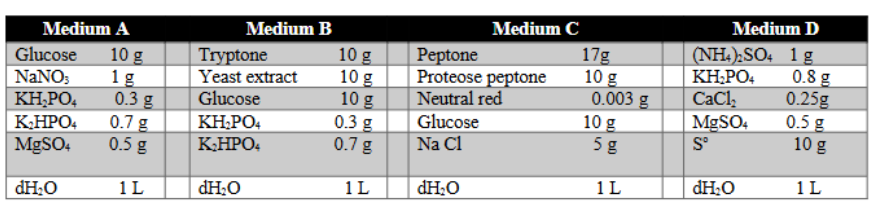
Define Medium B as defined, complex, selective, and/or differential and explain why.
complex because contains tryptone and yeast extract which have unknown exact compositions; no indicator or anything that selectively inhibits

Define Medium C as defined, complex, selective, and/or differential and explain why.
complex & differential bc has peptone and proteose peptone which have unknown exact compositions; neutral red is an indicator and there is nothing that selectively inhibits

Define Medium D as defined, complex, selective, and/or differential and explain why.
defined and selective; has exact known composition & selectively inhibits heterotrophs bc no organic carbon source and non-sulfur oxidizers bc high sulfur environment; no indicator to be differential

What is the source(s) of 1) carbon, 2) sulfur, and 3) nitrogen for organisms growing in Medium A?
glucose; MgSO4; NaNO3

What is the source(s) of 1) carbon, 2) sulfur, and 3) nitrogen for organisms growing in Medium B?
tryptone, yeast extract, glucose; tryptone, yeast extract; tryptone, yeast extract

What is the source(s) of 1) carbon, 2) sulfur, 3) nitrogen for organisms growing in Medium C?
peptone, proteose peptone, glucose; peptone, proteose peptone; peptone, proteose peptone

What is the source(s) of 1) carbon, 2) sulfur, 3) nitrogen for organisms growing in medium D?
CO2 (g); (NH4)2SO4, MgSO4, S0; (NH4)2SO4

What physiology does an organism growing in medium A have? Explain.
autotroph/heterotroph → aerobe; organic compound (glucose) for carbon source; has all other major nutrients; exposed to oxygen (so not anaerobe)
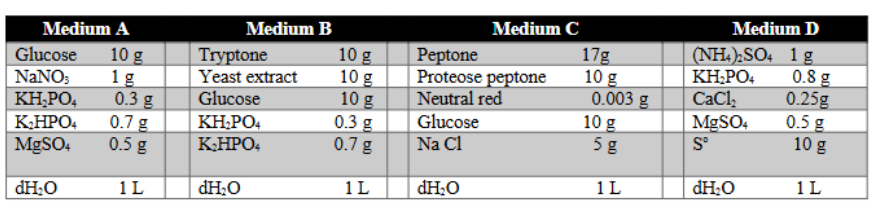
What changes would you make to the medium A/incubate conditions to grow an autotroph? explain.
replace glucose with CO2 to have no heterotrophs grow; increase time in incubation bc takes longer to grow when making molecules from inorganics
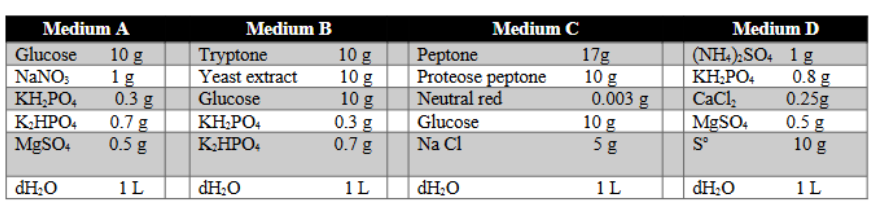
What changes would you make to the medium B/incubation conditions to grow an autotroph? explain
replace tryptone, yeast extract, and glucose with CO2 bc autotrophs can use inorganic carbon sources; introduce H2S and NaNO3 to include nitrogen and sulfur sources; also increase incubation time because takes longer to grow from inorganic compounds
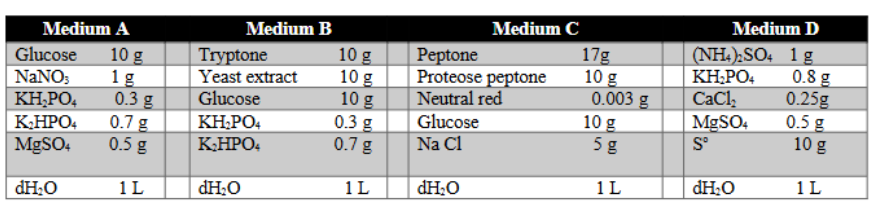
What changes would you make to the medium A/incubation conditions to grow a nitrogen fixer? explain
replace NaNO3 with N2(g) bc nitrogen fixers use N2 as nitrogen source and other microbes can’t
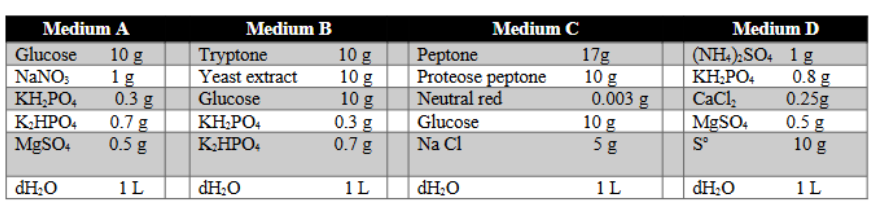
Can an organism in medium D be a pathogen? explain
yes but pathogens would need to be autotrophic sulfur oxidizers bc high sulfur environment and no organic compounds in media
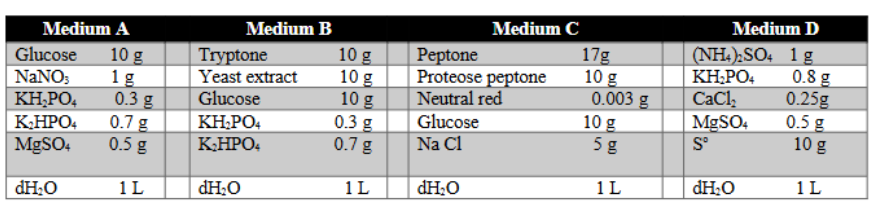
What physiology does an organism growing in medium D have? explain
aerobe sulfur-oxidizing chemolithotroph bc implied carbon source is CO2, inorganic compound; lots of sulfur compounds which need to be oxidized to form needed growth factors
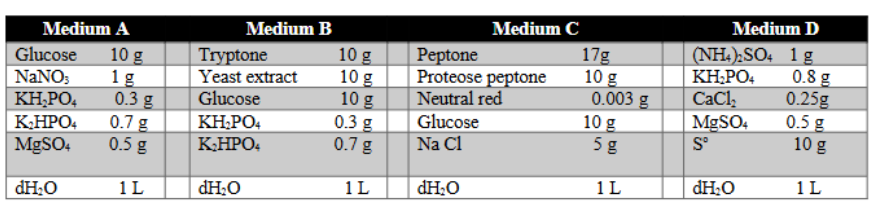
Can an organism growing in medium A be a pathogen? explain
yes because provides nutrient sources for carbon, nitrogen, oxygen, hydrogen, sulfur, and phosphorous for growth; not create a pathogen but help it grow
