Edit · Topic 2: Measuring Macroeconomic Data - The Measurement of Production (GDP), Income, and Expenditure | Quizlet
 Call Kai
 Learn
Learn Practice Test
 Spaced Repetition
 Match
Match Flashcards
 Knowt Play
1/31

There's no tags or description
Looks like no tags are added yet.
Name | Mastery | Learn | Test | Matching | Spaced | Call with Kai | Chat |
|---|
No analytics yet
Send a link to your students to track their progress
32 Terms
GDP (Gross Domestic Product)
The market value of all final goods and services newly produced within (the border of) a nation during a fixed period of time
What are the main sources of GDP growth?
Population Growth and Increases in Average Labor Productivity
National Income Accounting
An accounting framework used in measuring current economic activity
Total Production = Total Expenditure = Total Income
What are the 3 approaches to measure economic activity, excluding national income accounting?
Product Approach, Expenditure Approach, and Income Approach
Product Approach
Measures economic activity through the amount of output produced
The market value of all final goods and services newly produced in a country (within a nation) during a fixed period of time, typically one year.
Explain the Parts of the following definition
The market value of all final goods and services newly produced in a country (within a nation) during a fixed period of time, typically one year.
Market Value - a common way to measure goods and services that generate income (does not include non market items)
Final Goods and Services - A good/service purchased by a final user (not including intermediate goods as to not double count)
Newly Produced Goods and Services - only includes goods/services produced in the current period
Produced in a Country - the ownership of production is irrelevant, but needs to take place within a country's borders
GNP (Gross National Product)
output produced by domestically owned factors of production
NFP (Net Factor Payments from Abroad)
Payments to domestically owned factors located abroad, minus payments to foreign factors located domestically
GDP Equation
GDP = GNP - NFP
Intermediate Good
A good used in the production of another good
Value Added (by a firm/product)
Value of its production minus the value of the intermediate goods used in its production
Final Selling Price of a Product
This must equal the sum of the values added to the product at each stage of its production
Expenditure Approach - What are the 4 Major Categories of Expenditures?
1. (C) Consumption - Personal Consumption Expenditures
2. (I) Investment - Gross Private Domestic Investment
3. (G) Government Purchases - Government Consumption and Gross Investment
4. (NX) Net Exports - Net Exports of Goods and Services
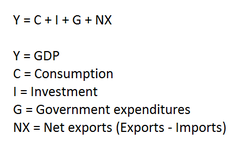
GDP Equation (Expenditure Approach)
Y = C + I + G + NX
(Consumption + Investment + Government Purchases + Net Exports
(C) Consumption
Spending by households on goods and services, including things produced abroad, and excluding spending on new houses
(C) 3 Categories of Consumption
1. Services - Health Care, Education, Haircuts, Financial Services, Transportation, etc.
2. Nondurable Goods - Food, Clothing, and Fuel
3. Durable Goods- Automobiles, Furniture, TV Sets, and Major Appliances
(C) What affects the level of consumption?
1. Current Disposable Income: (Personal Income - Personal Income Taxes + Transfer Payments)
2. Household Wealth: Assets (like homes, stocks and bonds, and bank accounts) - Liabilities ( Like Mortgages, Student Loans)
3. Expected Future Income
4. The Price Level
5. Interest Rate (higher interest rate encourages saving rather than spending, so they result in lower spending, especially on durable goods
(I) Investment
Spending by firms on new factories, office buildings, machinery, and additions to inventories + spending by households and firms on new houses
(I) Categories of Investment
1. Business fixed investment, such as new factories, office buildings, machinery, and research and development.
2. Residential investment, i.e. new single-family and multi- unit houses.
3. Changes in business inventories, i.e. goods that have been produced but not yet sold
(I) What affects the level of investment?
1. Expectations of Future Profitability: Firms build more investment goods when they are optimistic about future profitability.
2. The Interest Rate: Higher real interest rates result in less investment spending, and lower real interest rates result in more investment spending
3. Taxes: Higher Corporate Income Taxes mean there is less money available to reinvest
4. Cash Flow: Cash revenues received by a firm minus the cash spending by the firm
(G) Government Purchases
Spending by federal, state, and local governments on goods and services
(G) Government Consumption vs Government Investment
Government Consumption - like teachers' salaries and office supplies
Government Investment - like highways, airports, bridges, water and sewer systems, and military bases
(NX) Net Exports
Exports minus imports.
Add the value of goods and services sold to foreigners and subtract the value of the goods and services sold to Americans by foreignors
(NX) What affects net exports?
1. Price level in the U.S. versus the price level in other countries
2. U.S. growth rate versus the growth rate in other countries
3. U.S. Dollar Exchange Rate
Expenditure Components of U.S. GDP
- Consumption grew steadily as a share of GDP
- Investment is much more volatile than other components of GDP
- Government purchases have remained stable at around 20% of GDP through 2013. Fiscal year 2020, Federal spending was 31% of GDP
- Net exports have been negative
Given the Expenditure approach, what is the largest component of the U.S.'s GDP?
Consumption makes up nearly half of the GDP. U.S. Net exports are negative, since the value of our imports exceeds the value of our exports.
How do U.S. Expediture Components compare to other countries?
U.S.
- Highest share of GDP going to consumption
- Lowest share of investment, and.
- Net exports have been negative
China
- Lowest share of consumption
- Highest share of investment
- Largest share of net exports
Income Approach
Adds up the income generated by production.
National Income + Statistical Discrepancy = Net National Product (NNP)
Net National Product + Deprecitation = Gross National Product
Gross National Product - Net Fact Payments = Gross Domestic Product
Income Approch - Private and Government Sector Income
Private Disposable Income = (private sector earned income at home [Y or GDP] and abroad [NFP]) + (payments from the government sector [transfers TR and interest on government debt INT]) - (taxes paid to government [T])
(T) = Y + NFP + TR + INT - T
Governments Net Income = Taxes - Transfers - Interest Payments
T - TR - INT
Private Disposable Income + Governments Net Income = GDP + NFP = GNP
Shortcoming of GDP as a Measure of Total Production
Two types of Production are Omitted
- Household production (childcare, cleaning, cooking); jobs not typically paid for with money
- Underground economy: the buying and selling of goods/services that is concealed from the government, either for tax avoidance or because the goods/services are illegal
GDP per Capita
(GDP divided by population)
Is often used to represent differences in standards of living from country to country.
It would not reflect
- the value of leisure
- pollution and ofther negative effects of production
- crime and other social problems
- the distribution of income
Practice Problem:
ABC computer company has a $ 20,000,000 factory in silicon Valley.
During the current year ABC builds $2,000,000 worth of computer components. ABC's costs are: labor: $1,000,000, Interest on Debt: $100,000, and taxes: $200,000.
ABC Sells all its output to XYZ supercomputer using ABC's components.
XYZ builds four supercomputers at cost of $800,000 each (500,000 worth of components, $200,000 in labor costs, and $100,000 in taxes per computer). XYZ has a $30,000,000 factory.
XYZ sells three of the supercomputers for $1,000,000 each. At year's end, it had not sold the fourth. The unsold computer is carried on XYZ's books as an $800,000 increase in inventory.
Calculate the contribution to GDP of these transactions, showing that all the three approaches give the same answer
Answer:• ABC produces output valued at $2 million and has total expenses of $1.3 million: ($1 million for labor, $0.1 million interest, $0.2million taxes). So its profits are $0.7 million
XYZ produces output valued at $3.8 million ($3 million for the three computers thatwere sold, plus $0.8 million for the unsold computer in inventory) and has expenses of $3.2 million : ($2 million for components, $0.8 million for labor, and$0.4 million for taxes). So its profits are $0.6 million
According to the product approach, the GDP contributions of thesecompanies are $3.8 million, the value of the final product of XYZ. ABC'sproduction is of an intermediate good, used completely by XYZ, and so is notcounted in GDP.
According to the expenditure approach, the GDP contribution is also$3.8 million, with $3 million (of sold computers) adding to the capital stock(as investment spending), and $0.8 million (the unsold computer) as inventory investment.
The income approach yields the same GDP total contribution. The amountsare: Labor income: ($1.0 + $0.8 = $1.8 million) + Profit: ($.7+ $.6 =$1.3 million) + Taxes: ($.2 +$.4= $.6 million) + and interest ( $0.1 million)= $3.8 million. Total of all incomes = $3.8 million