DOUG BIO 1203: Unit 08 | Cellular Respiration & Metabolism
 Call Kai
 Learn
Learn Practice Test
 Spaced Repetition
 Match
Match Flashcards
 Knowt Play
1/51

There's no tags or description
Looks like no tags are added yet.
Name | Mastery | Learn | Test | Matching | Spaced | Call with Kai | Chat |
|---|
No analytics yet
Send a link to your students to track their progress
52 Terms
What is cellular respiration?
The process of nutrient breakdown with accompanying ATP synthesis.
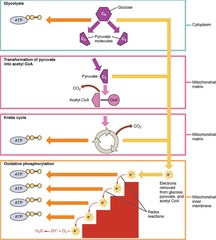
What are the roles of ATP, NAD, and FAD in energy metabolism?
ATP is the universal energy currency; NAD and FAD are electron carriers.
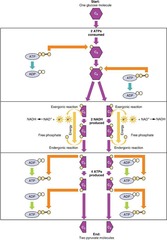
What is glycolysis?
The process that converts one glucose molecule into two pyruvic acid molecules.
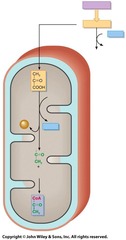
What is formed from pyruvic acid in cellular respiration?
Acetyl coenzyme A.
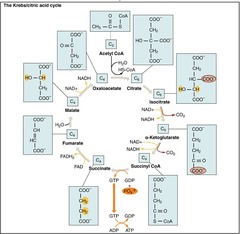
What is the Krebs cycle's role in cellular respiration?
It oxidizes nutrients to produce energy and regenerate oxaloacetic acid.
What is the electron transport chain?
A series of protein complexes that transfer electrons to generate ATP.
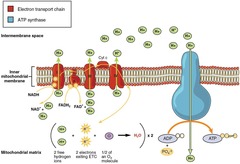
What is chemiosmosis?
The generation of ATP through the movement of protons across a membrane.
How much ATP is produced from the breakdown of one glucose molecule?
Up to 32 ATP.
What is the importance of oxygen in cellular respiration?
Oxygen is required for aerobic respiration and acts as the final electron acceptor.
What is the difference between aerobic and anaerobic respiration?
Aerobic respiration requires oxygen, while anaerobic respiration does not.
What are anabolic reactions?
Chemical reactions that build up molecules and require energy.
What are catabolic reactions?
Chemical reactions that break down molecules and release energy.
What is the primary source of energy in the body?
Carbohydrates, stored as glycogen.
What is the major energy reservoir in the body?
Lipids, stored in adipose tissue.
What role do proteins play in energy metabolism?
Proteins are not a primary energy source but are crucial for structure and function.
What are coenzymes?
Molecules used by enzymes to assist in reactions.
What is substrate-level phosphorylation?
Direct production of ATP from the oxidation of nutrients.
What is oxidative phosphorylation?
Production of ATP using high-energy electrons from nutrients.
What are redox reactions?
Reactions involving the gain (reduction) or loss (oxidation) of electrons.
What does LEO says GER stand for?
Lose Electrons = Oxidation; Gain Electrons = Reduction.
What happens during glycolysis?
Glucose is phosphorylated, split, and converted to pyruvic acid, yielding ATP and NADH.
What are the key products of glycolysis?
2 pyruvic acid, 2 ATP (net), and 2 NADH.
What occurs during pyruvic acid oxidation?
Pyruvic acid is converted to acetyl-CoA, producing CO2 and NADH.
What are the products of the Krebs cycle?
2 CO2, 3 NADH, 1 FADH2, and 1 ATP per acetyl-CoA.
What is the overall reaction for the catabolism of glucose?
C6H12O6 + 6O2 → 6CO2 + 6H2O + 32 ATP.
What is the total ATP yield from one glucose molecule during aerobic respiration?
32 ATP produced
What are the key products of glycolysis from one glucose molecule?
2 ATP and 2 NADH
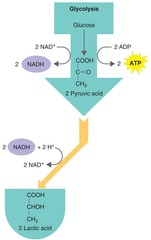
What happens to pyruvate in the absence of oxygen?
It is converted to lactate or ethanol, regenerating NAD+ for glycolysis.
What is the role of oxygen in aerobic respiration?
Oxygen is the final electron acceptor in the electron transport chain.
How much ATP does NADH yield in the electron transport chain?
2.5 ATP
How much ATP does FADH2 yield in the electron transport chain?
1.5 ATP
What is produced during the Krebs cycle for one acetyl-CoA?
1 ATP, 3 NADH, and 1 FADH2
What occurs during the process of gluconeogenesis?
Glucose is synthesized from non-carbohydrate precursors, primarily in the liver.
What is the function of lipolysis?
The breakdown of triglycerides into glycerol and fatty acids for energy.
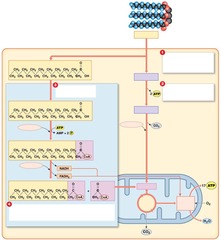
What is beta-oxidation?
The process of breaking down fatty acids into acetyl-CoA units.
What are ketone bodies and when are they produced?
Ketone bodies (e.g., acetoacetate, 3-hydroxybutyrate) are produced during ketogenesis when acetyl-CoA accumulates.
What is the by-product of protein metabolism?
Ammonia, which is converted to urea and excreted.
What happens to NADH and FADH2 during the electron transport chain?
They donate electrons and are recycled back to NAD+ and FAD.
What is the significance of the inner mitochondrial membrane?
It is where the electron transport chain and chemiosmosis occur.
What is the role of coenzymes in cellular respiration?
Coenzymes like NAD+ and FAD are essential for electron transport and energy production.
What is the primary energy source for most tissues?
Carbohydrates, primarily glucose.
What happens to the Krebs cycle during fasting?
It can stall due to a lack of oxaloacetate needed for acetyl-CoA entry.
What is the maximum possible ATP yield from one glucose molecule?
38 ATP, though actual yield is often lower due to inefficiencies.
What is the primary function of glycolysis?
To convert glucose into pyruvate, producing ATP and NADH.
What is the fate of pyruvate in aerobic conditions?
It is converted to acetyl-CoA before entering the Krebs cycle.
What can happen if there is a lack of oxygen during cellular respiration?
It can lead to the accumulation of NADH and stall the Krebs cycle and electron transport chain.
What is the role of acetyl-CoA in metabolism?
It serves as a key intermediate in the Krebs cycle and fatty acid synthesis.
What are the three main processes involved in lipid metabolism?
Lipolysis, beta-oxidation, and ketogenesis.
What is the significance of the electron transport chain?
It generates a proton gradient used to produce ATP via chemiosmosis.
What is the result of prolonged accumulation of ketone bodies?
It can lead to ketoacidosis, which can be dangerous.
What is the main energy storage form in the body?
Triglycerides, primarily stored in adipose tissue.
What is the primary role of proteins in metabolism?
To serve structural and enzymatic functions, and can be used for energy during fasting.