Lecture 3: The Anesthesia Machine
 Call Kai
 Learn
Learn Practice Test
 Spaced Repetition
 Match
Match Flashcards
 Knowt Play
1/39

There's no tags or description
Looks like no tags are added yet.
Name | Mastery | Learn | Test | Matching | Spaced | Call with Kai | Chat |
|---|
No analytics yet
Send a link to your students to track their progress
40 Terms
What are the parts of the high pressure system?
oxygen cylinder
cylinder valve
cylinder pressure gauge
regulator (or reduction valve)
What are the parts of the intermediate pressure system?
oxygen flush/bypass valve
What are the parts of the low pressure system?
flow meter
vaporizer
common gas outlet
common gas inlet
1-way valves (inspiratory, expiratory)
pop-off valve
The ____ pressure system runs from the oxygen cylinder to the pressure reducing valve (aka regulator). The ________ pressure system runs from the pressure reducing valve to the flowmeter. The ______ pressure system runs from the flowmeter to the common gas outlet.
high, intermediate, low
What are the 3 types of oxygen sources of an anesthesia machine?
cryogenic liquid supply
compressed gas in cylinders
oxygen concentrator
What are the large liquid oxygen containers installed at facilities that have a fairly constant demand and how do they work?
cryogenic liquid supply → liquid kept at -297 °F to prevent evaporation, then O2 drawn as required and passed through heater to increase temp and raise pressure
What does the pressure regulator on compressed gas cylinders ensure?
that gas is piped out at 50-55 psi
How does an oxygen concentrator work?
increases O2 concentration by absorbing nitrogen onto a molecular sieve and allows O2 and trace gases to pass through → resulting in O2 concentration of 90-96%
What are the pros and cons of an oxygen concentrator as an anesthesia machine oxygen source?
pros:
compact, lightweight, reliable units that are easily transported
can save money compared to liquid or cylinder oxygen sources
produces gas flows that would be acceptable for SA anesthesia patients
cons:
maintenance required (cleaning or replacing filters)
takes a few minutes to reach max concentration of 96%
How does an oxygen cylinder work?
cylinder filled and discharged through valve, the port is point of exit
conical depression opposite side of port, receives retaining screw from yoke
handle or cylinder wrench used to open/close a cylinder valve (open valve SLOWLY b/c rapid compression of gas generates heat)
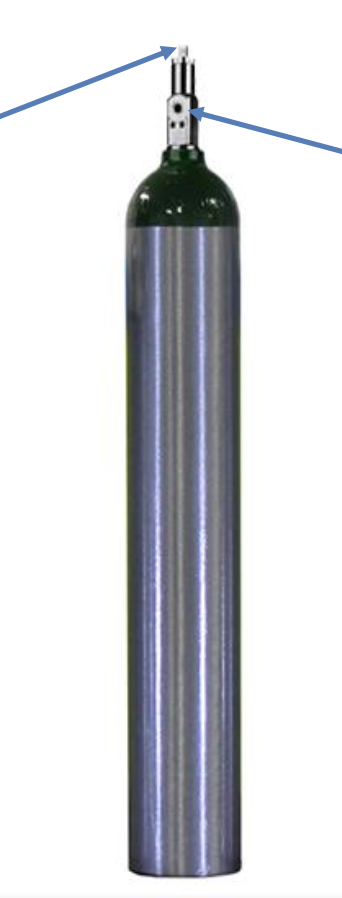
What are these parts of an oxygen tank?
left: handle attach
right: port
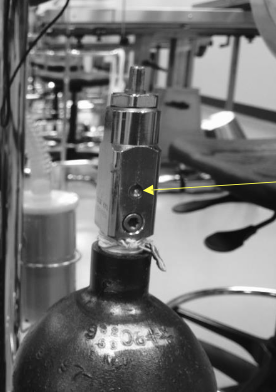
What is this part of an oxygen tank?
conical depression to receive yoke retaining screw
What is the function of a hanger yoke on an oxygen cylinder?
orients and supports cylinder, provides gas-tight seal
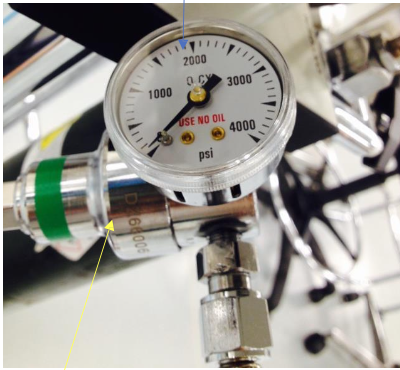
What are these parts of an oxygen cylinder? What are their functions?
yellow arrow: regulator → reduces the gas pressure from the cylinder to a usable level of a constant 50 psi
blue arrow: pressure gauge → allows user to calculate remaining liters in tank or pipeline pressure
An oxygen cylinder regulator terminates in a gas specific male ________.
DISS fitting
How must gas cylinder pressure gauges be installed and calibrated?
must be installed downstream of each pressure regulator and calibrated in psi
What psi indicates a cylinder change is needed?
< 500 psi
If a full tank has a known 660L of oxygen and the pressure gauge reads 2200 psi, how much oxygen is left in a tank reading 1500 psi?
P1 / V1 = P2 / V2 → 2200psi / 660L = 1500psi / L → 450L
What part receives O2 from the pipeline inlet or cylinder pressure regulator and directs a high unmetered flow directly to the common gas outlet? Why should this part never activated when connected to patient?
oxygen flush valve that delivers 35-75 L/min → possible barotrauma
The flow meter indicates rate of flow of gas passing through. Turn control know ________ to increase flow and ________ to decrease flow.
counterclockwise, clockwise
How does a variable orifice flow indicator work?
tube is internally tapered (smallest diameter at bottom), so as height increases = more gas flow
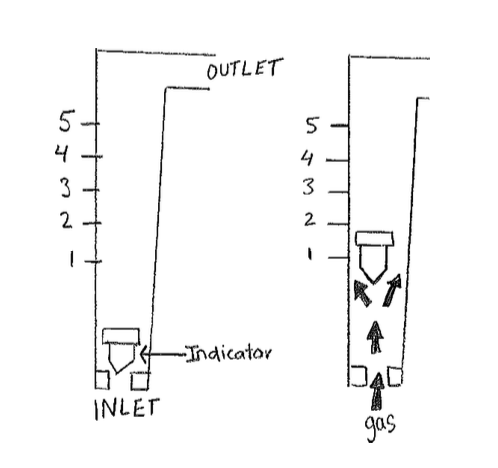
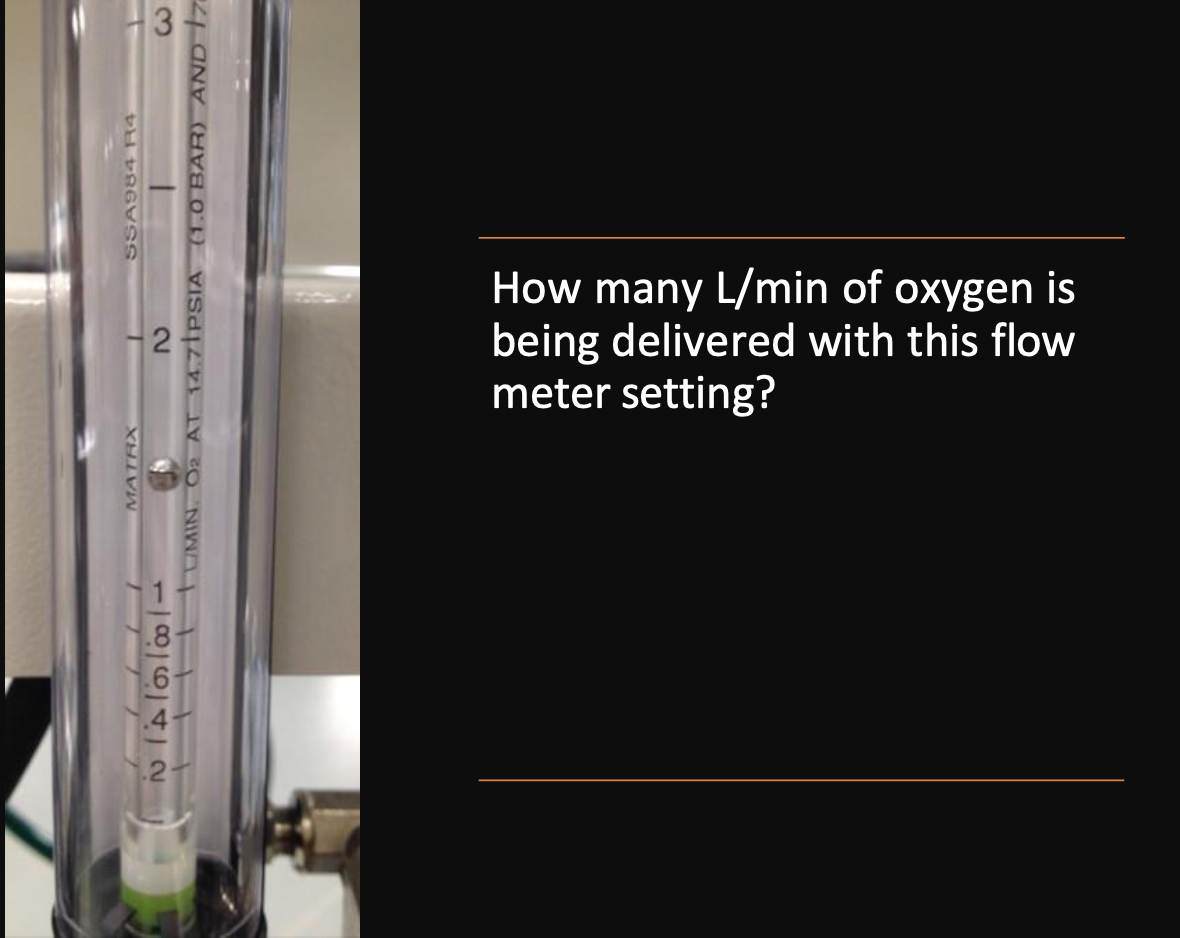
1.5 L/min
Where are unidirectional valves present and what do they do?
only present on a rebreathing system - allows gases to travel in one direction as the patient breaths (inspiratory and expiratory valve)
What are the disadvantages of unidirectional valves?
increases resistance to breathing; if one or both valves are leaky → patient will rebreathe CO2
if valves are sticky, pressure in the system and against breathing in and out
What is a vaporizer?
a device that changes a liquid anesthetic agent into its vapor and adds a controlled amount of that vapor to the fresh gas flow going into the patient breathing system
How does a vaporizer dilute the saturated vapor pressure?
by splitting the gas flow that passes through the vaporizer:
bypass the vaporizer outlet
vaporizing chamber
What prevents two vaporizers on machine being turned on at the same time?
interlock systems
What should happen if a vaporizer is tipped?
generally, it should be flushed with a high O2 flow rate for the max time recommended by manufacturer
ideally, vaporizer should be emptied prior to transport, left in upright position, and dial set to “0” position
What should happen if a vaporizer is filled with wrong agent?
vaporizer must be completely drained and all liquid discarded; O2 should be run through until no agent detected
What is the color coding of liquid anesthetic filling systems?
purple = isoflurane
yellow = sevoflurane
What receives all gases and vapors from the machine and delivers the mixture to the breathing system?
common/fresh gas inlet and outlet
The inspiratory reservoir of oxygen for the patient should be large enough for the patient to be able to take ______ breaths.
5-6
What are the reservoir bags used for?
used to monitor frequency of respiratory rate and compliance of patient’s pulmonary system during assisted ventilation
manual ventilation by anesthetist from squeezing bag up to 20 cmH2O while occluding APL valve momentarily or replace by ventilator hose during mechanical ventilation
What equation is used to determine the size of reservoir bag is used for a patient?
body weight (kg) x tidal volume (mL/kg) x 5, generally round up
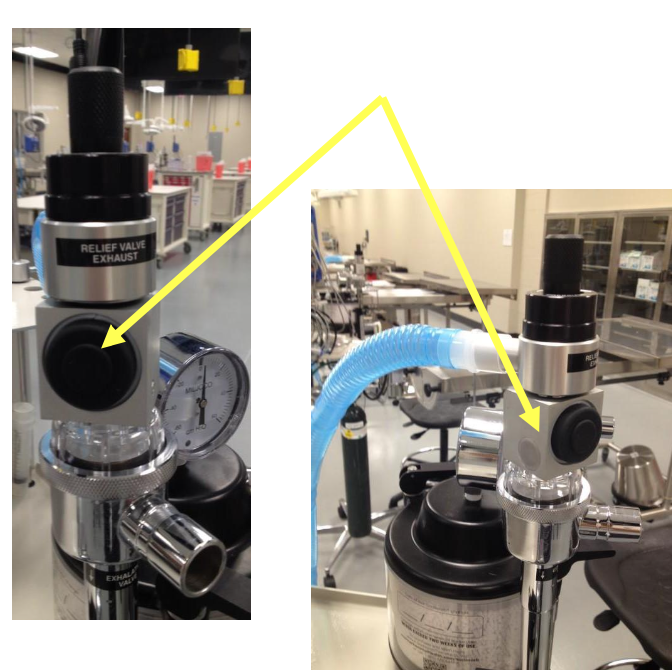
What is this part and what is it used for?
user adjustable pressure-limiting (pop-off) valve that releases gases to a scavenging system
used to control pressure in the breathing system: transiently close APL to deliver manual ventilation to a patient, otherwise must be kept open at all times
What are the top 3 “killers” of anesthesia machines?
closed pop-off valve
too little O2
too high vaporizer setting
What are some general anesthesia machine safety concerns?
improper cylinder storage
tipping over vaporizer
wrong inhalant in vaporizer
overfilling vaporizer
using oxygen flush valve when attached to a patient
O2 and N2O are flammable
How should oxygen cylinders be stored?
Cylinder valve, pressure regulator, or gauges should never come in contact with oils, greases, organic lubricants, rubber or combustible substances
Valve kept closed at all times unless cylinder is in use, ideally use a protection cap when stored. “Bleed” all pressure from system
Store between 20 to 130◦F, away from heat duct
Properly stored at all times (i.e. cart or attached to yoke)
How do you perform a machine leak test (machine pressure check)?
make sure O2 flow meter is OFF
close the APL (pop off) valve
occlude the patient end of the Y-piece with a hand, finger, or syringe plunger
use O2 flowmeter to fill system (can use VERY short bursts from flush to fill large bags)
observe the pressure gauge for at least 10 seconds
release the APL vlve
remove occlusion form Y-piece
When performing a machine leak test, what should be done if a leak occurs when observing the pressure gauge?
slowly titrate the O2 flow meter up to maximum of 300 ml/min:
if this stops the leak, the machine and breathing system is acceptable to use
if take >300 ml/min of O2 to stop the leak, the machine and breathing system should not be used until source of leak is identified