Cervical and thoracic Therx study guide
 Call Kai
 Learn
Learn Practice Test
 Spaced Repetition
 Match
Match Flashcards
 Knowt Play
1/53

There's no tags or description
Looks like no tags are added yet.
Name | Mastery | Learn | Test | Matching | Spaced | Call with Kai | Chat |
|---|
No analytics yet
Send a link to your students to track their progress
54 Terms
what does the c spine consist of?
▪ 7 vertebrae
▪ 8 nerve roots
▪ 12 facet joints
▪ 6 main ligaments
▪ 6 intervertebral
discs (IVDs)
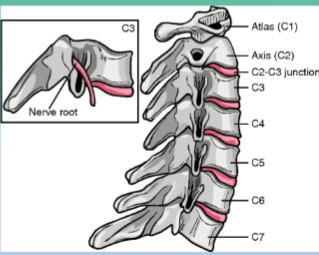
____ is the first cervical vertebrae which articulates with occipital condyles and moves as one unit with the occiput
Atlas
____ is the second cervical vertebrae made unique by the dens (odontoid process)
Axis
Together, the atlas and axis form the_________ joint
atlanto-axial (AA)
what is the primary motion of the AA joint?
cervical rotation, which can become limited by facet capsules and the alar ligament; convex-convex
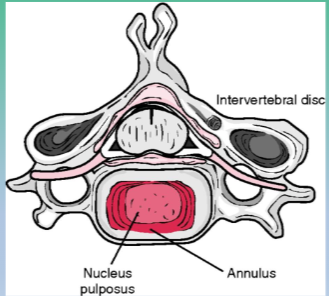
does the c spine move sequentially?
Does not occur sequentially; the lower cervical spine
moves before the upper in flexion and extension
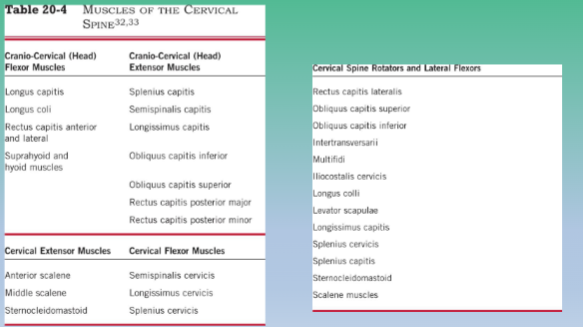
musculature c spine roles:
▪ Stabilize the spine
▪ Carry loads
▪ Produce motion
muscles provide what percentage of c-spine stability
80%, dynamically in neutral spine stability and ligaments stabilize at end ranges
ligaments have these 3 important functions in the c spine
1. Provide stability to the joint
2. Absorb energy during trauma
3. Act as a joint position transducer during physiologic
motions
percentage of stability ligaments provide
20%
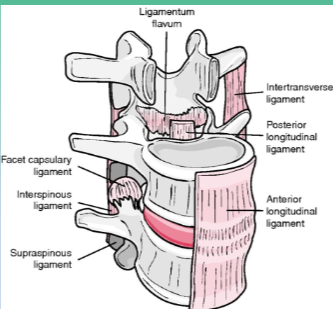
Anterior longitudinal ligament
▪ Runs the entire length of the spine from occiput to sacrum
▪ Is found along the anterior aspect of the vertebral body
▪ Has fibers that attach to each vertebra, as well as IVD
▪ Is the main ligament that resists spinal extension
Posterior longitudinal ligament (PLL)
▪ Runs the entire length of the spine
▪ Is found along the posterior aspect of vertebral bodies
▪ Is anterior to the spinal cord, posterior to the discs
▪ Has a thick, central portion that helps prevent disc
herniation
▪ Gets narrower in relation to the vertebrae distally
▪ Limits cervical flexion and distraction
Intertransverse ligament (ITL)
▪ Runs from the inferior aspect of the superior transverse process to the superior aspect of the inferior transverse process
▪ Gets taunt during rotation and lateral flexion
Interspinous ligament (ISL)
▪ Runs from the inferior aspect of the superior vertebra’s spinous
process to the superior aspect of the inferior vertebra’s spinous
process
▪ Gets taunt during flexion
Supraspinous ligament (SSL)
▪ Attaches to tips of spinous processes
▪ Runs the entire length of the spine
▪ Is located posterior to the ISL
▪ Together with the ISL, limits cervical flexion and anterior
horizontal displacement
what ligaments are aligned at right angles to articular facets and resists distraction?
capsular ligaments
Ligamentum flavum (LF)
▪ Originates bilaterally
▪ Attaches to the lamina of the superior and inferior
vertebrae
▪ Helps restrain hyperflexion as it is located posteriorly
▪ Has elastic properties, and with age and repetitive stress,
can degenerate and cause canal narrowing or cord
impingement
Alar ligament
attaches the dens of c2 to occipital condyles and restrains rotation
transverse ligament
holds the dens of c2 against the anterior ring of the atlas and limits flexion and anterior displacement of the atlas
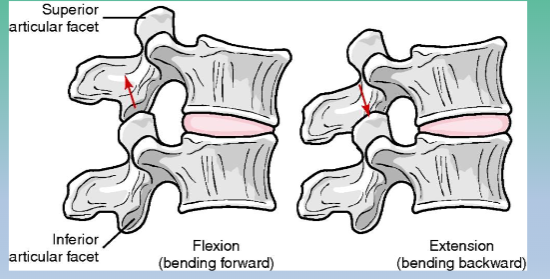
these joints face up and post. at a 45 degree angle and are hinge like diartrhodial synovial joints with fibrous capsules
Zygapophyseal (facet) joints; alignment of them prevents excessive anterior translation
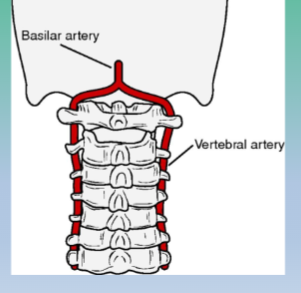
________________ upward toward the head through the foramen
of the transverse processes from C6-C1, Enters the brain and forms the basilar artery
vertebral artery
The test is positive for vertebral artery insufficiency if
the patient experiences:
▪ Dizziness, nausea, lightheadedness, blurred vision, or
nystagmus
▪ Side being tested is opposite the direction the head
is rotated toward.
normal spine postures seen
▪ Lordosis in lumbar and cervical spine
▪ Kyphosis in thoracic spine
these 3 factors are normal causes that can alter normal cspine curve
injury
muscle spasm
posture
postural exercises
▪ Nodding
▪ Retraction
▪ Sitting posture
▪ ROM
▪ Stretching
▪ Strengthening
this movement helps re-establish and strengthen deep cervical flexors
nodding/craniocervical flexion
Prolonged sitting can cause an increase in __________
cervical thoracic angle aka forward head position
cervical rom principles
▪ Begin in pain-free ranges in pain-free directions,
progressing to more painful ranges and planes
▪ Begin in straight planes, progressing to multiple
planes
▪ Be performed 5–15 times
▪ Be implemented until full pain-free ROM is restored
cervical stretching principles
▪ Start slow and go to the point that tension is felt
▪ Not reproduce a patient’s pain
▪ Start with straight plane and progress to a
combination of movements
▪ Be held 10–30 seconds and repeated 3–5 times
strengthening should follow the progression of this
▪ Isometric, isotonic, and then plyometric
▪ Straight plane to multi-plane motions
strengthening progression criteria
1. No pain during exercise
2. No pain in cervical muscles the day after
3. Pain-free ROM in all ranges
Manual Therapy can do what
decrease pain and muscle spasm, restore joint mobility, and increase cervical spine function

manual therapy techniques include
▪ Soft tissue massage
▪ Muscle energy
▪ Mobilizations
▪ SNAGS (Sustained Natural Apophyseal Glides)
▪ Traction

_______ ______ is a specific point in a muscle that is hypertonic; has a specific pattern of pain referral
trigger point
Responds well to direct pressure
▪ Causes spasm to decrease
▪ Can decrease somatic dysfunction
▪ Held until a decrease in both tension and pain is felt
▪ May take several treatments
what is muscle energy used for
▪ A voluntary contraction of a patient’s muscle
▪ In a precisely controlled direction
▪ At varying levels of intensity
▪ Against a distinct counterforce from the clinician
The contraction can be held 6–10 seconds, repeated 3–5
times
_______Is the application of passive joint oscillations performed
at the limit of the available ROM; Should be performed for 30–60 seconds, 3–5 times, and
then reassess for pain reduction and increased ROM
Mobilizations
Sustained Natural Apophyseal Glides (SNAGS)
▪ Utilize movement of the joint in conjunction with
mobilization
▪ Can restore normal vertebral motions
▪ Treatment plane: the plane or angle of the articulating
surfaces
▪ In the cervical spine, the treatment plane is 45 degrees
what patient conditions would traction be effective for
▪ Radicular pain
▪ Discogenic symptoms
▪ Hypomobility
▪ Nerve root irritation