(5) Neuron Physiology: Action Potentials
 Call Kai
 Learn
Learn Practice Test
 Spaced Repetition
 Match
Match Flashcards
 Knowt Play
1/27

There's no tags or description
Looks like no tags are added yet.
Name | Mastery | Learn | Test | Matching | Spaced | Call with Kai | Chat |
|---|
No analytics yet
Send a link to your students to track their progress
28 Terms
If a graded potential is _______ the threshold when it reaches the trigger zone, nothing happens
Below
Action potential
Brief, rapid, large changes in membrane potential
Action potential mV
~100mV
Graded potential mV
~15mV
Action potentials are a what process?
All or nothing
Explain Step 1 of the action potential sequence
Resting membrane potential (neuron -70mV)
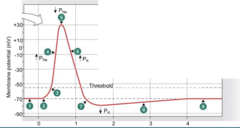
Explain Step 2 of the action potential sequence
Depolarizing stimulus (going from -70mV to -50mV) another name could be graded potential arriving at trigger zone
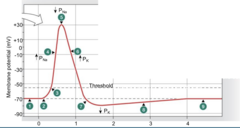
Explain Step 3 of the action potential sequence
Membrane depolarizes to threshold; voltage gated Na+ and K+ channels start to open

Explain Step 4 of the action potential sequence
Rapid Na+ entry depolarizing cell (sudden rapid rise in membrane potential from -50mV to 30mV)

Explain Step 5 of the action potential sequence
Na+ channels close and slower K+ channels open

Explain Step 6 of the action potential sequence
K+ moves out of the cell, repolarizing the membrane
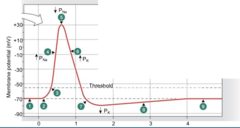
Explain Step 7 of the action potential sequence
K+ continues to leave the cell, hyperpolarizing it
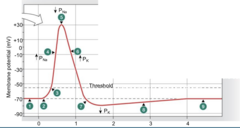
Explain Step 8 of the action potential sequence
K+ channels close, less K+ leaks out of the cell
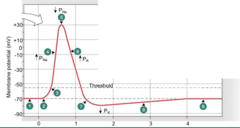
Explain Step 9 of the action potential sequence
Cell returns to resting potential

Resting membrane is more permeable to what ion?
K+
Voltage gated Na+ channels have an activation gate that opens ______ and an inactivation gate that closes ________
Rapidly, slowly
At rest, voltage gated Na+ channels have what open and what closed?
Activation gate is closed , inactivation gate is open
Absolute Refractory Period
Period of time after an action potential has begun when another action potential absolutely cannot be stimulated
Relative Refractory Period
The next 1-2 ms where some Na+ channels have reset. A stronger than normal stimulus could trigger another action potential
Voltage Gated K+ channels have only an activation gate that opens ________ respose to ________
slowly, depolarization stimulus
Na+ - K+ ATPase Pump
Actively pumps 3 Na+ out of the cell and 2K+ into the cell. Helps restore ions to proper compartment after action potential
When one region of the membrane depolarizes, charges flow to
Adjacent regions
Action potentials can only propogate forward, which means they are
Unidirectional
What happens if myelin is damaged or destroyed?
Action potential conduction can fail as the current leaks out of cells
The farther from the threshold,
The stronger the stimulus needed
K+ is the most important determinant of the
Resting membrane potential
Hyperkalemia
the state of having too much K+ in the blood, increasing membrane potential.
Makes cells too easy to stimulate, numbness, tingling, then muscle weakness
Hypokalemia
The state of having not enough K+ in the blood
Makes cells hard to stimulate, muscle weakness, cramps, or spasms