Principles of radiation
 Studied by 0 people
 Call Kai
 Learn
Learn Practice Test
 Spaced Repetition
 Match
Match Flashcards
 Knowt Play
1/23

There's no tags or description
Looks like no tags are added yet.
Name | Mastery | Learn | Test | Matching | Spaced |
|---|
No study sessions yet.
24 Terms
Labelling a tube head
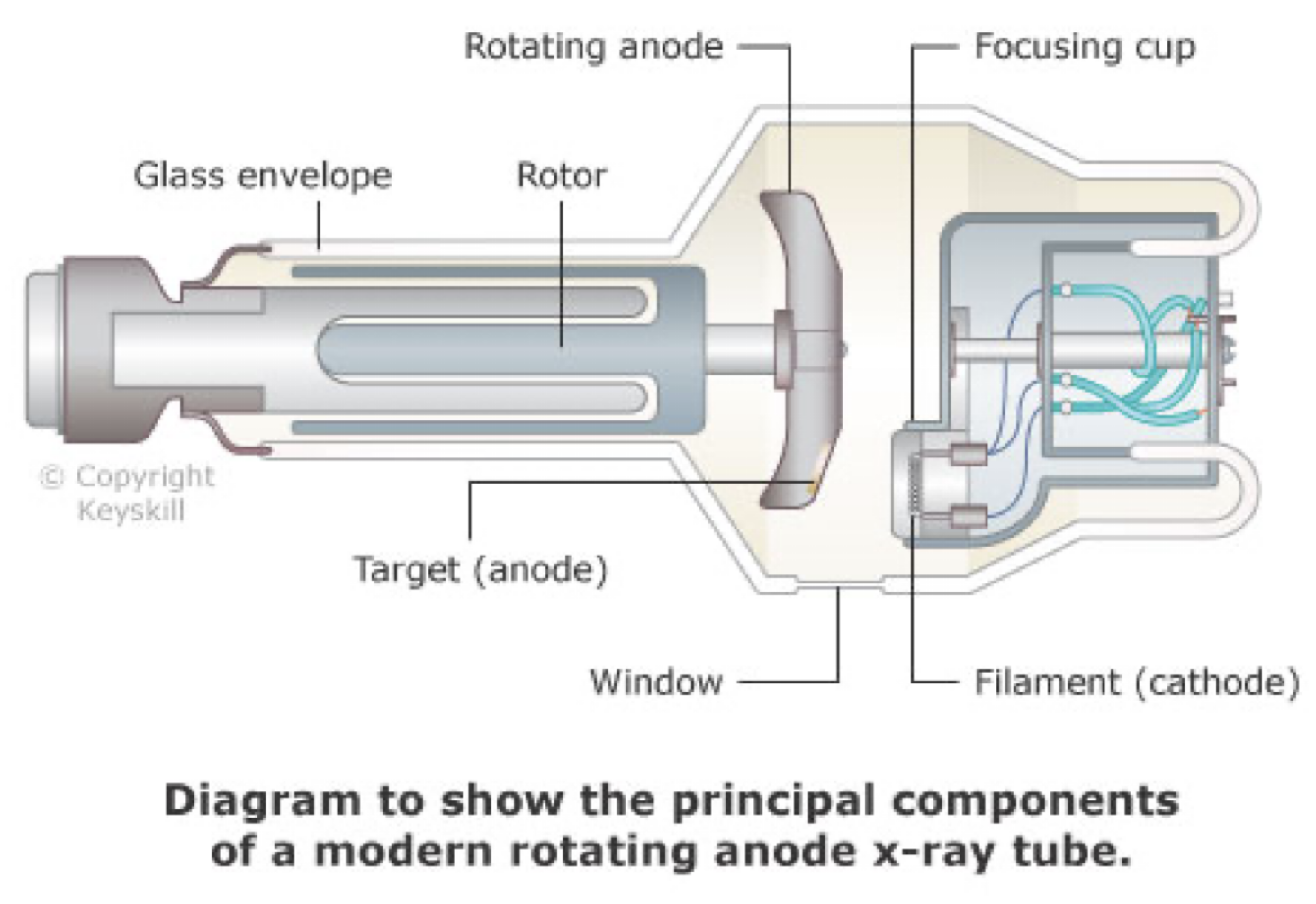
What is a cathode
Coiled wire filament
Transports electrical current
Negatively charged
What is an anode
AKA target anode
Stationary or rotating
Positively charged
What is a focusing cup
Contains cathode
Narrows and concentrates the beam
What is the function of the tube head
Contains a light diaphragm to change collimation
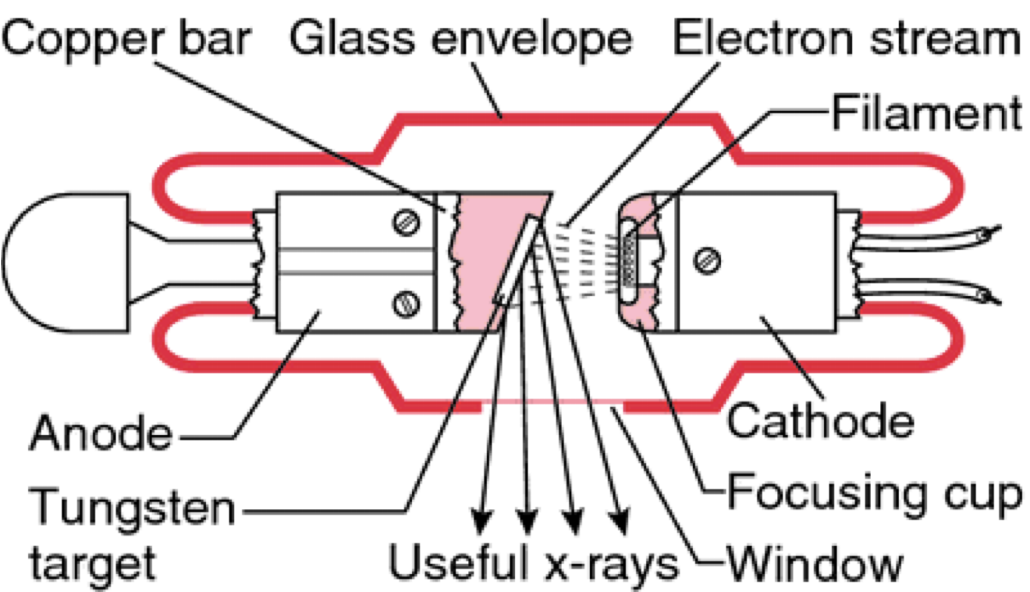
What is the structure of an x-ray tube head
Anode, cathode and part of copper stem are housed in an airtight glass envelope
Glass vacuum and everything in it is bathed in oil to insulate it and help conduct heat away from the anode
Then it is earthed and encased in a lead lined metal casing
These stationary anode machines are limited by the amount of heat they produce so they are only able to produce a primary beam of low intensity
More powerful machines require a rotating anode in order to produce enough x rays to penetrate large areas
Photons recap
They do not require a medium for transmission
They travel in straight lines but in any direction
They interact with matter by either scattering or being absorbed
When any electromagnetic radiation is emitted, the intensity of the radiation will decrease, the further away it travels from its source
How are x-ray photons produced
Photons are produced by electron interaction
Referred to as x-ray photons
Produced by high voltage acceleration of electrons
The negative charge created by the cathode will always move from the negative to the positive charge of the anode
There must be a step down filament
There must be a high tension filament transformer
What are the properties of a stationary anode
The anode target is set at an angle of 15-20 degrees to increase the surface area where the electrons hit the anode to distribute the heat
Made from Tungsten.
This is called the actual focal spot
Some machines offer a choice of focal spots (fine focus vs broad focus)
What does fine focus mean
Smaller cathode
Finer cross section of electrons
More detail
What does broad focus mean
Big cathode
Larger cross section of electron
Less detail, achieving a smaller effective focal spot is called the line focus principle
What are the properties of a rotating anode
Rotating anodes are more effective at removing the heat created by the Electrons
The anode is a disk with a bevelled edge set at 15-20 degrees which is driven by a motor.
The rest of the tube head is the same
During exposure the anode disk rotates rapidly (3,000-9,000) so the target that the electrons hit is constantly changing therefore the surface area of the target is much larger than in a stationary anode
What are the properties of the glass envelope
Made of Pyrex
Tolerate high heat
Immersed in oil (heat conduction)
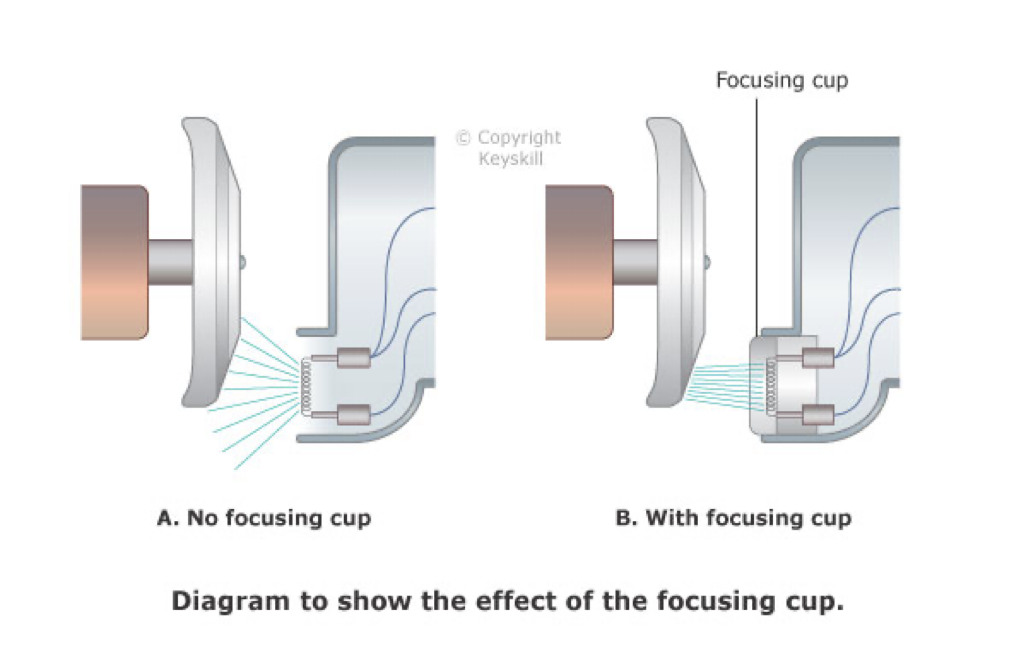
Focusing cup
Why is a focusing cup needed
Needed as it tries to control, manage and direct the stream of electrons from the cathode across to the target anode
Without a focusing cup we wouldn't have a fine level of focus/high resolution
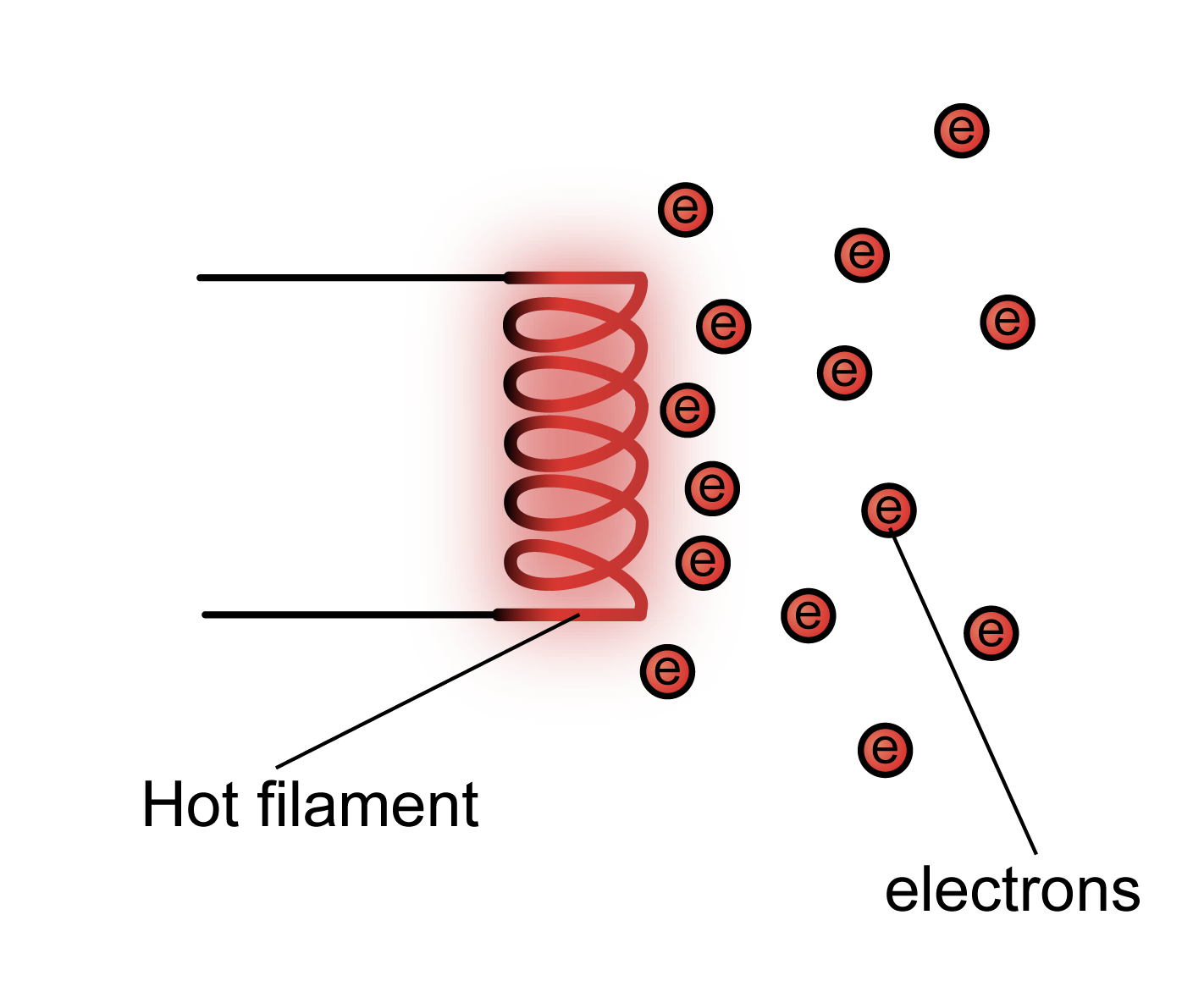
Cathode
What are the properties of a cathode
Cathode filament sits within the focusing cup and creates electrons
Electrons are created through the heat created via an electrical current to the cathode--> subject to mAs
How does an x-ray machine produce radiation (part 1)
Electric passes from the mains BUT is too strong, so before it enters the cathode it is stepped down with a filament transformer
When the electrical current passes through the cathode it heats up and releases a cloud of electrons (the size of which is dictated by the mAs) known as thermionic emission
In order for this to travel across to the anode at speed there needs to be a high electrical potential difference between the cathode (-ve) and anode (+ve)
How does an x-ray machine produce radiation (part 2)
This process takes up more electricity than the mains voltage can supply and so must be stepped up by a high tension transformer which is measured in Kilovolts (kV)
The cloud of electrons (-ve) is repelled by the cathode (-ve) and is attracted to the anode (+ve)
Electrons hit the target anode at speed to produce the x-ray photons via the release of their energy
How does an x-ray machine produce radiation (part 3)
X-ray photons then form the primary beam and exit the tube head via the tube window
Heat is a by-product of this process therefore both the cathode and anode of made from tungsten alloy as is has a high atomic number (74) and a high melting point (3380C). This results in 99% of the energy released from the electrons when they hit the target being lost in heat
This excess heat is absorbed by a copper block by conduction and travels via a copper stem to be cooled in an oil bath
What does mAs stand for
Milliamps x seconds
What does mAs control
Radiographs consist of quality and quantity
Controls the quantity of photons, blackening or density
MAs controls the amount of electrons created
This increases or decreases the radiation dose
What does KV stand for
Kilovolts
What does KV control
Controls the quality, contrast and grey scale
When increased the speed that electrons move across the tube head increases
Higher penetrability to move through tissue
Reduces the controls in tissues with different compositions