Exam 2 (L12-20) - No Cases
 Call Kai
 Learn
Learn Practice Test
 Spaced Repetition
 Match
Match Flashcards
 Knowt Play
1/288

There's no tags or description
Looks like no tags are added yet.
Name | Mastery | Learn | Test | Matching | Spaced | Call with Kai | Chat |
|---|
No analytics yet
Send a link to your students to track their progress
289 Terms
How do you distinguish between bands and mature neutrophils?
Bands are more uniform in shape. Mature neuts will be segmented
How do horse neutrophils differ from other species?
They're more scalloped/jagged
When do lysosome primary vs. secondary granules appear?
"Primary: late myeloblast/early promyeloctye stage
Secondary: appear in myelocytes"
What do lysosomes contain?
Hydrolytic enzymes and antibacterial agents
What lysosome granules are myeloperoxidase +?
Primary Granules
Which is easier to treat: a myeloid leukemia or a lymphoid leukemia?
Lymphoid leukema
What are heterophils?
Birds, reptiles and other species have a neutrophil equivalent that stains red
What are heterophils often mistaken as?
Eosinophils because they stain red
How can heterophils be distinguished from eosinophils?
Heterophils have more oblong granules while eosinophils have round granules
What cells disappear randomly from blood?
Granulocytes and monocytes
How do lymphocytes, eosinophils and monocytes recycle themselves?
Lymphocytes: tissues to blood
Eosinophils: tissue to lymphatics
Monocytes: tissue to bone marrow
How long are neutrophil's half-life?
Blood: 10-15 hours
Tissues: Few Days
What happens if neutrophils don't encounter bacterial in the blood during their lifespan?
Spontaneous apoptosis
What is the marginating neutrophil pool? What organs have them?
Neutrophils that are loosely attached to endothelium in unopened/inactive capillaries that are not counted on BW (typically found in lungs, spleen, liver etc.)
What causes pseudo-neutrophilia?
Marginalized neuts come out of the inactive capillaries when the animal is stressed, exercising or given epinephrine
What is the half-life of eosinophils?
Blood: Less than a day
Tissue: A week or more
What is the half-life of basophils?
Blood: 1-2 days
Tissue: A few days
What is the half-life of monocytes?
Blood: 1-3 days
Develop into macrophages/DCs in tissues: weeks to months
Where do monocytes have marginating pools?
Lungs
Where do lymphocytes have marginating pools?
Lungs
Where do most lymphocytes reside?
Lymphoid Organs (LN, thymus, GI peyer's patches, other lymphoid tissue)
Only _____% of total lymphocytes in the body are in the blood.
2-5%
Most blood lymphocytes are naive ____ and _____ lymphocytes.
T and B
Between T cells, B Cells and NK cells, which are the most numerous in the body?
T Cells > B Cells > NK Cells
What makes lymphocytes different from other WBCs in terms of their circulation?
Other WBCs "disappear" and don't typically return to where they came from, but lymphocytes typically return to lymphoid organs
What is the spleen's job in blood circulation?
Spleen "cleans" the blood - acts as filter, especially bacteria/organisms
What allows lymphocytes to return back to lymphoid organs?
Bind to HEVs (high endothelial venules) that allow lymphocytes to go from blood to lymphatics
What is special about memory lymphocytes?
Once they recognize an antigen, they will return to the tissue that had that antigen after recirculating
________ lymphocytes don't migrate.
Proliferating
What is the half-life of lymphocytes?
T: years
B: 2-3 weeks individual cells, years for proliferating clones
NK: 2 weeks
Neutrophils are most effective against ______.
bacteria
How do neutrophils detect bacteria?
Chemoattractants
What is required for neutrophils to reach the site of the bacteria?
Adhesions molecules -> Haptotaxis (like chemotaxis except more surface-bound than fluid movement)
What activates neutrophils?
Endothelial cells express L selectin to make neutrophils roll. B2 integrin is expressed and allows neutrophils to hold onto endothelium's IC adhesion molecule (ICAM) so they can migrate through wall to infection site
What are haptotaxis?
Chemoattractants activated by infection. Bind to neutrophils in order to bring them to the source.
What is leukotriene B4?
A chemoattractant that neutrophils release to signal that back-up is needed
Do leukocytes migrate through the endothelium of arteries or veins?
Veins, arteries are too fast
How does myeloperoxidase from neutrophil primary granules kill bacteria?
Myeloperoxidase is put into phagocytic granule.
NADPH oxidase converts oxygen to superoxide, which mutates to make hydrogen peroxide.
Miloperoxidase + hydrogen peroxide + halide (like Cl) -> hypoclorous acid (bleach), which kills phagocytized bacteria"
What are the ways neutrophils kill bacteria?
Hypochlorous Acid (H2O2)
ROS (ie. superoxide free radical)
Collagenase, Acid, Lysozyme
Cationic proteins and peptides (defensins) - not enzymatic
Lactoferrin to bind iron
What are NETs?
Neutrophil Extracellular Traps that are released and bind/kills bacteria, fungi, parasites + some viruses without phagocytosis
Active form of cell death - need superoxide free radicals
Besides neutrophils, what other cells release extracellular traps?
Eosinophils and mast cells
What does NETosis require?
Production of superoxide free radicals
How do eosinophils appear in the cat?
Rod shaped granules
How do eosinophils appear in the horse?
Raspberry Appearance
Most tissue eosinophils are located in _______.
GI mucosa
Eosinophils don't adequately defend against _______ and ______.
bacteria and viruses
What kind of inflammation does eosinophils cause?
Th2 cytokine-induced inflammation
Eosinophils defend against _____.
helminths (roundworms, flukes)
What kind of hypersensitivities do eosinophils produce?
Type 1 hypersensivity allergic reaction
Heartworm disease may show an increase in _________.
Eosinophils
How do eosinophils kill helminths?
Unable to phagocytize because helminths are too big.
Use oxygen metabolites, major basic and cationic proteins, neurotoxins
Where do basophils vs. mast cells mature?
Basophils - Bone Marrow
Mast Cells - Tissue
Which lasts longer: basophils or mast cells?
Mast Cells
Do basophils or mast cells proliferate once mature?
Mast Cells
Do mature basophils go through circulation?
Yes
Do mature mast cells go through circulation?
No
What do basophils respond to?
Allergens, helminths, ectoparasites
What do basophils and mast cells contain in their granules?
Histamine-bound polyanions (ex. heparin) - gives the cell their purple color
Basophils/Mast Cells release _____ and when binding to ________.
Histamine, antigen-IgE
Why is mast cell activation important?
Eosinophil recruitment and expulsion of parasites
______ are rapidly mobilized from marrow in response to inflammatory cytokines and have chemoattractants simliar to neutrophils.
Monocytes
What is the function of monocytes?
Antigen presentation to T lymphocytes and production of cytokines
______ promotes transformation of monocyte to macrophages.
M-CSF
What are M1 vs. M2 macrophages?
"M1 - antimicrobial
M2 - wound repair, tissue remodeling"
______ are more effective than neutrophils in viral, fungal, protozoal and helminth infections.
Macrophage
What free radical is most important in macrophages for killing their targets?
Nitric Oxide
How do macrophages link innate and adaptive immunity?
Have TLR that recognize bacterial molecules
Fc and complement receptors for opsonizing microorganisms
______ are important in wound healing
Macrophages
_______ remove aged or damage cells.
Macrophage
_________ degrade phagocytized RBCs and iron stores and release iron for recycling.
Macrophage
What cells remove blood-borne pathogens?
Red Pulp Macrophages (spleen) and intravascular macrophages (liver, bone marrow, lungs)
What lymphocytes have granules?
Cytotoxic T or NK Cells
What are the function of T lymphocytes?
Cellular immunity
CD4 - (Helper T) pathogens and neoplasia
CD8 (Cytotoxic T) antigen-dependent, viruses and neoplastic, cytokines that effect hematopoiesis"
What can cause false leukocytosis?
Platelet aggregates
nRBC presence
Incomplete lysis of erythrocytes
What can cause false leukocytopenia?
Clumped/lysed leukocytes
Clot in sample (trabs WBCs, platelets and some RBCs)
What’s the significance of drumsticks or barr bodies in neutrophils?
Inactivated X chromosomes in females
What’s the significance of neutrophil nuclear blebs?
Unknown significance
What is the May-Hegglin anomaly?
Triad: Neutrophil inclusions + thrombocytopenia + macroplatelets (macroplatelet with big inclusions in a nucleus)
Typically seen in pugs and humans
Neuts function normally
No bleeding tendency, normal platelet function
MYH9 mutation → heavy chain of non-muscle myosin IIA

What is unique about foal neutrophils?
Have visible primary granules
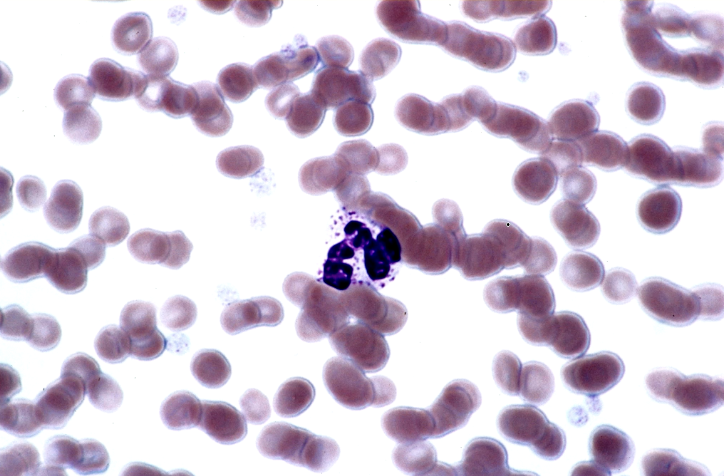
What species can have Dohle bodies in their neutrophils?
Cats

What species can have toxic granulation of their neutrophils?
Ruminants and horses

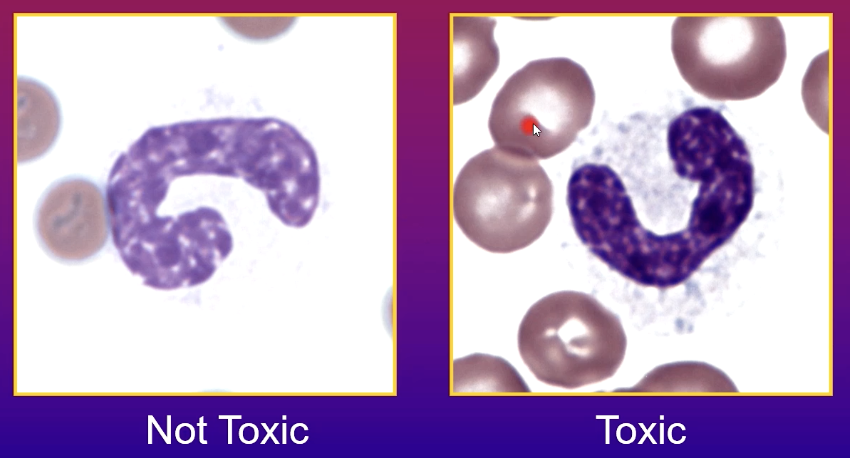
How can you tell the difference between a normal neutrophils and a toxic one?
Basophilic, foamy cytoplasm
What is a Pelger-Huet Anomaly?
Hyposegmentation of granulocytes (just looks like bands and monocytes in the sample) → dark chromatin
Typically in Australian Shepherds, but also can be in other breeds, horses and cats
Normal function, no clinical abnormalities

What anomaly may show as a false left shift on bloodwork?
Pelger-Huet → the mature neuts look like bands/monocytes
What is AML?
Acute Myelogenous Leukemia
Neoplasmia of non-lymphoid cells
>20% blast in bone marrow
What is CML?
Chronic Myelogenous Leukemia
Neoplasm of granulocytes
Leukocytosis w/ marked left shift
<20% blasts in bone marrow
What causes giant neutrophils?
Anything that causes RUSHED maturation → Inflammation, IMT (imatinib) and IMHA
Dysgranulopoiesis → ± neoplasm
Lymphoma
What is hypersegmentation?
When neutrophils have 5 or more distinct lobes
What causes hypersegmentation?
“Really old neuts”
Endogenous or exogenous glucocorticoids → stayed in blood longer than normal
Old blood
Heat Stroke
Resolving chronic infections → stayed in blood longer than normal
Myeloid neoplasms
What deficiencies in dogs and cats cause hypersegmentation?
Dogs → cobalamin deficiency
Cats → folate deficiency
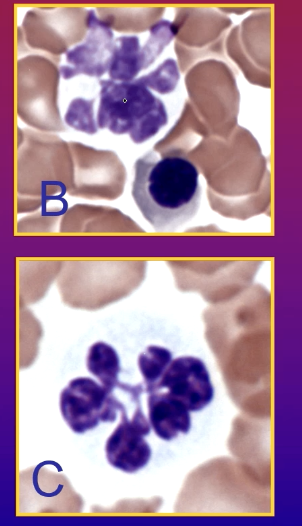
What are botryoid neutrophils?
Seen in heat stroke
Form of hypersegmentation where the nucelus looks like spokes of a wheel
What is sideroleukocytes?
WBC that have hemosiderin in their cytoplasms → IMHA

What lymphocyte changes occur in neoplastic conditions?
Neoplastic lymphocytes have granules → lymphoma
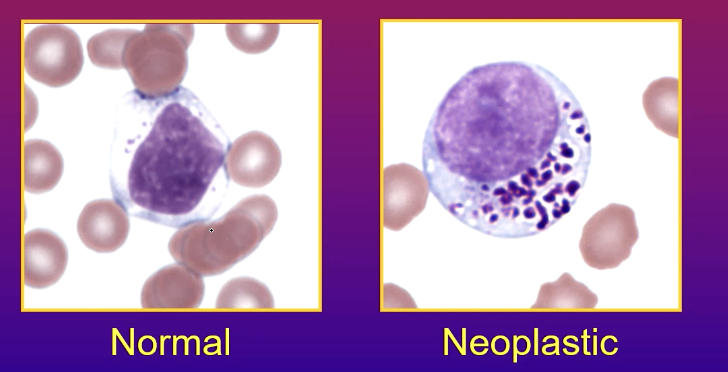
What are reactive/transformed/atypical lymphocytes?
Lymphocytes that occur in circulation more than normal
Use “atypical” when unsure if the lymphocyte is reactive or neoplastic
Dark blue cytoplasm
Vacuoles
Indented nuceli

How do monocytes appear on a blood smear?
Variety of shape nucleus
Basophilic cytoplasm
Vacuoles
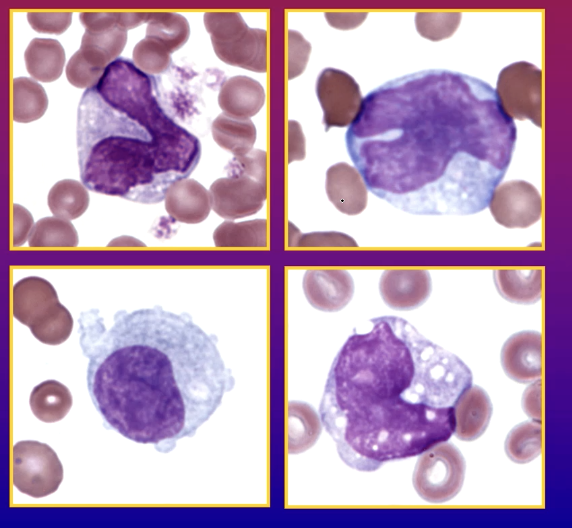
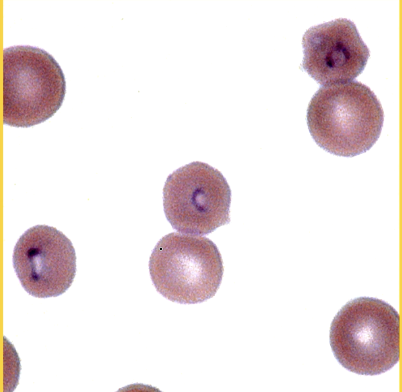
Cytauxzoon felis
What is the Brazil version of Babesia?
Rangelia
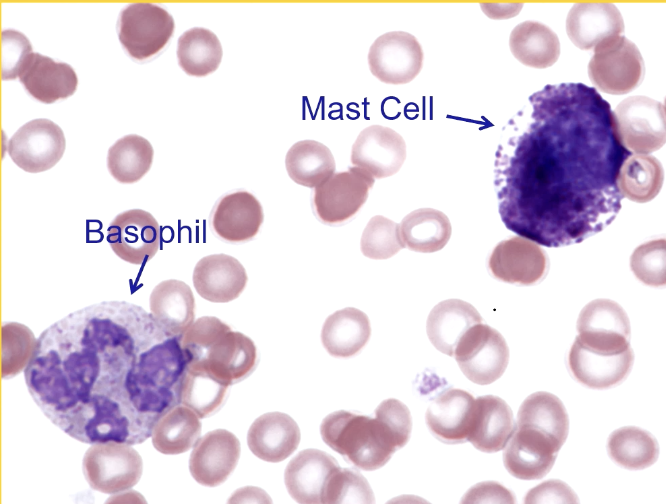
How can you distinguish between basophils and mast cells on a blood smear?
Basophils → segmented nuclei
Mast Cells → round nuclei
Absolute leukocyte counts are important because each leukocyte count has its own _______ and _______.
function and kinetics
What WBC type predominates in the blood of carnivores?
Neutrophils