PYB204 Perception and Cognition
 Call Kai
 Learn
Learn Practice Test
 Spaced Repetition
 Match
Match Flashcards
 Knowt Play
1/62

There's no tags or description
Looks like no tags are added yet.
Name | Mastery | Learn | Test | Matching | Spaced | Call with Kai | Chat |
|---|
No analytics yet
Send a link to your students to track their progress
63 Terms
What is cognitive psychology?
The science of how the mind is organised to produce intelligent thought, and how it is realised in the brain
Explain Williams Syndrome
Patients have difficulty processing visuospatial information
Spatial navigation is not completely lost, they can learn repeated routes better than age-matched healthy individuals
Brain structures that are critical for the place-based system are affected
Nativism vs Empiricism
Nativism is the philosophy that knowledge is innate whereas empiricism is the philosophy that knowledge is acquired through experience
Explain the concept of structuralism
The analysis of the human mind into primitive componential elements such as sensation and thought. This can be done by introspection. Key structuralist psychologists include Wundt and Titchener.
Explain the concept of functionalism
Functionalism states that the mind is defined solely by its own function - how it responds to various stimuli. As long as the same functional role is played it doesn’t matter what components the mind is made of. Functionalism also studied by introspection. Key psychologist William James.
Explain the concept of behaviourism
Only the directly observable should be studied, strictly about about stimulus-response relations. Psychologists such as Watson and Skinner played an important role in introducing experimental methods to psychological research.
Explain the role of light in perception
For an object to be visible it must either emit or reflect light
Light exists as part of the electromagnetic radiation continuum
The human eye is only capable of detecting light within a narrow range of wavelengths, and within this range there are different wavelengths which emit the colours we see
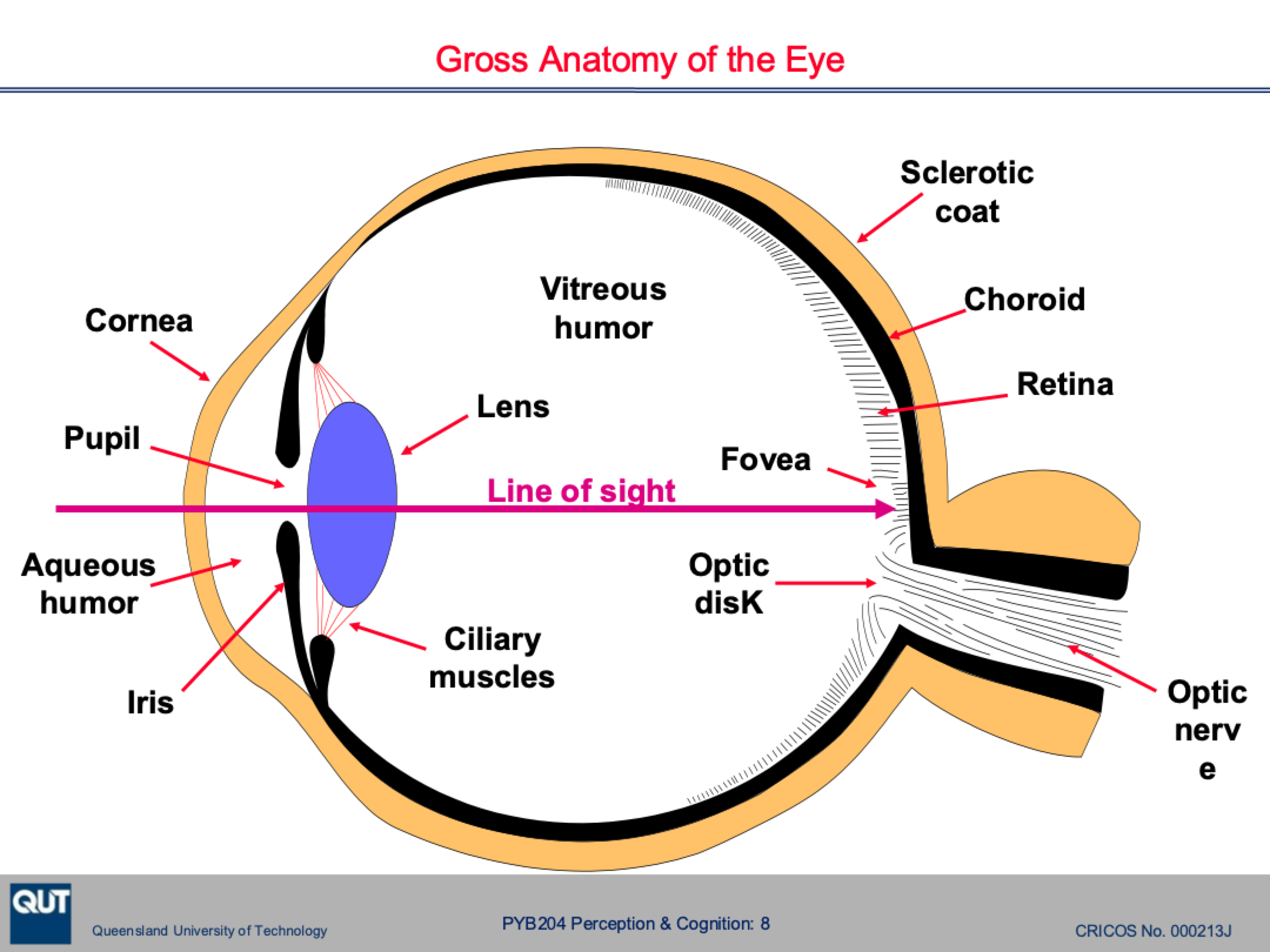
Anatomy of the eye
Ciliary muscles = control the contraction of the pupil to allow or prevent light coming through
Lens = focuses the information on the back of the eye for processing by photoreceptors
Fovea = the most centre part of your vision - consists of densely packed cones which gives us high visual acuity
Retina = rods which span the back of the eye
Optic disk = where the optic nerve comes into your eye (an unknown blind spot)
What is the role of eye movements (Saccades)
Humans don’t perceive things which are unchanging, so our eyes keep constantly moving in order for us to see things. If an image stays stabilised on the retina it disappears and our brain fills in the missing space.
E.g. star shaped contact lenses - after a few minutes you are no longer able to see the star as your brain fills in what image it thinks should be there
What is accommodation?
When the ciliary muscles control the shape of the lens to accommodate for near or far targets. A rounded lens brings the stimuli in close proximity into focus and blurs the rest, and a flat lens brings the further stimuli into focus and blurs the rest

What is triangulation
The process of locating a point by forming a triangle from two known points. Two eyes converge on a single target and the movement creates a triangle and allows the brain to calculate the distance to the target.
Explain the two kinds of visual parallax
Binocular parallax = when your eyes have two images and we can see the disparity of where objects are
Motion parallax = as you move how does the relative motion of the things in different planes around you change. E.g holding up two fingers at different distances from you, moving your head from side to side the finger further will move slower than the one closer
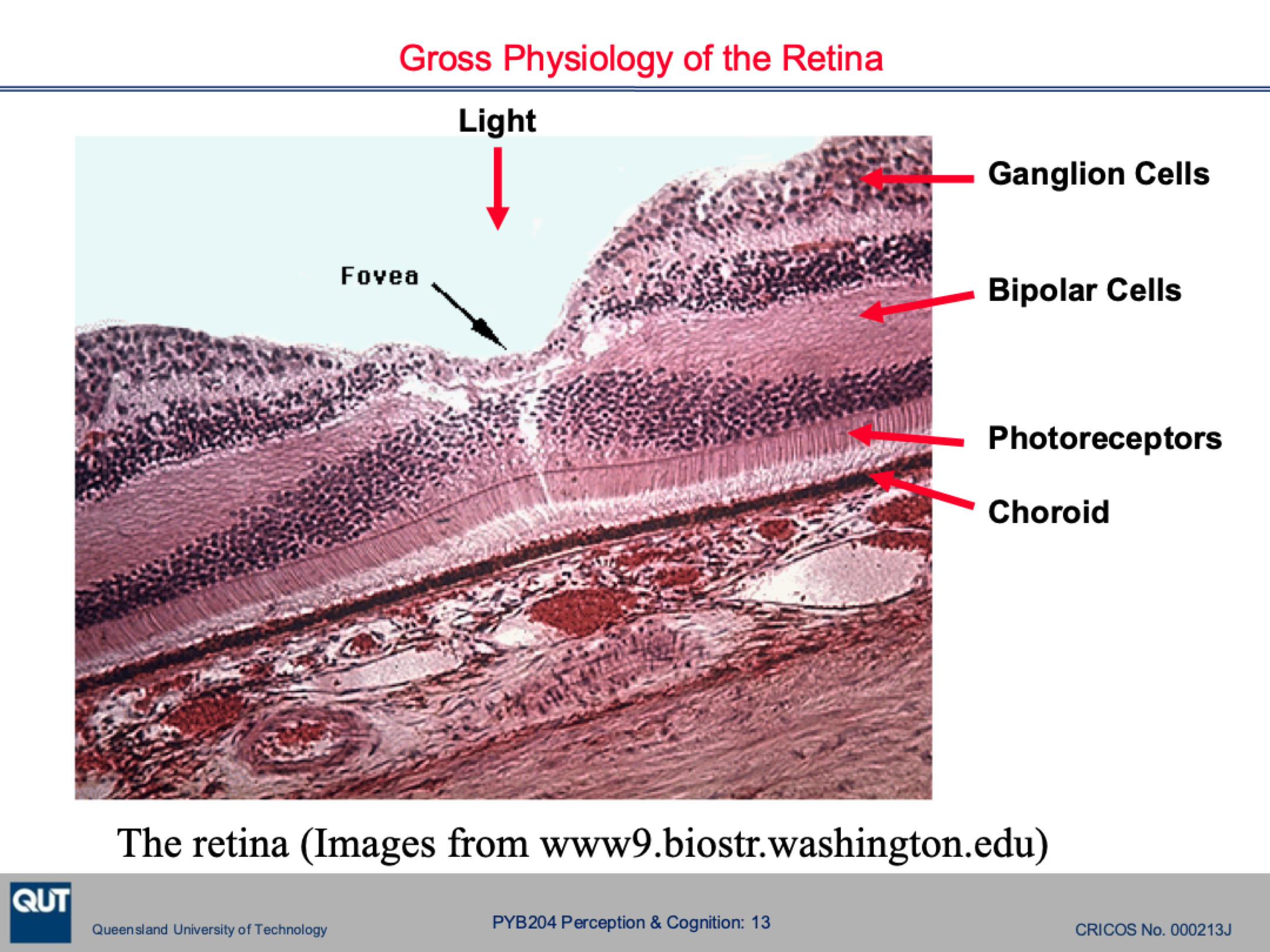
What components is the retina made up of
Ganglion cell layer = the thickest layer and the first true coding and primitive processing of visual information within the eye
Bipolar cells = the middle later made of interconnected cells which process the information from the photoreceptors
Rods = spread out photoreceptors
Choroid = absorbs most of the light and reflects just enough light back to the photoreceptors to activate them
Explain the role and function of cones
Responsible for coloured vision and active during the day/bright light
Have high acuity - enables us to see very fine detail as the cones are packed densely in the fovea
Explain the role and function of rods
Responsible for black and white vision and active during the night
Have low acuity - responsible for blurry peripheral vision and very sensitive to motion as the rods are widely spaced
What is the process of information processing in the retina
Receptor cells capture photons to initiate action potentials —> synapse with bipolar cells —> transmit info to ganglion cells —> ganglion cell axons form the optic nerve and carries the signal to the brain
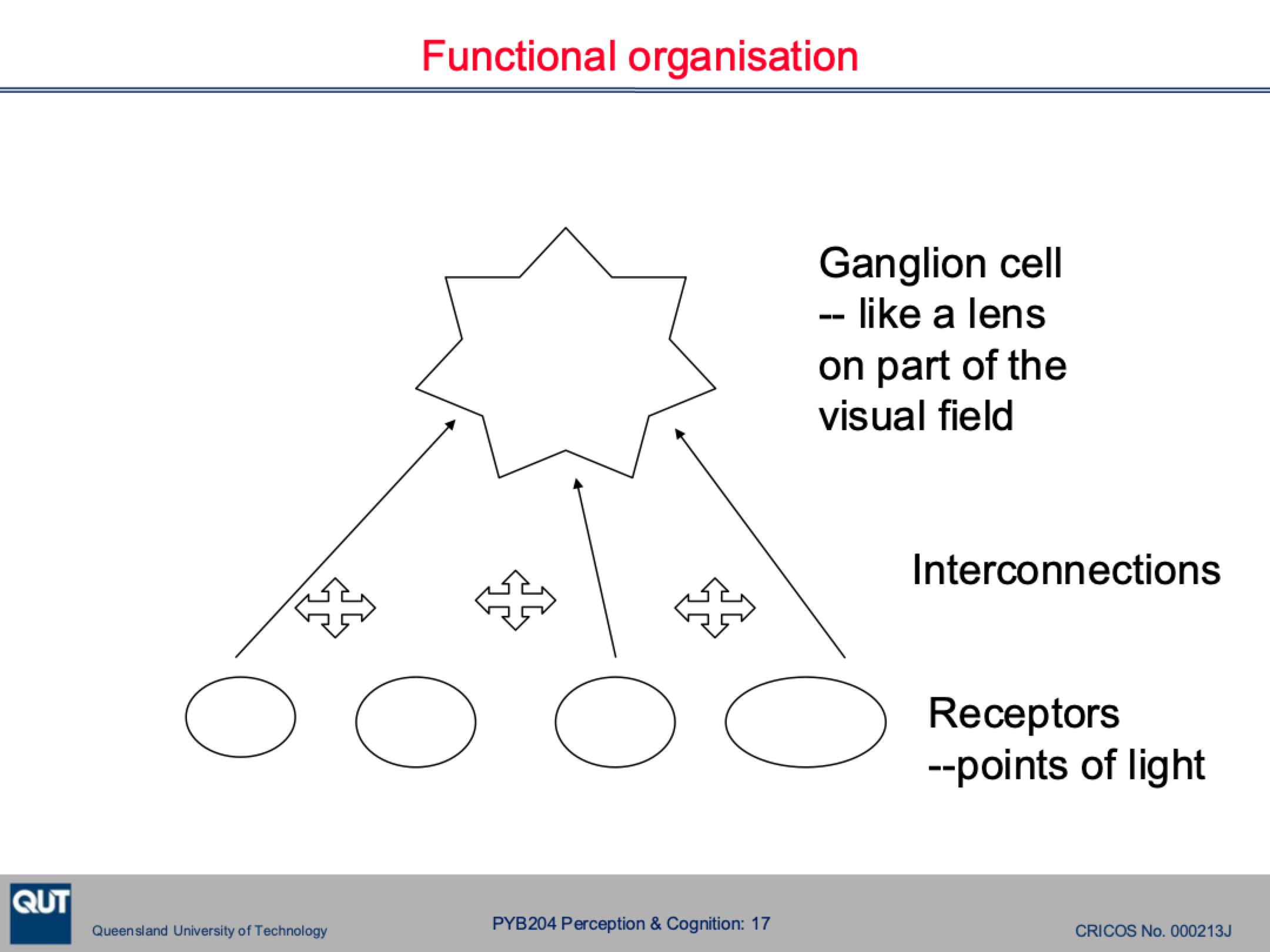
What is the functional organisation of the ganglion cell layer?
Acts like a lens, capturing an image over an area of the retina (receptive field). The ganglion can also enhance the image in its own local area.
Explain the passage of the visual signal
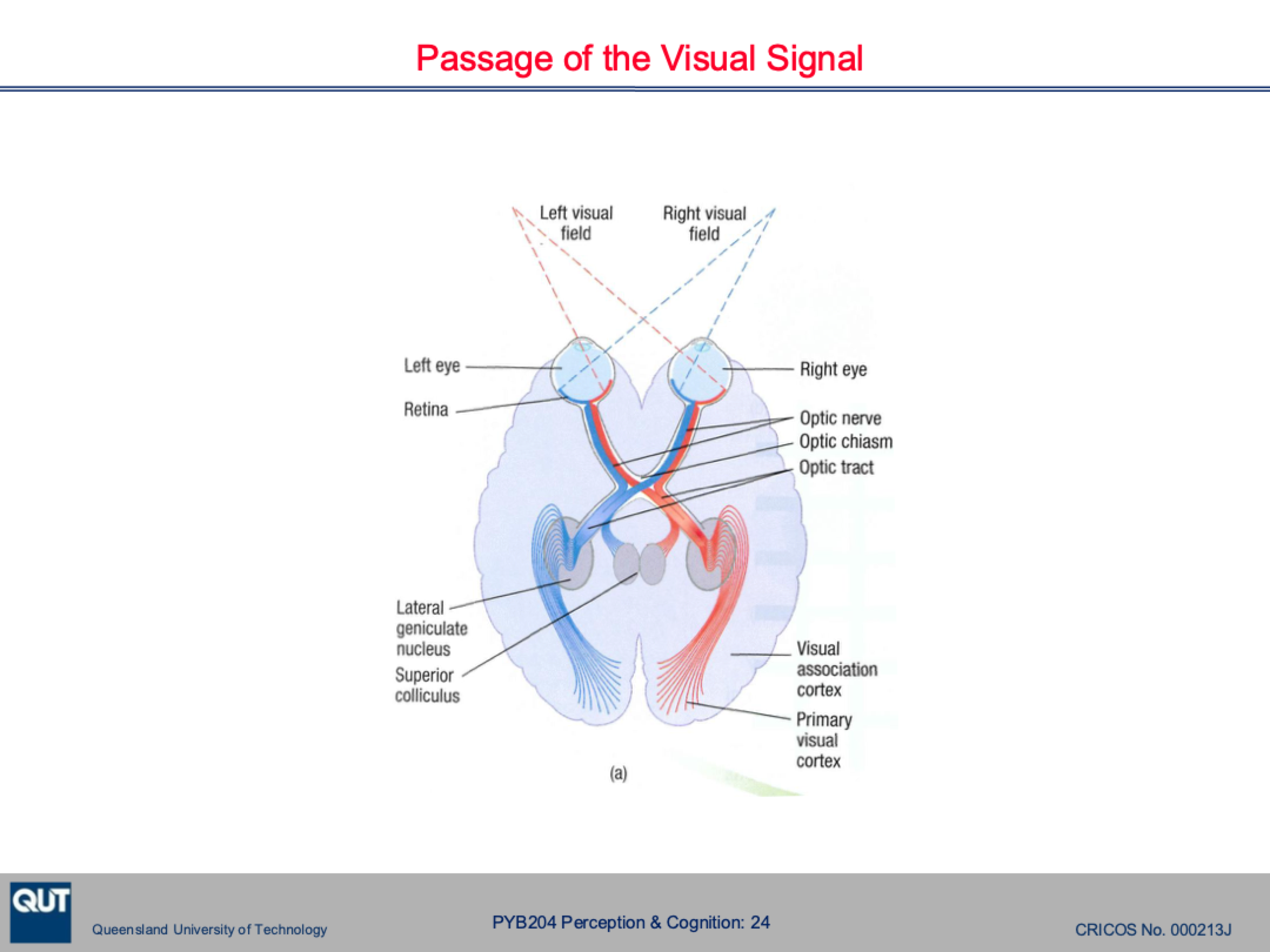
Visual information crosses the optic chasm (the criss cross)
Information from each eye then arrives at the lateral geniculate nucleus of the thalamus
The visual information is projected to the occipital cortex
Explain the tectopulvinar system
An old system which seems to serve several functions:
Localisation of objects
Guidance of eye movements
Gross pattern perception (identify large patters and respond to them quickly e.g. ducking before realising something was flying at you)
Schneider (1969)
Removed the LGN from some hamsters and the superior colliculi from others
Found that:
No LGN = unable to recognise patterns
No superior colliculi = able to recognise patterns but not able to accurately approach them
Focal system for recognition
Ambient system for localisation
Blindsight (Weiskrantz, 1977, 1992)
Some people with damage to the focal system can still react to visual stimuli although they claim they cannot see them.
E.g. some people with cortical blindness who cannot see anything, but when they’re feeling thirst they reach out to grab their drink and drink it
Name and describe the 3 feature detectors in the Primary Visual Cortex (V1)
Simple cortical cells - these neurons respond to stationary bars of light or dark in a very specific orientation (e.g., a vertical bar)
Complex cortical cells - These respond best to an oriented bar moving across their receptive field. Many of these neurons are also direction-sensitive, firing only when the bar moves in a specific direction (e.g., left-to-right)
Hypercomplex cortical calls - These have the most specific requirements, firing only in response to moving lines of a particular length, moving corners, or moving angles
Explain the directions of the dorsal and ventral streams
Dorsal stream - travels to the parietal lobe and is concerned with motion perception and spatial awareness
Ventral stream - travels to the temporal lobe and is concerned with object recognition
What causes sound and what are its characteristics?
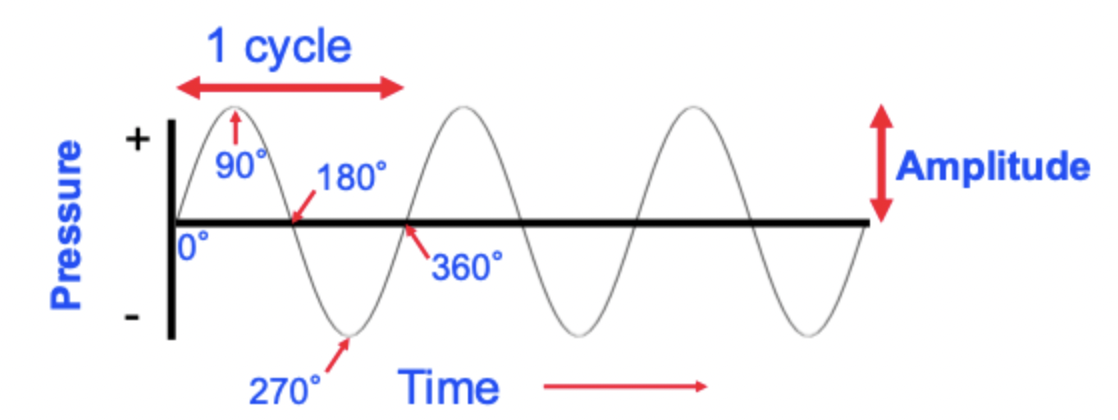
Sound is caused by changes in air pressure waves which are characterised by amplitude (decibels - loudness), frequency (hertz - pitch), and phase (position within a cycle).
What is the human hearing range?
20-20,000 Hz
Human pain threshold 0-120db
What are the characteristics and functions of the outer ear?
Pinna:
Increases the sound amplitude
Helps determine the direction from which a sound is coming
External auditory canal:
provides protection
increases the sound amplitude
Eardrum:
vibrates in response to sound waves
moves bones in the middle ear
What are the characteristics and functions of the middle ear?
Ossicles
malleus
incus
stapes
These are the smallest bones in the human body, and transmit the vibration of the eardrum into the cochlea through lever actions. They also provide protection against high amplitude sounds.
What are the characteristics and functions of the inner ear?
The three cochlea canals - vestibular canal, tympanic canal, and cochlear duct
Cochlea
contains the oval window = membrane covering an opening in the cochlea which is much smaller than the eardrum to help amplify sound waves
filled with watery liquid which moves in response to the vibrations coming from the middle ear
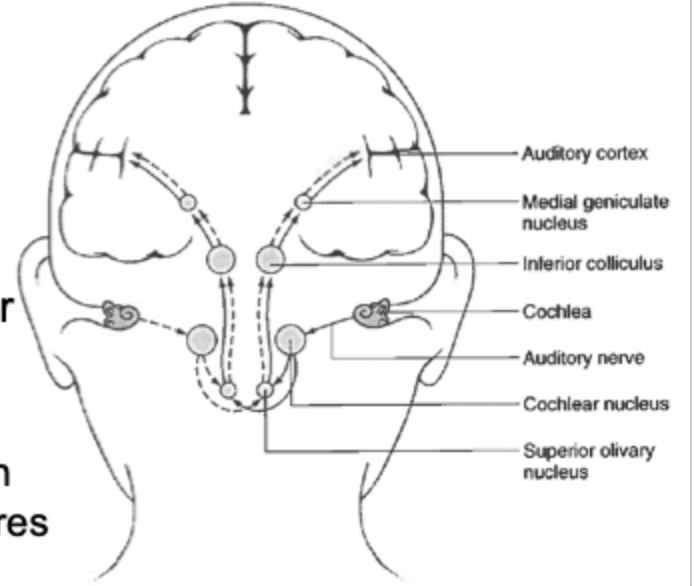
Explain the central auditory pathway
synapses from the cochlea to the cochlear nucleus
Superior olivary nucleus
Inferior colliculus
Medial geniculate nucleus
Auditory cortex
The signal arriving at the cochlear nucleus splits and goes to each of the superior olivary nuclei, beyond this point, input from both ears is present in both hemispheres.
What tasks can and cannot be performed without the auditory cortex being present
Can be performed without:
responding to the onset of sound
responding to changes in sound intensity
responding to changes in sound frequency
Cannot be performed without:
Discriminating the pattern of several tones
Discriminating the duration of sounds
Localising sounds in space
What term describes the lowest frequency component of a complex sound?
The fundamental
Which part of the outer ear assists in determining the direction from which a sound originates?
The pinna
What is the primary function of the eardrum (tympanic membrane)?
To vibrate in response to sound waves and move the middle ear bones
The semicircular canals in the cochlea are essential for which sensory function?
Vestibular sense (orientation)
What is a tonotopic map?
An orderly arrangement of neurons based on their frequency sensitivity
What term refers to the minimum intensity of a stimulus that can be detected by a perceiver?
The absolute threshold
What term describes the smallest change in a stimulus that a person can detect?
The difference threshold (also known as the Just Noticeable Difference or JND)
What methodology involves presenting a pre-determined set of stimuli ranging in magnitude multiple times in a random order?
The method of constant stimuli
Which measurement procedure uses ascending and descending series of trials to find a threshold?
The method of limits
Which procedure involves changing stimulus intensity based on the participant's previous response until a reversal occurs?
Staircase procedure
What is the role of hair cells on the Basilar membrane?
When the basilar membrane vibrates, hair cells are also set in motion which convert the vibrations into neural signals.
The constant ratio between the JND and the intensity of a reference stimulus is called the ____
Weber fraction
What is formula for Fechner’s law
S = k log i
What is formula for Webers law?
JND / physical intensity of a reference stimulus = k (constant)
What are the four possible outcomes of a decision trial in SDT, and how is a Correct Rejection defined?
Hit: Signal is present, and the observer says "Yes".
Miss: Signal is present, and the observer says "No".
False Alarm: Signal is absent, and the observer says "Yes".
Correct Rejection: Signal is absent, and the observer says "No" (correctly stating that no signal was present when there was only noise)
What is d-prime and what does it mean if the Noise and Signal + Noise distributions are very far apart?
D-prime is the measure of an observers physical sensitivity to a stimulus. If the noise and signal + noise distributions are very far apart, the observer has high sensitivity (a high d-prime). This means the signal is highly distinguishable from the noise, making the detection task much easier.
Visual agnosia is typically caused by damage to which cortical pathway?
The ventral pathway
What is Optic Ataxia
The inability to use visual information to guide motor actions (e.g. reading or putting an object into a slot)
What is visual agnosia?
The inability to recognise objects despite having undamaged basic visual pathways (colour, shape, motion).
How does the case of Patient DF demonstrate a "double dissociation" between the ventral and dorsal visual pathways?
Patient DF suffered from severe visual agnosia due to ventral pathway damage. While her basic visual acuity and non-visual object recognition remained fully intact, she could not identify objects by sight. However, she could still accurately grasp and interact with objects. This proved that object recognition and visually guided action are controlled by two separate, independent streams in the brain.
What process does face perception require, and how did "Larry's nose/house" experiment demonstrate this cognitive process?
Face perception requires holistic processing (processing the whole face configuration together, rather than as a collection of individual features).
In the experiment, participants recognised Larry's facial features (like his nose) significantly better when presented within his whole face than in isolation.
However, house features (like a door) were recognised equally well whether shown alone or within the whole house, proving face recognition is uniquely holistic
List and define the four Gestalt principles
Similarity: We group elements together that share physical characteristics (such as shape or colour).
Closure: We tend to fill in missing gaps in a visual pattern to perceive a complete, enclosed object.
Good Continuation: We group elements together that follow a smooth, continuous path or line.
Proximity: We group elements together that are physically close to one another
What is the core mechanism of the Template-Matching Model in pattern recognition, and what is its main limitation?
We compare incoming sensory inputs directly against exact stored mental templates (literal miniature representations). Its main limitation is that it is highly inflexible; it fails to explain how we easily recognise superficial variations of the same object, such as different hand-written styles of the letter "A"
What is the core premise of Feature Analysis (specifically Selfridge's Pandemonium Model), and what visual phenomenon supports it?
Proposes that a visual pattern is perceived as a combination of elemental features (like lines, curves, and angles) which are processed hierarchically.
E.g. when an image is artificially stabilised on the retina, whole features (like an entire vertical bar) disappear simultaneously, demonstrating that the brain represents visual patterns as discrete feature units
What is Biederman's Recognition-by-Components (RBC) theory, and what experimental finding supports it?
It proposes that 3D objects are first segmented into a set of basic volumetric sub-objects called geons, and then recognised based on their spatial arrangement. This is supported by findings showing that objects with midsegment deletions (preserving vertices/corners to identify geon intersections) are recognised far more accurately than objects with component deletions (where entire geons or parts are missing)
How does neural selectivity change as visual signals travel from the retina to the Inferotemporal (TE) cortex?
Neurons respond to increasingly complex patterns:
Retina & LGN: Respond simply to spots of light (using center-surround receptive fields).
V1 (Primary Visual Cortex): Act as feature detectors, responding to oriented bars, moving lines, and corners.
V4: Respond to geometric shapes, concentric circles, radial patterns, and colour.
Inferotemporal (TE) Cortex: Respond to highly complex patterns and faces
Grandmother Cell Hypothesis vs. Ensemble Coding
Grandmother Cell Hypothesis: Proposes that the final perception of a specific object/face is coded by a single specialised neuron. Weaknesses: High vulnerability to cell death, unreliable firing rates, and inability to explain novel object perception or recognition flexibility.
Ensemble Coding: Proposes that object recognition results from the collective, simultaneous firing pattern of a distributed network (ensemble) of cells
What is the difference between Bottom-Up and Top-Down processing?
Bottom-Up Processing: Sensory- or stimulus-driven processing that travels from our sensor receptors to the brain (e.g. hearing a loud noise and turning your head in the direction of sound)
Top-Down Processing: Information processing which starts in the brain with memories or prior knowledge to interpret incoming stimuli (e.g. walking around your dark house at night easily because you know where your furniture is)
What is the Word-Superiority Effect, and how does it demonstrate top-down processing?
It is the phenomenon where individual letters (e.g., "D") are recognised more quickly and accurately when presented within a meaningful word context (e.g., "WORD") than when presented alone ("D") or within an ungrammatical non-word context (e.g., "WORK"). This demonstrates top-down processing because higher-level semantic/lexical knowledge actively influences the recognition of lower-level visual features
What is the Phoneme-Restoration Effect, and how does it demonstrate top-down auditory perception?
It is an auditory phenomenonwhere the brain "hears" a missing or covered speech sound in a word because the surrounding context makes sense.Observers report hearing the complete, intact word and are typically unable to accurately locate where the tone occurred, demonstrating that higher-level knowledge about vocabulary and grammar tells the lower-level auditory system what sound is missing.
What is the function and role of horizontal and amacrine cells in the retina?
Horizontal cells connect adjacent photoreceptors or bipolar cells, while amacrine cells link adjacent bipolar or ganglion cells —> this lateral communication enables lateral inhibition, which actively suppresses adjacent neural responses to sharpen edges, outline boundaries, and enhance image contrast