Chapter 22: The Chemistry of Enolate Ions, Enols, and α, β-Unsaturated Carbonyl Compounds
 Call Kai
 Learn
Learn Practice Test
 Spaced Repetition
 Match
Match Flashcards
 Knowt Play
1/87

There's no tags or description
Looks like no tags are added yet.
Name | Mastery | Learn | Test | Matching | Spaced | Call with Kai | Chat |
|---|
No analytics yet
Send a link to your students to track their progress
88 Terms
Ester → (more/less) acidic and (more/less) stable enolate ions than ketones.
less, less
Enolate formation from ketones and esters is favored in the presence of…
sterically hindered strong non-nucleophilic bases such as LDA
The N—H of primary and secondary amides is (more/less) acidic than the α-H on an α-carbon.
more
Order the acidic strength of these from strong to weak:
aldehydes, amides, carboxylic acids, esters, ketones
carboxylic acids > amides > aldehydes/ketones > esters
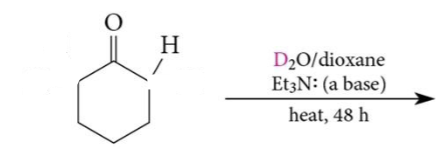
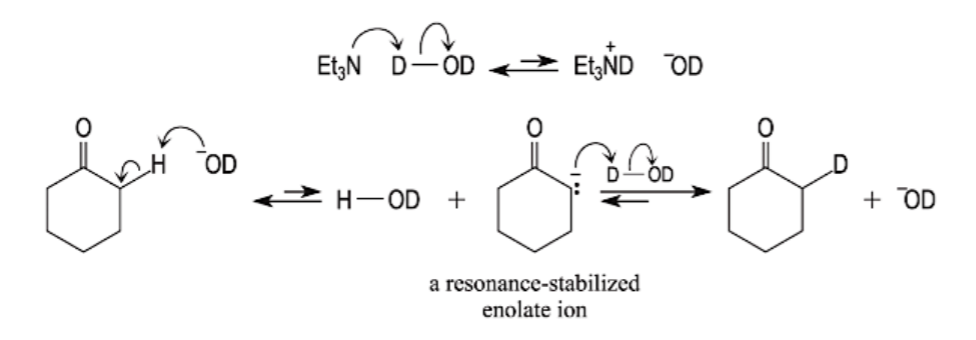
draw the mechanism for the exchange of α-H for D in basic conditions
What kinds of enolates are racemized by base?
enolates with asymmetric α-carbons
enol
any compound where a —OH group is on an α-carbon of a C=C
β-dicarbonyl compounds are more stable in the enol form due to…
intramolecular hydrogen bonding and resonance
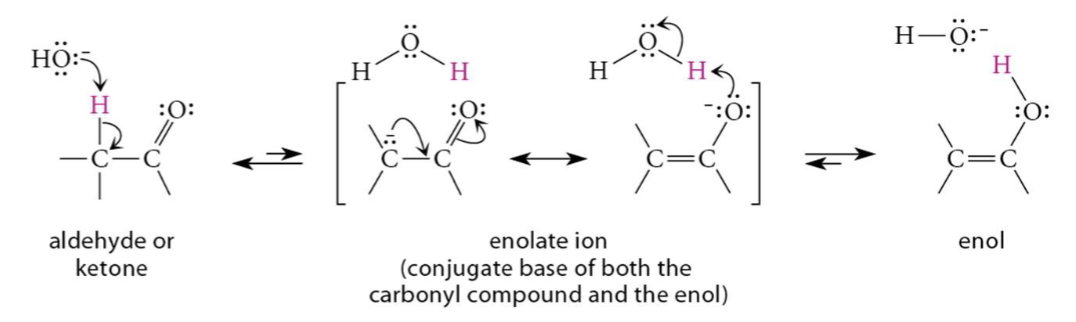
draw the mechanism for base-catalyzed enolization
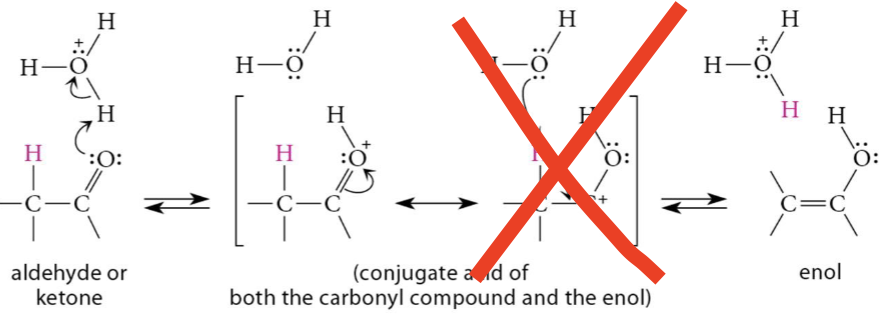
draw the mechanism for acid-catalyzed enolization
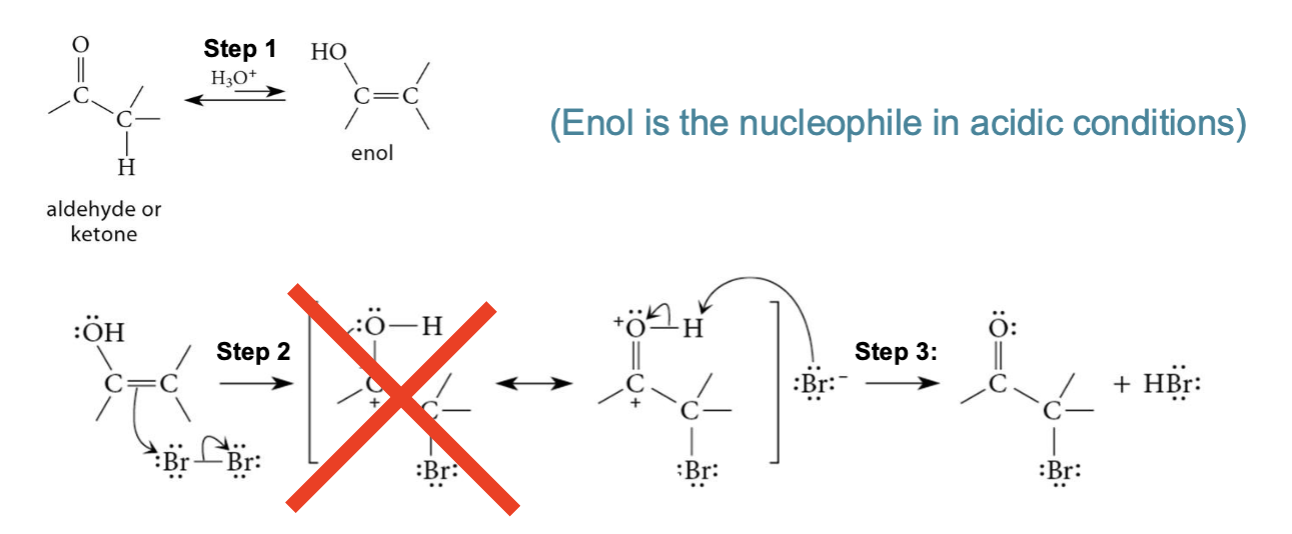
What is the reagent used for α-halogenation of ketones in acidic conditions?
X2, CH3COOH
What is the reagent used for α-halogenation of ketones in basic conditions?
X2, NaOH
In α-halogenation of ketones in acidic conditions, only _____ occurs.
monohalogenation
show the mechanism for α-halogenation of ketones in acidic conditions
In α-halogenation of ketones in basic conditions, only _____ occurs.
polysubstitution
Why does polysubstitution result from α-halogenation of ketones in basic conditions?
increased reactivity of mono-bromo compounds towards the base
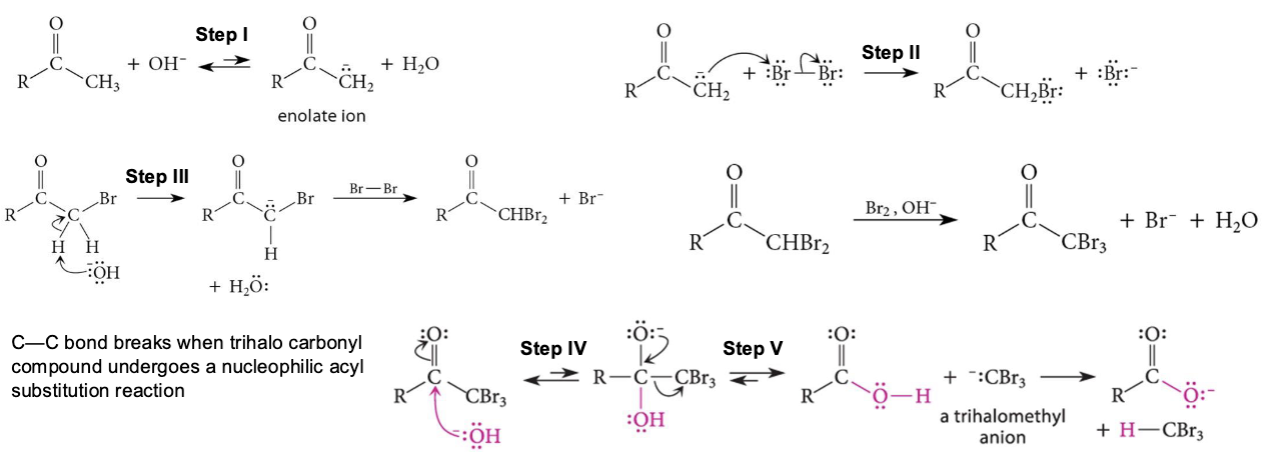
haloform reaction
when methyl ketone is used in base catalyzed α-halogenation of ketones, a carboxylic acid and haloform (HCX3) are formed
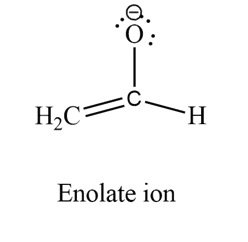
draw what the enolate ion will look like on the final
draw the mechanism for the haloform reaction
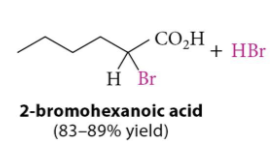
What does the Hell-Volhard-Zelinsky (HVZ) reaction do?
α-bromination of carboxylic acids
What reagent is used in the Hell-Volhard-Zelinsky (HVZ) reaction?
Br2, P or PBr3
What must the carboxylic acid have in order to do the Hell-Volhard-Zelinsky (HVZ) reaction?
an α-hydrogen
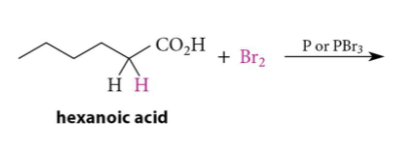
solve
Rates of SN2 rxn in α-halo carbonyl compounds are much (faster/slower) than alkyl halides.
faster
Do α-halo carbonyl compounds undergo SN1 rxns?
no
Do α-halo carbonyl compounds undergo SN2 rxns?
yes, very quickly
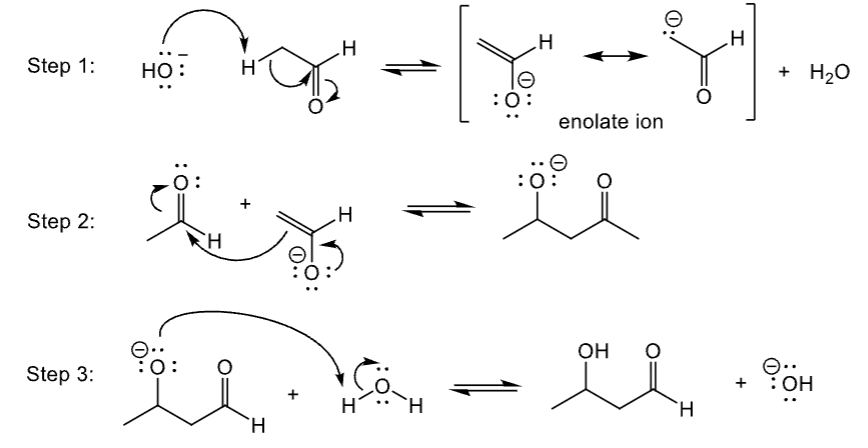
What happens in an aldol reaction?
an enol or enolate ion acts as a nucleophile and adds to the carbonyl carbon of an aldehyde or ketone
draw the mechanism for base-catalyzed aldol addition reaction
Aldol reaction consists of ____ and ____.
addition, condensation
Aldol addition is (reversible/irreversible).
reversible
Equilibrium for aldol addition is more favorable for aldehydes or ketones?
aldehydes
What is aldol condensation?
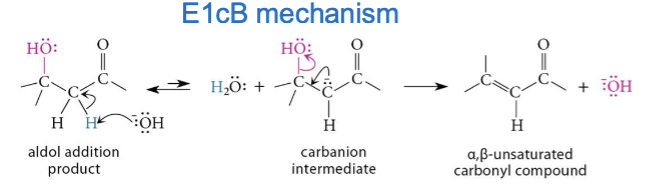
aldol addition followed by elimination
What is the mechanism called for the elimination in aldol condensation?
E1cB (conj base)
draw the mechanism for base-catalyzed aldol condensation reaction
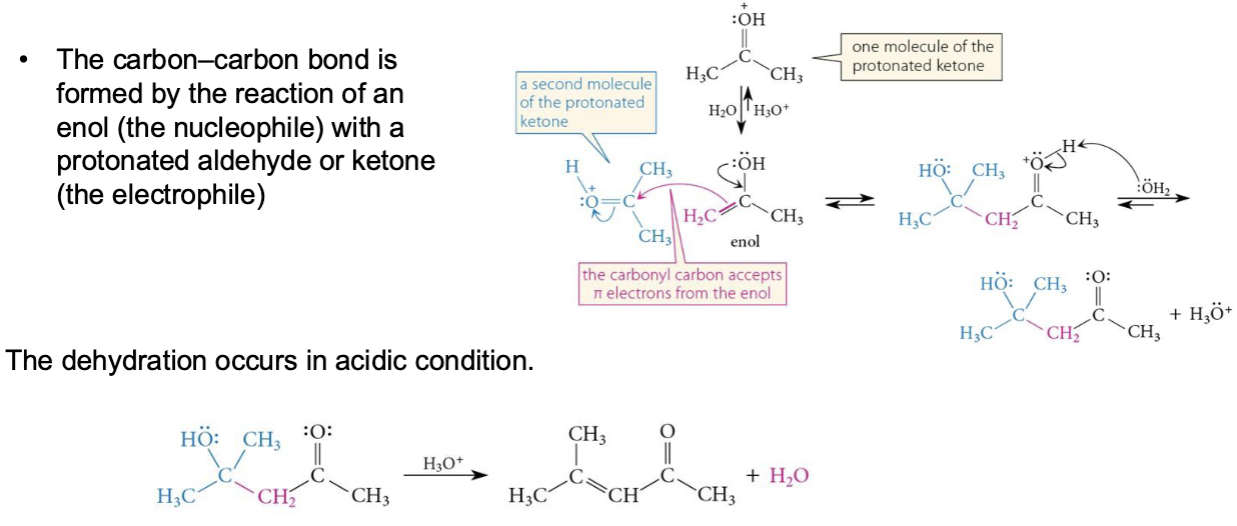
What do acid-catalyzed aldol reactions produce?
condensation products;
α,β-unsaturated aldehydes or ketones
draw the mechanism for acid-catalyzed aldol condensation reaction
Intramolecular aldol reactions result in _____ formation.
ring
Intramolecular aldol reactions are favorable for the formation of 5- and 6-membered rings due to…
proximity effect
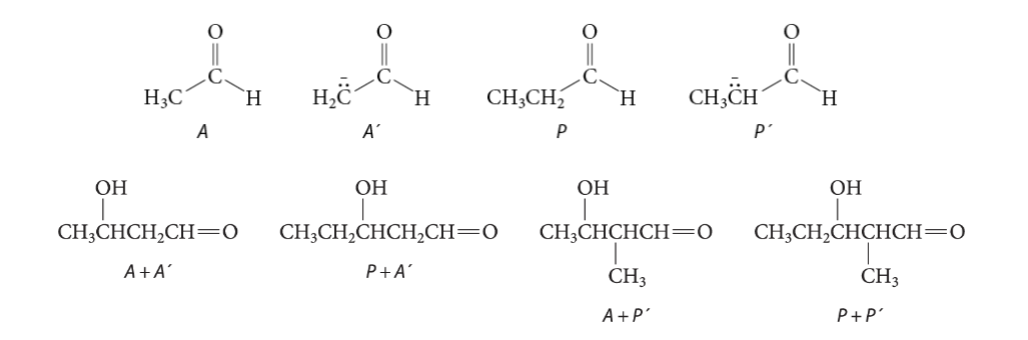
Cross aldol reactions involve…
two different enolizable carbonyl compounds that produce a mixture of products
How many products can A and P give for a crossed aldol reaction?
4;
A + A’,
P + A’,
A + P’,
P + P’
Claisen-Schmidt condensation
crossed aldol condensation that uses reactants chosen to limit the number of possible products
How does the Claisen-Schmidt crossed aldol condensation limit the number of possible products?
by using a carbonyl compound with no α-hydrogens
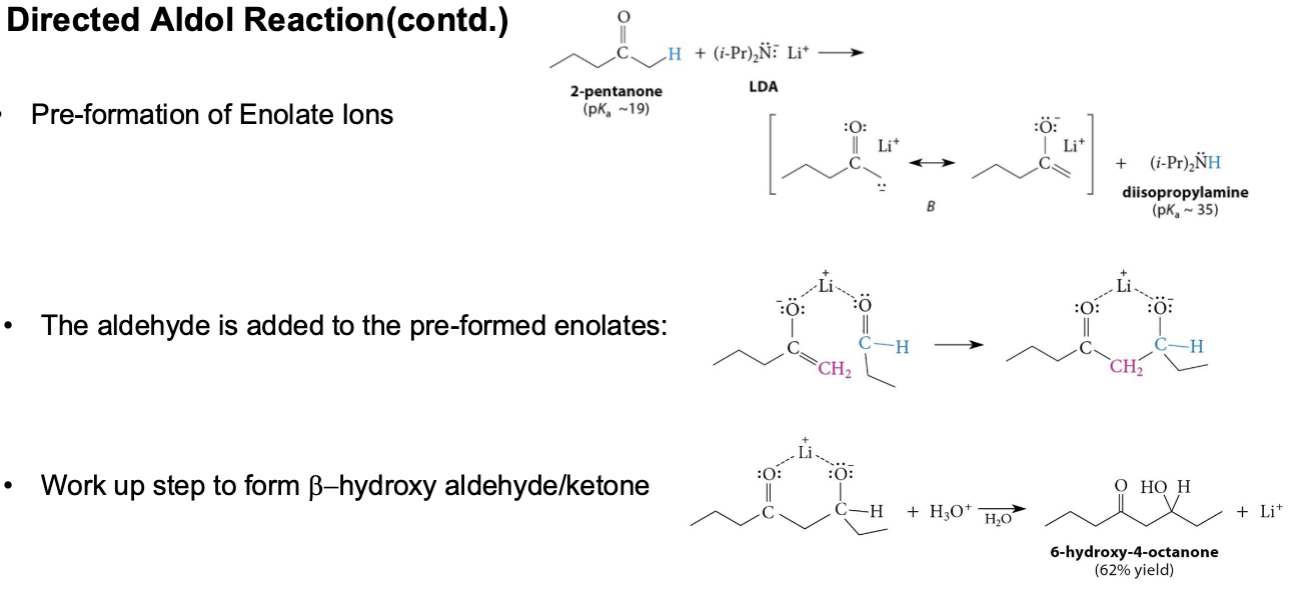
What happens in a directed aldol reaction?
a strong base is used to generate the enolate of a carbonyl compound in a separate step;
the preformed enolate reacts with an aldehyde or ketone to make a crossed aldol product
What reagent is used in a directed aldol reaction?
LDA, THF
(-78ºC)
In directed aldol reaction, unsymmetrical ketones can form…
two different enolates, kinetic enolate B and thermodynamic enolate A

What does LDA do?
forms enolate ions rapidly and irreversibly from ketones at -78ºC
What enolate formation does LDA favor?
kinetic enolate formation
draw the mechanism for directed aldol reaction
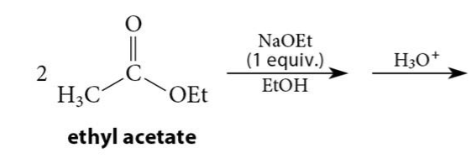
What is a Claisen condensation and what does it do?
reaction between an ester enolate and an ester that forms a β-keto ester via nucleophilic acyl substitution
What is matched to the ester alkoxy group in a Claisen condensation to avoid transesterification?
alkoxide base and alcohol solvent
What is the reagent used in the Claisen condensation?
NaOEt (slightly more than 1 equivalent), EtOH
H3O+ (workup)
Dieckmann condensation reaction
intramolecular version of the Claisen condensation reaction
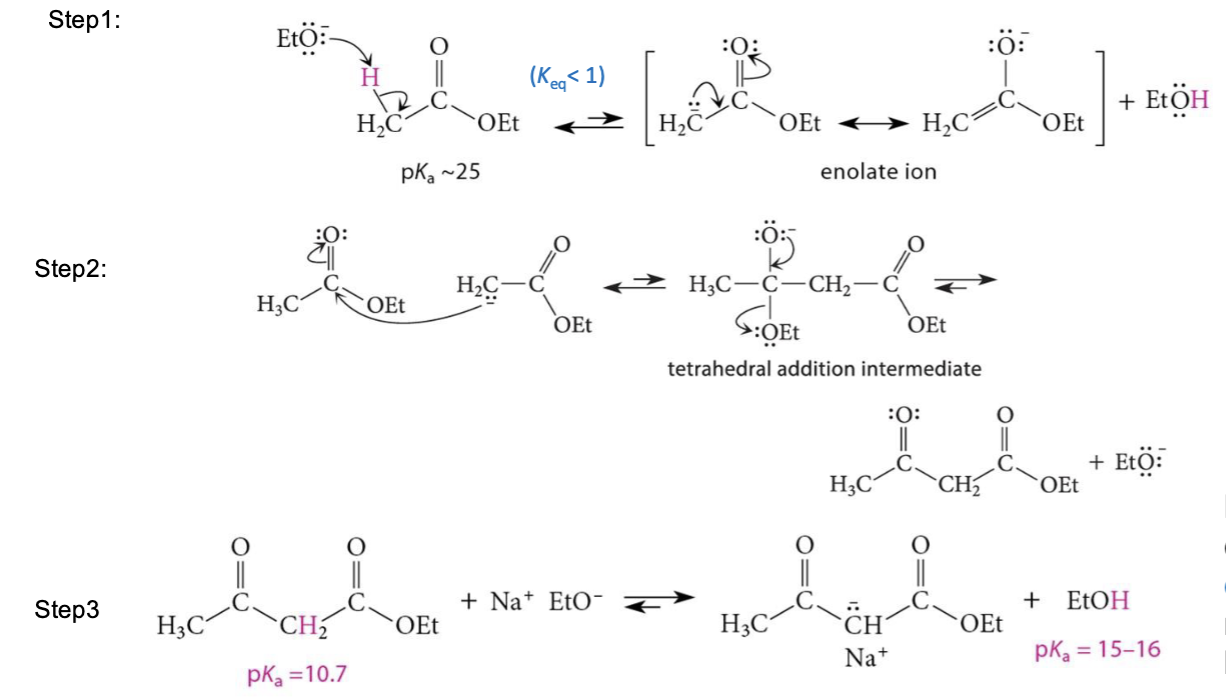
draw the mechanism for the Claisen condensation mechanism
What is required for a Claisen condensation reaction?
2 α-hydrogens
Why is no product observed when no α-hydrogens are present in a Claisen condensation reaction?
the final deprotonation step would not be able to occur and equilibrium would favor the reactants → reverts the reaction to the starting materials
What is the difference between aldol condensation and Claisen condensation?
Aldol:
1. addition rxn of enolate w aldehyde/ketone + dehydration
2. catalyzed by both acid and base
3. aldol addition requires only 1 α-hydrogen
Claisen:
1. nucleophilic acyl substitution rxn of enolate w ester
2. requires full equivalent of base (not acid catalyzed)
3. requires 2 α-hydrogens
Crossed Claisen condensation reaction
Claisen condensation with two different esters
When is the crossed Claisen condensation reaction most useful?
if one ester is especially reactive or has no α-hydrogens
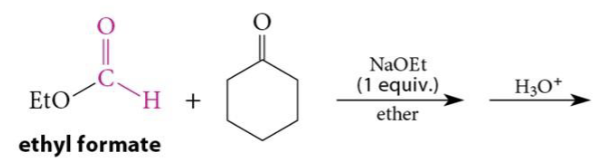
What is the product of this crossed Claisen condensation reaction of ketones with esters?
β-diketone
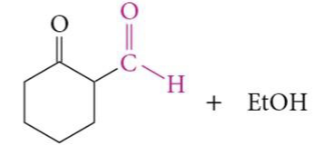
Alkylation of β-diesters leads to form…
a new C—C bond
How do you turn a malonic acid into carboxylic acids?
NaOH, H2O
H3O+
heat
draw the mechanism for forming a ketone from β-keto esters
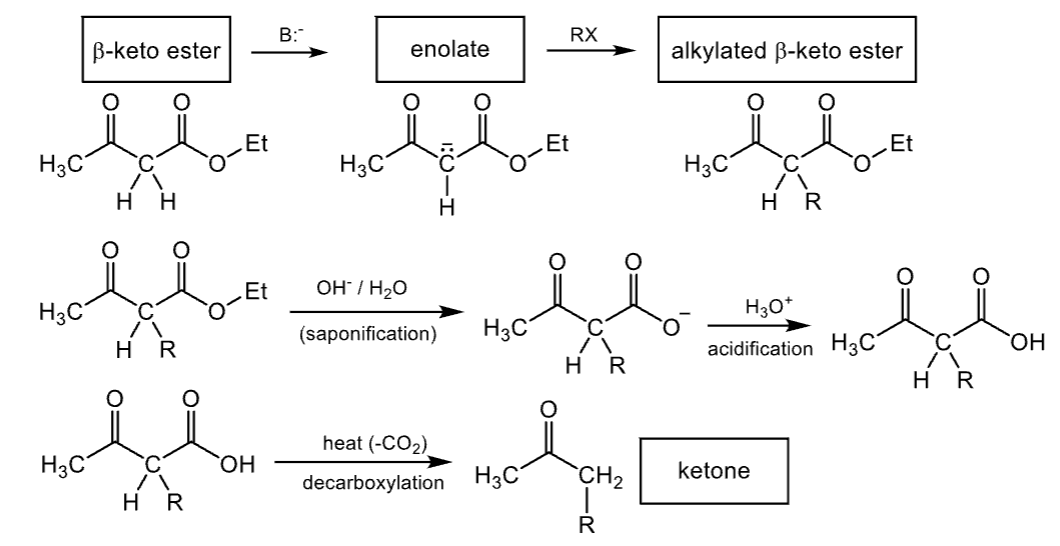
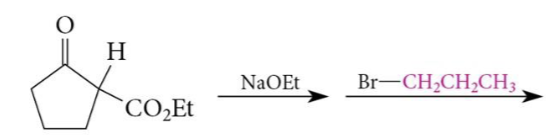
solve
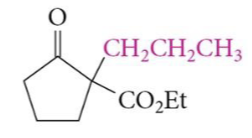
Reformatsky reaction
an enolate is formed by the reaction of powdered Zn with an α-bromo ester
Knoevenagel condensation reaction
aldol condensation reaction of malonic ester, acetoacetic ester, and a relatively acidic carbonyl compound
Alkenes that are conjugated with carbonyls are generally called…
α,β-unsaturated carbonyl compounds
Strongly basic nucleophiles (RLi, RMgX, LiAlH4) react rapidly and irreversibly at the _____.
carbonyl carbon
Less basic nucleophiles (organocuprates, cyanide, enolates) react at the _____.
β-carbon (conjugate addition)
For α,β-unsaturated aldehydes and ketones, nucleophiles that undergo reversible carbonyl addition tend to favor…
conjugate addition
draw the mechanism for addition of HCN to an α,β carbonyl compound
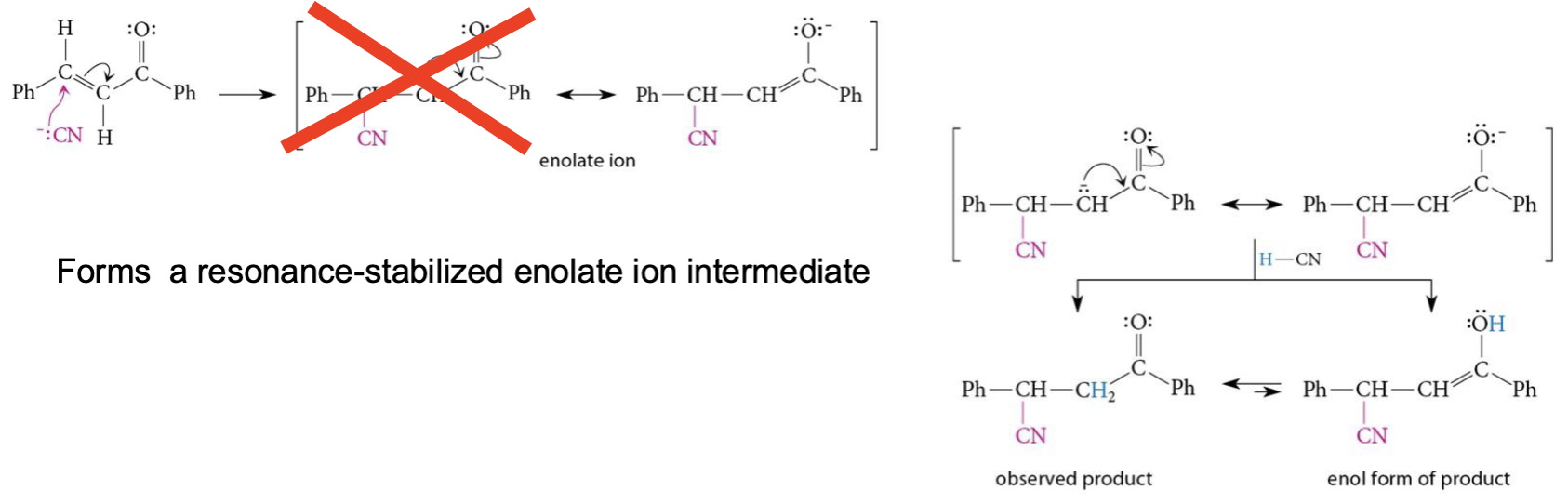
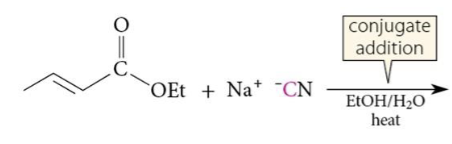
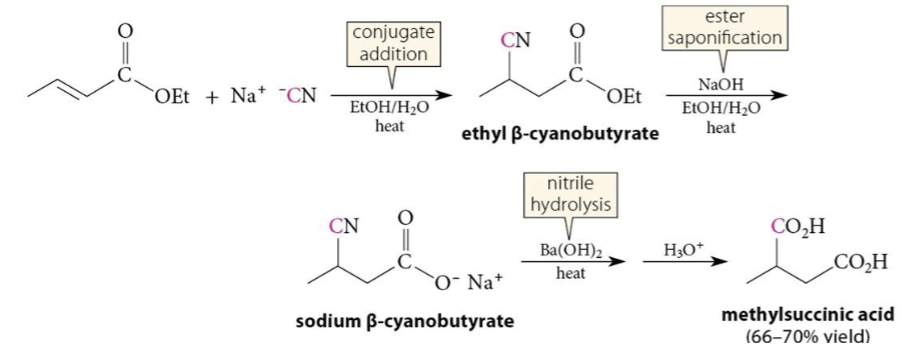
solve conjugate addition with α,β-unsaturated esters
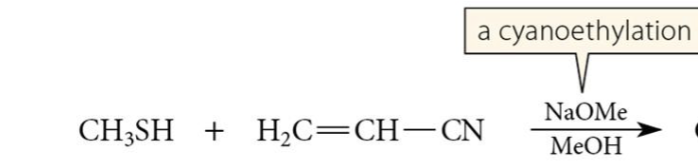
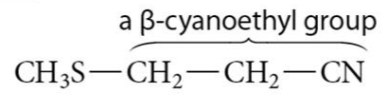
solve conjugate addition with α,β-unsaturated nitriles
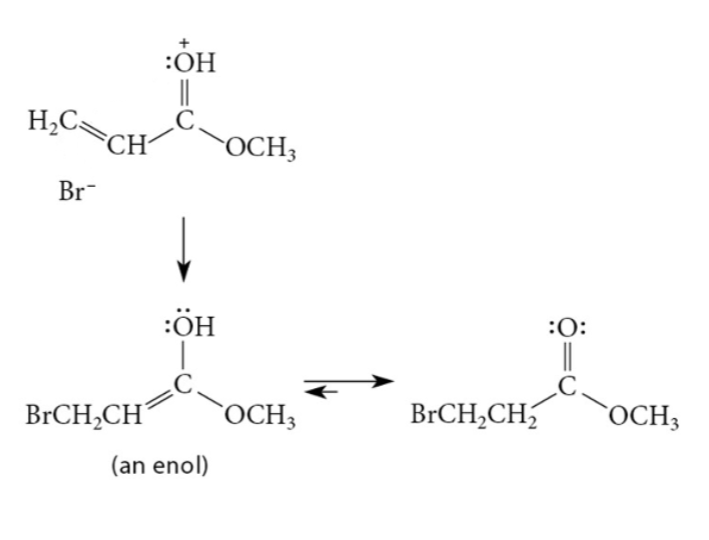
draw the mechanism of acid-catalyzed conjugate addition to α,β carbonyl compounds
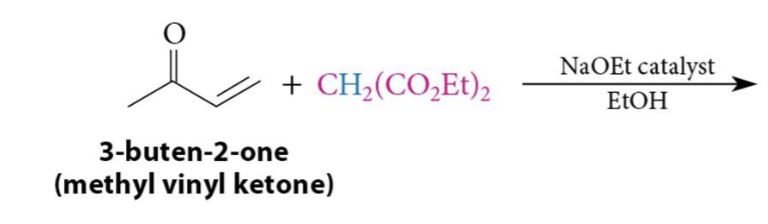
Michael additions
conjugate additions of stabilized enolates to α,β-unsaturated carbonyl compounds
What are Michael additions common for?
enolate ions derived from malonic ester derivatives and β-keto esters
solve
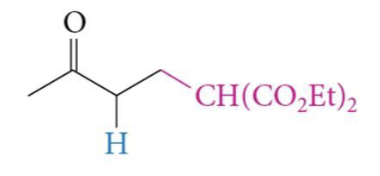
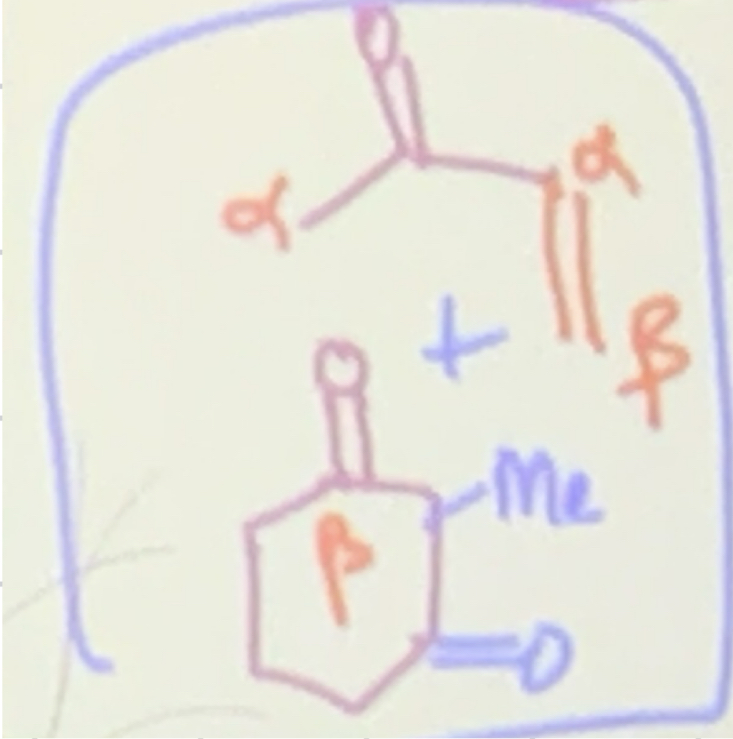
Robinson annulation
Michael addition followed by an intramolecular aldol condensation to form a 6-membered ring;
often yields cyclohexanone derivatives
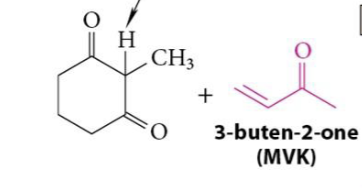
solve using Robinson annulation
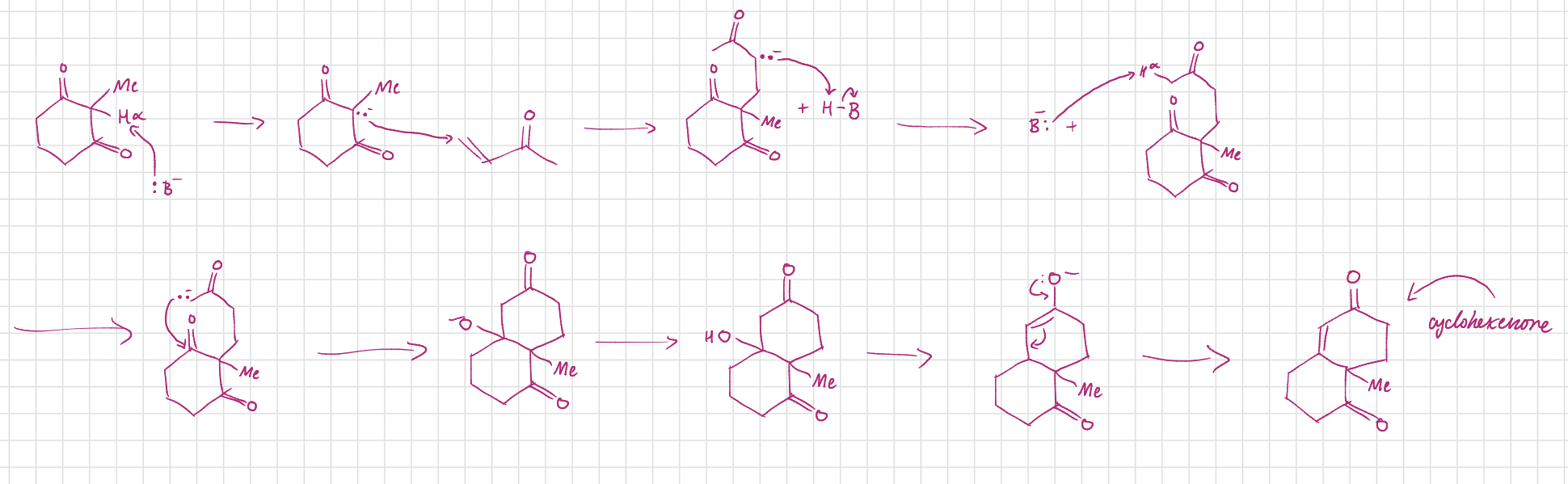
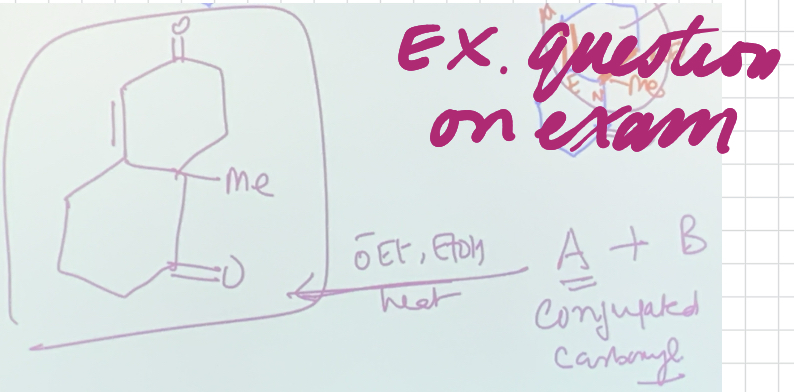
solve
Carbonyl reduction is (faster/slower) than conjugate addition and is (reversible/irreversible).
faster, irreversible
Reduction of α,β-unsaturated carbonyls occurs under (thermodynamic/kinetic) control.
kinetic
What reagent can reduce α,β-unsaturated ketones?
NaBH4, MeOH
The C=C of α,β-unsaturated carbonyls can be selectively reduced by…
catalytic hydrogenation
Organolithium reagents (RLi) and Grignard reagents (RMgX) react with α,β-unsaturated carbonyl compounds at the…
carbonyl carbon
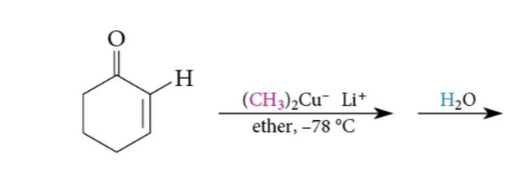
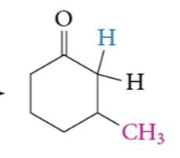
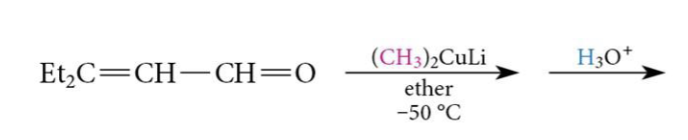
What do lithium dialkylcuprates (R2CuLi) do to α,β-unsaturated carbonyl compounds?
they undergo conjugate addition and introduce an alkyl group at the β-carbon and retaining the carbonyl group in the product
solve
solve
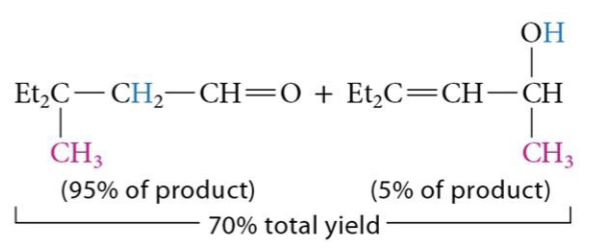
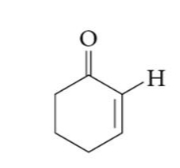
draw the mechanism for addition of lithium dialkylcuprate reagents to this structure
