Chem 14C Exam 2
 Call Kai
 Learn
Learn Practice Test
 Spaced Repetition
 Match
Match Flashcards
 Knowt Play
1/48

There's no tags or description
Looks like no tags are added yet.
Name | Mastery | Learn | Test | Matching | Spaced | Call with Kai | Chat |
|---|
No analytics yet
Send a link to your students to track their progress
49 Terms
What must happen for a vibration to appear in an IR spectrum?
The vibration must change the dipole moment
How do you distinguish an alcohol from a carboxylic acid in IR?
Alcohol: broad O-H (3200-3600) Carboxylic Acid: Very broad O-H (2500-3300), Carbonyl (~1700)
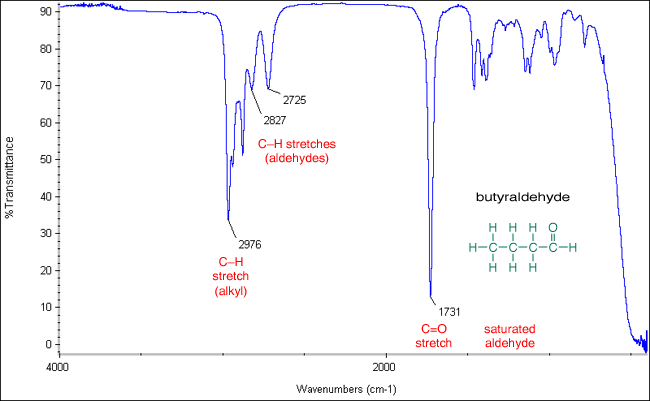
How can you distinguish an aldehyde from a ketone by IR?
Aldehyde has weak C–H stretches at 2720 & 2820 cm⁻¹.
What happens to the carbonyl IR frequency when conjugation increases?
It shifts to lower wavenumber because resonance weakens the C=O bond.
Why are O–H peaks broad?
Hydrogen bonding creates a range of O–H bond strengths.
Primary vs secondary vs tertiary amines in IR?
Primary → 2 N–H peaks
Secondary → 1 N–H peak
Tertiary → 0 N–H peaks
What does an odd molecular ion mass indicate?
An odd number of nitrogens.
What causes the M+1 peak?
Mainly one ¹³C isotope.
Estimate number of carbons from M+1?
%M+1/%M+ x 100 = ans, ans/1.1= # carbons
One chlorine isotope pattern?
M:M+2 = 3:1
One bromine isotope pattern?
M:M+2 = 1:1
Two bromine isotope pattern?
1:2:1
Two chlorine isotope pattern?
9:6:1
How do isotope probabilities combine?
AND → multiply
OR → add
What fragment usually forms in EI mass spec?
The fragment producing the most stable carbocation.
What fragmentation is common for amines and alcohols?
α-cleavage next to the heteroatom.
What does the mass spectrometer detect?
Charged fragments only.
What does GC do?
Separates compounds in a mixture.
What is retention time?
Time required for a compound to exit the GC column.
What does MS determine?
Molecular weight
Fragmentation pattern
Can help determine molecular formula
What is the wavenumber for carbonyl in IR?
1700
What is the wavenumber for aldehyde in IR?
2720 and 2820
What is the wavenumber for alcohol in IR?
3200-3600 (broad)
What is the wavenumber for the O-H in carboxylic acid in IR?
2500-3300 (very broad)
What is the wavenumber for a terminal alkyne?
3300 (sharp)
What is the wavenumber for a C-C triple bond?
2100-2260 (may be weak or absent if symmetric)
What does a D2O exchange confirm?
Exchangeable protons
OH
NH
NH₂
COOH
Peak disappears after adding D₂O because H is replaced by D.
What is the typical chemical shift range for carbonyl in 13C NMR?
~160–220 ppm
What is the typical chemical shift range of aromatics/alkenes in 13C NMR?
~100–160 ppm
What is the typical chemical shift range for C-O carbons in 13C NMR?
~50–90 ppm
What is the typical chemical shift range for alkyl carbons in 13C NMR?
~0–50 ppm
What is an alkyl group?
A saturated carbon group
Are alkynes further upfield or downfield from alkenes?
Upfield. The geometry of the triple bond places the alkyne nucleus in a shielding region of the induced magnetic field
DEPT-135 interpretation?
↑ = CH, CH3
↓ = CH2
missing = C (no H)
Quartet at ~4 ppm + Triplet at ~1.2 ppm
Ethoxy group
CH3CH2O–
CH2 next to oxygen = quartet (~4 ppm)
CH3 = triplet (~1.2 ppm)
Formula has 4 oxygens and 2 DOU. IR shows one carbonyl frequency.
Could there be two identical carbonyl-containing functional groups?
Before interpreting spectra...
Always ask:
Molecular formula
DOU
IR functional groups
Obvious NMR fragments
Symmetry
How do I identify carbon types using Normal ¹³C + DEPT?
1. Normal 13C
→ Every carbon appears.
2. DEPT-90
→ Only CH appears.
3. DEPT-135
↑ CH or CH3
↓ CH2
Missing (but present in normal 13C) = quaternary C
¹³C NMR: Where do carbonyl carbons appear?
Ketones/Aldehydes: 190–220 ppm (ketones often ~205–220)
Esters, acids, amides: 160–185 ppm
Carbonyl carbons are always far downfield because they are highly deshielded.
Geminal vs. Vicinal
Geminal: attached to the same carbon
Vicinal: attached to adjacent carbons
¹H NMR: What does a multiplet at ~7.2 ppm integrating to 5 H indicate?
A monosubstituted benzene ring (C₆H₅–).
What is the relationship between the energy of a photon and its frequency?
Directly proportional
What is the single bond length of a conjugated diene versus a typical single C-C bond?
148 pm vs 153 pm
What is the stabilization energy associated with a conjugated diene?
15 KJ/Mol
Beyond what temperature does the diels alder reaction become unfavorable?
Over 200 degrees C
What is lambda max of butadiene?
217nm
Why is endo the major product in a diels-alder reaction?
Endo places pi containing substituents towards the bridge, which allows secondary orbital interactions in the transition state that lower the activation energy. The endo product is kinetically favored
When asked to find reactants of a diels-alder reaction, how do you number the carbons?
Find the pi bond, that is carbons 2 and 3
What is the pattern of breaking when finding the reactants of a diels-alder reaction?
4 and A and 1 and B