Macronutrients (copy)
 Call Kai
 Learn
Learn Practice Test
 Spaced Repetition
 Match
Match Flashcards
 Knowt Play
1/52

There's no tags or description
Looks like no tags are added yet.
Name | Mastery | Learn | Test | Matching | Spaced | Call with Kai | Chat |
|---|
No analytics yet
Send a link to your students to track their progress
53 Terms
Macronutrients are…
Nutrients needed by the body in large amounts
What are the 3 macronutrients?
Carbohydrates
Protein
Fats
What elements do protein contain?
Carbon (C)
Hydrogen (H)
Oxygen (O)
Nitrogen (N)
Proteins are made up of…
Chains of amino acids
What are essential amino acids?
Amino acids that are needed to keep the human body functioning & healthy
They are not made by the body so they have to be provided by food
HBV proteins are…
Proteins that contain all the essential amino acids
HBV = high biological value
Sources of HBV proteins
- Animal products (e.g. meat, fish, poultry, dairy)
- Soya beans
LBV proteins are…
Proteins that do not contain all the essential amino acids
LBV = low biological value
Sources of LBV proteins
Plant based foods (e.g. peas, beans, pulses, nuts, seeds, cereals)
What is protein complementation / food combining?
Mixing different LBV proteins to provide all the essential amino acids (e.g. dhal & rice can be used together to form a HBV protein)
Vegetarians & vegans rely on this to get essential amino acids as they are limited to most HBV proteins because they are mainly sourced from animal products
Recommended nutrient intake (RNI) for protein
0.75kg per kg of body weight
15% of total energy intake
Pregnant women need an extra 6g per day & breastfeeding women need an extra 8g-11g per day
Functions of protein…
- Growth & repair
- Production of enzymes, haemoglobin, hormones & antibodies
- Some used structurally for hair & nails
- Secondary source of energy
Protein deficiency symptoms…
- Stunted growth
- Poor digestion as enzymes are not produced
- Hair loss
- Problems with the liver & immune system
- Kwashiorkor
What elements do fats contains?
Carbon (C)
Hydrogen (H)
Oxygen (O)
Fats are made up of…
3 fatty acids & glycerol
What are the 2 types of fat?
Saturated fat
Unsaturated fat
Saturated fats are…
Fats where each carbon atom is combined with 2 hydrogen atoms
They are solid at room temperature
Sources of saturated fats
- Fatty cuts of meat
- Dairy products (e.g. milk, butter, cheese, cream)
- Chocolate & confectionery
- Biscuits, cakes & pastries
Unsaturated fats are…
Fats where there is at least 1 carbon atom that is not surrounded by hydrogen
There are 2 types → monounsaturated & polyunsaturated
Monosaturated fats are…
Fats that have 1 hydrogen space available
They are soft at room temperature but will turn solid in the fridge
Sources of monosaturated fats
- Avocados
- Olives & olive oil
- Peanuts
Polyunsaturated fats are…
Fats that have more than 1 hydrogen space available
they are very soft or oily at room temperature & will not turn solid in the fridge
Sources of polyunsaturated fats
- Salmon
- Walnuts
- Flax seeds
- Chia seeds
Which type of fat is considered to be healthier & why?
UNSATURATED FATS because they reduce cholesterol levels which can be built up due to too much saturated fat
Having high cholesterol levels is dangerous as it can cause coronary heart disease which increases the risk of heart attacks & strokes
Hydrogenation is…
The process of adding hydrogen into oil fats to turn them into solid fats
Essential fatty acids (EFAs) are…
The small unit of fat that is needed to keep the human body functioning & healthy
They are not made by the body so they have to be provided by food
2 examples of essential fatty acids
OMEGA 3 → helps to protects the heart, found in oily fish & leafy green vegetables
OMEGA 6 → helps to lower cholesterol, found in fruit, vegetables & grains
Recommended nutrient intake (RNI) for fats
35% or less of total energy intake
Less than 11% should come from saturated fats
Functions of fat…
- Energy source
- Insulation of the body
- Protection of organs
- Helps us to feel satiety after eating (being full)
Fat deficiency symptoms…
- Lack of energy
- Weight loss
- More susceptible to bone & organ damage as the layer of fat protection is thinner
- Less insulation
Consequences of too much fat
- Obesity
- Diabetes type 2
- High cholesterol levels
- Coronary heart disease
- Increased risk of heart attacks & strokes
What are visible & invisible fats?
VISIBLE FATS → fats that can be seen (e.g. butter, the fat on meat)
INVISIBLE FATS → foods containing fat that cannot be seen (e.g. cakes, biscuits, pastries, chocolate)
How can fat intake be reduced in the diet?
- Compare food labels to choose food options that are lower in fat
- Choose reduced-fat dairy products or dairy alternatives
- Grill, bake, poach or steam food instead of frying & roasting
- Choose less fatty cuts of meat & remove any visible fat
- When cooking, use an oil spray or measuring spoons to control the amount of oil you are using
What elements do carbohydrates contain?
Carbon (C)
Hydrogen (H)
Oxygen (O)
Carbohydrates are made up of…
Simple sugars
What are the 2 types of carbohydrate?
Simple carbohydrates
Complex carbohydrates
Simple carbohydrates are…
Carbohydrates made up of small chains of sugars
These can be monosaccharides or diasaccharides
Complex carbohydrates are…
Carbohydrates made up of longer chains of sugars
These are polysaccharides
Monosaccharides are…
1 simple sugar unit
(e.g. glucose, fructose & galactose)
Diasaccharides are…
2 simple sugar units bonded together
(e.g. sucrose, lactose & maltose)
Polysaccharides are…
Multiple sugar units bonded together
(e.g. starch & fiber)
What are the advantages & disadvantages of simple carbohydrates?
- Quick & easy to digest so energy can be provided faster
- They do not fill you up & can cause over overeating
What are the advantages & disadvantages of complex carbohydrates?
- Higher content of nutrients & fibre
- Provides a feeling of satiety which prevents overeating
- Take longer to digest
Sources of simple carbohydrates
- Fruit
- Milk
- Refined sugars (e.g. sweets, syrup, soft drinks, sugar)
Sources of complex carbohydrates
- Pasta
- Rice
- Bread
- Potatoes
Recommended nutrient intake (RNI) of carbohydrates
50% of total energy intake
Functions of carbohydrates…
- Provide energy for all life processes
- Adds ‘bulk’ to our diets which helps us to feel satiety
- Excess is stored as fat
Carbohydrate deficiency symptoms…
- Lack of energy
- Fatigue & weakness
- Low blood sugar levels (hypoglycemia)
Dietary fibre is…
Non-digestible cellulose found in plant based foods
Sometimes called NSP = non-starch polysaccharide
Sources of dietary fibre
- Wholegrain products (e.g. wholegrain rice, pasta & bread)
- Beans & pulses
- Nuts & seeds
- Dried fruit
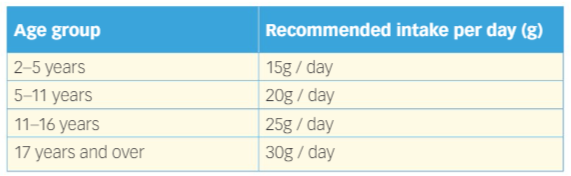
Recommended nutrient intake (RNI) of dietary fiber
Adults → 30g per day
Young children do not need as much fiber as it fills them up quickly which might prevent them from eating other important nutrients
Functions of dietary fibre…
- Helps to make peristalsis more efficient by absorbing water in the intestine to make the waste food (faeces) soft & bulky so that it can travel out the body quickly
- Provides a feeling of satiety
- Reduces cholesterol levels
Dietary fibre deficiency symptoms…
- Diverticular disease
- Bowel cancer
- Constipation