Term 3 - Enculturation of Social Norms
 Call Kai
 Learn
Learn Practice Test
 Spaced Repetition
 Match
Match Flashcards
 Knowt Play
1/12

Earn XP
Description and Tags
The role of peer influence in the development of self - section C only
Name | Mastery | Learn | Test | Matching | Spaced | Call with Kai | Chat |
|---|
No analytics yet
Send a link to your students to track their progress
13 Terms
Positive
Positive:
Role model
Compliments --> self-esteem
Navigating new experiences
Social connections - problem solving, empathy (e.g. in a kindergarten setting, play and learning to share)
Negative Influences
Negative influences:
In group/out group bias - discrimination, bullying
Group think - thinking and decision making
Social Identity Theory
Social Identity Theory:
How individuals define themselves based on their group memberships
Social comparison, social categorisation, social identification, positive distinctiveness
Social Identity Theory (Tajfel & Turner, 1979) proposes that individuals develop part of their self-concept through their membership in social groups
The theory suggests that people first engage in social categorisation, where they classify themselves (ingroup) and others (out group) into different groups
They then move to social identification, adopting the norms, values, and behaviours of groups they belong to
Next, through social comparison, individuals compare their group with other groups, often viewing their own group more favourably
Finally, positive distinctiveness occurs when individuals seek to maintain a positive social identity by emphasising the strengths of their group
During adolescence, peer groups become increasingly important, meaning these processes can significantly influence the development of an individual's self-concept and identity
Social identity theory will not be named on the exam question - it'll just be "role of peer influence in the development of self"
Enculturation
Enculturation:
The role of enculturation of social norms in the development of self
Could be all sections
Section A and B (sociocultural approach) - describe the role of enculturation in one or more human behaviours
Section C - human development
Cultural and Social Norms
Cultural and Social Norms:
A cultural norm is a shared expectation or rule for how an individual should behave to be accepted within a culture
A social norm is an unwritten rule or expectation about how people should behave in a particular group, society, or context
When individuals deviate from social or cultural norms, they may be punished, marginalised, or stigmatised
More positively, they may be seen as creative and affecting change in society
Being social animals, the need to belong plays a strong rule in the desire to conform to social norms
Enculturation of Gender Roles
Enculturation of Gender Roles:
Enculturation is the process by which individuals learn and internalize the values, beliefs, and norms of their culture, shaping their identities and social behaviours
One significant aspect of enculturation is the transmission of gender roles, which are the expectations and behaviours culturally assigned to individuals based on their perceived gender
From an early age, children are exposed to these roles through various socializing agents, including family, education, media, and peers
These influences not only teach them what it means to be "masculine" or "feminine" but also reinforce stereotypes that shape their aspirations, relationships, and self-perceptions
Babies are not born with a "culture." Vertical cultural transmission is how we develop an understanding of our culture's values, language, and expectations from our parents
Oblique cultural transmission occurs when individuals learn through interacting with gatekeepers - for example, members of the older generation, such as teachers and people in the media
Horizontal cultural transmission occurs when individuals learn from their peers
Enculturation can occur through direct tuition-that is, being told by someone what you are supposed to do
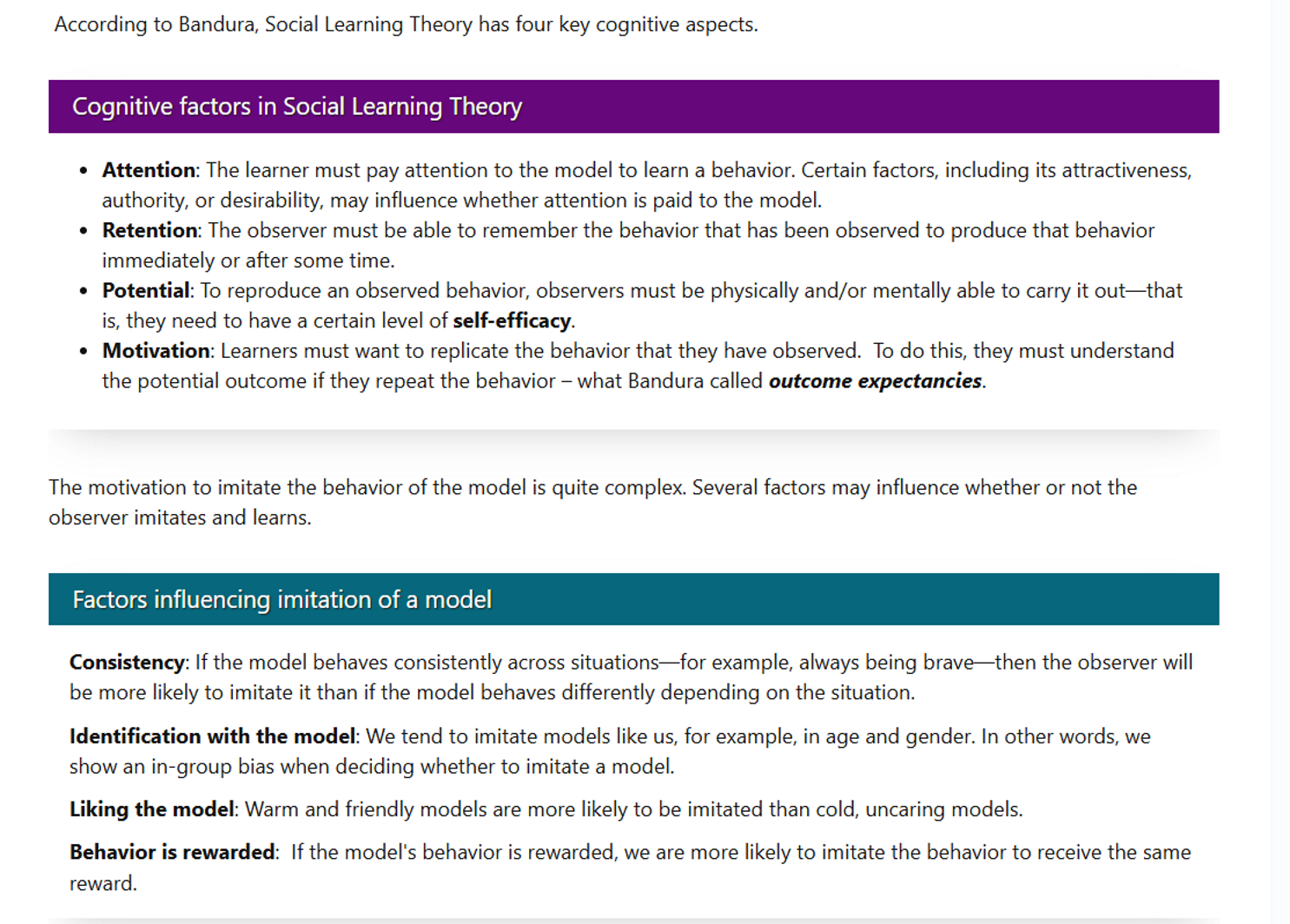
Social learning underpins enculturation. It is how we learn through observation and imitation of the behaviour of those around us who act as our role models
Please watch the following video as a reminder of Social Learning Theory
Evaluation of the Social Learning Theory for Enculturation
Evaluation of the Social Learning Theory for Enculturation:
A strength of the Social Learning Theory is that it takes into account the social and cultural context in which enculturation occurs. It predicts that children acquire internal standards for behaviour through reward and punishment - either by personal or vicarious experience. A number of empirical studies support the notion of modelling
One weakness of the Social Learning Theory is that it cannot explain why there seems to be considerable variation in the degree to which children conform to a culture's norms-for example, the level to which individual boys and girls conform to gender role stereotypes. The Social Learning Theory does not explain nonconformists
Another limitation is that when discussing enculturation, there are too many variables that may play a role that it is not possible to limit the explanation simply to the modelling of behaviour. For example, since the majority of caregivers are still women, boys and girls have very similar experiences in their development. Social Learning Theory does not account for this. Based on SLT's argument, children's gender identity should overall be more feminine. This shows the importance of peers and other socializing factors
Emic
The emic approach focuses on understanding behaviour, beliefs, and practices from within the cultural context. It uses concepts and categories that are meaningful to the members of that culture.
Goal: To capture the insider’s view and interpret phenomena as participants themselves understand them.
Example: A researcher studying mental health in Japan might explore how “amae” (a culturally specific concept of dependency and closeness) influences interpersonal relationships and well-being. This concept is unique to Japanese culture and cannot be fully understood using Western psychological terms.
Etic
The etic approach studies behaviour from an external, objective standpoint, often applying universal theories or frameworks across cultures.
Goal: To identify general principles that apply across different cultural contexts.
Example: A researcher comparing depression rates across countries using standardised diagnostic criteria like the DSM-5 is taking an etic approach. The same measurement tool is applied globally, regardless of cultural differences
Filial Responsibility
Filial Responsibility:
It is generally accepted that in more collectivist societies, young people are encultured into caring for the elderly and showing them respect. In Asian cultures, adult children taking responsibility for their elderly parents is termed filial responsibility
Cultural practices, such as honouring ancestors, participating in traditional ceremonies, and engaging in rituals that highlight respect for elders, play an important role in enculturating children to the value of filial responsibility. This includes things like birthday celebrations, holidays, or even everyday tasks where children are expected to serve or assist elders
Filial responsibility is not just a personal or familial matter; it is also influenced by the broader community and society. Social expectations, reinforced by family friends, neighbours, and community leaders, can often pressure children to follow these practices. The desire to meet these social expectations can significantly influence how children understand their role within the family
Discussing Enculturation
Discussing Enculturation:
Enculturation is a lifelong process; this makes it difficult to study without prospective, longitudinal studies. These studies are impractical to carry out. Studies are often cross-sectional, not longitudinal
Reductionist - enculturation assumes that we develop our behaviour by interacting with the environment. Biological factors are not addressed
Many studies focus on a single factor in enculturation e.g., direct tuition from parents. The actual process of enculturation is very complex, and several factors interact in the development of behaviour
Enculturation theories do not explain why some people do not conform to cultural norms
Culture is dynamic. Enculturation research does not explain how and why culture changes over time
There is the problem of the operationalization of culture as a variable in a globalized and Internet-connected world
Social Factors of SLT (4)
Model
Observation
Imitation
smth else idk ask someone
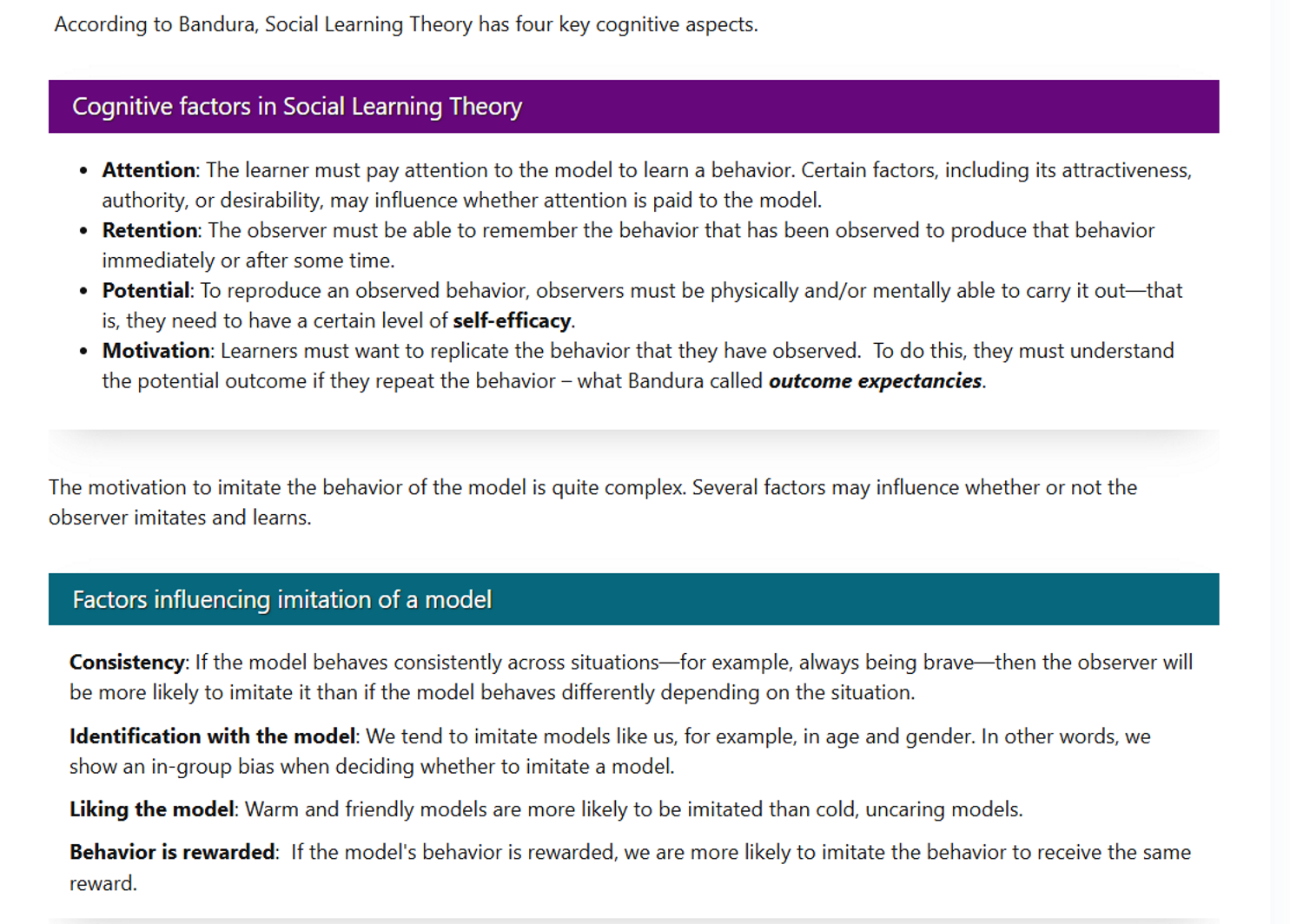
Cognitive Factors of SLT (4)