Chemistry Titration Key Terms
 Call Kai
 Learn
Learn Practice Test
 Spaced Repetition
 Match
Match Flashcards
 Knowt Play
1/25

There's no tags or description
Looks like no tags are added yet.
Name | Mastery | Learn | Test | Matching | Spaced | Call with Kai | Chat |
|---|
No analytics yet
Send a link to your students to track their progress
26 Terms
Primary Standard Solution
Solution made with a pure chemical with known number of moles dissolved in a known volume, thus, it has a known concentration. Features include high purity, non reactive with the air.
anhydrous standard
Water free substance used to prepare standard solutions in the titration.
Titrant
The solution of known concentration placed inside the burette.
aliquot
The volumetric portion of the solution of unknown concentration (in the conical flask).
Why is it okay for the conical flask to be rinsed with distilled water?
Because the reaction depends on the number of moles of known solution reacting with the number of moles of unknown solution (in the conical flask), despite the concentration of the flask decreasing, the number of moles present remains the same.
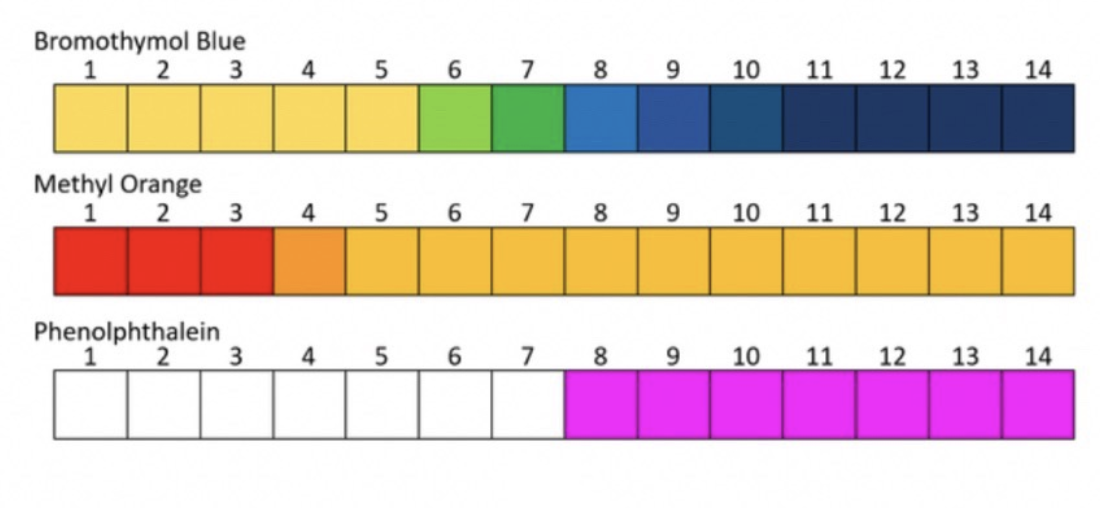
considering the concentration of these indicators, choose an appropriate indicator for a strong acid and strong base and explain why.
bromothymol blue, because the equivalence point is reached at pH 7, hence, the blue colour change will clearly indicate when the reaction’s equivalence point as occured.
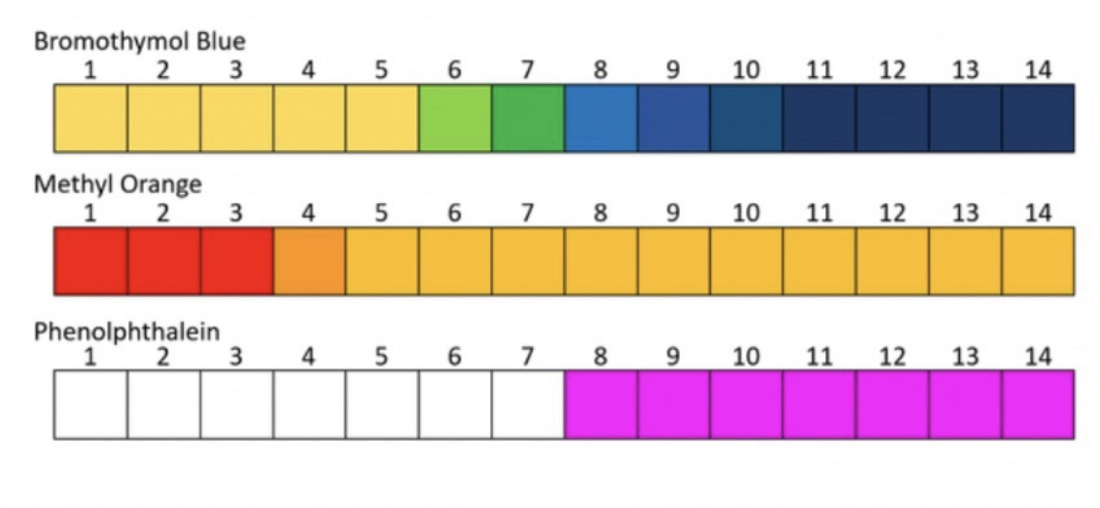
considering the concentration of these indicators, choose an appropriate indicator for a strong acid and strong base and explain why.
methyl orange, because the equivalence point is reached at lower ~4pH, hence, the orange colour change will clearly indicate when the reaction’s equivalence point as occurred.
equivalence point
The point in an acid-base reaction when the number of moles of acid equal the number of moles of base.
titre
Volume of the titrant required to reach the equivalence point.
Dilution factor
volume of total solution/ volume of initial sample solution
Validity
How well an experiment measures what was intended.
Reliability
Measures the consistency of results.
Accuracy
Measures how closely calculated experimental values are to the true accepted values in scientific literature.
analyte
the solution of unknown concentration being analysed.
endpoint
The experimental moment where the indicator changes colour.
Why is phenolphthalein suitable in determining when the reaction end point has occurred for a weak acid strong base reaction? mention both end point and equivalence point in your answer.
Because its narrow colour-changing range (at ~8.2-10pH) matches the basic pH of the solution formed between a weak acid and strong base at which the reaction’s equivalence point is reached. This also aligns with when the reaction endpoint occurs (where the colour change happens).
Difference between endpoint and equivalence point?
The endpoint is the indicator colour change; the equivalence point is the exact stoichiometric completion of the reaction (where moles of base equal moles of acid)
How is reliability improved?
Repeating trials and obtaining concordant titres.
What are concordant titres?
Titres within 0.10 mL of each other.
How is validity improved?
Controlling variables and using appropriate equipment and procedures.
How is accuracy improved?
Correct technique, using calibrated equipment, and minimising systematic errors like parallax.
Describe
State characteristics or features.
Explain
define and describe relevant terms, then relate cause and effect.
Analyse
Define and describe relevant terms, relate cause and effect, then identify relationships, trends, and significance.
Evaluate
Make a judgement supported by evidence.
Conclude
State what the evidence shows.