RAID Types
 Call Kai
 Learn
Learn Practice Test
 Spaced Repetition
 Match
Match Flashcards
 Knowt Play
1/6

Earn XP
Description and Tags
midterm topic
Name | Mastery | Learn | Test | Matching | Spaced | Call with Kai | Chat |
|---|
No analytics yet
Send a link to your students to track their progress
7 Terms
Disk Striping
Is a method of storage that spreads data bits across all disks in the array, increasing performance and capacity
Disk Mirroring
Actively duplicates bits across two disks to prevent data loss
RAID 0
Uses disk striping to combine drives into one larger and faster logical drive
Advantage:
- Faster read and write because of disk stripping
- Larger storage than any single disk
- Only 2 disks are required, but more disks will increase capacity and performanceDisadvantage
- NO Data protection, if 1 disk fails - ALL data is lost

RAID 1
Provides data protection by mirroring data across 2 disks
Advantages:
- Data protection: If 1 disk fails, there is no data loss
- No performance loss if a disk fails
- Fast recoveryDisadvantages:
- Max storage is limited to the size of a single disk
- Does not increase performance or capacity

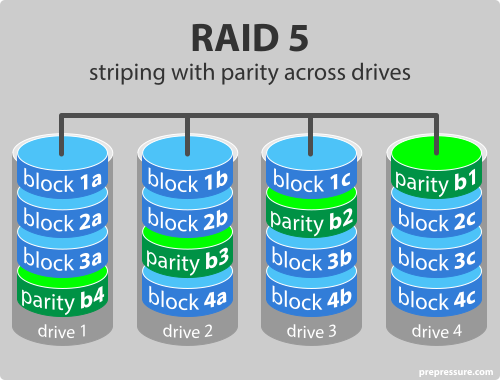
RAID 5
Uses disk stripping to combine drives into one larger and faster logical drive and distributes parity across all disks in the array
Parity Data is a smaller representative value that can be used to recreate data if data is lost
Advantage:
- If one disk fails, parity will be used to recreate the data
- Larger storage than a single driveDisadvantage
- THREE Disks are required: More disks will increase capacity not protection or performance
- Parity is SLOW! Parity calculation may affect performance
RAID 6
Similar to RAID 5 but adds another parity block
Requires at least FOUR drives
You could lose 2 drives and data would still be available

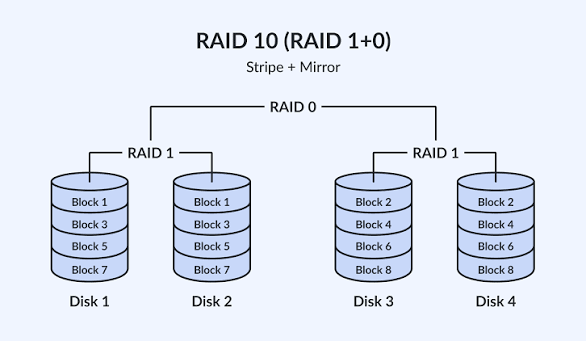
RAID 10 (1+0)
Combines disk into RAID 1 arrays and then combines those arrays into a RAID 0
Advantage:
- Faster read/write because of disk striping
- Larger storage
- More disks = increased capacity, performance, and protection
- Fast recovery: No performance lost if a disk failsDisadvantage:
- FOUR disk minimum