1a. Nature- nurture debate
 Call Kai
 Learn
Learn Practice Test
 Spaced Repetition
 Match
Match Flashcards
 Knowt Play
1/7

There's no tags or description
Looks like no tags are added yet.
Name | Mastery | Learn | Test | Matching | Spaced | Call with Kai | Chat |
|---|
No analytics yet
Send a link to your students to track their progress
8 Terms
Define the nature-nurture debate
Nature-nurture debate is the discussion whether behaviour is biologically or environmentally driven.
How are approaches separated into nature and nurture?
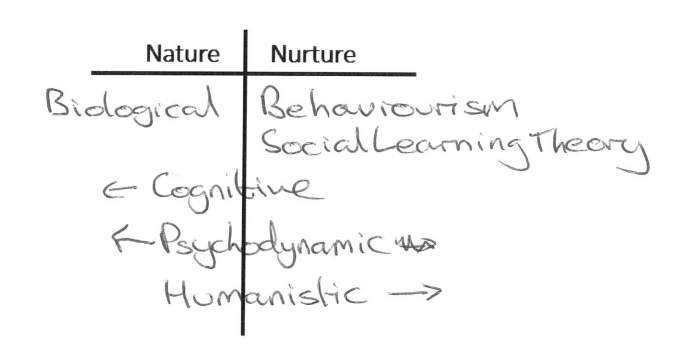
How can people who have been adopted be used to investigate nature vs nurture?
Adopted ppl can be used to investigate nature vs nurture=
Adoption studies aim to separate the effects of genetics and environment by studying individuals who were adopted and raised apart from their biological parents. Researchers compare: Adopted children with their biological parents (for genetic influences) – adopted children with their adoptive parents for environmental influences They generally conclude that both nature and nurture have involved, e.g., Tienari et al on schizophrenia (see Approaches Booklet)
How can twins be used to investigate nature vs nurture?
Twin studies compare similarities between identical (monozygotic/MZ) twins and fraternal/non-identical (dizygotic/D2) twins to estimate the relative contributions of genetics and environment. M2 Ewins shave 100% & their genes at birth and DZ share 50% at birth. By comparing the concordance (or correspondence) rates on a specific trait, they can estimate its heritability. They generally show that genetics play a significant role, but that environment also matters. e.g. Gottesman and Shields on Schizophrenia (see Approaches Booklet)
What is meant by the interactionist approach?
The interactionist approach= nature and nurture interact to form a person’s behaviour
For e.g, in clinical psychology, models of mental illness like the diathesis-stress model emphasise the interaction of genetic vulnerabilities (nature) and environmental triggers (nurture). This suggests that nature dictates nurture e.g. the inheritance of candidate genes for OCD dictate whether a traumatic experience in the environment will trigger the disorder.
What is epigenetics?
Epigenetics refers to changes in our genetic activity that happen throughout our lives and are caused by interactions with our environment. Experiences like smoking, diet, pollution, and even war all leave epigenetic marks on our DNA, and these marks tell our bodies which genes to use and which to ignore (de/activate), which will in turn influence the genetic codes of our children and future descendants. Epigenetics therefore introduces another factor into explaining an individual's behaviour, the life experience of previous generations.
What was the Dias and Ressler study?
Dias and Ressler (2014) gave male lab mice electric shocks every time they were exposed to the smell of acetophenone, a chemical used in perfume, conditioning into them a fear reaction whenever that smell was presented. The next two generations of offspring, that were isolated from their parents at birth, also exhibited the same fear despite not being exposed to the conditioning. Therefore, the conditioning must have affected the DNA of their parent and been inherited by the offspring; this suggests that it is in fact nurture that dictates nature.
examq: What is meant by the ‘nature-nurture’ debate in psych?
This debale highlights the possibility that human behaviour is governed by natere, or biological factors like genetics, and nurture, or environmental factors like our upbringing. Interactionism highlights that iti sa combination of both .e. the Diathesis-Stress Model/Epigenctics.