ACT Science: Outside Knowledge
 Call Kai
 Learn
Learn Practice Test
 Spaced Repetition
 Match
Match Flashcards
 Knowt Play
1/101

There's no tags or description
Looks like no tags are added yet.
Name | Mastery | Learn | Test | Matching | Spaced | Call with Kai | Chat |
|---|
No analytics yet
Send a link to your students to track their progress
102 Terms
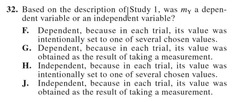
General: Independent Variable
The variable that is being manipulated/systematically changed by the scientist.
(For example, if you are changing fertilizer brands to see which causes the most plant growth, the independent variable is the fertilizer brand.)
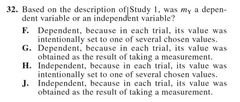
General: Dependent Variable
The variable that is changing in response to the independent variable. This is the "output" or "result" of a study - this is what is being measured by the experimenters.
(For example, if you are changing fertilizer brands to see which causes the most plant growth, the dependent variable is the plant growth)
General: Control Group
The group that does not receive the independent variable.
(For example, if you are changing fertilizer brands to see which causes the most plant growth, the control group is the one that gets regular dirt instead of a fertilizer)
General: Constant Variable
A factor that stays the same across all test subjects and throughout the duration of the experiment/study.
(For example, if you are changing fertilizer brands to see which causes the most plant growth, examples of constant variables could be: how much water each plant receives or how many hours of sunlight the plants get)
General: Directly related or directly proportional
When two variables increase together or decrease together.
If Y is directly proportional to X then:
Y = k * X
Where "k" is the constant of proportionality (a number that changes based on the experiment)
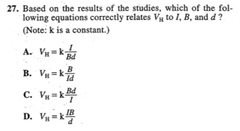
General: Inversely related or inversely proportional
When two variables change in opposite directions (one increases, the other decreases)
If Y is inversely proportional to X then:
Y = k / X
Where "k" is the constant of proportionality (a number that changes based on the experiment)
Chemistry: pH range of acids
0-7 (7 is neutral)
Chemistry: pH range of bases (also called alkaline solutions)
7-14 (7 is neutral)
Biology: What reactants go into photosynthesis?
Carbon dioxide, water, and sunlight
Biology: What does photosynthesis produce?
Glucose (plant food/sugar) and oxygen
Physics: What subatomic particles comprise the atomic nucleus?
Protons and neutrons
Physics: What are the charges of protons, neutrons, and electrons?
Protons are positive, neutrons are neutral, and electrons are negative
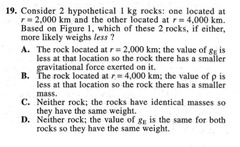
Physics: What is the general principle of gravity?
Smaller objects are attracted to larger objects
Genetics: Allele
Different versions of a gene (often represented with either an uppercase or lowercase letter)
Genetics: Dominant traits
Traits that are expressed whenever AT LEAST ONE dominant (uppercase) allele is present
Ex.) Genotype(s): FF or Ff
Genetics: Recessive traits
Traits that are expressed ONLY WHEN TWO recessive (lowercase) alleles are present
ex.) Genotype: ff
Genetics: Heterozygous
An organism that has two different alleles for a trait
ex.) Genotype: Ff
Genetics: Homozygous
An organism that has two identical alleles for a trait
ex.) Genotype: FF or ff
Genetics: Genotype
An organism's genetic makeup, or allele combinations.
Usually represented with some combination of upper and lowercase letters.
Genetics: Phenotype
The physical characteristics of an organism (the physical result of the genotype. for example, brown hair)
Genetics: Trait
A physical characteristic
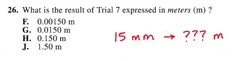
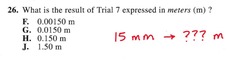
General: How many millimeters are in a meter?
1000 mm = 1 m
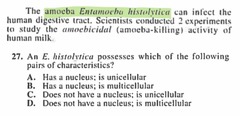
Biology: What is an Amoeba?
A unicellular organism with a nucleus.
(Think of it like a bacteria, but with a nucleus: aka DNA)
Physics: Law of Conservation of Mass
Matter is neither created nor destroyed (generally when considering a chemical reaction)
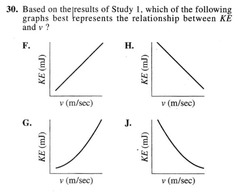
Physics: Kinetic Energy (KE)
The energy an object has due to its motion
(KE is based on two things: mass and speed/velocity, the more mass or speed an object has, the more Kinetic Energy it has)
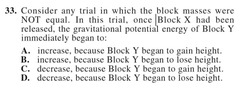
Physics: Potential Energy (PE)
The energy an object has due to its "potential" for stored energy.
(PE is usually based on an object's height off of the ground, the higher it is, the more PE it has)
Chemistry: What is a Catalyst?
A substance that speeds up the rate of a chemical reaction
Physics: What is a Proton?
A positively charged particle in the nucleus of an atom
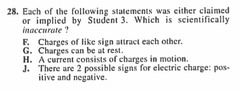
Physics: What is a Neutron?
A small particle in the nucleus of the atom, with no electrical charge
Physics: What is a Electron?
A negatively charged particle; located outside the atomic nucleus
Chemistry: In a chemical reaction, what are the "Products"?
The elements or compounds produced by a chemical reaction.
These are located on the RIGHT side of a balanced chemical equation.
Chemistry: In a chemical reaction, what are the "Reactants"?
A starting material in a chemical reaction.
These are located on the LEFT side of a balanced chemical equation.
Genetics: What are gametes?
The reproductive cells (sperms and eggs)
Astronomy: What is the order of the planets (starting at the Sun and going outward)?
Sun, Mercury, Venus, Earth, Mars, Jupiter, Saturn, Uranus, Neptune
(A common mnemonic to help you remember is: My Very Excellent Mom Just Served Us Noodles)
Chemistry: In a chemical reaction, what is a "limiting reactant (reagent)"
Any reactant that is used up first in a chemical reaction; it determines the amount of product that can be formed in the reaction.
(Ex. A reaction uses oxygen and iron to produce a new compound, but the reaction runs out of oxygen before it runs out of iron - therefore the oxygen is the limiting reactant)
Chemistry: What is "a solution"?
A solution is made when a "solute" (oftentimes a solid or a powder) is dissolved into a "solvent" (oftentimes a liquid like water).
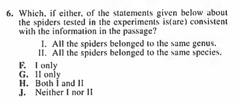
Genetics: What does the term "Genus" refer to?
This is the first part of the scientific name in binomial nomenclature.
(Ex. Humans are known as "Homo Sapiens", our genus is "homo" and our species is "sapiens")
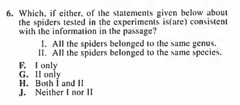
Genetics: What does the term "Species" refer to?
A group of similar organisms that can breed and produce fertile offspring; the second part of the scientific name in binomial nomenclature.
(Ex. Humans are known as "Homo Sapiens", our genus is "homo" and our species is "sapiens")
Biology: What is Cellular Respiration (CR)?
CR is the process that releases energy by breaking down glucose and other food molecules in the presence of oxygen.
This is most often associated with animal cells on the ACT.
Geology: What is erosion and weathering?
The processes by which rock, sand, and soil are broken down and carried away.
This is usually caused by: wind, flowing water, moving ice (glaciers), or plant roots breaking up the soil.
General How many milliliters are in a liter?
1000 mL = 1 L
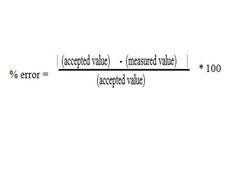
General: What is the "percent error" formula?
|accepted value-measured value| / accepted value x100
Where the "accepted value" is usually determined by a model/equation and the "measured value" is from a real experiment/measurement.
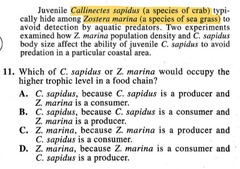
Biology: Whats the difference(s) between predator and prey?
A predator is an organism that eats another organism. The prey is the organism that the predator eats.
General: What does a balance measure?
Mass (in some type of "gram")
General: What does a graduated cylinder measure?
Volume (in some type of "liter")
General: What does a pH meter measure?
pH
General: What does a light microscope allow you to measure?
You can use it to count anything that is too small to see with the naked eye.
General: What does a thermometer measure?
Temperature (usually in degrees Celsius, degrees Fahrenheit, or "Kelvins")
General: What does a metric ruler measure?
Length (in some type of "meters")
General: What does a calorimeter measure?
The change in thermal energy (calories)
This is RARELY asked about.
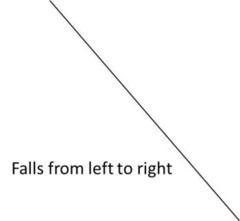
General: What does it mean for a line to have a negative slope?
The line will fall from left to right.
As the Independent Variable (X) increases, the Dependent Variable (Y) decreases.
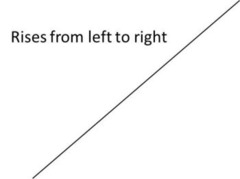
General: What does it mean for a line to have a positive slope?
The line will rise from left to right.
As the Independent Variable (X) increases, the Dependent Variable (Y) increases.
General: What is a telescope used for?
To help see far away objects
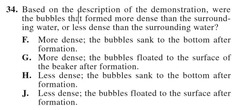
General: What is density - and how is it calculated?
Density = Mass/Volume
This is generally used to describe how "heavy" an object is.
In a solution, more dense materials will "sink" and less dense materials will "rise/float".
Chemistry: What is an element's "melting point"?
The temperature at which an element transitions from a solid to a liquid.
Chemistry: What is an element's "boiling point"?
The temperature at which an element transitions from a liquid to a gas.
Chemistry: What does the term "condensation" refer to?
The change of state from a gas to a liquid.
Chemistry: What does the term "evaporation" refer to?
The change of state from a liquid to a gas.
Chemistry: What does the term "conductivity" refer to?
The ability of an object to transfer heat or electricity to another object.
Chemistry: What does the term "resistivity" refer to?
A material's opposition to the flow of electric current.
Biology: Amino Acids are the building blocks of...?
Proteins.
Biology: Fatty Acids are the building blocks of...?
Lipids.
Biology: Nucleotides are the building blocks of...?
DNA. They are composed of a sugar, a phosphate, and one of 4 DNA bases
Physics: What is the equation for force?
Force = Mass x Acceleration
(F = M x A)
What should you do if one of the answer choices is "Cannot be determined"?
Proceed with caution! Double check the units of measure in the answers and on the graph to make sure they correspond. "Cannot be determined" is sometimes the answer (about 70% of the time) but not always.
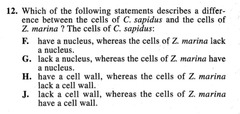
Biology: What kinds of cells have cell walls?
Plant cells and fungi (NOT animal cells)
Genetics: What are sex-linked traits?
Traits controlled by genes located on sex chromosomes.
Physics: How does temperature affect kinetic energy and molecular speed?
As temperature increases, kinetic energy and molecular speed both increase as well.
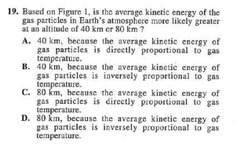
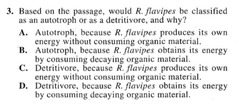
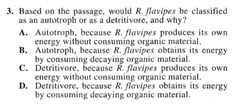
Biology: What is an Autotroph/Producer?
An organism that makes its own food (plants)
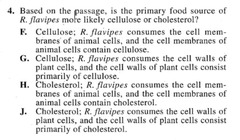
Biology: What is Cellulose?
A substance (made of sugars) that is common in the cell walls of plants, algae, or fungi.
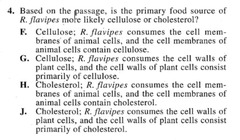
Biology: What is Cholesterol?
A lipid that forms an essential component of animal cell membranes.
Biology: What are Detritivores/Decomposers?
Organisms that feed on dead organic matter.
Biology: What is a Heterotroph/Consumer?
An organism that eats other organisms.
General How many milligrams are in a gram?
1000
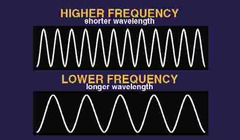
Physics: What is the relationship between frequency and wavelength?
As frequency increases, wavelength decreases.
Biology: What are the differences between a haploid and diploid cell?
Haploid have 1 copy of each chromosome - gametes. Diploid have 2 copies of each chromosomes - somatic (body) cells.
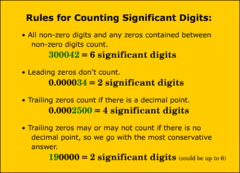
General: Significant Digit Rules
1. Non zero numbers are always significant
2. Zeros between non zero numbers are always significant
3. All final zeros to the right of the decimal place are significant
4. Placeholder zeros are not significant
5. Counting numbers and defined constants have an infinite number of significant figures
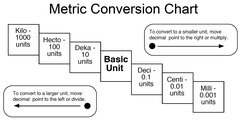
General: What are the rules for Metric System Conversions
• To convert larger unit to smaller unit, move decimal point to right
• To convert smaller unit to larger unit, move decimal point to left
- 1 kilogram = 1,000 grams
- 1 gram = 1,000 milligrams
Remember King Henry Died Drinking Chocolate Milk (see image).
Biology: What is Photosynthesis?
Photosynthesis is the process by which plants use sunlight, water, and carbon dioxide to create oxygen and energy in the form of sugar
This is most associated EXCLUSIVELY with plant cells.
Chemistry: What is an element's "freezing point"?
The temperature at which an element transitions from a liquid to a solid.
Biology: Is Endothermic is another word for "___________-blooded" (warm or cold)?
Warm-Blooded.
These creatures are able to maintain a constant body temperature, regardless of their environment.
Ex.) Birds and Mammals
Biology: Is Ectothermic is another word for "___________-blooded" (warm or cold)?
Cold-Blooded.
These creatures are unable to self-regulate to keep their body temperature constant and therefore have to rely on their environment to warm up (think of a reptile sitting in the sun).
Ex.) Insects, Reptiles, Fish, and Amphibians
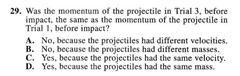
Physics: What is Momentum?
Momentum = Mass x Velocity
The heavier an object is (or the faster it's moving) the more momentum it has.
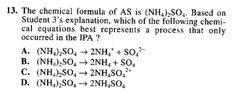
Chemisty: What is an Ion?
An ion is any particle or molecule with an electric charge (this happens when there are more/less electrons than protons).
This can be recognized by a small "+" or "-" in the exponent of the element/molecule.
Physics: What is a Force Vector?
An arrow that represents the DIRECTION and MAGNITUDE of a force.
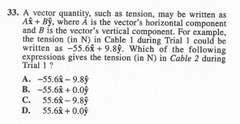
Physics: What are the most common types of Forces on the ACT?
Gravity
- Friction (between two surfaces)
- Tension (in a rope/wire)
- Drag (a force that opposes motion)
Physics: What are the uncommon types of Forces on the ACT?
- Applied Force (caused by a push or a pull from an outside force)
- Air resistance (usually as an item is falling/flying through the air)
- Normal Force (the "opposite" force to gravity, caused by a surface)
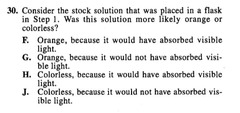
Physics: Color is caused by the ____________ of light at different wavelengths.
Absorption
Physics: Are Mass and Weight the same thing?
No. Mass is an objective measure of how many atoms make up an object and weight is a subjective measurement of an object's mass (while under the effects of GRAVITY).
Chemistry: On the pH Scale, what's the range of values for Acidic, Neutral, and Basic substances?
Acidic pH < 7
Neutral pH = 7
Basic pH > 7
Chemistry: Endothermic reactions _____________ energy/heat.
Absorb
Causing the surrounding environment (the air or a solution where the reaction is occurring) to cool off/get colder.
Chemistry: Exothermic reactions _____________ energy/heat.
Produce
Causing the surrounding environment (the air or a solution where the reaction is occurring) to warm up/get hotter.
Chemistry: What can be done to speed up a chemical reaction?
Increase how much energy (heat or electricity) is being used in the experiment.
Chemistry: What can be done to slow down a chemical reaction?
Decrease how much energy (heat or electricity) is being used in the experiment.
Chemistry: What does it mean for a solution to be Homozygous?
The solution is well mixed and everything inside of it is equally blended and NOT differentiated.
Ex.) Think of mixing sugar/salt with water
Chemistry: What does it mean for a solution to be Heterozygous?
Whether the solution is well-mixed or not, there is still a distinct differentiation between the components of the solution.
Ex.) Think of mixing oil with water
Chemistry: What are the freezing and boiling points of water?
Freezing: 0°C
Boiling: 100°C
Chemistry: What is a Solvent?
A solvent is any liquid that is used to dissolve a solid/solute.
Chemistry: What is a Solute?
A solute is any solid that is dissolved into a liquid/solvent.
Physics: Charges of LIKE SIGN _______________
Repel each other