English Language Techniques Memorisation
 Call Kai
 Learn
Learn Practice Test
 Spaced Repetition
 Match
Match Flashcards
 Knowt Play
1/29

Earn XP
Description and Tags
Revision
Name | Mastery | Learn | Test | Matching | Spaced | Call with Kai | Chat |
|---|
No analytics yet
Send a link to your students to track their progress
30 Terms

Alliteration
A repeated letter at the beginning of a series of words

Onomatopoeia
Sound of the word resembles the meaning of the word

Rhyme
When two lines or more end with words with the same sound at the end

Rhythm
Created through the syllable count

Enjambment
When a sentence or idea in a poem continues onto the next line without any punctuation at the line break

Caesura
This is when a full stop is used in the middle of a line of poetry

Nouns
An object or thing

Adjectives
Describes the object or thing

Verbs
Describes what is being done

Adverbs
Describes how the verb is being done

Emotive verb
Express strong feelings or emotional reactions in the form of an action

Emotive adverb
Addition to an action that conveys strong feelings or emotional reactions

Emotive adjective
Express strong feelings or emotional reactions when describing a subject

Similes
Compares one thing to another using like or as

Metaphors
Compares one thing to another

Personification
When a nonhuman object or idea is given human characteristics

Pathetic fallacy
When the weather is used to show mood or tone

Symbolism
When one thing represents another
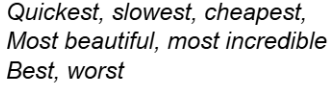
Superlatives
An adjective in its strongest form

Imperatives
A command or order

Repetition
Repeats a word, phrase, or line to increase the effect

Lists/lists of three
Three or multiple items separated by commas

Rhetorical questions
A question asked for effect or to make a point

Hyperbole
Deliberate exaggeration

Facts and statistics
Evidence used to back up a point

Quotations
Directly quoted words from a named source

Dialogue
Words spoken by a character

Short sentences
Used to make a point clearly or to build up a sense of drama

Commas for parenthesis
When two commas are used to add in extra information

First person narrator
When we hear directly from a character or author