BS 161 - unit 1
 Call Kai
 Learn
Learn Practice Test
 Spaced Repetition
 Match
Match Flashcards
 Knowt Play
1/27

There's no tags or description
Looks like no tags are added yet.
Name | Mastery | Learn | Test | Matching | Spaced | Call with Kai | Chat |
|---|
No analytics yet
Send a link to your students to track their progress
28 Terms
bond
interaction between atoms
when a bond forms, energy is ________
released
when a bond forms, entropy ______ for the system
increases
2nd law of thermodynamics
covalent bonds
within molecules not between molecules
electronegativity
the ability of atoms to attract electrons
order HCON from most to least electronegative
oxygen > nitrogen > carbon = hydrogen
non polar covalent bond
shared pair of electrons between 2 atom
bond strenght in aqeous solution: strong
example: methane
polar covalent bond
difference in electronegativity leads to permanent partially negative atoms
bond strenght in aqeous solution: strong
example: H2O
ionic interaction
forms between oppositvely fully charged ions
bond strenght in aqeous solution: weak
example: NaCL
ion dipole interaction
when one atom with a permanent partial charge interacts with a fully charged atom
bond strenght in aqeous solution: weak
example: water and Na Ion
hydrogen bond
interaction between a partially positvely charged hydrogen with a more lectornegative atom with a partial negative charge
USE DASHES TO INDICATE HYDROGEN BOND
bond strenght in aqeous solution: individually weak, collectively have strong infleunce on behaviors
example: H2O and H2O
hydrophobic clustering
molecules seperate themselves out from water, no attraction bringing molecules together
bond strenght in aqeous solution: weak
example: oil and water
london dispersion forces
very weak attraction between transient opposite temporary partial charges
bond strenght in aqeous solution: weakest
example: any 2 molecules
hydroxyl
OH
polar

carbonyl
CO
polar

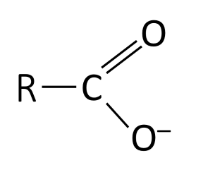
carboxyl
COOH or COO-
negatively charged, at pH of 7 at the cell acts as acids
amino
NH, NH2, +NH3
positively charged
acts as a base at pH of a cell
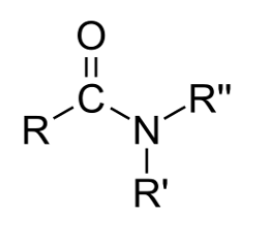
amide
C(=O)NH
CONH2
polar
sulfhydrl
SH
polar

phosphate
OPO3 2-
negatively charged, acts as an acid

methyl
CH3
nonpolar

what is a typical cell made of
water mainly, macromolecules, ions and small molecules
proteins
monomer: amino acids, have an amino group, carboxyl group, and a central group, and side chain
linking bond: peptide bond (carboxyl of one amino acid to the amino group of the next amino acid)
example: collagen, provides structure, long rod that suppports strcuture in cell walls

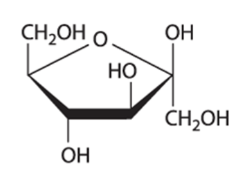
carbohydrates
monomer: monosachrrides, carbon, hydrogen and oxygen atoms in a 1:2:1 ratio
glucose
linking bond: glycosidic - glucose monomers linked by hydroxyl groups (dehydration reaction)
example: cellulose, cell walls, rigid and packed making it good for cell walls
starch, energy, open making it easier to breakdwon
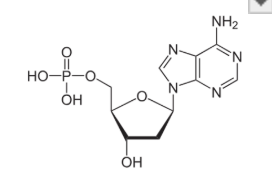
nucleic acid
monomer: nucleotides, phosphate group, 5 carbon sugar, nitrogenous base
cytosine, thymine (uracil in RNA), guanine and adenine
linking bond: phosphodiester linkage (sugar, phosphate backbone)
example: DNA, storing and transmitting genetic info, bases are in teh inferior of the helix, ufncitonal groups are polar and will intearct with one another
lipids
nonpolar and hydrophobic
functions: barriers for keeping stuff in and out of a cell, energy storage
saturated fatty acid
saturated with hydrogens, no double bonds, more solid, and more IMFs
unsaturated fatty acid
bent shape, more fluid, has a couble bond