Pregnancy and Hypertensive Disoreders
 Call Kai
 Learn
Learn Practice Test
 Spaced Repetition
 Match
Match Flashcards
 Knowt Play
1/14

Earn XP
Description and Tags
Don't let this exam give you preeclampsia—deliver those answers before the pressure gets severe!
Name | Mastery | Learn | Test | Matching | Spaced | Call with Kai | Chat |
|---|
No analytics yet
Send a link to your students to track their progress
15 Terms
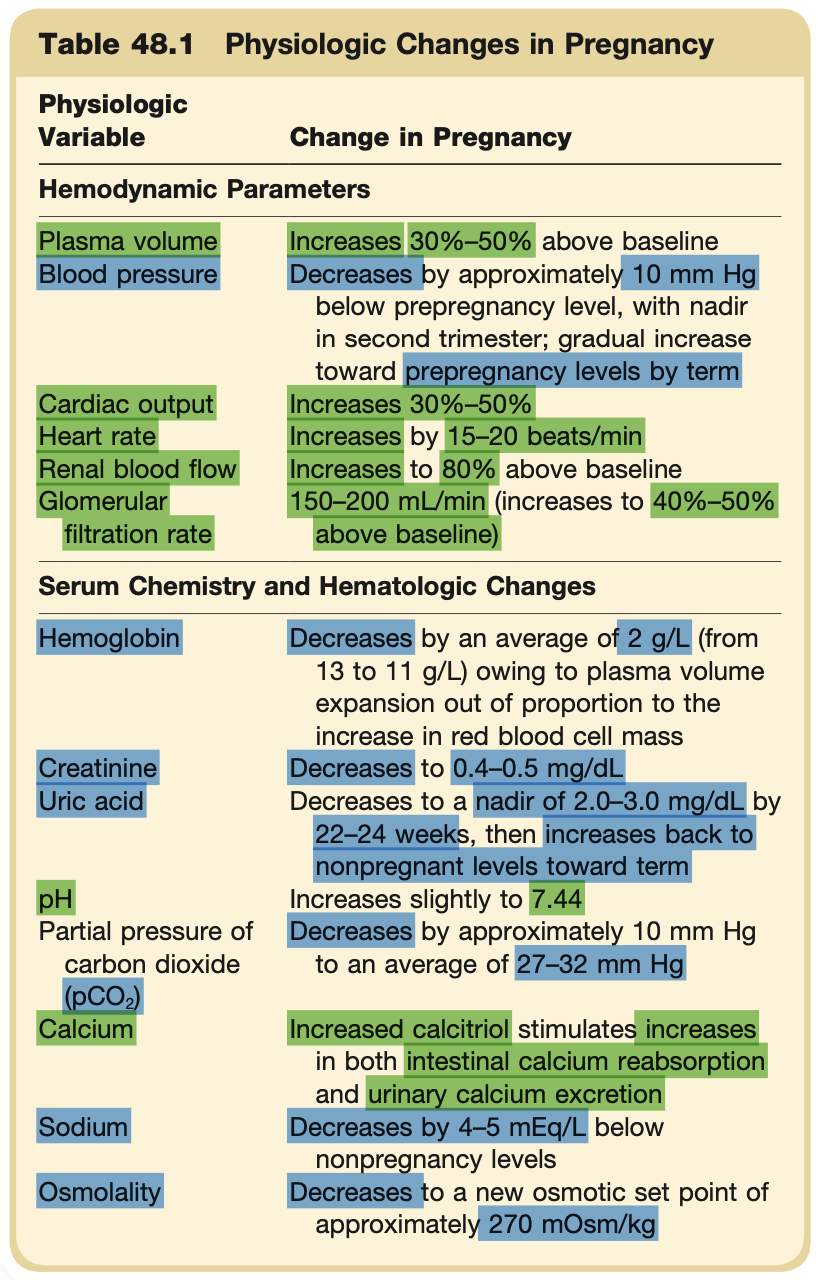
During normal pregnancy, which of the following hemodynamic changes is expected by the end of the second trimester?
a. A 1.5mg/dL increase in uric acid levels
b. A nadir in blood pressure approximately 10 mm Hg below prepregnancy levels
c. A decrease in cardiac output to facilitate fetal perfusion
d. An increase in systemic vascular resistance
Answer: b
Reference: Chapter 48, Pregnancy and Kidney Disease, Page 1622–1623.
Explanation: Option b is correct as mean arterial pressure falls and reaches its nadir at 18–24 weeks. Option a is incorrect because uric acid level falls, not rises. Option c is wrong as cardiac output increases by 30%–50%. Option d is incorrect because SVR decreases significantly
Which immunosuppressive medication is considered safe for use in a pregnant kidney transplant recipient?
a. Mycophenolate mofetil
b. Tacrolimus
c. Sirolimus
d. Rapamycin
Answer: b
Reference: Chapter 48, Pregnancy and Kidney Disease, Page 1622 (Key Points).
Explanation: Option b is correct as calcineurin inhibitors like tacrolimus are safe in pregnancy. Options a, c, and d are incorrect because mycophenolate and rapamycin (sirolimus) are teratogenic and contraindicated
A 26-year-old pregnant woman, whose baseline creatinine prepregnancy of 0.85mg/dL has a serum creatinine of 1.0 mg/dL. How should this result be interpreted?
a. It is a normal value for a healthy pregnancy.
b. It reflects a state of renal impairment in pregnancy.
c. It indicates the patient is in a state of hyperfiltration.
d. It is invalid due to physiologic anemia.
Answer: b
Reference: Chapter 48, Pregnancy and Kidney Disease, Page 1624–1625.
Explanation: Option b is correct; because GFR increases in pregnancy, normal creatinine falls to 0.4–0.5 mg/dL; thus, 1.0 mg/dL is high. Option a is wrong for this reason. Option c is wrong as hyperfiltration would lower creatinine further. Option d is unrelated to creatinine interpretation.
According to the 2013 ACOG criteria, preeclampsia can be diagnosed in a hypertensive pregnant woman without proteinuria if which of the following is present?
a. Trace pedal edema
b. Serum uric acid 8.5 mg/dL
c. Platelet count 90,000/μL
d. Hemoglobin 10.7 g/L
Answer: c
Reference: Chapter 48, Pregnancy and Kidney Disease, Page 1628 (Table 48.3).
Explanation: Option c is a "severe feature" that allows diagnosis without proteinuria. Option a is a feature of normal pregnancy. Option b is common in preeclampsia but not a diagnostic criterion. Option d describes physiologic anemia, not preeclampsia
Results from the CHIPS trial regarding "tight" (DBP 85) vs. "less-tight" (DBP 100) BP control in pregnancy showed that tight control:
a. Reduced the risk of severe maternal hypertension
b. Increased the rate of pregnancy loss
c. Improved neonatal outcomes significantly
d. Increased the risk of HELLP syndrome
Answer: a
Reference: Chapter 48, Pregnancy and Kidney Disease, Page 1641–1642.
Explanation: Option a is correct; tight control was safe and reduced maternal complications like severe HTN. Option b and c are wrong as there were no differences in pregnancy loss or neonatal care. Option d is wrong; there was actually a trend toward increased HELLP in the less-tight group
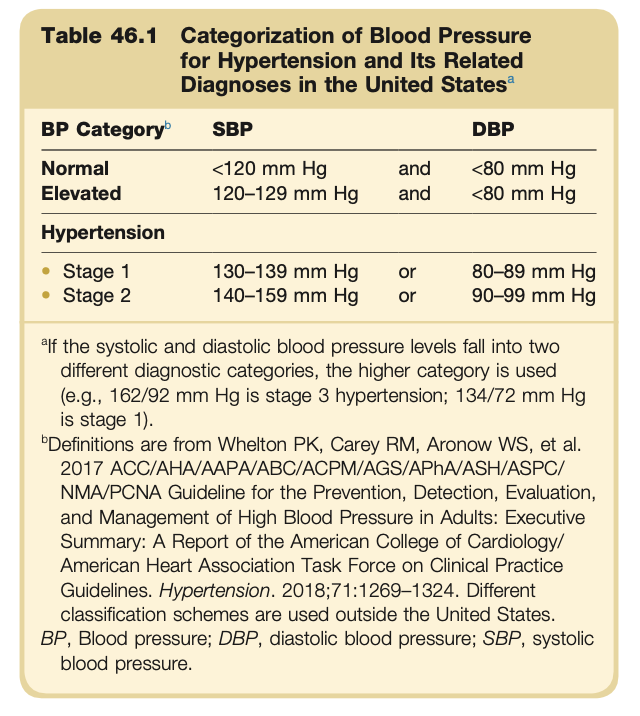
According to the 2017 ACC/AHA guidelines, a blood pressure of 135/85 mm Hg is categorized as:
a. Elevated
b. Stage 1 Hypertension
c. Stage 2 Hypertension
d. Normal
Answer: b
Reference: Chapter 46, Primary and Secondary Hypertension, Page 1538 (Table 46.1).
What is the most commonly used clinical measure to assess arterial stiffness in humans?
a. Mean arterial pressure
b. Carotid-femoral pulse wave velocity
c. Diastolic blood pressure load
d. Central venous pressure
Answer: b
Reference: Chapter 46, Primary and Secondary Hypertension, Page 1551.
Explanation: Option b is the traditional and most common measure. Options a, c, and d are hemodynamic parameters but not specific measures of stiffness
Hypertension in Cushing syndrome is partially driven by cortisol overwhelming which enzyme in the kidney?
a. ACE
b. 11β-hydroxysteroid dehydrogenase type 2
c. 17-alpha hydroxylase
d. Aldosterone synthase
Answer: b
Reference: Chapter 46, Primary and Secondary Hypertension, Page 1566.
Explanation: Option b is correct; excess cortisol overwhelms this enzyme, allowing cortisol to activate the mineralocorticoid receptor. Options a, c, and d are part of the RAAS but not the mechanism of cortisol-induced MR activation.
A patient with obstructive sleep apnea and hypertension is treated with CPAP. What is the expected effect on blood pressure?
a. A 10-15 mm Hg reduction in SBP
b. A modest reduction (approx -1 mm Hg per hour of use)
c. No effect on blood pressure
d. Immediate cure of hypertension
Answer: b
Reference: Chapter 46, Primary and Secondary Hypertension, Page 1567.
Explanation: Option b is correct; CPAP has a modest effect, though greater in those with severe OSA or high adherence
For patients with Stage 3 or higher proteinuric CKD, which drug class is most strongly supported by evidence to slow disease progression?
a. RAAS blockers (ACE inhibitors or ARBs)
b. Beta-blockers
c. Calcium channel blockers
d. Loop diuretics
Answer: a
Reference: Chapter 46, Primary and Secondary Hypertension, Page 1570, 1579 (Fig 46.17).
Explanation: Option a is the standard for renoprotection. Options b, c, and d are useful for BP control but are not first-line for slowing CKD progression specifically
When initiating an ACE inhibitor or ARB in a patient with CKD, a rise in serum creatinine is common. Up to what percentage rise is generally considered acceptable?
a. 10%
b. 20%
c. 30%
d. 50%
Answer: c
Reference: Chapter 46, Primary and Secondary Hypertension, Page 1561, 1579.e8 (Board Review).
Explanation: Option c is the guideline-based threshold; a rise >30% should prompt evaluation for renovascular HTN
According to the CORAL and ASTRAL trials, renal artery stenting for atherosclerotic disease generally:
a. Significantly reduces mortality compared to medical therapy.
b. Fails to add substantial benefit to optimized medical therapy for most patients.
c. Is the first-line treatment for all incidental stenosis.
d. Is contraindicated in patients with diabetes.
Answer: b
Reference: Chapter 47, Renovascular Hypertension, Page 1582.
A clinician performs a physical examination on four patients presenting with lightheadedness. Which of the following patients meets the diagnostic criteria for orthostatic hypotension?
a. A patient whose BP changes from 140/90 mmHg seated to 135/85 mmHg after 3 minutes of standing.
b. A patient whose BP changes from 130/80 mmHg seated to 105/75 mmHg after 3 minutes of standing.
c. A patient whose BP changes from 150/95 mmHg seated to 140/70 mmHg after 1 minute of standing.
d. A patient whose BP changes from 120/80 mmHg seated to 115/78 mmHg after 1 minute of standing.
Answer: b
Reference: Chapter 46, Primary and Secondary Hypertension, Page 1555.
Explanation: Orthostatic hypotension is traditionally defined as a drop of ≥20 mmHg systolic or ≥10 mmHg diastolic within three minutes of standing from a supine or seated position.
A 63-year-old male with CKD (eGFR 51 mL/min/1.73 m²) and albuminuria (430 mg/day) is treated for poorly controlled hypertension. His regimen is adjusted to include chlorthalidone and olmesartan. One week later, his blood pressure has improved to 132/80 mm Hg, but his serum creatinine has increased from 1.3 mg/dL to 1.7 mg/dL. What is the most appropriate next step based on clinical guidelines?
a. Stop the olmesartan immediately due to acute kidney injury.
b. Change the diuretic to a loop diuretic now that the eGFR is lower.
c. Continue the present management and re-evaluate in 2 to 3 weeks.
d. Add a beta-blocker to help further lower the blood pressure.
Answer: c
Reference: Chapter 46, Primary and Secondary Hypertension, Page 1579.e8 (Board Review Q4).
Explanation: Option c is correct because an initial rise in serum creatinine of up to 30% after starting an ACE inhibitor or ARB is common and acceptable, reflecting hemodynamic changes (reduced intraglomerular pressure) rather than structural damage
According to clinical data, at what threshold of serum creatinine at the start of pregnancy does the risk for an accelerated decline in renal function both during and after pregnancy rise above 30%? a. > 0.9 mg/dL
b. > 1.0 mg/dL
c. > 1.2 mg/dL
d. > 1.5 mg/dL
Answer: d
Reference: Chapter 48, Pregnancy and Kidney Disease, Page 1647.