Engineering Fundamentals
 Call Kai
 Learn
Learn Practice Test
 Spaced Repetition
 Match
Match Flashcards
 Knowt Play
1/60

There's no tags or description
Looks like no tags are added yet.
Name | Mastery | Learn | Test | Matching | Spaced | Call with Kai | Chat |
|---|
No analytics yet
Send a link to your students to track their progress
61 Terms
Set
Is a well-defined collection of distinct objects, considered as a single entity.
The objects are called elements or members of the set.
∈
“is an element of, belongs to”
∉
“is not an element of, does not belong to”
Statement Form
{odd numbers less than 7}
Roster / Listing Method:
B = {a, e, i, o, u}.
Rule / Set-builder Form:
Ex.: B = {x∣x is a vowel in the English alphabet}
Empty Set (Null Set):
A = { }
Singleton Set:
Ex. A = {2 }
Finite Set:
Ex.: A = {blue, red, yellow}
Infinite Set:
Ex.: W = {0, 1, 2, 3, 4, 5, ...}
Equal Sets:
Ex.: P = Q, if P = {1, 3, 9, 5, −7} and Q = {5, −7, 3, 1, 9,}
Equivalent Sets:
Ex. P ~ Q, if P = {1, 3, 9, 5, −7} and Q = {a, b, c, d, e,}
Universal Set (U):
A master set that contains all possible objects under consideration for a specific
discussion or problem.
Subset:
Ex. A = {1, 2, 3} and B = {1, 2, 3, 4, 5}
A ⊆ B
Proper Subset:
Ex. A = {1, 2, 3, 4} and B = {1, 2, 3, 4, 5}
A ⊂ B
Power Set:
Ex. If A = {a, b, c}
P(A) = { {a}, {b}, {c}, {a, b}, {b, c}, {a, c}, {a, b, c}, {∅}}
Disjoint Sets:
Ex. A = {1, 2, 3} and B = {4, 5, 6}
Overlapping Sets:
Ex. A = {1, 2, 3, 4} and B = {3, 4, 5, 6}
Elements (Members):
Is any object, number, symbol, or item that belongs to a
particular set. Denoted by “∈”
Cardinality of a Set.
Ex. Given Q ={Jack, Queen, King, Ace}, then: n(Q) = 4,
Ex. Given S = {3, 4, 5, ...31}, then: /S/ = 29
Complement of the Universal Set:
U′ = ∅
Complement of the Empty Set:
∅′ = U
Double Complement Law:
(A′)′ = A
Union with Complement:
A ∪ A′ = U
Intersection with Complement:
A ∩ A′ = ∅
Intersection of Sets:
Ex. A = {1, 2, 3, 4, 5}
B = {4, 5, 6, 7, 8}
A∩B = {4, 5}
Union of Sets:
Ex. A = {1, 2, 3, 4, 5}
B = {4, 5, 6, 7, 8}
A ∪ B = {1, 2, 3, 4, 5, 6, 7, 8}
Relative Difference of Sets:
Ex. A = {1, 2, 3, 4, 5}
B = {3, 4, 5, 6, 7}
A – B = {1, 2}
B – A = {6, 7}
Symmetric Difference of Sets:
Ex. A = {1, 2, 3, 4}
B = {3, 4, 5, 6}
A ⊝ B = {1, 2, 5, 6}
Natural Numbers (N):
Ex. {1, 2, 3, 4, 5...}
Whole Numbers (W):
Ex. {0, 1, 2, 3, 4...}
Integers (Z):
Ex. {..., -4, -3, -2, -1, 0, 1, 2, 3, 4,...}
Rational Numbers (Q):
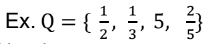
Irrational Numbers:
Ex. Q′ = {√2, √5, π , e}
Real Numbers (R):

Imaginary Numbers:

Complex Numbers:
Ex. C = 7 +3i