Module 17: The Diversity of Animal and Fungus Life
 Call Kai
 Learn
Learn Practice Test
 Spaced Repetition
 Match
Match Flashcards
 Knowt Play
1/61

There's no tags or description
Looks like no tags are added yet.
Name | Mastery | Learn | Test | Matching | Spaced | Call with Kai | Chat |
|---|
No analytics yet
Send a link to your students to track their progress
62 Terms
Domains and Kingdoms of Life
Earth – 4.6 BYA
Prokaryotes – 3.8 BYA
Eukaryotes – 2.0 BYA
First Animals – 635 MYA
What is an Animal?
Multicellular, heterotrophic, eukaryotes.
Lack cell walls
Collagen: connective tissue of most animals.
Contain muscle and nervous tissue.
Allow for movement and nerve impulses.
Most reproduce sexually.
Asymmetrical:
no symmetry.
Radial symmetry:
body parts distributed evenly around a central point
Bilateral symmetry:
opposite sides of sagittal plane are mirror images of one another
Digestive System
Animals have diverse nutritional requirements and feeding strategies.
Intercellular digestion:
digestion inside cells
Gastrovascular cavity:
central cavity with a single opening that functions in both digestion and distribution of nutrients.
Alimentary canal:
digestive tract with two openings (mouth and anus).
Hydrostatic skeleton:
Water held under pressure within a closed body compartment.
Cnidarians, Flatworms, Annelids, Roundworms.
Exoskeleton:
hard covering deposited on the animal's surface that provides protection and points for muscle attachment.
Arthropods, Molluscs.
Endoskeleton:
hard ossified skeleton buried within soft tissue.
Sponges, Echinodermata, Chordata
Segmentation
Series of repeating parts or body segments.
Efficient movement .
Movement of parts
Evolved independently in three phyla:
Annelida
Arthropoda
Chordata
Protostome
mouth developes from blastopore
mouth develops first
Deuterostome
anus developes from blastopore
anus develops first
Invertebrates
Animals without a backbone
Sponges
No tissues or organs
Intercellular digestion
Protostome development
Filter-feeders
Free-swimming larvae
Sessile as adults
Choanocyte:
Specialized cells with flagella that create water current up through osculum
Osculum
opening at the top of the sponge.
( The small purple cells within the gel layer are called amoebocytes)
They engulf food within the gel layer
Cnidarians
Sea jellies,
Corals
Sea anemones
CHARACTERISTICS:Cnidarians
Protostome development.
Radial symmetry.
Gastrovascular cavity.
Cnidocytes: stinging cells.
Two life stages:
Medusa
Polyp
Flatworms
Tape worms
flukes
CHARACTERISTICS: Flatworms
Protostome development.
Bilateral symmetry.
Lack of gas exchange structures.
Rely on diffusion.
Hydrostatic skeleton.
Well-defined head and tail regions.
Hermaphroditic.
Can engage in both sexual and asexual reproduction
Annelida
Earth Worms
leaches,
polychaete worms
Proper cardiovascular system with heart & vessels
CHARACTERISTICS: Annelida
Protostome development.
Hydrostatic skeleton.
Bilateral symmetry.
Segmented bodies.
Complete digestive tract
Molluscs
clams
snails,
octopus
CHARACTERISTICS: Mollusces
Protostome development.
Bilateral symmetry.
Exoskeleton (shell), Hydrostatic in some.
Alimentary canal.
Radula: scraping mouth part.
Muscular foot.
Mantle.
Forms shell
Round Worms
Nematodes
CHARACTERISTICS
Protostome development.
Exoskeleton.
Molt exoskeleton to grow.
Bilateral symmetry.
Alimentary canal.
Many are parasitic.
Arthropods
Includes barnacles, spiders, insects, millipedes and crustaceans
CHARACTERISTICS
Protostome development
Bilateral symmetry
Alimentary canal
Ecdysis
Molt exoskeleton to grow
Jointed appendages
Segmented bodies
Head, thorax, abdomen
General Anatomy of Arthropods
Open circulatory system
Hemolymph: circulatory fluid.
Highly developed sense organs:
Compound eye.
Antennae.
Touch and smell.
Olfactory receptors.
Specialized mouthparts for various feeding behaviors
Echinoderms
Sea stars
sea urchins,
sand dollars,
sea cucumbers
CHARACTERISTICS:Echinoderms
Deuterostome development.
Shares a common ancestor with chordates.
Radial symmetry evolved from bilateral symmetry.
Alimentary canal.
Endoskeleton.
Tube feet:
Locomotion and sensory system.
Chordates
Includes fish, reptile, birds, and mammals
CHARACTERISTICS:
Deuterostome development.
Bilateral symmetry.
Alimentary canal.
Endoskeleton.
Dorsal hollow nerve cord.
Notochord.
Pharyngeal gill slits.
Post anal ta
Includes fish, amphibians, reptiles, birds, and mammals
Notochord
Dorsal nerve cord:
Pharyngeal slits:
Post-anal tail:
Notochord
develops into vertebrate column in vertebrate.
Dorsal nerve cord:
develops into brain and spinal cord in vertebrates.
Pharyngeal slits:
gills in fish, present in embryos of terrestrial vertebrates but disappears during development.
Post-anal tail:
present in embryo of humans, becomes tail bone
Fishes
More fish species than all other vertebrate groups combined.
Jawless fish
Hagfish
Cartilaginous fish
Sharks, skates and rays
Bony fishes
Ray finned fish
Teleosts
Lobe finned fish
Lungfis
Adaptations to Terrestrial Environments
Jaws
Lungs
Limbs
Amniotic egg:
Jaws
Allowed organisms to grasp food.
Diversification of feeding methods.
Lungs
Allowed organisms to breathe air outside of water.
Limbs
Allowed organisms to move around and search for food on land.
Amniotic egg:
Allowed for organisms to reproduce away from water.
Vertebrates Move onto Land
Early Tetrapods→Amphibians —> Reptiles —> mammals & dinosaurs (birds)
Tiktaalik (~ 375 mya)/ Traits of fish & amphibian:
Gills,
scales,
lungs,
flexible neck,
four legs
Amphibians
Frogs and Salamanders
Approximately 6,150 species.
Most go through metamorphosis (“two lives”).
Aquatic, gill breathing larvae.
Terrestrial, lung breathing adults.
Thin, highly vascularized skin.
Three-chambered heart.
Ectothermic.
Gymnophiona (caecilians)
The unknown amphibian.
200 species of slender, limbless, snake-like amphibians.
Predators that burrow in wet, tropical regions
Amniotic Egg
Egg with hard outer casing (shell) and inner supportive membranes that provide padding to the developing embryo.
Reptiles and a couple mammals have leathery eggs.
Birds have hard shells.
“Egg” evolved to for placenta in mammals.
“Reptiles”
Snakes, lizards, tortoises, crocodiles and birds
Ectothermic.
Except birds
Three-chambered hearts.
Except crocodiles and birds (4 chambers)
Scales and scutes.
Lungs.
No embryonic stage with gills.
Extant Dinosaurs - Birds
Ostrich, penguins, kiwi, sparrows, eagles, and albatross
Endothermic dinosaurs.
Four-chambered heart.
Feathers.
Wings.
Bill with no teeth.
Strong, lightweight skeleton.
Mammals
Monkeys, giraffes, rats, tigers, whales, elk, and humans
Endothermic.
Four-chambered heart.
Hair at some point of their development.
Mammary glands produce milk.
Three inner ear bones.
Differentiated teeth.
Monotremes
egg laying mammals
Echidna and platypus
Marsupials
most of their young's development occurs within a pouch.
Kangaroo and opossum
Placentals
young develop within a placenta inside of mother
Primates: Lemurs, lorises, monkeys, apes, humans
Nails instead of claws.
Clavicle.
Two lower limb bones.
Opposable thumb.
Reduced snout.
Reduced olfactory region of brain and increased cerebrum .
Binocular vision.
Depth perception
Humans and Apes: Homo sapiens characteristics
Bipedalism
Evolved early on.
A big, fat brain (literally).
Language
Symbolic thought
Artistic expression
Use complex tools
Reduced jaw bones and jaw muscles.
Differ from chimpanzees in 19 regulatory genes
Fungi: What are they?
Single-celled or multicellular eukaryotes:
Many are mutualistic with plants.
About 110,000 described species.
Total number estimated at 6 million species
Many cause problems…but not all!
Many cause problems…but not all! (fungi)
Many are pathogenic:
About 300 cause human illness.
Many more infect plants.
Important decomposers in many ecosystems.
Human benefits:
Food: mushrooms & yeast.
Antibiotics.
I, Fungi
Single-celled forms: yeasts.
Multicellular, filamentous forms – mycelia.– Some species exhibit both forms
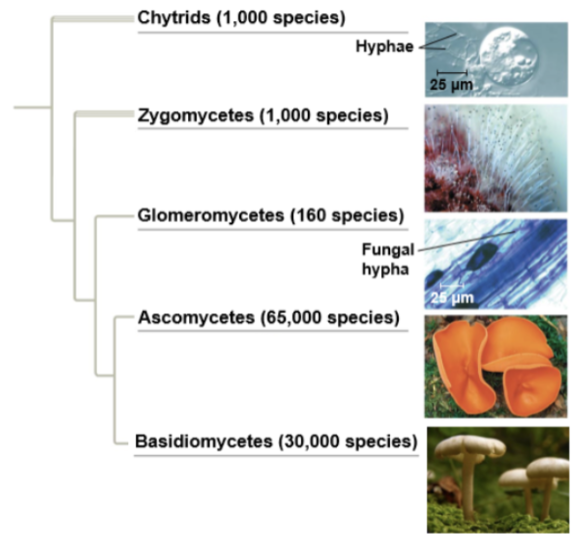
fungi diversity