5A Rates of Reactions
 Call Kai
 Learn
Learn Practice Test
 Spaced Repetition
 Match
Match Flashcards
 Knowt Play
1/23

There's no tags or description
Looks like no tags are added yet.
Name | Mastery | Learn | Test | Matching | Spaced | Call with Kai | Chat |
|---|
No analytics yet
Send a link to your students to track their progress
24 Terms
Explain by reference to Collision theory, how the rate of reaction changes when the concentration of a reagent changes
the higher the concentration, the faster the rate of reaction
at higher concentrations there are more reactant particles per unit volume
So collisions are more frequent
Explain how increasing the temperature increases the rate of reaction
at a higher temperature more molecules have energy above the activation energy
Molecules also have higher kinetic energy, so they move faster and frequency of collisions also increase
Write down the rate equation for A+B→C with orders m and n
rate = k[A]m[B]n
Define order of reaction
The power to which the concentration of a reactant is raised in the rate equation
What is the overall order of a reaction
The same of the individual orders of reactants in the rate equation
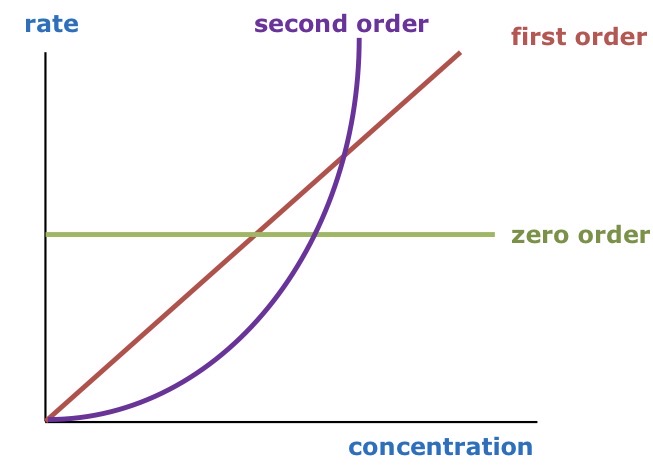
Sketch the rate-conc graphs for 0, 1st, and 2nd order reactions
What change does a 0 order reactant have on the rate
The rate is independent to the concentration of the reactant
What change does a 1st order reactant have on the rate
Rate is directionally proportional to the concentration of the reactant
What change does a 2nd order reactant have on the rate
Rate is directionally proportional to the squared of the reactant concentration. E.g. if conc x2, rate x4
What does ‘initial rate’ mean
The instantaneous rate at the start of the reaction (i.e. when t=0)
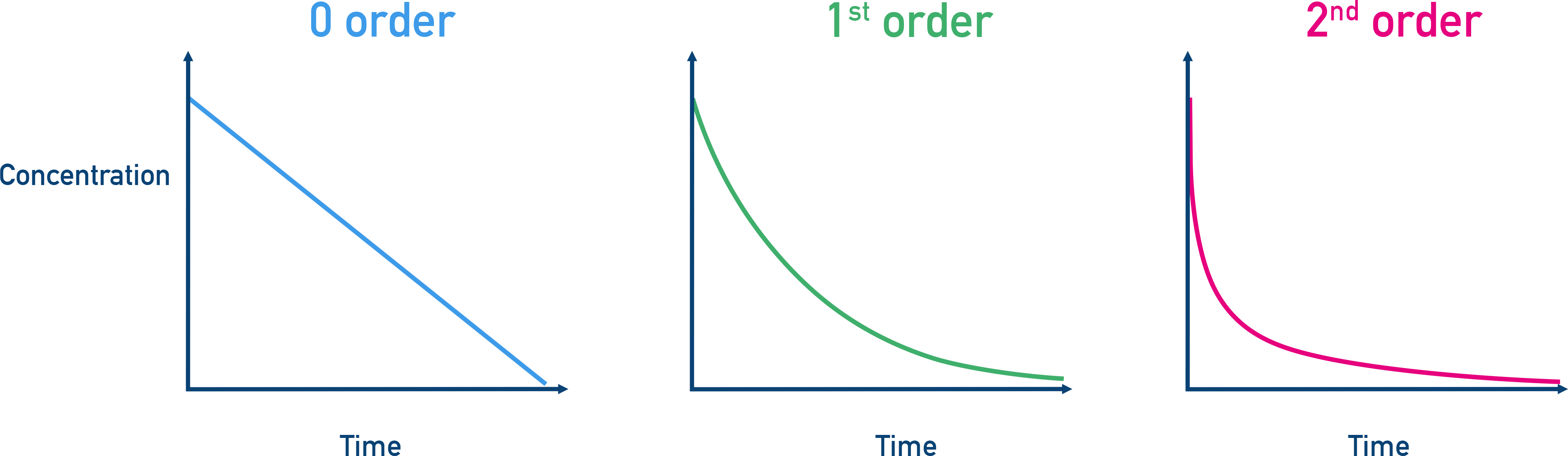
Sketch a conc-time graph for 0, 1st, and 2nd order reactants
What’s the definition of ‘half-life’
Half-life is the time taken for the concentration of a reactant to decrease by half
What happens to the half-life of a 0, 1st, and 2nd order reactant
0 order - decreases
1st order - stays the same
2nd order - increases
How can a colorimeter be used to moniter the concentration of a colourful reactant during a reaction
Produce a calibration curve by measuring the absorbance of a series of known concentration solutions and plotting absorbance against conc
Measure the absorbance measured by the colorimeter during the reaction
Plot a graph
Which equation describes how the value of the rate equation constant (k) changes with temperature
The Arrhenius Equation
𝒌 = 𝑨𝒆−𝑬𝒂/𝑹𝑻 (Present −𝑬𝒂/𝑹𝑻 is in superscript)
How does the value of the rate constant of a catalysed reaction differ from that of the uncatalysed reaction
K for the catalysed reaction is increased
This is because the activation energy for the catalysed route is lower, so the 𝒆−𝑬𝒂/𝑹𝑻 part of the Arrhenius equation increases
What is the formula that links the relationship between k and half-life
K = ln(2) / 0.5t
How can the rate of reaction be found from a conc-time graph
rate = change in conc / change in time
So rate is equal to the gradient
Give 4 examples of continuous monitoring methods
colorimeter- measure increase in absorbance of light
conductivity probe - measure the decrease in conductivity
gas syringe - measure volume of a gas produced
balance - measure mass loss
Describe what a ‘clock method’ is
Method where a significant change (like colour change) is suddenly detected after a little delay
Why can we use 1/time to measure initial rate in the ‘clock’ method
rate = change in conc / change in time
As we measure the same amount of reactant each time change in conc is constant, so initial rate is proportional to 1/time
Compare the advantages and disadvantages of the continuous monitoring method vs the clock method
Continuous monitoring
more accurate :)
more work to monitor several reactions over some time :(
takes longer to process results :(
Clock method
quick and simple to carry out :)
easy to process results :)
only gives an approximation of the initial rate :(
According to collision theory, what conditions must be satisfied for a reaction to occur
Reactant particles must collide:
in the correct orientation
with sufficient energy to overcome the activation energy barrier
What is the ‘rate determining step’
The slowest step in the reaction mechanism of a multi-step reaction