Histology - A&P I
 Call Kai
 Learn
Learn Practice Test
 Spaced Repetition
 Match
Match Flashcards
 Knowt Play
1/84

There's no tags or description
Looks like no tags are added yet.
Name | Mastery | Learn | Test | Matching | Spaced | Call with Kai | Chat |
|---|
No analytics yet
Send a link to your students to track their progress
85 Terms
Four basic tissues
epithelial, connective, muscle, and nervous tissues
characteristics of epithelial tissue
High rate of mitosis, apical and basal surfaces, tightly packed cells, avascularity with innervation, and a basement membrane
epithelial tissue location
lining of GI tract organs and other hollow organs and skin surface (epidermis)
simple squamous tissue
a type of epithelial tissue composed of one layer of tightly packed, diamond shaped cells

simple squamous function
filter or exchange membrane
endothelium
simple squamous tissue found in capillary walls and lining larger blood vessels
mesothelium
simple squamous tissue found in pericardial, pleural, and peritoneal membranes
alveoli
air sacs of the lungs; composed of simple squamous
simple cuboidal tissue
a type of epithelial tissue composed of one layer of square shaped cells

simple cuboidal tissue function
used for secretion (eg. sweat glands)
simple cuboidal tissue locations
found in most glands and the kidney tubules
simple columnar tissue
a type of epithelial tissue composed of one layer of rectangle shaped cells

simple columnar tissue function
complex absorption or secretion
simple columnar tissue location
lining of stomach, small intestine (microvilli), and fallopian tubes (cilia)
microvilli
special structure found in small intestine; increase surface area
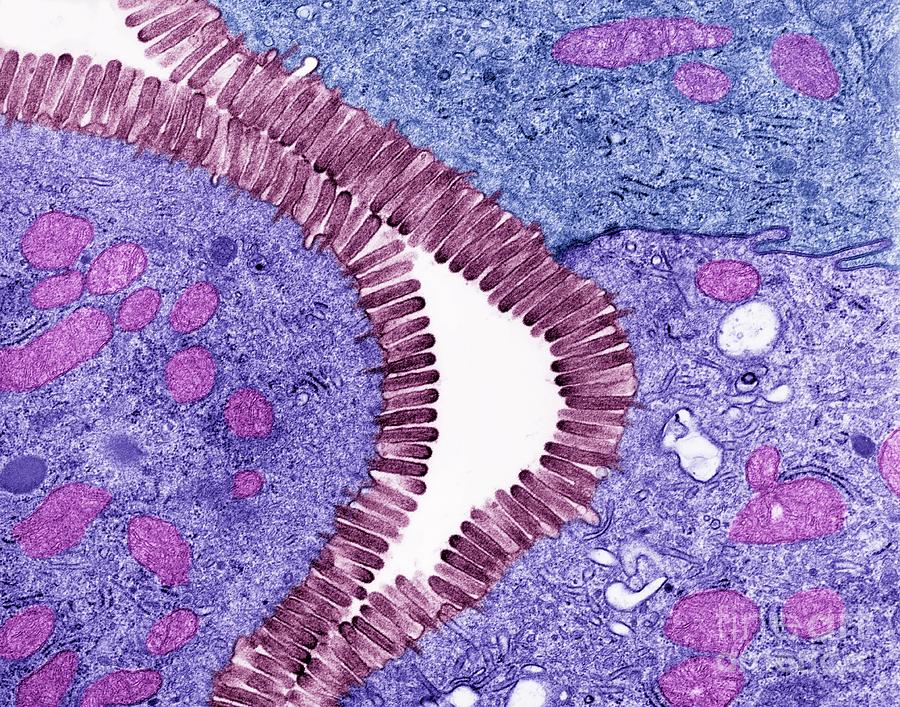
cilia
special structure found in fallopian tubes; provide movement for eggs

goblet cells
special structures found in the digestive tract; secrete mucus to protect from acid

stratified squamous tissue
a type of epithelial tissue composed of multiple layers of squished, diamond shaped cells
stratified squamous tissue function
protects against abrasion
stratified squamous tissue location
layer next to lumen (apical surface)and layer resting on basement membrane (basal layer); found in skin, oral cavity, throat, and esophagus
pseudostratified ciliated columnar tissue
a type of epithelial tissue composed of one layer of columnar tissue that appears to be stratified; all cells have contact with the basement membrane but are different lengths

transitional tissue
a type of epithelial tissue composed of multiple layers of cells designed to stretch and protect from urine in the bladder

Characteristics of connective tissue
Many different types of cells, large extracellular matrix, and vascularity
Types of connective tissue proper
Loose and dense connective tissues
Types of loose connective tissues
Areolar and adipose tissue
Areolar tissue
A loose connective tissue that has all three fiber types and lots of ground substance

Function of areolar tissue
Works as a “packing material” that holds internal structures in place; binds the epithelium to underlying structures
Adipose tissue
A loose connective tissue that hardly has any extracellular matrix; does not have closely packed fibers

Function of adipose tissue
Provides protection, insulation, and excess fuel storage
Location of adipose tissue
Under skin, around abdomen, and around organs
Adipocytes
Fat cells that are filled with lipid

Fascia
Tight, packing tissue that holds muscles and tissues in place; grey looking

Elastic fibers
Fibers that allow a tissue to stretch and recoil like a rubber band

Collagen fibers
The strongest of the three fibers; allows connective tissue to resist forces while providing structure

Reticular fibers
Fine fibers that form form networks and function as a scaffolding; provides structure and form for soft tissues and organs
Ground substance
An aqueous solution that contains mainly dissolved solutes; surrounds cells in tissue
Extracellular matrix
Part of connective tissues that surround cells; built by blast cells; contains fibers and ground substance
Dense connective tissues
Tissues that contain closely packed fibers either very little ground substance; includes dense regular and dense irregular tissue
Dense regular tissue
A type of connective tissue in which the collagen fibers are arranged parallel to each other; has poor vascularization

Location of dense regular tissue
Located in ligaments and tendons
Function of dense regular tissue
Attaches muscle to bone and bone to bone; provides high tensile strength in one direction
Dense irregular tissue
A type of connective tissue in which fibers are randomly seen in multiple directions; has poor vascularization;

Location of dense irregular tissue
Located in dermis of skin and the organs
Function of dense irregular tissue
Provides structural strength and allows tissues to withstand tension in many directions
Supportive connective tissue
Type of tissue that is considered “heavy weight”; contains cartilage, osseous tissue, and blood
Cartilage
A supportive connective tissue that is strong yet flexible; serves as a shock absorber and reduces friction in joints; has avascularity (which limits ability to self repair); includes hyaline, elastic, and fibrocartilage
Hyaline cartilage
A type of connective tissue that contain collagen fibers; provides rigidity but some flexibility; the weakest of the three types of cartilage

Function of hyaline cartilage
Provides resilience under pressure; gives smoothness to joints
Location of hyaline cartilage
Joints, nose, larynx, trachea, and ribs
Fibrocartilage
The toughest of the three types of cartilage; contains collagen fibers in matrix that alternate between rows of lacunae
Function of fibrocartilage
Acts as a shock absorber and resists extreme pushes
Location of fibrocartilage
Intervertebral discs, pubic symphysis, and menisci of the knees
Elastic cartilage
Highly flexible cartilage; contains numerous elastic fibers in extracellular matrix

Location of elastic cartilage
External ear, epiglottis, and auditory tube in middle ear
Function of elastic cartilage
allows tissue to recoil to original place and shape
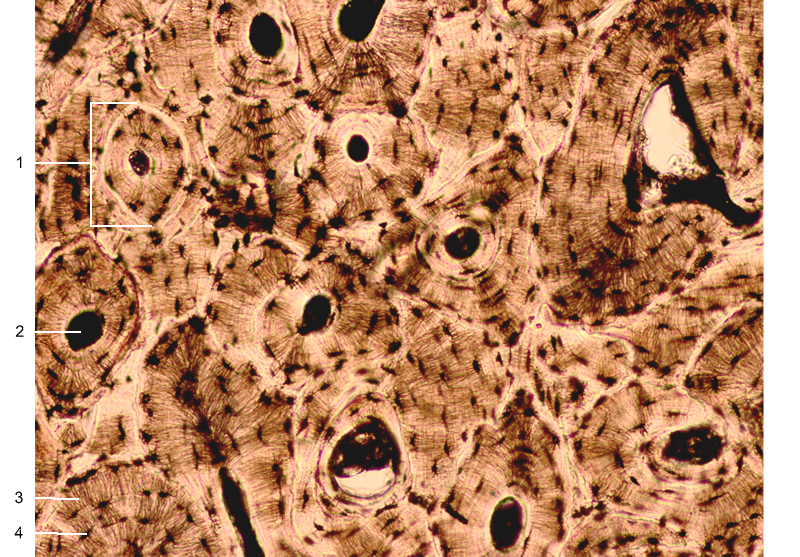
Osseous tissue
bone tissue
function of osseous tissue
weight-bearing; provides structure to the body and armor-like protection for vital organs; mineral storage
osteoblasts
bone building cells
osteocytes
bone-maintaining cells; highly vascular
osteoclasts
bone-destroying cells
materials of bone extracellular matrix
hard matrix; collagen fibers; calcium phosphate
Blood
A type of connective tissue that connects all body systems and provides substances needed for function, survival, and defense

Plasma
Blood’s liquid, nonliving extracellular matrix
Erythrocytes
The most abundant cells that transport exigen from the lungs to the body’s tissues and carry carbon dioxide back to the lungs; also called red blood cells
Leukocytes
Vital components of the immune system; protect the body by identifying and destroying pathogens, foreign particles, and cancer cells; also called white blood cells
Thrombocytes
Cell fragments that play a vital role in blood clotting by sealing damaged blood vessels; also called platelets
Formed components of blood
Erythrocytes, leukocytes, and thrombocytes
Function of blood tissue
Transports gases, wastes, and nutrients throughout the body
muscle tissue
Tube-like cells that allow for movement and contraction; highly vascularized; cells are numerous and tight with little extracellular matrix; contain myofilaments; cannot regenerate; includes skeletal, cardiac, and smooth muscle
skeletal muscle
muscle tissue that is found attached to bones via tendons and ligaments; is striated and voluntary; arranged in fascicles

function of skeletal muscle
provides bodily movements, maintains posture, stabilizes joints, and generates heat
cardiac muscle
muscle tissue found only in the heart; is striated but involuntary; contain branched fibers and intercalated discs

function of cardiac muscle
to pump blood through the heart and into the circulatory system
smooth muscle
type of muscle in the walls of organs; is non-striated and involuntary

function of smooth muscle
to propel substances through internal passageways; control the width of blood vessels and airways
nervous tissue
the main component of the nervous system; located in the brain, spinal cord, and nerves; includes neurons and glial cells

function of nervous tissue
to regulate and control body functions
neurons
the basic functional and structural units of the nervous system; send and receive electrochemical signals; enable perception, sensation, movement, emotions, memory, and reasoning
glial cells
supportive and non-conducting cells that support, insulate, and protect neurons
chondrocytes
mature cells found in cartilage
chondroblasts
cartilage-building cells
fibroblasts
fiber-building cells; create ground substance
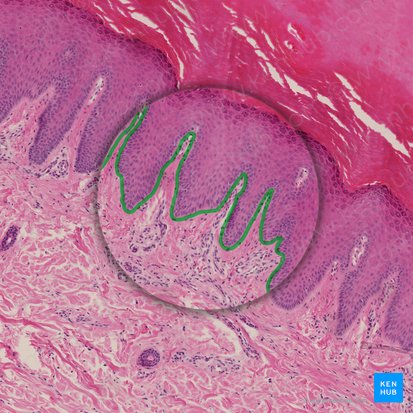
basement membrane
a double-layered structure that is between the epithelium (above) and the connective tissue (below)
apical surface
the “free surface”; exposed to the external environment; found in epithelial tissue
basal surface
the “bound” surface; bound to underlying tissue; found in epithelial tissue