Lvl2: Financial statement analysis
 Call Kai
 Learn
Learn Practice Test
 Spaced Repetition
 Match
Match Flashcards
 Knowt Play
1/41

There's no tags or description
Looks like no tags are added yet.
Name | Mastery | Learn | Test | Matching | Spaced | Call with Kai | Chat |
|---|
No analytics yet
Send a link to your students to track their progress
42 Terms
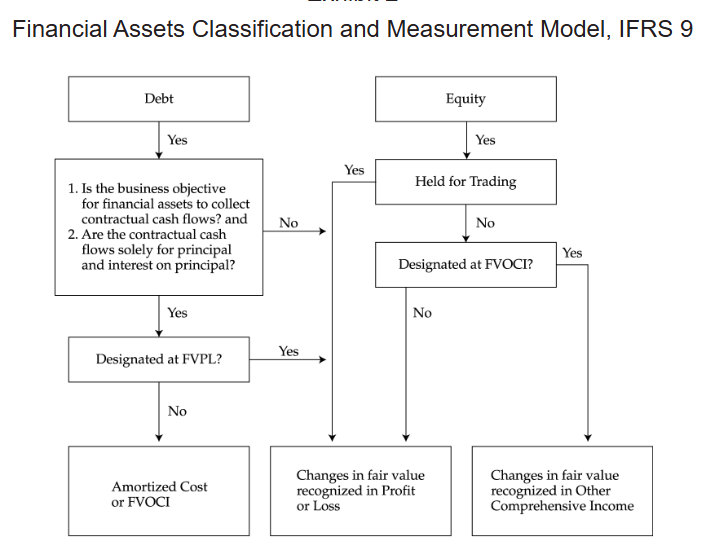
IFRS9 classification
IFRS9 reclassification
Reclassifications of debt instruments are permitted only when the business model changes. The choice to measure equity investments at FVOCI or FVPL is irrevocable.
Consolidation - contingent liabilities
recognize any contingent liability assumed in the acquisition if 1) it is a present obligation that arises from past events, and 2) it can be measured reliably.
IFRS include contingent liabilities if their fair values can be reliably measured. US GAAP includes only those contingent liabilities that are probable and can be reasonably estimated.
“Partial goodwill” vs “Full goodwill”
partial - fair value of consideration given) less the acquirer’s share of the fair value of all identifiable tangible and intangible assets, liabilities, and contingent liabilities acquired
full - fair value of the entity as a whole less the fair value of all identifiable tangible and intangible assets, liabilities, and contingent liabilities
IFRS either ; US GAAP only full
NCI
IFRS either full or partial ; US GAAP only full
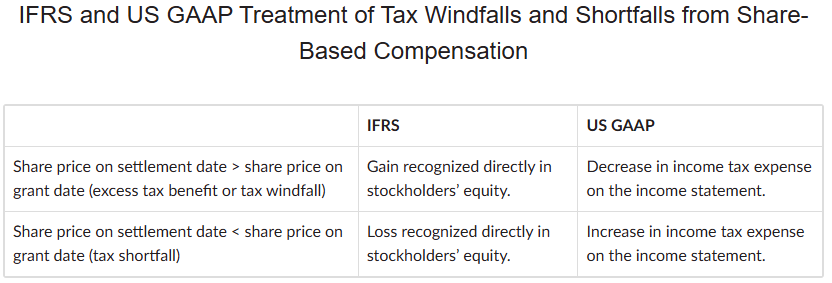
share based comp - tax
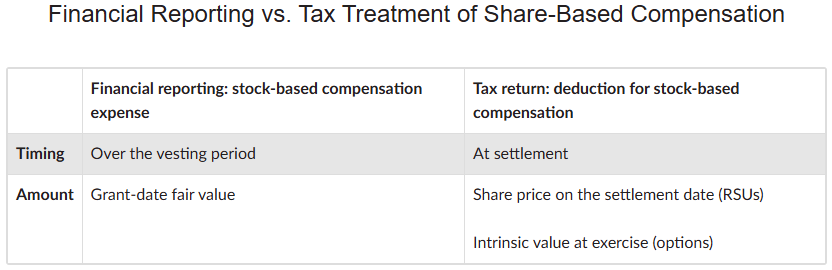
tax windfall from increase in share price
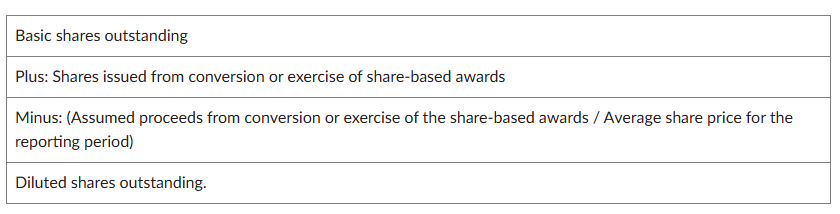
shares outstanding
Assumed proceeds from cash exercise + Average unrecognized share-based compensation expense
In-the-money options (average share price > strike price) are dilutive and included in diluted shares outstanding.
Out-of-the-money and at-the-money options are anti-dilutive and left out of diluted shares outstanding.
RSUs are dilutive except when the average stock price is materially below the stock price at the RSU grant date. This can result in anti-dilutive RSUs because the unrecognized stock-based compensation expense is based on grant date share prices.
Funded status
Funded status = Fair value of plan assets – Pension obligation
Pension obligation = The present value, without deducting any plan assets, of expected future payments required to settle the obligation resulting from employee service in the current and prior periods.
different plans’ funded statuses cannot be netted
Pension expense - IFRS
Service cost - PL operating- current (from service in current period); past
Net interest expense/income - PL financing - pension obligation accretion
Remeasurement - OCI - actuarial + actual vs assumed rate
Pension expense - GAAP
Current service cost - opex
Interest cost - int exp - gross - pension obligation unwinding
Expected return on plan - offset in earnings - expected rate of return
Amortization of past service cost - OCI
Amortization of net gains or losses - PL or OCI - actuarial + actual vs assumed
valuation of DB plan
underfunded plan is considered debt
overfunded plan is ignored in valuation
remove net interest expense if net pension balance is deducted from enterprise value
Basel III
minimum capital requirement - % of risk-weighted assets funded with equity capital (equity capital excluding deferred tax and intangible assets)
minimum liquidity - high-quality liquid assets - 30 day stress scenario
stable funding - tenor of deposits and type of depositor
Camels
Capital adequacy, Asset quality, Management capabilities, Earnings sufficiency, Liquidity position, and Sensitivity to market risk.
1-5 rating - 1 best
composite rating - weighted
Capital adequacy
absorb potential losses
risk weighted assets - cash 0%; corporate loans 100%
capital tiers - tier 1 common stock retained earnings, oci tier 2 subordinate
Asset quality
existing and potential credit risk of assets
Management capabilities
governance structure, internal controls, ability to identify and control risk
Earnings
adequate return on capital to capital providers
Liquidity Position
to pay liabilities
liquidity coverage ratio - min % of expected cash outflows that must be held in highly liquid assets
net stable funding ratio - min % of required stable funding sourced from available stable funding - liquidity
Concentration of funding - proportion obtained from a single source
Contractual maturity - maturity of assets compared to funding source
Snensitivity to market risk
interest rate, ex rate, equity prices, commodity prices
Other banking-specific considerations
Govt support
Govt ownership
Mission of banking entity
Corproate culture
Other considerations - bank
Competitive environment
Off-bs items
Segment information
currency exposure
risk factors
Basel III
combined ratio
insurance expenses / net premiums earned - low=hard insurance market > attracts new entrants
underwriting loss ratio + expense ratio
underwriting loss ratio: claims paid / net premiums written
expense ratio: underwriting + sales comm / net premiums earned
lower better
loss reserves
historical with estimate of future losses
if optimistic > priced too low
the longer the obligation runs > more difficult to estimate
profitability measure of health insurance
total benefits paid per net premium
commission & exp per net premium
net interest margin
diff between int income on loans - int paid on deposits
loans - LT
deposits - ST
reporting quality vs earnings quality
reporting - information in financial reports - decision useful; faithful rep
earnings - financial condition; sustainable activities
Beneish Model
probability of earnings manipulation
M-Score = DSR + GMI + AQI + SGI + DEPI - SGAI + Accruals - LEVI
DSR (days sales receivable index) = (Receivablest/Salest)/(Receivablest−1/Salest−1).
GMI (gross margin index) = Gross margint−1/Gross margint.
AQI (asset quality index) = [1 − (PPEt + CAt)/TAt]/[1 − (PPEt−1 + CAt−1)/TAt−1],
SGI (sales growth index) = Salest/Salest−1.
DEPI (depreciation index) = Depreciation ratet−1/Depreciation ratet, where Depreciation rate = Depreciation/(Depreciation + PPE).
SGAI (sales, general, and administrative expenses index) = (SGAt /Salest)/(SGAt−1/Salest−1)
Accruals = (Income before extraordinary items9 − Cash from operations)/Total assets.
LEVI (leverage index) = Leveraget/Leveraget−1, where Leverage is calculated as the ratio of debt to assets.
higher M score (less neg number) > increased prob
Earnings persistence
Earningst+1 = α + β1Earningst + ε
A higher coefficient (β1) represents more persistent earnings.
larger component of accruals would be less persistent and thus of lower quality.
Altman model
probability of bankruptcy
Z-score =
1.2 (Net working capital/Total assets) + : ST liq risk
1.4 (Retained earnings/Total assets) + : accum profitability & age
3.3 (EBIT/Total assets) + : profitability
0.6 (Market value of equity/Book value of liabilities) + : leverage ratio
1.0 (Sales/Total assets) : ability to generate sales
higher Z score better
bankruptcy <1.81 < unclear < 3 < low prob
shortcoming of Altman model
single period
past performance- going concern assumption
cash flow quality
positive OCF
OCF derived from sustainable sources
OCF adequate to cover capital expenditures, dividends, and debt repayments
OCF with relatively low volatility (relative to industry participants)
cash flow classification
FRS permits companies to classify interest paid either as operating or as financing.
IFRS also permits companies to classify interest and dividends received as operating or as investing.
US GAAP requires that interest paid, interest received, and dividends received all be classified as operating cash flow
balance sheet quality
completeness
unbiased measurement
clear presentation
balance-sheet-based and cash-flow-based accruals ratios
Balance sheet accruals ratio for time t = (NOAt − NOAt −1)/[(NOAt + NOAt−1)/2], and
Cash flow accruals ratio for time t = [NIt − (CFOt + CFIt)]/[(NOAt + NOAt−1)/2],
abs value - lower better
net asset balance sheet exposure
assets translated at the current exchange rate are greater than liabilities translated at the current exchange rate
Factors Considered in Determining the Functional Currency
sales price of goods and services
competitive forces and regulations
labor, material, cogs
financing
receipts
extension of parent or autonomy
large or small portion of parent
remitted to parent
need funds from parent
hyper inflation
cumulative 3-year inflation rate > 100%
IFRS - restated for local inflation > translate both BS and PL to parent presentation currency at current rate (monetary assets not restated, only non-monetary assets from date of revaluation; equity from beg of year or historical)
GAAP - remeasure as if functional currency is the reporting currency - temporal
current vs temporal method
current - foreign currency is the functional currency - translation adj in equity
temporal - parent presentation currency is functional currency - translation diff as gain/loss
SPEs
IFRS - all SPEs need to be consolidated
GAAP - qualifying SPEs do not need to be consolidated
Share based compensation
FV on grant date (RSU: share price; Option: FV of option)
recorded in PL over vesting period; and equity account
valuation considerations with share based comp
dilution from outstanding but unvested share-based awards - use diluted shares outstanding
dilution from future share-based awards - deduct share-based compensation from free cash flow