Lecture 3: Action Potentials, Synapses, and Neurotransmitter Function
 Call Kai
 Learn
Learn Practice Test
 Spaced Repetition
 Match
Match Flashcards
 Knowt Play
1/21

There's no tags or description
Looks like no tags are added yet.
Name | Mastery | Learn | Test | Matching | Spaced | Call with Kai | Chat |
|---|
No analytics yet
Send a link to your students to track their progress
22 Terms
What is an action potential?
An all-or-none electrical signal that travels down a neuron's axon when depolarization exceeds a threshold.

What ion influx causes depolarization during an action potential?
Sodium ions (Na+)
What is the threshold potential for generating an action potential?
Approximately -50 mV, though it can vary.
What are the phases of an action potential?
1. Resting potential, 2. Rising phase, 3. Overshoot (peak), 4. Falling phase, 5. Undershoot.
How is stimulus intensity encoded in neuronal communication?
By the frequency and pattern of action potentials, not by the amplitude or duration of individual action potentials.
What is a synapse?
The space between the presynaptic and postsynaptic neurons where chemical communication occurs.

What role do neurotransmitters play in neuronal communication?
They are released from the presynaptic neuron and bind to receptors on the postsynaptic neuron, affecting its activity.
What ion is necessary for neurotransmitter release at the presynaptic neuron?
Calcium ions (Ca2+)
What happens when an action potential reaches the axon terminal?
It causes depolarization, opening voltage-gated Ca2+ channels, leading to neurotransmitter release via exocytosis.

What determines the function of the postsynaptic cell?
The type of receptor located on the postsynaptic cell.
What are the two main types of post-synaptic receptors?
1. Transmitter-gated ion channels, 2. G-protein coupled receptors (GPCRs).
What is an excitatory post-synaptic potential (EPSP)?
A depolarization of the postsynaptic membrane due to the influx of Na+ ions.
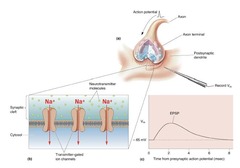
What neurotransmitter is typically associated with EPSPs?
Glutamate.
What is an inhibitory post-synaptic potential (IPSP)?
A hyperpolarization of the postsynaptic membrane due to the influx of Cl- ions.
Which neurotransmitter is typically associated with IPSPs?
GABA.
What are the effects of transmitter-gated ion channels?
They rapidly change the membrane potential of the postsynaptic cell.
What is the process of recycling synaptic vesicles called?
Endocytosis.
What is the role of the presynaptic neuron in synaptic transmission?
To release neurotransmitters into the synaptic cleft.
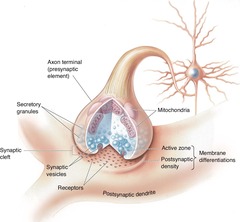
What happens to receptors on the postsynaptic membrane upon neurotransmitter binding?
They change conformation and exert effects on the postsynaptic neuron.
What is the significance of the action potential being an all-or-none response?
It means that once the threshold is reached, the action potential will occur fully, without varying in size.
What is the role of Na+ conductance in action potentials?
It is proportional to the number of open channels, affecting the depolarization phase.
What is the effect of Ca2+ influx at the axon terminal?
It stimulates the fusion of synaptic vesicles with the presynaptic membrane to release neurotransmitters.