1: HYPERTENSION
 Call Kai
 Learn
Learn Practice Test
 Spaced Repetition
 Match
Match Flashcards
 Knowt Play
1/121

There's no tags or description
Looks like no tags are added yet.
Name | Mastery | Learn | Test | Matching | Spaced | Call with Kai | Chat |
|---|
No analytics yet
Send a link to your students to track their progress
122 Terms
HYPERTENSION (High Blood Pressure)
It is the blood pressure elevated enough to perfuse tissues and organs
greater than or 140 mmHg
Systolic:
Diastolic: equal to or greater than 90 mmHg
HYPERTENSION (High Blood Pressure)
Persistent elevation in arterial pressure (consistent)
Increased pressure into the walls of the arteries
Sphygmomanometer
device used to measure blood pressure
equal to or greater than 90 mmHg
Systolic: greater than or 140 mmHg
Diastolic:
Peak value (heart contraction- The numerator)
In arterial blood pressure
Systolic BP =
Diastolic BP = Nadir value (heart relaxation- The denominator) - when the heart is relaxed, it fills blood that is why there is still pressure.
Nadir value (heart relaxation- The denominator) - when the heart is relaxed, it fills blood that is why there is still pressure.
In arterial blood pressure
Systolic BP = Peak value (heart contraction- The numerator)
Diastolic BP =
JNC/Joint National Commission 7
The table of hypertensionn is based on?
Mmhg: ≤ 120/80
Category:Normal
Mmhg: 120-139/80—89
Category: Prehypertension
Mmhg: ≥140/90
Category: Hypertension
Mmhg: 140-159/90—99
Category: Stage 1
Mmhg: ≥160/100
Category:Stage 2
SBP >180 or DBP > 120 mmHg
Hypertensive Emergency-
Systolic and Dystolic?
Hypertensive Emergency
End-Organ function or Organ damage
SBP> 160-180 mmHg or DBP2 100-120 mmHg
Asymptomatic Markedly Elevated Blood Pressure (formerly Hypertensive urgency)
SBP and DBP?
Asymptomatic markedly elevated blood pressure
Formerly hypertensive urgency
Primary, Essential or Idiopathic hypertension
No specific cause can be identified
Primary, Essential or Idiopathic hypertension
The average age of onset is about 35 years (90%)
renal artery constriction,
coarctation of the aorta,
pheochromocytoma,
Cushing's disease,
and primary aldosteronism.
Secondary hypertension is identifiable cause such as?
ages of 30 and 50 (10%)
Secondary hypertension develops between ages?
Renal artery constriction
kidney damage can also result to cardiovascular disorders
Pheochromocytoma
Tumor in the adrenal medulla wherein the NE is converted to Epinephrine which is the primary neurotransmitter of the sympathetic nervous system (fight or flight). Results in tachycardia in heart, vasoconstriction in vessels contributing to the increase of blood pressure
Cushing’s disease
excess of cortisol (sodium and water retention increasing blood volume at the same time, blood pressure.)
Primary aldosteronism
excess of aldosterone (sodium and water retention increasing blood volume at the same time, blood pressure.)
Age and Ethnicity
Smoking
High salt intake
Health problems
Inactive lifestyle
Alcohol
High stress level
Obesity
PREDISPOSING FACTORS IN PRIMARY HYPERTENSION
5-10 mmhg nicotine that is deposited and flows to the blood leading to obstruction of blood flow
HBP in smoking is due to?
Due to salt attracts water causing edema (water retention) resulting in high blood pressure
HBP due to high salt intake is because of?
Sedentary lifestyle that the excess energy s being used too much in heart contraction
HBP in inactive lifestyle is due to?
High cholesterol levels
HBP in Obesity is due to?
Angiotensinogen
ACE (Angiotensin converting enzyme)
B2 A drenoceptor
Alpha Adducin
Functional variation of genes that may contribute to essential Hypertension
ACE (Angiotensin converting enzyme)
Used for the conversion of Angiotensin 1 to 2 which is a potent vasoconstrictor.
BP = TPR x CO
Determinants of Blood Pressure
TPR is Total Peripheral Resistance
resistance as the heart pumps out blood
blood pressure
TPR is directly proportional to the ___
arteries
primary resistance vessels
TPR is that the ___ are the involved vessels which are also known as ____ which keep blood from coming back to the heart
10 resistance vessels
Tone of arterioles in TPR
Downward resistance (decrease BP)
TPR when dilated
Upward resistance (Increased BP)
TPR when constricted
Cardiac output
CO is?
pumped blood per minute
Cardiac output
CO = SV x HR
Equation of CO
Cardiac output
is the volume of the blood pumped by the heart per minute
Stroke volume
volume of the blood pumped by the heart every beat.
(60-80 mL)
How many mL of SV?
Heart Rate
number of beats per minute
(60-100 bpm)
How many bpm for Heart rate?
3.6 L to 8 L per minute.
How many Liters per minute?
Inotropic activity of the heart
Preload/Venous return
Factors Affecting Stroke Volume:
Strength of cardiac contraction (inotropism)
Inotropic activity of the heart
tone of veins / capacitance vessels
contain highly elastic blood
Preload / Venous Return
downward venous return
When Venous return is dilated?
upward venous return
When the venous return is constricted
1. Resistance Arterioles
2. Capacitance Venules
3. Pump output Heart
4. Volume Kidneys
CNS sympathetic nerve in BP
Baroreceptor reflex arc
Renin angiotensin-aldosterone system
Mosaic theory
Fluid volume reulation
BLOOD PRESSURE REGULATION IN THE BODY
Kidneys are responsible for volume regulation. When the amount of blood pumped by the heart decreases the kidneys will retain salt and water to be able to increase the venous return back to the heart.
When a patient has edema and HTN, salt and water must be excreted to be able to manage the high blood pressure
Explain the fluid volume regulation
Important in the moment-moment control of BP
Such as in transition from a reclining to an upright posture
In orthostatic hypotension, the baroreceptors will be activated to bring the blood pressure back to normal.
Baroreceptor reflex arc mechanism
Baroreceptor
It is a stretch receptor.
increase volume
increase pressure
Baroreceptors is activated in the presence of factors that distend its tissues such as:
Found in the carotid and aortic arch
Baroreceptor is found in the?
Respond to blood pressure
Influence - Arteriolar dilation & Constriction.
Baroreceptor responds to? and influence?
Affector
Central integrating area
Effector
Inhibitory interneuron
COMPONENTS OF BARORECEPTOR REFLEX ARC
AFFECTOR
Made up of carotid baroreceptors
Affector
It brings stimuli to the central area
Central integrating area
It is the central vasomotor area and It interprets the stimuli and appropriate responses
Effector
It is composed of blood vessels and the heart and It performs the function of central integrating area.
inhibitory effect
decrease sympathetic discharges.
Inhibitory interneuron when it is stimulated, it can cause an ___ on the central area to _____
Renin
an enzyme which can be secreted from the Juxtaglomerular apparatus
Renin angiotensin-aldosterone system
It is important in LONG TERM blood pressure regulation.
Kidney
In the R.A.A.S. which is responssible for the long term blood pressure control
Angiotensin II
Causing:
Increased sodium reabsorption
Fluid volume
Blood pressure
In stimulates the aldosterone that can cause?
Renin is secreted juxtaglomerular apparatus then Angiotensin 1 will be converted to angiotensin 2 by the angiotensin converting enzyme (ACE) increasing the SVR for vasoconstriction. Along with them is the aldosterone which is a hormone responsible for water and sodium retention increasing the blood volume and cardiac output.
Explain the flow of the picture
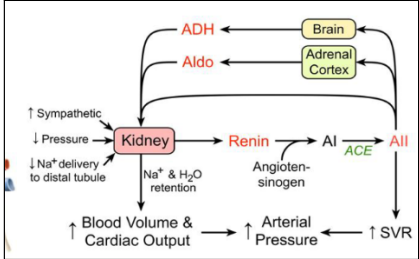
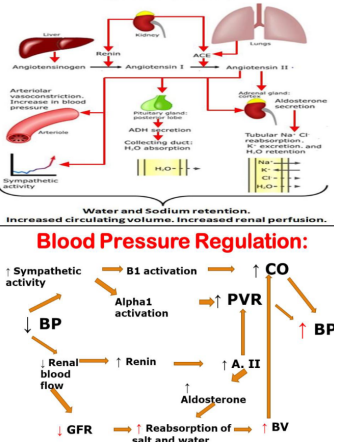
When the BP becomes low the BARORECEPTOR REFLEX ARC (upper part of the diagram) will act first which results in increased sympathetic activity. Adrenoceptors have B1 activation which is located in the heart in which when activated, the heart will contract, increasing the cardiac output resulting in an increase in blood pressure. Another adrenoceptor is Alpha 1 receptor which is located in blood vessels resulting in vasoconstriction increasing TPR/PVR which also results in an increase in blood pressure.
In RAAS (lower part of the diagram)the kidneys will act by lowering the renal blood flow and glomerular filtration rate to retain the water and sodium. This will reabsorb water and salt, increasing the blood pressure. Kidneys can also form Renin from JGA producing the angiotensin 2 which is a potent vasoconstrictor resulting in an increase in TPR/PVR which leads to increasing blood pressure. Angiotensin 2 can also activate aldosterone which aids in water and salt retention increasing the blood volume.
Explain the difference in between the baroreceptor and RAAS
Mosaic Theory
multiple factors responsible for sustaining blood pressure.
the sympathetic nervous system
renin- angiotensin aldosterone system and potential defects in the sodium transport within and outside the cell may play a role in long term hypertension
Vasoactive Substances that are involved in the normal maintenance of normal blood pressure
Mosaic theory is the interaction between?
Nitric oxide
Endothelin
Bradykinin
The mosaic theory has a vasoactive substance that includes?
Nitric Oxide
The vasodilating factor
Nitric Oxide
Potent vasodilator and Decrease TPR
EDRF or Endothelium Derived Relaxing Factor
Nitric Oxide Formerly known as_____
Endothelin
This can increase TPR and a vasoconstrictor peptide
Bradykinin
Potent vasodilator inactivated by ACE and DECREASE TPR
Bradykinin
An atrial natriuretic peptide (naturally occurring diuretic)
Cardiac effects
Renal effects
Cerebral effects
Retinal Effects
COMPLICATIONS OF HYPERTENSION
Angina pain
Left ventricular hypertrophy
In the cardiac effects it includes?
Angina pain
chest pain which can radiate into the left arm
Left ventricular Hypertrophy
resulting to edema of extremities
The size of the left ventricle decreases which limits its capacity to hold oxygenated blood resulting in lower cardiac output.
Results to edema since the kidneys will retain more water and salt.
Explain the cardiac effect of the left ventricular hypertrophy
Polyuria
Nocturia
Diminished ability to concentrate urine and red blood cells in urine
Elevated serum creatine
Complication of renal effects includes the?
Polyuria
This is the urinary incontinence and an excessive urination due to HBP
Nocturia
Urination at night
Elevated serum creatinine
This complication indicated renal failure
Transient ischemic attacks
Development of aneurysm with hemmorrhage
Cerebral thrombosis
Cerebral effects can cause?
Transient ischemic attack
numbness in the half part of the body due to low oxygen supply in the brain caused by obstructed blood vessels.
Development of Aneurysm with hemorrhage
severe lack of oxygen due to blockade
Blurred vision
Spots
Blindness
Retinal effects affects the visual defects such as?
Weight reduction
Adopt DASH eating plan
Dietary sodium reduction
Physical activity
Moderation of alcohol consumption
Give the enumeration of Non-pharmacologic intervention
5-20mmHg blood pressure
every 10kg weight loss reduces _____
Adopt DASH eating plan
Consume a diet rich in fruits, vegetables, and low-fat dairy products with a reduced content of saturated fat and total fat
100mEq/d (2.4 g sodium or 6g sodium chloride)
Dietary Sodium reduction is reduce dietary sodium intake to no more than ____
(at least 30mins per day, most days of the week)
In physical activity engage in regular aerobic physical activity, such as brisk walking _____