1.1.1 Derivatives
 View linked note
 Call Kai
 Learn
Learn Practice Test
 Spaced Repetition
 Match
Match Flashcards
 Knowt Play
1/3

There's no tags or description
Looks like no tags are added yet.
Name | Mastery | Learn | Test | Matching | Spaced | Call with Kai | Chat |
|---|
No analytics yet
Send a link to your students to track their progress
4 Terms
Derivative
instantaneous rate of change at a specific point
the slope of the tangent line to the function's graph at that point
How can you define the derivative of y = f(x) at x = a using h?
h represents some distance away from a
meaning as h → 0, the distance is getting smaller
a number divided by a smaller number makes the numerator bigger
ex. 1/0.1 = 10
as h gets close to zero, the numerator becomes smaller since the distance keeps decreasing
ex. (7+3) - 7 = 3 → (7 + 2) - 7 = 2 → (7 + 1) - 7 = 1 → (7 + 0.0000...1) - 7 = 0
Eventually, the numbers become so small that when the small denominator multiplies the small numerator, it is closer to 0 than anything else
∴ limit exists
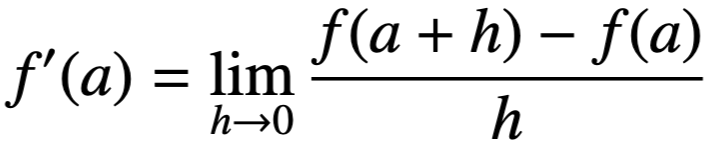
How can you define the derivative of y = f(x) at x = a using x and a?
[x, f(x)] is a point on the graph
[a, f(a)] is a point on the graph
as x → a, x is slowly moving closer towards a
when x = a, it must have the same slope since they are the same point now
the slope at x, f(x) is the slope of a, f(a)
![<ol><li><p>[x, f(x)] is a point on the graph</p></li><li><p>[a, f(a)] is a point on the graph</p></li><li><p>as x → a, x is slowly moving closer towards a </p></li><li><p>when x = a, it <span style="color: red;"><strong>must</strong></span> have the same slope since they are the same point now</p></li><li><p>the slope at x, f(x) is the slope of a, f(a)</p></li></ol><p></p>](https://knowt-user-attachments.s3.amazonaws.com/a28d2acd-9882-4416-be06-c40d3f604b66.png)