PDP 2026 exam
 Call Kai
 Learn
Learn Practice Test
 Spaced Repetition
 Match
Match Flashcards
 Knowt Play
1/79

There's no tags or description
Looks like no tags are added yet.
Name | Mastery | Learn | Test | Matching | Spaced | Call with Kai | Chat |
|---|
No analytics yet
Send a link to your students to track their progress
80 Terms
Critical section definition
A section of code that may only be executed by one process at any one time.
Mutual Exclusion definition
A property, the requirement that one thread of execution never enter its critical section at the same time that another concurrent thread of execution enters its own critical section.
Starvation definition
The problem encountered in concurrent computing where a process / thread is perpetually denied necessary resources to process its work.
Deadlock definition
A program state in which each member of a group is waiting for some other member to take action.
Race condition definition
Any situation where the outcome depends on the relative ordering of execution of operations on two or more threads.
Data race definition
Happens when there are two memory accesses in a program where both
target the same location
are performed concurrently by two threads
are not reads
are not synchronization operations
A future definition?
A future implements an (asynchronous) one-off event
waiting for the occurrence of the event is possible
the event is typically the completion of an asynchronous task with return value
Atomic operation definition?
A set of operations that appears to the rest of the system to occur at once without being interrupted (uninterruptible).
Test-and-set instruction definition?
Set value to true
Return value tells if prior value was true or false
Both done as a single atomic operation
Test-and-set lock?
Test the lock: if free, it atomically sets it to locked and enters critical section
If lock already taken, keep testing (spin)
Release the lock: when finished, it sets lock back to unlocked
LoadLoad program reordering?
Load ins reordered before/after another.
LoadStore program reordering?
Store ins reordered before load ins
StoreLoad reordering?
Load ins reordered before store ins
StoreStore program reordering?
Store ins reordered before/after another.
A multiprocessor is sequentially consistent if
the result of any execution is the same as if the operations of all the processors were executed in some sequential order,
and the operations of each individual processor appear in this sequence in the order specified by its program
StoreLoad reordering not allowed
Total Store Order (TSO) memory model?
More relaxed but weaker
StoreLoad reordering allowed in threads
How to avoid StoreLoad reordering in TSO explicitly?
With memory fence: instruction inserted in source code that explicitly enforces a memory ordering
Memory fence what is it?
Instruction inserted in source code that explicitly enforces a memory ordering.
Different kind of memory fences?
Full memory fence = all operations before the fence are finished before all other operations after the fence
StoreLoad fence = all store operations before fence are finished all load operations after fence
LoadLoad, StoreStore, LoadStore
Software memory model?
Putting another memory on top of a (weaker) hardware memory model.
Categories of atomic operations supported in Cpp with different memory ordering semantics?
Load = atomically read from var
Store = atomically write to var
Read-Mofidy-Write = automatically read and write
Coarse-grained synchronization for a linked list?
Protect whole linked list with a single lock.
Congestion if many threads wanna access.
Fine-grained synchronization (for linked list)?
Split object into independently-synchronized components
Lock while traversing the list, no validation
Disadvantages: long chain of acquire/release + inefficient (because of traversal locking)
Optimistic synchronization (for linked lists)?
In general: traverse without locks, then lock, validate and possibly restart
Validation via scanning again to make sure nodes still adjacent
Lazy synchronization for linked lists for example?
Traverse without locks, lock, validate, mark/remove, but contains() never locks (thanks to markers even though if the elements still exists)
Validation done locally using the locked nodes → no second traversal
Logical deletion (marked = true)
Physical deletion (update pointers)
Linked list synchronization patterns?
Coarse-grained
Fine-grained
Optimistic
Lazy
Lock-free
Lock-free synchronization for linked lists?
Rely on atomic operations
Thread reads current pointer
Prepare new node
Atomically perform Compare-and-Swap (CAS)
If pointer unchanged, update
If another thread changed it first, the CAS fails & retry
C++ execution policies?
std::execution::par_unseq → multi-threaded, vectorization (fastest)
std::execution::par → multi-threaded, no vectorization
std::execution::par → single thread
Parallel execution policy what to take into consideration?
Make sure that there are no data races or deadlocks.
Power consumption of a processor?
P~V²f
Power consumption of processor rule of thumb?
Reduction of 1% voltage and 1% reduces the power consumption by 3& and the performance by0.66%.
Vectorization definition?
Single instruction defines n operations (instruction-level parallelism).
Features of GPU threads?
Light-weight, little creation overhead, fast context switching
Up to 32 per core
Why do GPUs have good performance watt ratio?
Many low frequency cores (watt usage), no control logic
More transistors for computation (peak performance)
GPU architecture abstracted?
GPU → Device → GPU Processing Cluster (GPC) → Streaming Multiprocessor (SM) → Processing Element (PE) / “Core”
SIMD / Vector?
Single thread executes a single instruction stream, but the hardware has wide vector registers and ALUs that apply that instruction across multiple data elements simultaneously.
→ programmer packs data into vector registers and issues one vector instruction
→ x86 SSE/AVX
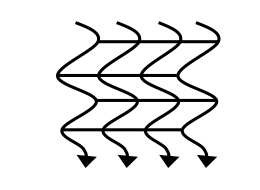
SIMT (Single Instruction, Multiple Threads)?
System presents the architecture as multiple scalar threds, but hardware groups them into bunches (“warp” of 32 threads) that execute in lockstep using a shared PC.
→ write code as each thread is independent with their own IDs but the GPU hardware executes the same instructions across all active threads
→ diverging with if/else
→ FPU
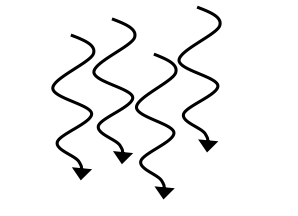
MIMD/SPMD
Multiple truly independent threads cores, each having its own hardware PC, cache and execution pipeline.
→ multicore CPU
Pool of warps what does it mean?
A streaming multiprocessor maintains a pool of active warps residing concurrently in hardware registers.
Warp scheduler?
Selects eligible warps and issues their instructions to the execution pipelines with zero context-switch overhead.
Thread blocks?
Multiple warps grouped into thread blocks.
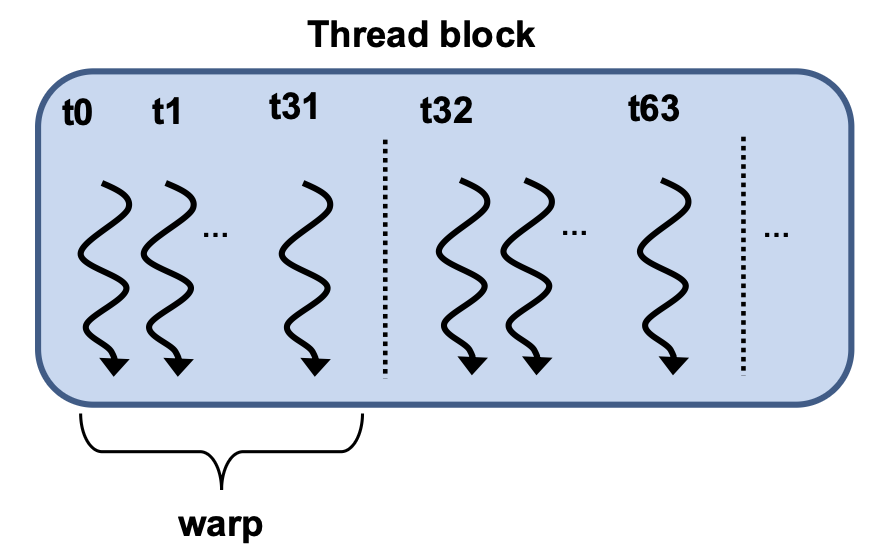
Threads inside a block are scheduled on the same …
… multiprocessor!
How large should a thread block be?
Around 512.
Each thread is executed by a …
… core
Each thread block is executed on a …
streaming multiprocessor (SM).
Multiple thread blocks are grouped into
thread block clusters.
Thread block clusters are executed on a
GPC.
Kernel is executed as a
grid of clusters of blocks of threads on a device.
GPU programming design cycle?
Assess (find hotspots with profile)
Parallelize (replace serial hotspot via library calls, low-level code)
Optimize (iteratively)
Deploy (and verify)
Different techniques to do GPGPU programming higher level to lower level?
Libraries (cuSPARSE)
Directives (OpenMP)
Programming Languages (CUDA)
How to calculate t_compute?
arithmetic operations [FLOP] / Pmax
How to calculate t_memory?
data transfers (LOAD, STORE) [words] / bs
How to calculate t_kernel?
max(t_compute, t_memory)
How to calculate the total execution time t_GPU?
t_GPU = t_H2D + t_kernel + t_D2H
How to calculate t_H2D or t_D2H?
t_H2D = alpha + LOADs / b_PCI
where alpha is latency, and STOREs for other way respectively
Occupancy per SM how to calculate?
Occupancy = active warps / max supported active warps
Kernel code built-in variables?
gridDim: dimensions of gird (dim3)
blockDim: dimensions of block (dim3)
blockIdx: block index within grid (uint)
threadIdx: thread index within block (uint)
global index: gIdx = blockIdx.x * blockDim.x + threadIdx.x
Kernel usage with execution configuration?
kernel_func<<<dimGrid, dimBlock>>>(a, b, c)
How to allocate memory in device?
cudaMalloc(pointerToGPUMem, size)
How to free memory pointer from device?
cudaFree(pointerToGPUMem)
How to transfer memory from pointer to pointer for device or the other ways?
cudaMemcpy(dest, src, size, direction)?
direction: cudaMemcpyHostToDevice, —-DeviceToHost, —DeviceToDevice, —Default
Ways to optimize CUDA applications in high level?
Data access patterns
Memory coalescing
Branching
Synchronization
Heterogeneous computing
Array of Structures vs Structure of Arrays (SoA)?
Stores complete Pt objects contiguously in memory, which leads to strides, non-coalesced memory accesses when single fields accesses
Group all identical fields contiguously into separate arrays → better when accessing single elements
Branch efficiency?
The ratio of executed flow control decisions over all executed conditionals.
What does heterogeneous computing mean in terms of GPUs?
CPU & GPU both fully utilized
Challenge in load balancing
What are the most common deep learning operations?
Fully connected (MLP, CNN, Transformer)
Convolution (CNN)
Attention (Transformer)
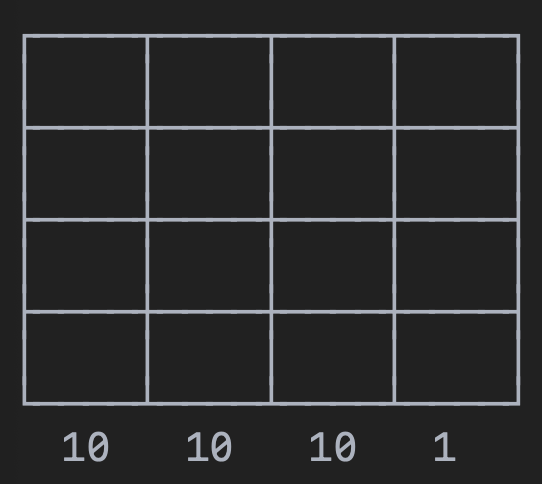
What is meant by tile quantization in tensor cores?
Tensor cores operate on fixed-size matrix fragments (tiles), e.g. 10 × 10
If matrix not dividable by 10, e.g. 40 × 31, we still need 4×4 tiles.
We have to do work of 40 × 40 but only need 40 × 31.
WASTED WORK INSIDE A TILE.
What is meant by wave quantization in tensor cores?
e.g. 20 even tiles to process
GPU has 16 SMs
First wave → 16 tiles, 16 SMs
Second wave → 4 SMs, 12 SMs idle
Tail wave = the 75% idle SMs
Parallel data architectures in bulk-synchronous parallelism?
Shared memory (single memory for all Ps)
Distributed memory (data exchange via message passing in network)
Ways to pass messages in distributed memory machines?
Classical/explicit approach: MPI (p-2-p, collective)
Abstract/implicit approach: BSP (bulk-synchronous parallel)
Elements of BSP algorithm?
Series of supersteps
Computation phase
Communication phase
Barrier
How does block distribution and and cyclic distribution look like?
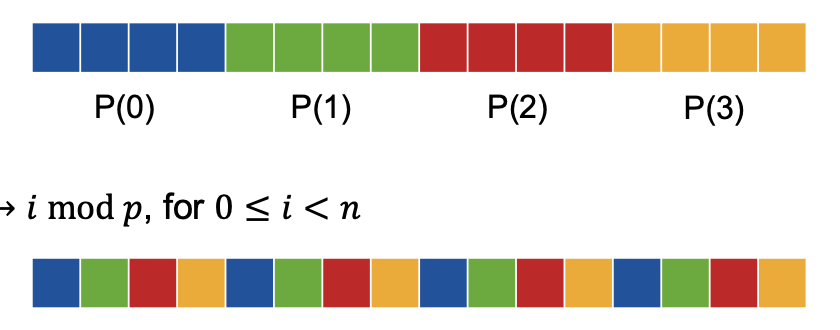
How to characterize BSP computer as a 4-tuple?
p: number of processors
g: communication cost per data word [s/word]
l: latency [s]
r: computation rate per processor [FLOP/s]
Work metric of computation cost calculations?
wi(s) , where number of floating-point operations (FLOPs) perfomed by processor s during superstep i
Time until all processors have finished in the BSP computation phase?
\frac{1}{r}\cdot\max_{0\le s<p}w_{i}^{\left(s\right)}\left\lbrack s\right\rbrack
What is h-relation in cost of communication phase?
\max_{0\le s<p}\max\left\lbrace r_{i}^{\left(s\right)},t_{i}^{\left(s\right)}\right\rbrace [words]
→ maximum number of words transmitted/received by any process in superset i
Time until all other processors have finished communication phase?
ghi , where g is communication cost per data word
Cost of superset (computation phase and communication phase together)?
T_{i}=\frac{1}{r}\cdot\max_{0\le s<p}w_{i}^{\left(s\right)}+gh_{i}+l\left\lbrack s\right\rbrack
→ computation + communication + latency l
BSP library interface?
Environment → object representing physical system
SPMD Block → execute identical code across all available processors
World → enables communication & synchronization between processors