Topic 6: Anaerobic Respiration
0.0(0)
Studied by 2 people View linked note
 Call Kai
 Learn
Learn Practice Test
 Spaced Repetition
 Match
Match Flashcards
 Knowt Play
Card Sorting
1/8

There's no tags or description
Looks like no tags are added yet.
Last updated 6:32 PM on 3/29/23
Name | Mastery | Learn | Test | Matching | Spaced | Call with Kai | Chat |
|---|
No analytics yet
Send a link to your students to track their progress
9 Terms
1
New cards
3 main ways pyruvate from glycolysis is used:
\
* Pyruvate oxidation and Krebs cycle (aerobic conditions)
* Alcoholic fermentation (anaerobic conditions)
* Lactic acid fermentation (anaerobic conditions)
* Pyruvate oxidation and Krebs cycle (aerobic conditions)
* Alcoholic fermentation (anaerobic conditions)
* Lactic acid fermentation (anaerobic conditions)
2
New cards
Alcoholic Fermentation
A type of anaerobic fermentation in which pyruvate is converted to ethanol and CO2 by yeast cells, generating 2 ATP
3
New cards
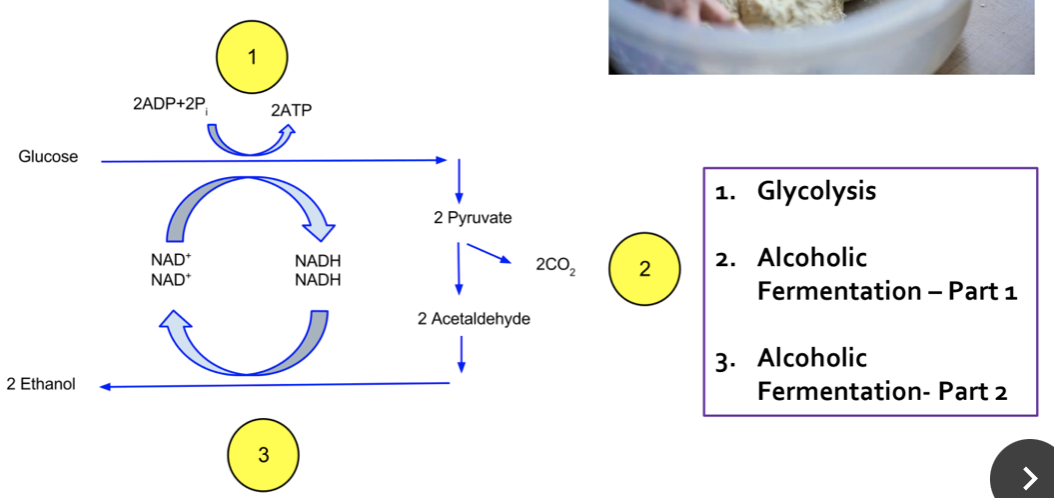
Steps of Alcoholic Fermentation
1. 2 pyruvate → 2 acetaldehyde + 2 CO2
2. 2 acetaldehyde + 2 NADH + 2 H+ → 2 ethanol + 2 NAD+
4
New cards
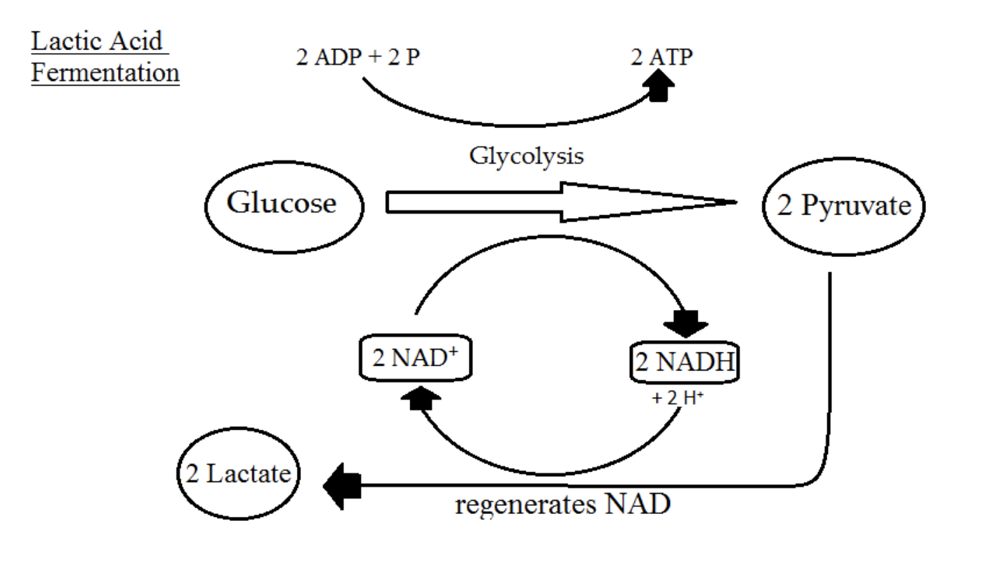
Lactic Acid Fermentation
* A type of anaerobic fermentation in which pyruvate is converted to lactate by muscle cells during exercise, generating 2 ATP
* Pyruvate is reduced directly by NADH to form lactate
* 2 pyruvate + 2 NADH + 2 H+ → 2 lactate + 2 NAD+
* Pyruvate is reduced directly by NADH to form lactate
* 2 pyruvate + 2 NADH + 2 H+ → 2 lactate + 2 NAD+
5
New cards
Lactate
* onized form of lactic acid
* Lactate is acidic, which drops the pH of the blood leading to cramping and muscle fatigue
* When at rest lactate is converted back to pyruvate in the liver
* Lactate is acidic, which drops the pH of the blood leading to cramping and muscle fatigue
* When at rest lactate is converted back to pyruvate in the liver
6
New cards
How cellular respiration and fermentation are naerobic and aerobic alternatives for producing ATP from sugars
\
* Both use glycolysis to oxidize sugars to pyruvate to form 2 ATP by substrate-level phosphorylation
* Both use NAD+ as an electron acceptor
* In fermentation, the electrons of NADH are passed to an organic molecule (ethanol or lactate/lactic acid), regenerating NAD+
* Under aerobic respiration, a molecule of glucose yields 38 ATP, but the same molecule of glucose yields only 2 ATP under anaerobic respiration
* Both use glycolysis to oxidize sugars to pyruvate to form 2 ATP by substrate-level phosphorylation
* Both use NAD+ as an electron acceptor
* In fermentation, the electrons of NADH are passed to an organic molecule (ethanol or lactate/lactic acid), regenerating NAD+
* Under aerobic respiration, a molecule of glucose yields 38 ATP, but the same molecule of glucose yields only 2 ATP under anaerobic respiration
7
New cards
Deamination
* Proteins must first be digested to individual amino acids and their amino groups removed via deamination
* The process of removing amino groups from amino acids, which allows the carbon skeletons to enter glycolysis or the Krebs cycle as substrates
\
* The process of removing amino groups from amino acids, which allows the carbon skeletons to enter glycolysis or the Krebs cycle as substrates
\
8
New cards
Fatty Acid Oxidation
* The process of breaking down fatty acids into two-carbon fragments, which can enter the Krebs cycle as acetyl CoA and generate large amounts of ATP
* Fats must be digested to glycerol and fatty acids
* Glycerol can be converted to glyceraldehyde-3-phosphate, an intermediate of glycolysis
* Fats must be digested to glycerol and fatty acids
* Glycerol can be converted to glyceraldehyde-3-phosphate, an intermediate of glycolysis
9
New cards
Proteins and Fats as energy sources
\
* Carbohydrates, fats, and proteins can all be catabolized through the same pathways in cellular respiration
* They can enter glycolysis and the Krebs cycle at specific locations
* Carbohydrates, fats, and proteins can all be catabolized through the same pathways in cellular respiration
* They can enter glycolysis and the Krebs cycle at specific locations