Patterns and Expressions (Number and ALgebra)
 Call Kai
 Learn
Learn Practice Test
 Spaced Repetition
 Match
Match Flashcards
 Knowt Play
1/20

There's no tags or description
Looks like no tags are added yet.
Name | Mastery | Learn | Test | Matching | Spaced | Call with Kai | Chat |
|---|
No analytics yet
Send a link to your students to track their progress
21 Terms
Independent Variable (in functions)
The input into a function, representing the variable that is known. Normally, it is represented by the variable x.
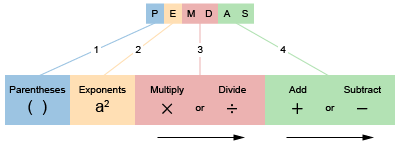
Order of Operations
PEMDAS: set order in which multi-step equations must be solved: Parenthesis, exponents, multiplication, and division, addition and subtraction
Linear Expression
An expression that does not contain any exponents. Ex: 2x+3
Sequence
A list of numbers, shapes, symbols, or terms listed in a specific order; most follow a pattern. Ex: 3, 6, 9, 12, 15
Dependent Variable (in functions)
The output of a function, or the result after solving the function using the independent variable. It’s commonly represented by the variable y.
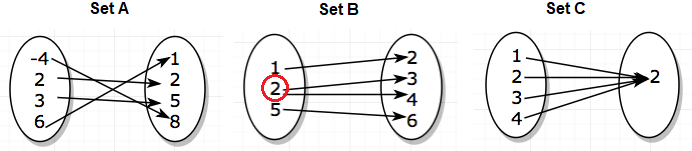
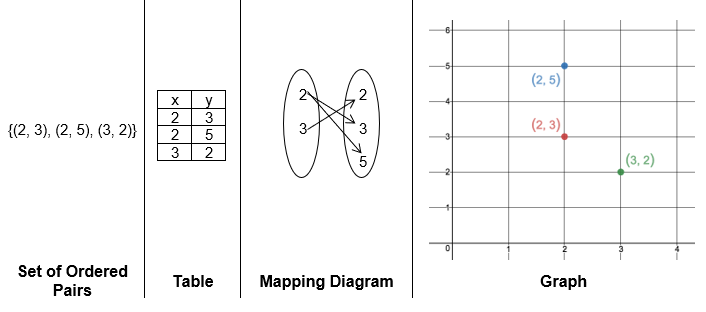
Mapping Diagram
A diagram showing a relation’s inputs and their corresponding outputs using arrows
Dependent Variable
A variable that changes in response to another variable. Ex: In the equation y=2x+4, y is the dependent variable. In the equation T=13.50h+45, T (total amount of money) is the dependent variable. It depends on h (# of hours worked).
Coefficient
A number that multiplies a variable. Ex: In the expression 3x+1, 3 is the coefficient of x.
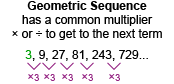
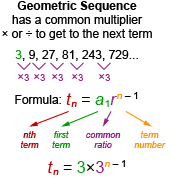
Common Ratio
The amount you multiply by to get from one term to the next in a sequence
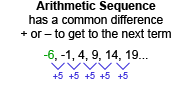
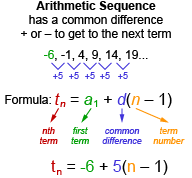
Common Difference
The difference between the terms in a sequence
Rate
A quotient of two quantities. Ex: Cost per person ($/person), miles per hour (miles/hour)
Function
A special type of relation where each input has only one output. Ex: {(0,2), (2,3), (3,4), (5,6)}
Independent Variable
A variable that determines the value of another variable. Ex: In the equation y=2x+4, x is the independent variable. In the equation T=13.50h+45, h (the # of hours worked) is the independent variable and determines T (the total amount of money earned).
Shape Pattern
A sequence composed of a repeating pattern of shapes

Arithmetic Sequence
A sequence that has the same common difference between terms.
Geometric Sequence
A sequence whose terms are generated by multiplying each term by the same common ratio
Constant
A number without a variable; value does not change (stays constant). Ex: in the expression 2x+4y-5, the constant is -5
Distributive Property
A number in front of a group of terms will multiply all terms in the grouping individually. Ex: a(b+c) = ab+ac
Relation (in math)
A relationship between sets of values. In math, the relation is often between x values (inputs) and y values (outputs), and can be represented as a set of ordered pairs, a table of values, a mapping diagram, or a graph. Ex: {(2,3) , (2,5), (3,2)}
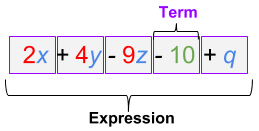
Term
Each part of an expression that is separated by a + or - sign. Ex: In the expression 7x+6y-5, there are 3 terms: 7x, 6y, and -5.
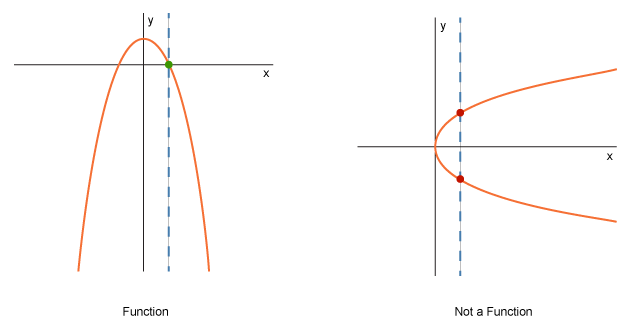
Vertical Line Test
A method for examining the graph of a relation to determine whether or not the relation is a function; pass a vertical line (like a pencil) through all the points of the graph, and if the vertical line passes through more than one point of the graph at the same time, the relation is not a function