Classification of Tissues Ex.6 (BIOL 2401)
 Call Kai
 Learn
Learn Practice Test
 Spaced Repetition
 Match
Match Flashcards
 Knowt Play
1/29

Earn XP
Description and Tags
Vocabulary flashcards covering epithelial, connective, muscle, and nervous tissue classifications and characteristics.
Name | Mastery | Learn | Test | Matching | Spaced | Call with Kai | Chat |
|---|
No analytics yet
Send a link to your students to track their progress
30 Terms
Tissues
Groups of cells that are similar in structure and function, which organize to perform specific body functions.
Organs
Structures formed by organized groups of tissues that perform specific body functions, such as the heart, kidney, and lungs.
Epithelial tissue
Tissue comprising sheets of cells that cover body surfaces or line body cavities.
Apical surface
The free surface of epithelial membranes that is distinct from the basal surface, exhibiting apical-basal polarity.
Basement membrane
An amorphous material secreted by the basal lamina of epithelial cells and the reticular lamina of connective tissue cells, which attaches and supports epithelial cells.
Avascular but Innervated
A characteristic of epithelial tissues indicating they lack a direct blood supply and obtain nutrients via diffusion from underlying connective tissues, but are supplied by nerves.
Simple epithelium
An epithelial tissue consisting of a single layer of cells attached to the basement membrane, found where absorption, filtration, and secretion occur.
Stratified epithelium
An epithelial tissue consisting of two or more layers of cells attached to the basement membrane, found in high-abrasion areas for protection.
Squamous cells
Flat and scale-like epithelial cells.
Cuboidal cells
Cube-like or box-like epithelial cells that have the same height and width.
Columnar cells
Tall, column-shaped epithelial cells.
Pseudostratified epithelium
A simple columnar tissue with cell nuclei located at different levels above the basement membrane, giving a false appearance of being stratified; often ciliated.

Transitional epithelium
A stratified epithelium whose cells can slide over one another to permit distension and stretching of urinary organs such as the bladder.

Simple squamous epithelium
Single layer of flattened cells with disc-shaped central nuclei and sparse cytoplasm that functions in diffusion, filtration, and secretion in serosae.

Simple cuboidal epithelium
Single layer of cubelike cells with large, spherical central nuclei that functions in secretion and absorption in kidney tubules and small gland ducts.
Stratified cuboidal epithelium
An epithelium consisting of two cubelike cell layers, found in sweat glands, mammary glands, and salivary glands.
Stratified columnar epithelium
An epithelium consisting of several cell layers with a cuboidal basal layer, found in location such as the male urethra.
Connective tissue
The most abundant, widespread, and varied tissue type in the body, providing protection, support, immunity, and fat storage.
Neurons
Excitable cells serving as functional units of nervous tissue, highly specialized to receive stimuli, generate, and transmit electric signals.
Neuroglia cells
Cells in nervous tissue that function to support and protect neurons.
Muscle tissue
Tissue highly specialized to contract and produce body movement, divided into skeletal, cardiac, and smooth muscle types.
Areolar connective tissue
A soft packaging tissue of the body containing elastic fibers, collagen fibers, and fibroblast nuclei.
Adipose tissue
Connective tissue located deep to the skin and around organs that provides padding, insulates, and stores energy reserves in adipocytes.

Motor Neurons
Nervous tissue structure showing distinct cell bodies, nerve processes (axons and dendrites), and surrounding glial cells.

Hyaline Cartilage
Cartilage tissue showing chondrocytes located within territorial matrix and surrounded by a perichondrium layer.

Simple columnar epithelium
Single layer of rectangular cells to round to oval nuclei, located in digestive tract, gallbladder, and sometimes excretory ducts in some glands
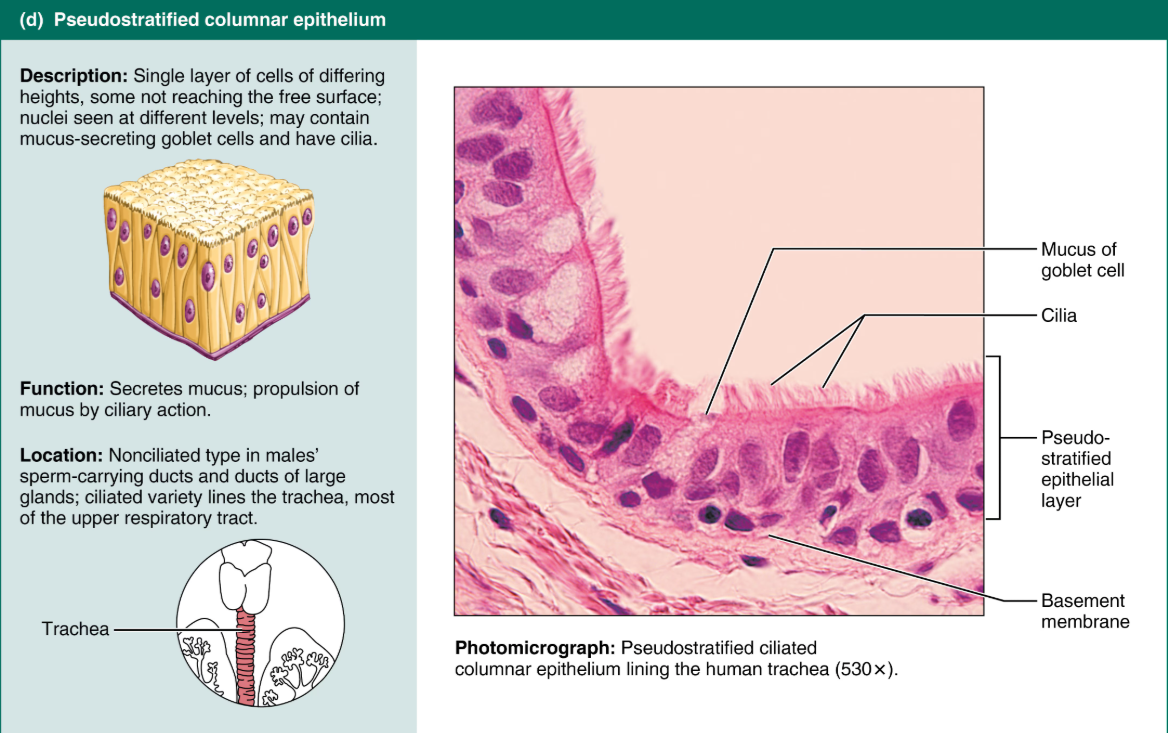
Pseudostratified columnar epithelium
Single layer of cells at dif. heights and the nuclei is at different levels

stratified squamous epithelium
thick membrane with many cell layers, cuboidal or columnar- basal cells, surface cells are flattened (squamous)

Stratified cuboidal epithelium
generally two layers of cube like cells

Stratified Columnar epithelium
many cell layers, basal cells usually cuboidal, superficial cells elongated and columnar