skeletal muscles
 Call Kai
 Learn
Learn Practice Test
 Spaced Repetition
 Match
Match Flashcards
 Knowt Play
1/42

There's no tags or description
Looks like no tags are added yet.
Name | Mastery | Learn | Test | Matching | Spaced | Call with Kai | Chat |
|---|
No analytics yet
Send a link to your students to track their progress
43 Terms
what is the smallest component of the skeletal muscle
filaments or miofilaments: actin aka thin and myovin aka thick
what do multiple filaments combined make
a sarcomere
what do we get when we group sarcomeres
myofibril
what do you call multiple myofibril
a muscle fiber
multiple fibers are
a fassicle
multiple fassicles are called
muscle
what is the sarcolema
a muscle’s cell membrane
what surrounds the sarcollema
endomysium - endo means inside mysium means muscle and they also wrap around the muscle fibers
whats directly around the endomysium
paramysium
what detrmines the shape of a muscle
the fassicle arrangement
tru or false the dibers of a fassicle are not parallel
false they are all parallel within a fassicle
whats the tissue that surrounds and hikd the fassicles together
epimysium
whats a fascicle
the bundle of muscle fibers wrapped by the perimysium
aponeurosis vs tendon
aponeurosis is flatter whereas tendon is twisted
direct vs indirect attachment
direct: epimysium fused to periosteum(bone) or pericondrium(cartillage ex: pectoralis major at costal cartillage of ribs to sternum)
gassicke arrangements
parallel
almost parallel but taper off: fusiform
circular
triangular
pennate
types of pennate fassicle arrangements
multipennate: deltoid
bipennate: rectus femoris
unipennate: digital extensors
longer muscke equals what
longer range of motion
cross sectional area increase results in what
greater force
what is pennate
when the muscle attaches along the length of the tendon like feathers on feather
parralel muscle arrangement allows for greater what but less what than pennate
greater speed but less force
why are soe muscle fassicles arranged to generate more force
some muscles prioritize force while other prioritize range of motion
what do you call the muscle cell membrane
sarcolemma
what surrounds the myofibril
sarcoplasmic reticulum
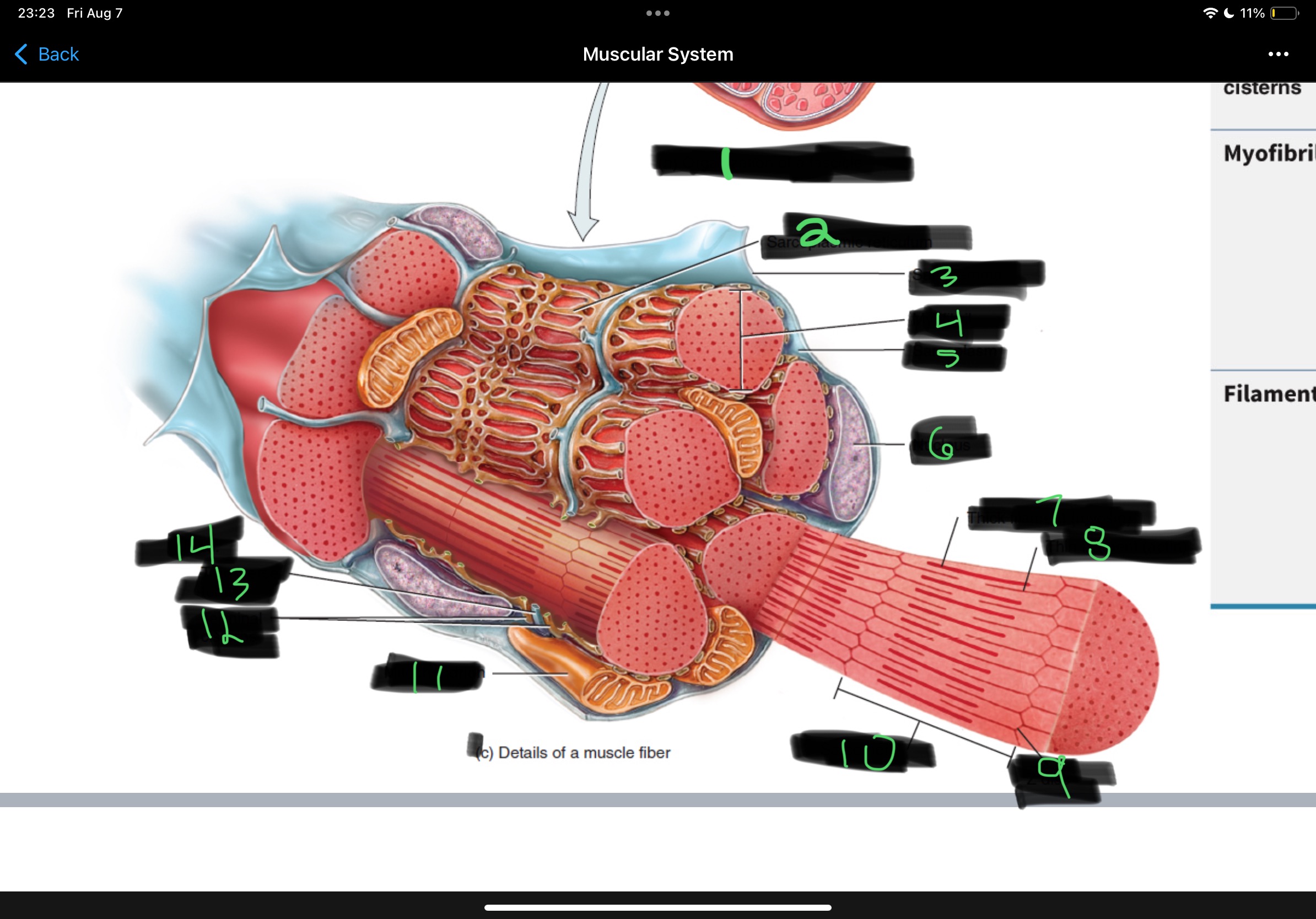
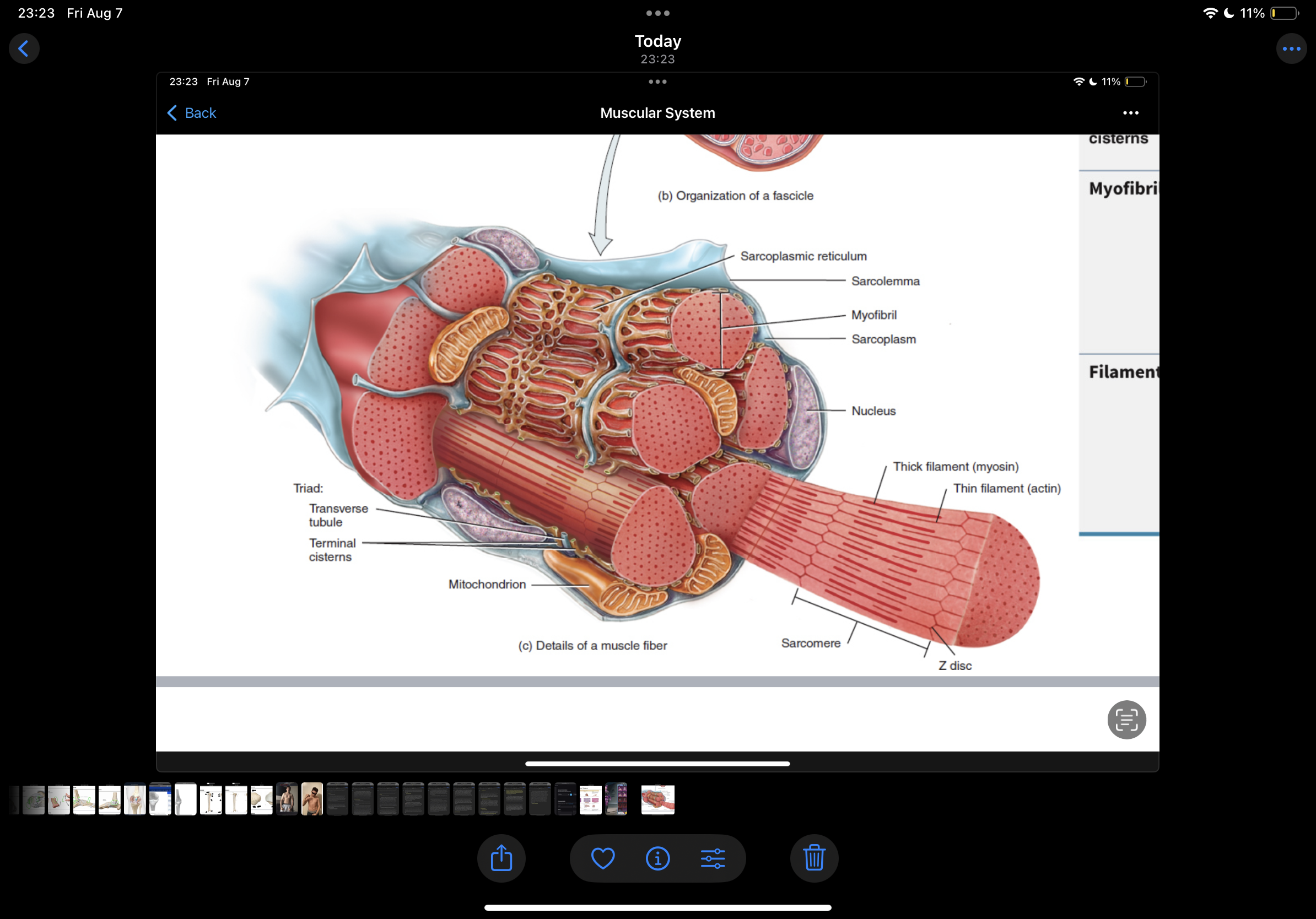
purpose of termjnal cisternae
part of sarcoplasmic reticulum (buldgy part) stores Ca^2+
what are the t tubules
the space outside in betwen the terminal cisternae of the sarcolemma
continuous with extracellular space
contains the voltage sensors
what di the voltage sensors do
connect the calcium from rhe terminal cisternae ro the actin and myosin of rhe cell inside
myosin anatomy
2 heads and a tail (2gold clubs teisted together with the handles together)
binding site for actin and atp
atp binding site serves as an enzyme called ATPase that hydrolises ATP to ADO and phosphate
actin protein anatomy
intertwined pearl necklaces
active site for myosin
tropomyosim
troponin
troponin has a binding site for actin, troponin, calcium(stored in the terminal cisternae of the sarcoplasmic reticulum)
what is titin
an elastic protein gives msucle its ability to recoil
what are the contractile proteins
actin, myosin,
regulatory proteins
tropomyosin, troponin
strutural proteins
titin, actinin, myomesin, nebulin, dystrophin
what js a z disc
end of sarcomere
why is the a band cross section darkest
thick and rhinestone filaments, taken at the end of the myosin filaments
m line cross section
has thick filaments linked by accessory proteins, second darkest, taken at the middle line betwwen z discs
H zone cross secrion
thick filamets only, third darkest, taken within the mysin filaments where there is no actin
I band cross secrional
has thin filaments only, lightest where there is actin is on,y and no myosin(thick filaments)
what time of muscle does not need nervous innervation
cardiac muscle
what is an action potential
a nerve impulse sent by the nervous system
what 3 things need ro haple. for a skeletal muscle contraction
must be stimukated by a nerve ending
must generate and propagate an action potential
there must be a brief rise in intracellular calcium
what is the order of the congraction on a cellular level
action potential arrives at the axon terminal of motor neuron
voltage gated calcium channels open and calcium enters the axon terminal
calcium entry cause some synaptic vessicles ro release their contents (acetylcholines) by exocytosis
acerylcholine, a neurotransmitter, diffuses across the synaptic cleft and binds to the receptors in the sarcolemma.