Biology Exam #2
 Call Kai
 Learn
Learn Practice Test
 Spaced Repetition
 Match
Match Flashcards
 Knowt Play
1/133

There's no tags or description
Looks like no tags are added yet.
Name | Mastery | Learn | Test | Matching | Spaced | Call with Kai | Chat |
|---|
No analytics yet
Send a link to your students to track their progress
134 Terms
What are the four major biological macromolecules?
Carbohydrates, lipids, proteins, and nucleic acids.
What is a monomer?
A small subunit that can be linked to other subunits to build a polymer.
What is a polymer?
A chain made of many repeating monomers.
Which major macromolecule is NOT a true polymer?
Lipids. They do not have repeating monomer units.
What happens during a dehydration reaction?
Two monomers are linked together and water is produced/removed.
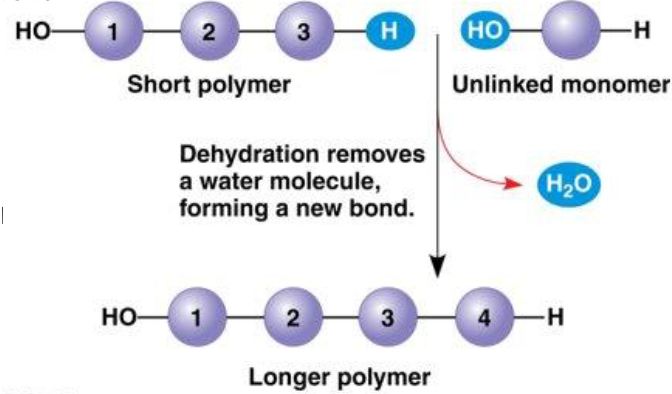
What happens during hydrolysis?
Water is added to break a covalent bond and disassemble a polymer.

What is the monomer of a carbohydrate?
A monosaccharide.
How many carbons do most monosaccharides have?
3–7 carbons; 5- and 6-carbon sugars are especially common.
What two functional groups are found in all monosaccharides?
Hydroxyl groups (-OH) and at least one carbonyl group (C=O).
What is an aldose?
A sugar whose carbonyl group is at the end of the carbon chain.
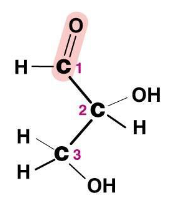
What is a ketose?
A sugar whose carbonyl group is in the middle of the carbon chain.

What is a monosaccharide?
One sugar unit.
What is a disaccharide?
Two monosaccharides joined by a covalent bond.
What is a polysaccharide?
Many monosaccharides joined by covalent bonds.
Examples of monosaccharides
Glucose
Fructose
Galactose
Examples of dissaccharides
Sucrose
Maltose
Lactose
Examples of polysaccharides
Starch: used for energy storage in plants.
Glycogen: used for energy storage in animals.
Cellulose: main structural component in plant cell walls that gives plants cells rigidity; cannot be digested by animals.
Chitin: in cell walls of fungi, and exoskeleton of insects and crustaceans.
What is a lipid?
A biological molecule that is generally hydrophobic; lipids are not true polymers.
What are the three lipid types?
Fats, phospholipids, and steroid hormones.
What is fat made of?
Glycerol and fatty acid chain(s)

What is glycerol?
An alcohol that contains 3 carbons with 3 hydroxyl (-OH) groups.
What is a fatty acid?
Hydrocarbon chains of 16-18 carbons + carboxyl (-COOH) group.
What is a triglyceride?
Important group of fats made up of one glycerol + three fatty acid chains.

Why are fats hydrophobic?
The nonpolar C–H bonds in the hydrocarbon chain fatty acids make them hydrophobic.
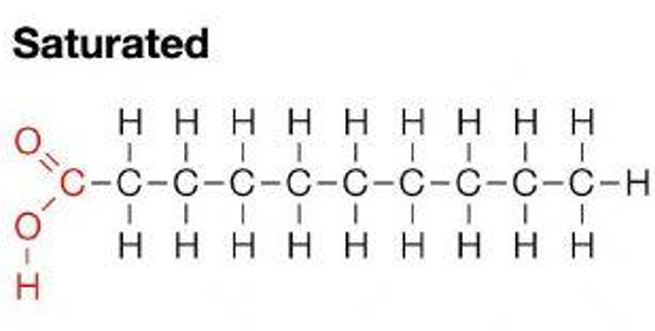
Saturated fats
Have fatty acid chains that are saturated with hydrogens. All carbons have maximal hydrogens bonded.
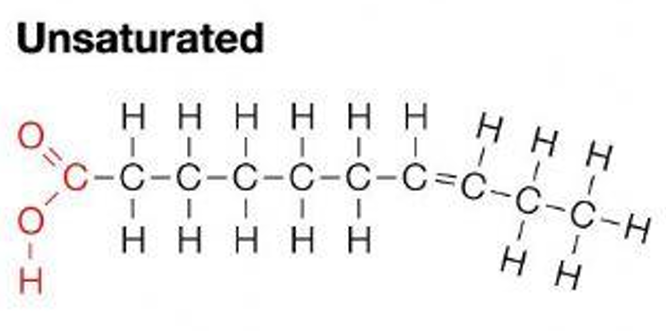
Unsaturated fats
Have fatty acid chains that are NOT saturated with hydrogen. Maximal amount of hydrogen is not bonded. Contains one or more double bonds.
Cis and trans fatty acids
Double bonds in unsaturated fatty acids can have cis or trans orientation.
Cis fats are healthy.
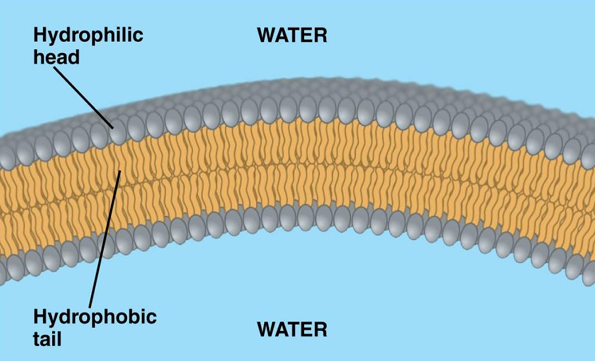
What is a phospholipid made of?
Glycerol + phosphate group (PO4) + two fatty acid chains.

Which part of a phospholipid is hydrophilic?
The head.
Which part of a phospholipid is hydrophobic?
The two fatty acid tails.
How are phospholipids arranged in a membrane?
They form a bilayer with hydrophobic tails together and hydrophilic heads facing the watery environments.
Steroid hormone
Has ring structure derived from cholesterol
Contains a carbon skeleton with 4 fused rings
Does NOT have glycerol subunit, but is grouped with fats and phospholipids because they’re hydrophobic
What is the monomer of a protein?
An amino acid.
What is a polypeptide?
A polymer of amino acids.
What is a peptide bond?
Covalent bond that holds amino acids together that is linked together by dehydration reaction between carboxyl (-COOH) and amino groups (-NH2) of two amino acids.

What four parts are attached to the central carbon of an amino acid?
An amino group, carboxyl group, hydrogen, and R group/side chain.

What determines which amino acid it is?
Its R group/side chain.
How many standard amino acids are used to build proteins?
20.
What is the N-terminus?
The amino acid in the linked chain of peptide bonds with a free amino group. (engine)
* Think: N-terminus = NH2
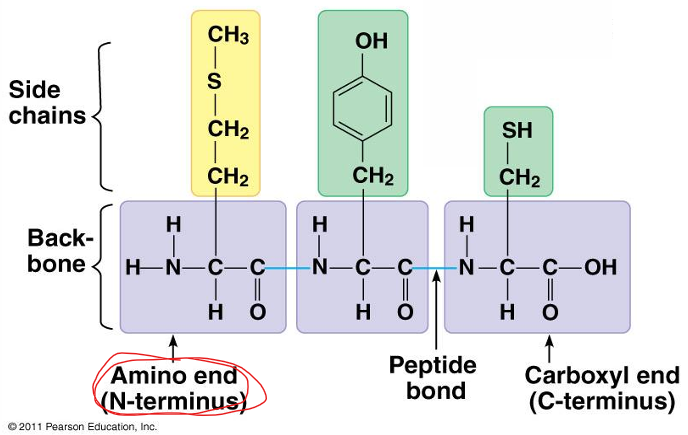
What is the C-terminus?
The amino acid in the linked chain of peptide bonds with a free carboxyl group. (caboose)
* Think: C-terminus = -COOH / Caboose

Where are new amino acids added to a growing polypeptide?
To the C-terminus (making a new caboose).
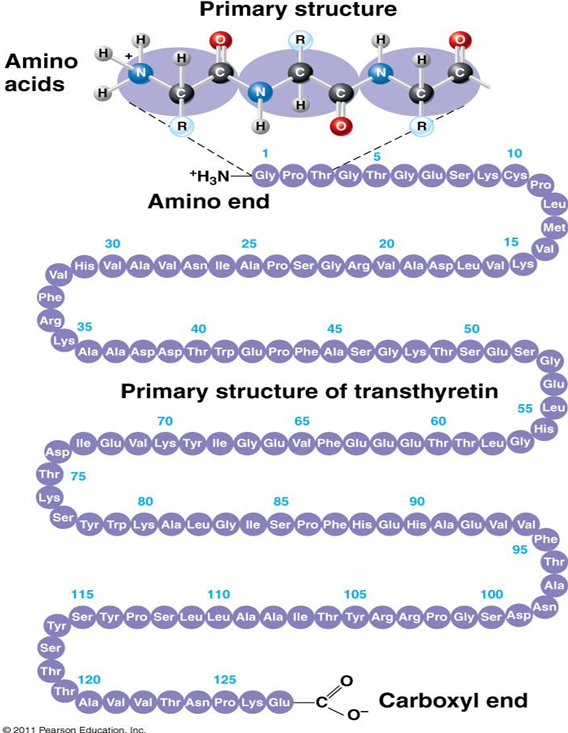
What is primary protein structure?
The amino acid sequence.
What is secondary protein structure?
Folding of the backbone into alpha helices and beta sheets. Stabilized by hydrogen bonds.

What is tertiary protein structure?
The overall 3D folding of one polypeptide caused by interactions among R groups/side chains.

What is quaternary protein structure?
The interaction of multiple polypeptide chains. Not all proteins have quaternary structure.

What types of interactions are in tertiary structure?
Disulfide bonds: A strong covalent bond between sulfur atoms in two different sulfhydryl groups.
Hydrogen bonds
Hydrophobic interactions
Ionic bonds
What is denaturation?
Loss of a protein's normal 3D structure, causing it to lose function.
What conditions can cause protein denaturation?
Changes in pH, salt concentration, or temperature.
What is the monomer of a nucleic acid?
A nucleotide.
What are the three parts of a nucleotide?
A nitrogenous base + Pentose (5-carbon) sugar + 1 phosphate group.

What sugar is found in DNA?
Deoxyribose.
What sugar is found in RNA?
Ribose.
What are the two major nucleic acids?
DNA and RNA.
What is the main role of DNA?
It stores hereditary information.
What is the main role of RNA emphasized in lecture?
It assists in protein production.
What is the basic structure of DNA?
Two polynucleotide strands that run antiparallel forming double helix.
Sugar phosphate backbone on outside
Inside made of nucleotide bases with hydrogen bonds

Complementary base pairing
Nitrogenous bases only bind to other complementary bases through hydrogen bonding (A—T, C—G).
What are all cells surrounded by?
A plasma membrane.
What are the two broad categories of cells?
Prokaryotic cells and eukaryotic cells.
What is a major difference between prokaryotes and eukaryotes?
Eukaryotic cells have a nucleus and membrane-bound organelles; prokaryotic cells do not.
What is the nucleus?
The organelle that contains most of a eukaryotic cell's DNA.
What is the nucleolus?
A region inside the nucleus involved in ribosome production.
What do ribosomes do?
They make proteins.
What is the rough ER?
A membrane network with ribosomes attached; it is involved in protein production and processing.
What is the smooth ER?
A membrane network without ribosomes; it is involved in lipid-related functions and detoxification.
What does the Golgi apparatus do?
It modifies, sorts, and packages molecules for transport.
* Think: Amazon
What do lysosomes do?
They contain enzymes that digest materials inside the cell.
What do mitochondria do?
They carry out cellular respiration and produce ATP.
What do chloroplasts do?
They carry out photosynthesis in plant cells.
What are vesicles?
Small membrane-bound sacs that transport materials within or out of cells.
What is the endomembrane system?
A group of interacting membranes and organelles involved in protein/lipid processing, transport, and related functions.
• Plasma membrane
• Nuclear envelope
• Endoplasmic reticulum
• Golgi apparatus
• Lysosomes
• Vesicles
• Vacuoles
Microtubules
Made from tubulin, a protein.
Can grow and shrink.
Support the cell and provide compression resistance.
Organelles are carried by motor proteins along microtubules.
* Makes up centrioles, flagellum, and cilia.
Microfilaments.
Made of actin, a protein.
Bears tension.
Myosin: motor protein that binds to actin.
Intermediate filaments
Structural support and maintains cell shape.
More permanent/do not grow or shrink.
What is the cytoskeleton?
A network of protein fibers that helps maintain cell shape, organize the cell, and support movement/transport.
Made of microtubules, intermediate filaments, and microfilaments
What is the plasma membrane?
A selectively permeable phospholipid bilayer surrounding the cell.
Phospholipids are amphipathic: polar and nonpolar end
What does selectively permeable mean?
The membrane allows some substances to cross more easily than others.
What direction does passive transport move substances?
Down their concentration gradient: high concentration → low concentration.
What is diffusion?
The net movement of particles from high concentration to low concentration.
What is osmosis?
The diffusion of water across a selectively permeable membrane.
What is facilitated diffusion?
Passive movement down a concentration gradient through membrane proteins.
What is active transport?
Movement of substances against a concentration gradient using cellular energy.
What is the Na+/K+ pump?
A membrane protein that uses energy to move Na+ and K+ against their gradients.

What is endocytosis?
Movement of material into a cell by forming a vesicle from the plasma membrane.

What is exocytosis?
Movement of material out of a cell when a vesicle fuses with the plasma membrane.

What is a hypertonic environment?
The solution outside the cell has a higher solute concentration; water tends to leave the cell.
What is a hypotonic environment?
The solution outside the cell has a lower solute concentration; water tends to enter the cell.
What is an isotonic environment?
The solute concentration is effectively equal inside and outside, so there is no net water movement.
What happens to a cell in a hypertonic solution?
Water leaves the cell, so the cell shrinks.
What happens to a cell in a hypotonic solution?
Water enters the cell, so the cell swells.
What happens to a cell in an isotonic solution?
There is no net movement of water, so the cell stays about the same size.
In a saltwater solution, solute moving down its concentration gradient across a membrane is what type of transport?
Passive transport/diffusion, assuming the solute can cross the membrane.
What is the key difference between diffusion and osmosis?
Diffusion describes movement of particles; osmosis specifically describes movement of water.
What is the key difference between active and passive transport?
Active transport requires energy and can move substances against a gradient; passive transport does not require cellular energy and moves down a gradient.
What is the key difference between hypertonic and hypotonic?
Hypertonic outside = more solute outside → water leaves. Hypotonic outside = less solute outside → water enters.
Which cytoskeletal component is made of tubulin?
Microtubules.
Which cytoskeletal component is made of actin?
Microfilaments.
Which organelle is covered with ribosomes?
Rough ER.
Which organelle modifies and packages molecules?
Golgi apparatus.
Which organelle is associated with ATP production?
Mitochondria.