PSYCH 101 QUIZ
 Call Kai
 Learn
Learn Practice Test
 Spaced Repetition
 Match
Match Flashcards
 Knowt Play
1/109

There's no tags or description
Looks like no tags are added yet.
Name | Mastery | Learn | Test | Matching | Spaced | Call with Kai | Chat |
|---|
No analytics yet
Send a link to your students to track their progress
110 Terms
phrenology
Frank Joseph gall
Language output
Bro a,s area
Language input
Wernicke,s area
Wilhelm wundt
Studied the tructure of the mind (structuralism)
William James
Ievdhfunction of our mental processes are critical to our behavior *functionalism)
Sigmeund freud
The unconscious mind
We bring the unconscious to the conscious
Psychoanalysis
Abraham Maslow and car rogers
Humanistic psychology
John Watson and Ian Pavlov (Pavlov’s dogs —> focus only on observable behaviors); BF Skinner —> animals learn by interacting with their environment
Behaviorism
The mouses (engineer the environment and you can engineer human behavior)
Skinners box
Illusion
Errors of perception, memory or judgement where subject experiences differed from object reality
Gestalt psychology
Emphasizes that the whole is greater than the sum of its parts
Mueller-lyer line
Optical illusion
Sir Frederic Bartlett (people fill in memories); Karl Ashley (parts of rat brains)
Conginitive psychology
John Garcia (rat poisoning); explains mind and behavior in terms of adaptive value of abilities that are preserved by natural selection
Evolutionary psychology
Normal Triplett (tricycle)
Studied social psychology through cyclists
Margaret mead
Anthropologist who studied cultural psychology
Francis Cecil sumner
Father of black psychology
NATIVISM
PLATO
nativism
, the view that certain kinds of knowledge are innate or inborn.
Aristotle
who believed that the child’s mind was a “blank slate” on which only experience could write, and he was a strong proponent of what we now call philosophical empiricism,
nature vs nurture
the plato aristotle debate most commonly mirrors what
Genie Wiley “feral child”
name of the girl in the case study
Clive Wearing
man in case study that could not remember even up to 30 seconds ago
H.M
man in case study who could not make new memories (anterograde amnesia) due to damage to his hippocampus after a bike incident
Lens, cornea, iris, pupil, retina
Parts of the eye (see quizlet for def)
Fovea
an area of the retina where vision
is the clearest and there are no rods; lower acuity for peripheral vision
Photoreceptors, bipolar neurons, ganglion cells, optic disk, optic nerve, brain PBGOOB
Order of transduction
Neuron
cells in the nervous system that
communicate with one another to perform
information-processing tasks
cell body
coordinates information processing tasks and keeps the cell alive
Ion eat perspective (lines get closer), interposition (object in front of another), texture gradient
Monocular depth cues
Convergence ( as smth closer to ur face your eyes go inward); retinal disparity (close one eye)
Binocular disparity
Pitch
How high or low a sound is (frequency)
Amplitude
A sound’s intensity
Timbre
A listener’s experience of sound quality or resonance (complexity)
Pinnacle, ear canal, eardrum
The outer ear
Ossicles: hammer, anvil, stirrup
Middle ear
Cochlea (snail), basilar membrane (vibrates from cochlear fluid), cilia (receptor neurons)
Semicircular canals: balance
The inner ear
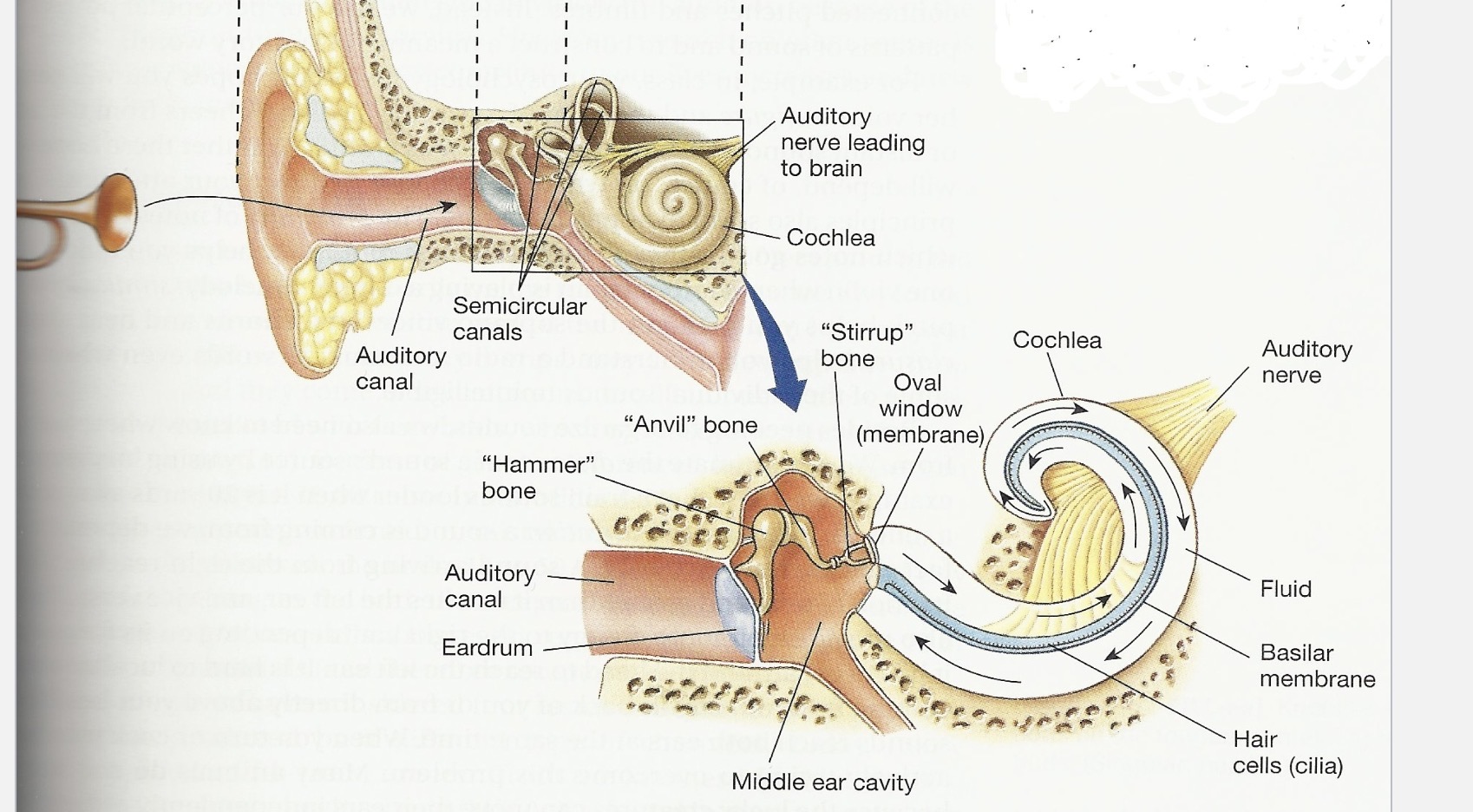
Loudness and timing
Stereophonic hearing says that what helps s localize sound

pressure, texture, pattern, vibration
4 types of mechanoreceptors under the skin help us sense:
Cold and warmth
Thermoreceptors help us sense?
A-delta fibers
C-fibers
Tissue damage is detected by what pain receptors
=signals arriving from pain
receptors in the body can be stopped or gated by
interneurons in the spinal cord via feedback from
2 directions: skin receptors and brain signals
Gate-control theory
Input from spinal cord, signals from brain centers, memories, emotions, expectations, attention
What things can cause abnormal patterns in neural matrix and simulate pain
Olfactory receptor neurons
ORN
Made up of axons from ORNS; send messages to brain
Olfactory bulb

ORN Binding site, Olfactory receptor neuron, glomerulus, olfactory nerve
Anatomy of smell
Papillae, tastebuds
Your tongue has hundreds of ____ and thousands of ___
Taste receptors that react with tasting molecules in food
Microvilli
Sweet, sour, bitter, salty, umami
5 sensations of taste

Taste bud anatomy
rancid & poisonous
High in calories
Important for all bodily functions
High in protein
Bitter & sour —>
Sweet —>
Salt —→
Umami —→
True
True or false food aversion is learned
dendrites
receives information from other neurons and relays it to the cell body
axon
transits information to other neuron, mucles, or glands
myelin sheath
insulating layer of fatty material
nodes of Ranvier
connect the myelin sheaths and increases efficiency of signal transmission
the junction or region between the axon of one neuron and the dendrites or cell body of another
synapse
learn neuron firing
sensory neurons
from external world through spinal cord to brain
motor neurons
spinal cord to muscles to induce movement
interneurons
neurons that connect sensory neurons, motor neurons, or other interneurons
enzyme deactivation
reuptake, enzyme deactivation, autoreceptors
neurotransmitters leave the synapse during what
-70milivolts
voltage of resting potential
-55 milivolts
voltage of action potential
refractory period
neuron cant fire again during
Na+ and K +
what helps maintain neuron @-7 milivolts
terminal buttons
knoblike structures that
branch out from an axon
neurotransmitters
chemicals that transmit
information across the synapse
how does a neuron stay at the resting potential
potassium 2 in and sodium 3 out
receptors:
parts of the cell membrane that
receive the neurotransmitter and initiate a new
electric signal
acetylcholine (ach); dopamine (DA); Norepinephrine (NE), Serotonin(5-HT), Endorphins
types of neurotransmitters
voluntary motor control, memory, learning - alzheimer’s disease
acetylcholine
regulates motor behavior, pleasure, emotional arousal’
dopamine
Resting Potential
When the neuron is at rest, positively charged
potassium ions (K+) flow out.
Action potential
an electric signal that is
conducted along an axon to a synapse
Occurs only when threshold for stimulation is
reached; all-or-none (approximately -55 mV)
– Cell becomes positively charged (+40 millivolts)
Refractory period:
the time following an
action potential during which a new action
potential cannot be initiated
schizophrenia
when you have too much dopamine
parkinson’s disease
when you have too little dopamine
influences mood and arousal - depression
norepinephrine
regulates sleep, dreaming, mood, aggression - depression, anxiety, OCD
serotonin
chemicals that act within pain and pleasure pathways and emotion centers of the brain - runner’s high
ENDORPHINS
LDOPA
since you cant get through the blood brain barrier, what can u give someoen with parkinson’s
selective serotonin reuptake inhibitor
SSRI
prozac
is used for depression and is an ssri
Nervous system:
an interacting network of
neurons that conveys electrochemical
information throughout the body; CNS and PNS
Nerves
bundles of axons and glial cells that
support neurons.
CNS
part of the nervous system that is only made up of the brain and spinal cord
Peripheral nervous system (PNS)
part of the nervous system that connects the central nervous system to the body’s organs and muscles ; made up of the autonomic and somatic
AUTONOMIC: autopilot —> sympathetic (arousing & parasympathetic (calming)
SOMATIC: communicates with sense organs and voluntary muscles: sensory (afferent sensory input) motor (efferent (motor output)
explain parts of PNS
body to brain
sensory nervous system
brain to body
motor nervous system
forebrain, midbrain, hindbrain
major divisions of the brain
hindbrain
Transduction
When sensors in the body convert physical signals from the environment into neural signals sent to the CNS
SENSORY ADAPTATION
Sensitivity to prolonged stimulations tends to decline over time as an organism adapts to current conditions (stimulus doesn’t change)
Wavelength
Light waves vary in what