Chapter Six (A & P)
 Call Kai
 Learn
Learn Practice Test
 Spaced Repetition
 Match
Match Flashcards
 Knowt Play
1/127

There's no tags or description
Looks like no tags are added yet.
Name | Mastery | Learn | Test | Matching | Spaced | Call with Kai | Chat |
|---|
No analytics yet
Send a link to your students to track their progress
128 Terms
What is the initial composition of the human skeleton?
The human skeleton initially consists of cartilage.
What is the role of perichondrium in cartilage?
Perichondrium is a layer of dense connective tissue that surrounds cartilage, helping it resist outward expansion and providing blood vessels for nutrient delivery.
What are the three types of cartilage?
Hyaline cartilage, elastic cartilage, and fibrocartilage.
Where is hyaline cartilage found?
In articular joints, costal areas (ribs), respiratory structures (larynx), and nasal cartilage (nose tip).
What distinguishes elastic cartilage from hyaline cartilage?
Elastic cartilage contains elastic fibers, providing more flexibility.
What is fibrocartilage known for?
Fibrocartilage contains thick collagen fibers and has great tensile strength, found in structures like menisci of the knee and vertebral discs.
What are the seven important functions of bones?
Support, protection, movement, mineral and growth factor storage, blood cell formation, triglyceride storage, and hormone production.
What is hematopoiesis?
The process of blood cell formation that occurs in red marrow cavities of certain bones.
How are bones classified based on location?
Into axial skeleton (skull, vertebral column, rib cage) and appendicular skeleton (bones of upper and lower limbs).
What are the four shapes of bones?
Long bones, short bones, flat bones, and irregular bones.
What characterizes long bones?
Longer than they are wide, such as limb bones.
What are short bones?
Cube-shaped bones found in the wrist and ankle, including sesamoid bones like the patella.
What are flat bones and provide examples?
Thin, flat, slightly curved bones like the sternum, scapulae, ribs, and most skull bones.
What defines irregular bones?
Bones with complicated shapes, such as vertebrae and hip bones.
What types of tissues are found in bones?
Bone (osseous) tissue, nervous tissue, cartilage, fibrous connective tissue, muscle cells, and epithelial cells in blood vessels.
What is the difference between compact and spongy bone?
Compact bone is a dense outer layer that appears smooth, while spongy bone consists of a honeycomb of small, needle-like or flat pieces called trabeculae.
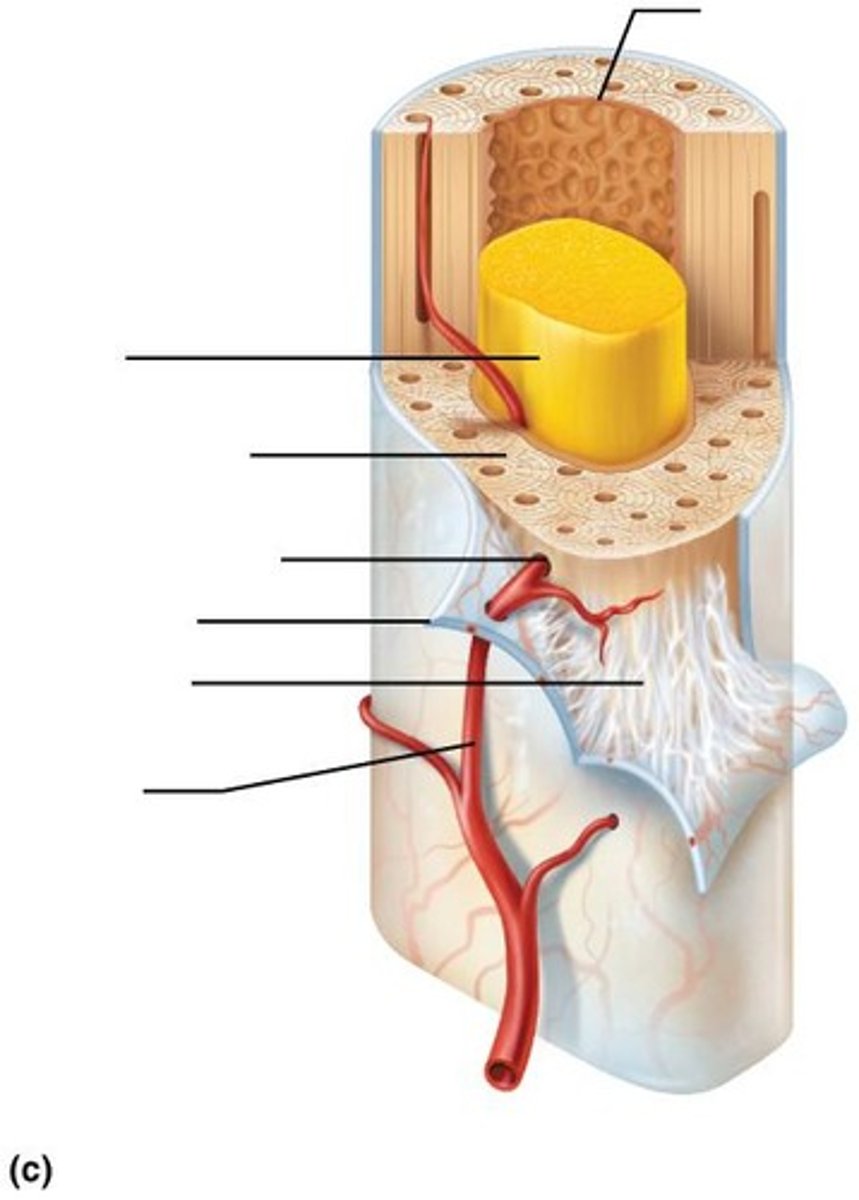
What is the structure of short, irregular, and flat bones?
They consist of thin plates of spongy bone (diploe) covered by compact bone, with no defined marrow cavity.
What is the diaphysis of a long bone?
The tubular shaft that forms the long axis of the bone, consisting of compact bone surrounding a central medullary cavity.
What are epiphyses in long bones?
The ends of long bones that consist of compact bone externally and spongy bone internally.
What covers the articular surfaces of bones?
Articular cartilage covers the articular (joint) surfaces.
What is the epiphyseal line?
The remnant of the childhood epiphyseal plate where bone growth occurs, located between the diaphysis and epiphysis.
What is calcification of cartilage?
The process where cartilage hardens, which can occur during normal bone growth in youth or in old age.
What is the function of osteocalcin?
Osteocalcin is a hormone secreted by bones that helps regulate insulin secretion, glucose levels, and metabolism.
What is the role of cartilage-forming cells in appositional growth?
They secrete matrix against the external face of existing cartilage, laying down new matrix on the surface.
How does interstitial growth occur in cartilage?
Chondrocytes within lacunae divide and secrete new matrix, expanding cartilage from within.
What are the two types of membranes associated with bone?
Periosteum and endosteum
What is the function of the periosteum?
It covers external surfaces of bones except joints and contains nerve fibers and blood vessels.
What are the two layers of the periosteum?
Fibrous layer (outer) and osteogenic layer (inner)
What is the endosteum?
A delicate connective tissue membrane covering the internal bone surface.
Where is red marrow found in bones?
In trabecular cavities of spongy bone and diploë of flat bones.
What is the primary function of red marrow?
Hematopoiesis (blood cell formation)
What can yellow marrow convert to under certain conditions?
Red marrow, if a person becomes anemic.
What are bone markings?
Sites of muscle, ligament, and tendon attachment, or areas involved in joint formation.
Name the three types of bone markings.
Projection, depression, and opening.
What is the role of osteogenic cells?
They are stem cells that can differentiate into osteoblasts or bone-lining cells.
What do osteoblasts do?
They are bone-forming cells that secrete unmineralized bone matrix called osteoid.
What is the function of osteocytes?
They maintain bone matrix and act as stress or strain sensors.
What are osteoclasts responsible for?
Bone resorption (breakdown of bone).
What is an osteon?
The structural unit of compact bone, consisting of an elongated cylinder.
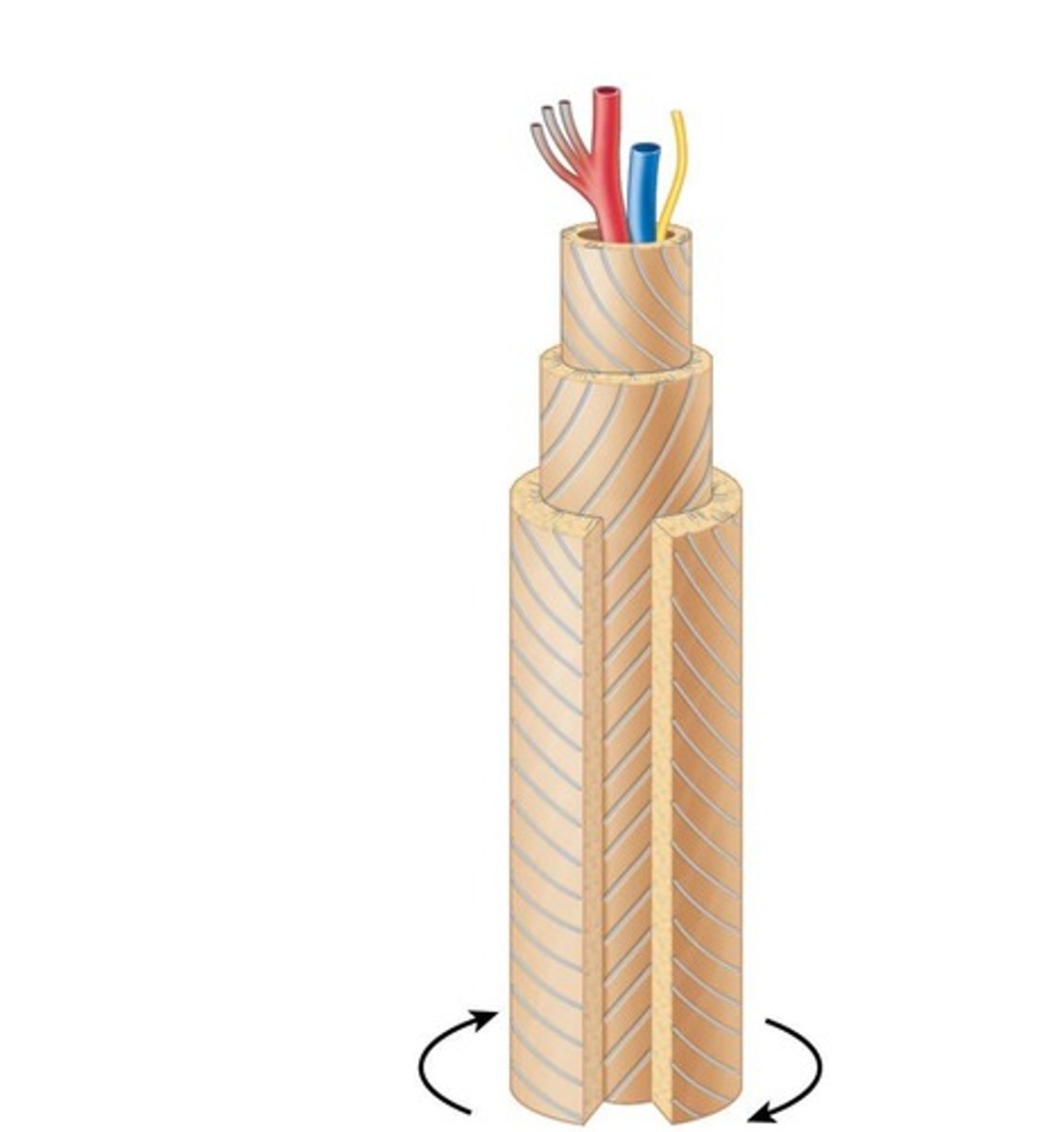
What is the function of the central (Haversian) canal?
It contains blood vessels and nerve fibers.
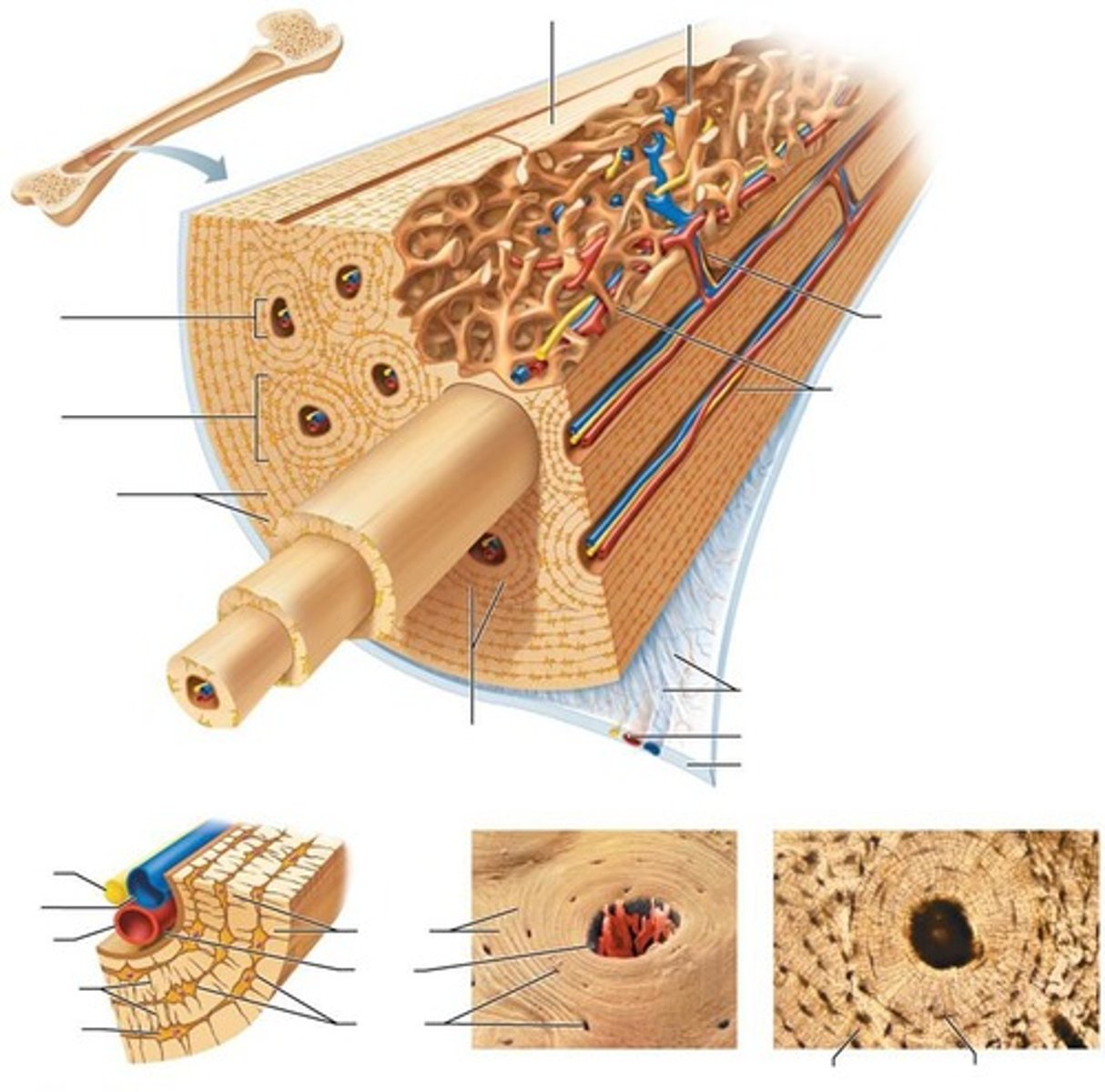
What are lacunae?
Small cavities that contain osteocytes.
What are canaliculi?
Hairlike canals that connect lacunae to each other and to the central canal.
What are interstitial lamellae?
Lamellae that are not part of an osteon, filling gaps between forming osteons.
What are circumferential lamellae?
Layers of lamellae that extend around the entire surface of the diaphysis.
How does spongy bone differ from compact bone?
Spongy bone appears poorly organized but is actually aligned along lines of stress.
What are trabeculae in spongy bone?
Irregularly arranged lamellae that confer strength to bone.
What is the primary component of osteoid?
Collagen and calcium-binding proteins.
What is the role of bone-lining cells?
They help maintain the bone matrix.
What is the significance of the ruffled borders of osteoclasts?
They increase surface area for enzyme degradation of bone.
What is the primary function of the fibrous layer of the periosteum?
It secures the periosteum to the bone matrix through Sharpey's fibers.
What happens to osteoblasts when they become trapped in the matrix?
They differentiate into osteocytes.
What is the relationship between osteoblasts and osteoclasts?
Osteoblasts build bone while osteoclasts break it down, allowing for remodeling.
What is the role of nutrient foramina in bones?
They allow blood vessels and nerves to enter the bone.
What is ossification?
The process of bone tissue formation.
When does the formation of the bony skeleton begin?
In month 2 of development.
Until what age does postnatal bone growth occur?
Until early adulthood.
What are the two types of ossification?
Endochondral ossification and intramembranous ossification.
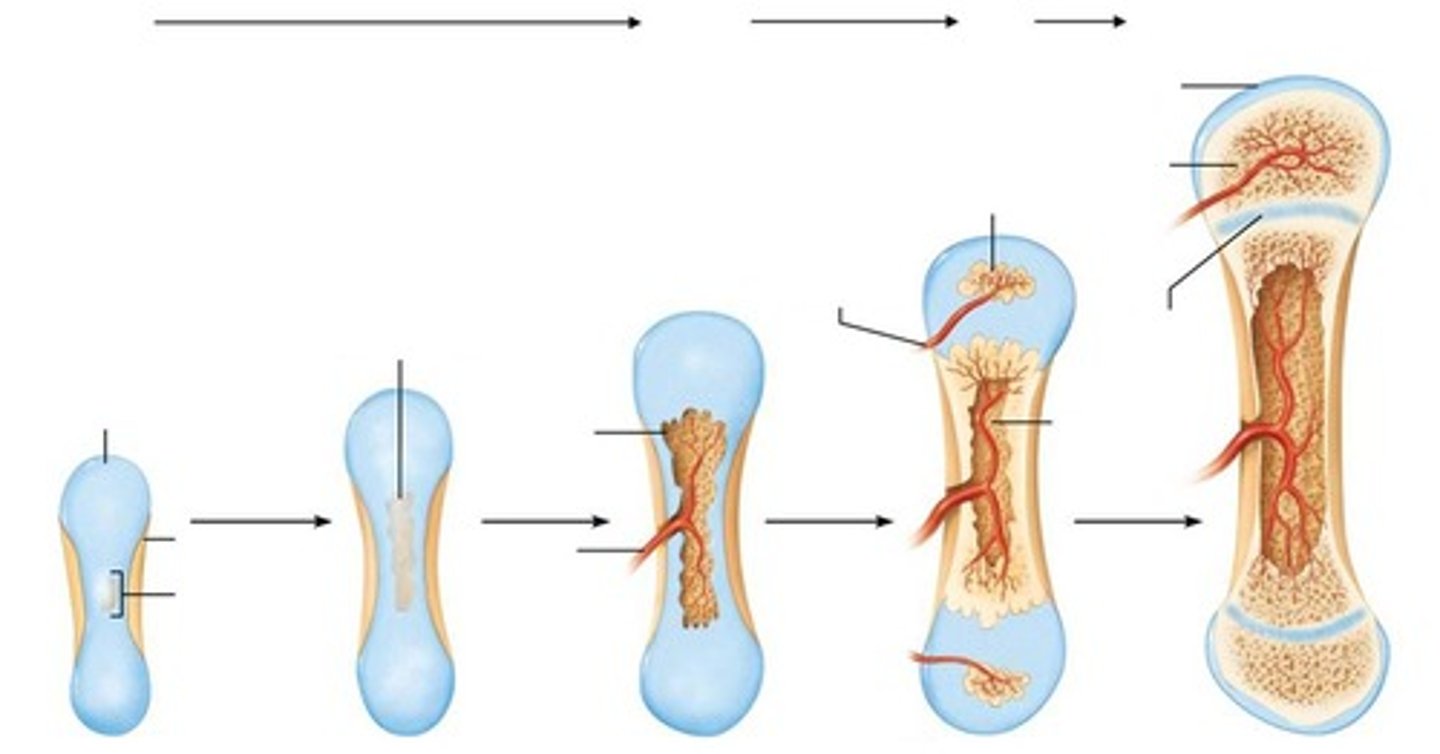
What is endochondral ossification?
Bone forms by replacing hyaline cartilage and is responsible for forming most of the skeleton.
What type of bones are formed by intramembranous ossification?
Membrane bones, such as the frontal, parietal, occipital, temporal bones, and clavicles.
What bones does endochondral ossification primarily form?
All bones inferior to the base of the skull, except for the clavicles.
What is the primary ossification center?
The center of the shaft where ossification begins.
What occurs during the first step of ossification?
A bone collar forms around the diaphysis of the cartilage model.
What happens to the central cartilage in the diaphysis during ossification?
It calcifies and then develops cavities.
What is the periosteal bud?
A structure that invades cavities, leading to the formation of spongy bone.
What are the five main steps in the process of endochondral ossification?
1. Bone collar forms, 2. Central cartilage calcifies, 3. Periosteal bud invades, 4. Diaphysis elongates, 5. Secondary ossification centers appear.
What remains after the epiphyses ossify?
Hyaline cartilage remains only in the epiphyseal plates and articular cartilages.
What initiates intramembranous ossification?
Mesenchymal cells cluster and differentiate into osteoblasts.
What is osteoid?
The organic matrix secreted by osteoblasts that later becomes mineralized.
What is the role of osteoblasts in bone formation?
They secrete osteoid and help in the formation of bone tissue.
What is the significance of the periosteum in bone development?
It forms from the outer layer of woven bone and is essential for bone growth and repair.
What is lamellar bone?
A type of mature bone that replaces woven bone during ossification.
What happens to immature spongy bone during ossification?
It is remodeled into mature spongy bone filled with red marrow.
What is the function of mesenchymal cells in bone development?
They cluster to form ossification centers and differentiate into osteoblasts.
What is trabeculae?
The structural units of spongy bone formed during ossification.
What is the final outcome of intramembranous ossification?
Compact bone replaces immature spongy bone, and red marrow develops.
How do long bones grow in length?
Through interstitial (longitudinal) growth of the epiphyseal plate.
What is appositional growth?
The process by which bones increase in thickness.
At what stage do bones stop growing?
During adolescence.
Which bones continue to grow slowly throughout life?
Some facial bones.
What is the role of the epiphyseal cartilage in long bone growth?
It is essential for interstitial growth at the epiphyseal plate.
What are the five zones of the epiphyseal plate?
Resting zone, proliferation zone, hypertrophic zone, calcification zone, ossification zone.
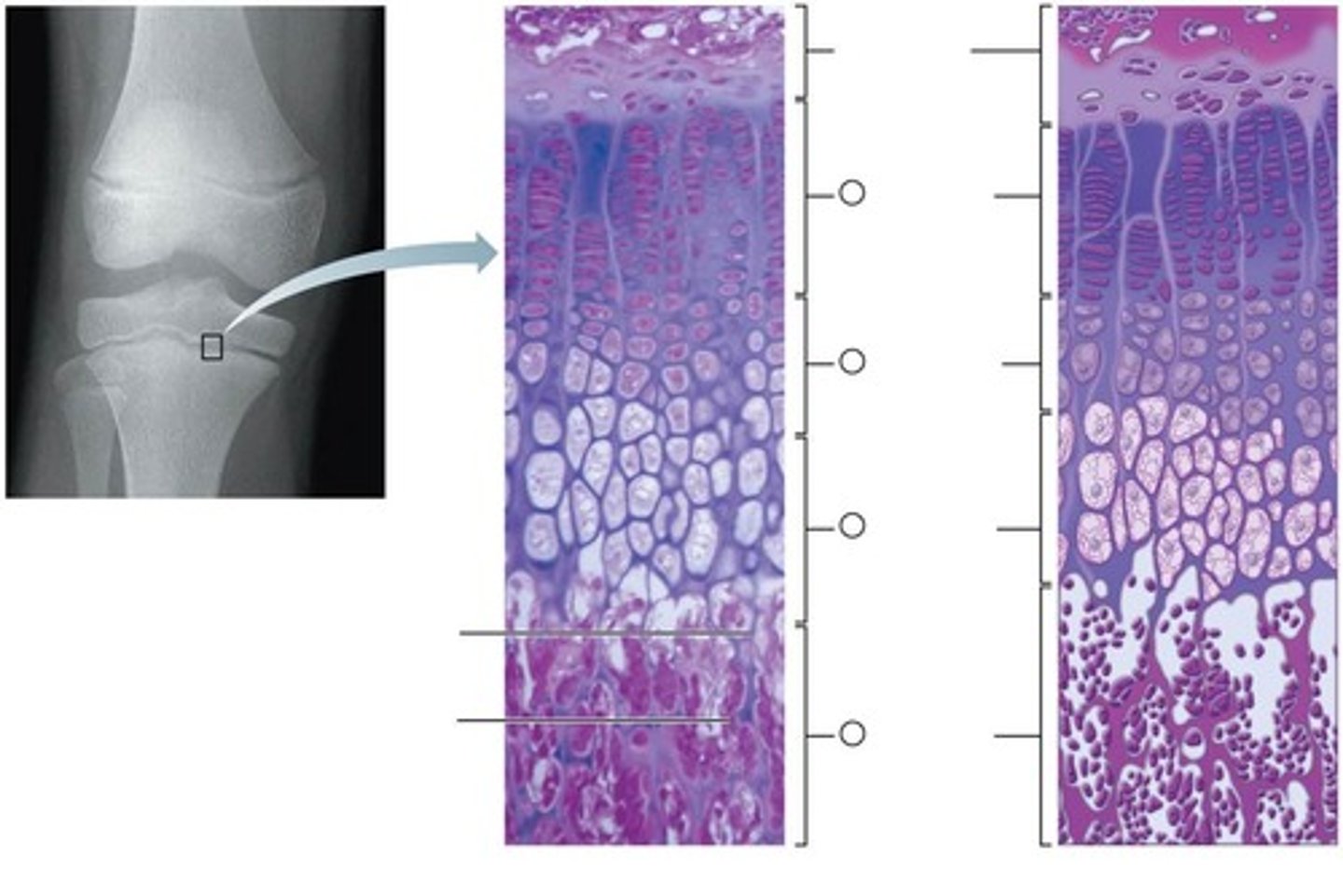
What occurs in the resting (quiescent) zone?
It is relatively inactive cartilage on the epiphyseal side of the epiphyseal plate.
What happens in the proliferation (growth) zone?
Cartilage cells rapidly divide, pushing the epiphysis away from the diaphysis.
What characterizes the hypertrophic zone?
It contains older chondrocytes that enlarge and form interconnecting spaces.
What occurs in the calcification zone?
The cartilage matrix calcifies, leading to the death and deterioration of chondrocytes.
What happens in the ossification zone?
Chondrocyte deterioration leaves calcified cartilage spicules that are replaced by new bone.
When does epiphyseal plate closure occur?
When the epiphysis and diaphysis fuse, ceasing bone lengthening.
At what ages does epiphyseal plate closure typically occur in females and males?
Females: around 18 years; Males: around 21 years.
What is the process of appositional growth?
Bones widen as they lengthen, occurring throughout life in response to stress.
How do osteoblasts and osteoclasts contribute to bone remodeling?
Osteoblasts secrete bone matrix, while osteoclasts remove bone on the endosteal surface.
What is the role of growth hormone in bone growth?
It stimulates epiphyseal plate activity during infancy and childhood.
How does thyroid hormone affect bone growth?
It modulates growth hormone activity to ensure proper proportions.
What hormones promote adolescent growth spurts?
Testosterone in males and estrogens in females.
What is bone remodeling?
The process involving both bone deposit and resorption, recycling about 5-7% of bone mass weekly.
What is the function of osteoclasts in bone resorption?
They break down the bone matrix and secrete enzymes to digest it.
What triggers the deposit of new bone matrix?
Mechanical signals and increased concentrations of calcium and phosphate ions.
What is the osteoid seam?
A band of unmineralized bone matrix marking the area of new matrix deposition.
What is the calcification front?
The transition zone between the osteoid seam and older mineralized bone.
What hormone is released in response to low blood calcium levels?
Parathyroid hormone (PTH).
What is the effect of calcitonin?
It can lower blood calcium levels temporarily, although its effects are negligible at normal levels.