AMC - Overview of currently used Abx - exam 1
 Call Kai
 Learn
Learn Practice Test
 Spaced Repetition
 Match
Match Flashcards
 Knowt Play
1/69

Earn XP
Description and Tags
all done slides and notes from class
Name | Mastery | Learn | Test | Matching | Spaced | Call with Kai | Chat |
|---|
No analytics yet
Send a link to your students to track their progress
70 Terms
how to treat a dental abscess
extraction of molar and initial treatment - 5 days augmentin (amoxicillin/clavulanic acid)
follow up treatment - 5 days amoxicillin, 5 days metronidazol
abx def
an agent that specifically kills or inhibitors the growth of a bacterium
abx types
natural, semi-synthetic (modified natural compound), synthetic
cell wall importance for abx
important permeability barrier and often determines activity of antibiotics - gram +vs has 1 membrane and a thick peptidoglycan layer; gram -ve has 2 cell membranes and thin peptidoglycan
common gram+ pathogens (3)
staphylococcus aureus, streptococcus (S. pneumoniae, S. pyrogenes), listeria monocytogenes
5 important gram -ve pathogens
pseudomonas aeruginosa, escherichia coli, salmonella (S. typhi, S. enterica), neisseria (N. meningitidis, n. gonorrhoae), klebsiella pneumoniae
5 classes of bacteria
mycobacteria, gram negative, gram +ve, chlamydias, rickettsias
what classes of bacteria are 98% of infections in NL
gram -ve and gram +ve
broad vs narrow spectrum abx + egs
broad - work for many diff types of bacteria, eg tetracyclines which work for gram -ve, gram +ve, chlamydias and rickettsias; streptomycin which works for mycobacteria and gram -ve bacteria; penicillins which work for gram -ve, gram +ve and some chamydias
narrow - only work for some, eg isoniazid - only some mycobacterium, polymyxins - only some gram -ve
when should you use broad vs narrow spectrum
broad if you dont know the cause, if you do know the cause then narrow is often better
egs of obligate intracellular pathogens
rickettsia, chlamydia - difficult for abx to target cause they need to go inside the cell
bactericidal vs bacteriostatic abx (when are they useful also) `egs
bactericidal - kills the bacteria - very helpful,
bacteriostatic - inhibits the growth of bacteria - can be used and then immune system handles the rest,
egs of bacteriostatic and bactericidal abx (3;2)
bacteriostatic: tetracyclines, aminoglycosides, sulfonamides
bactericidal: beta lactam, quinolone
what do tests (like Kirby Bauer disk diffusion) test?
Minimal inhibitory concentration - to test minimal bactericidal concentration would have to take the bacteria out and see if you can culture them again
how do diff gen abx work
many abx discovered as natural compounds and then improved over time
1st gen abx descr
can work sufficiently but the compounds were never intended as medicine (ie to work in a vertebrate) - have suboptimal ADMET
2nd gen abx - using example of tetracyclines
chemical modifications to increase absorption and stability, lower toxicity, preserve effectivity; also for broadening the working spectrum of the antibiotic; 2nd gen of tetracycline is doxycyline which is semi-synthetic

what is this - label top and bottom - what can you change
doxycycline - top is upper peripheral modification region (can change side groups and keep activity while improving ADME); bottom is lower peripheral non modifiable region (need to keep it the same)
3rd gen abx
when bacteria develop resistance, new abx needed - eg tigecycline cannot be pumped out by efflux pumo

what does this show
1st gen, 2nd gen and 3rd gen tetracyclines
most important group of antibiotics
beta lactams

penicillin functional groups - (left to right)
N-acyl group, beta lactam ring, thiazodiline ring ; 6-aminopenicillanic acid
penicillin G features (2)
gram +ve activity, beta lactamase sensitive
what is the target of beta lactams
peptidoglycan biosynthesis, normally peptidoglycan cross linking by transpeptidase gives rigidity to bacteria - very tight layer, penicillin binds to transpeptidase which prevents it from cross linking and greatly weakens the peptidoglycan layer, killing the bacterium; beta lactam ring resembles D-Ala-D-Ala

what is this a mechanism of
penicillin

diff between left and right (what are the arrows pointing at?)
left: penicillin - bond that is cleaved by PBPs but resulting enzyme-antibiotic bond cannot be resolved
right: D-Ala-D-Ala, bond that is cleaved by PBPs
penicillin G descr
benzylpenicillin, only parenteral (ie not oral) administration; spectrum: excellent gram + and anaerobe activity; used for serious infections causes by streptococci; active against some gram -ve (eg N. meningitidis)
what do diff penicillins change
N-acyl group
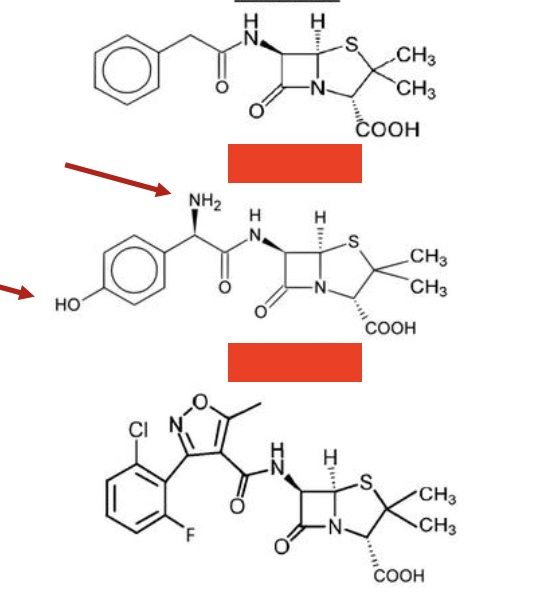
label top to bottom
penicillin G, amoxicillin, flucloxacillin
3 types of penicillins descr
amoxicillin - spectrum: excellent gram+ (inc eterococci) and anaerobic activity, broader gram- activity than penicillin G, good bioavailability → oral administration
flucloxacillin - semisynthetic penicillin resistant to the action of penicillinases, infections by S aureus (not MRSA tho)
piperacillin - broad gram- activity, inc. P. aeruginosa (but usually w/ beta-lactamase inhibitor tazobactam)
eg of 2nd class of beta lactam abx
cephalosporins - also from natural compounds, have the same mode of action as penicillins

label 1 and 2
1 - penicillins
2 - cephalosporins
cephalosporins what do they have in common in name
all start w/ “cef”
cephalosporins descr - also gen 1 descr
mostly iv administration
1st gen - eg cefazolin, excellent gram+ activity (inc S. aureus), good gram-activity; used in surgical prophylaxis in dutch hospitals
gen 2 cephalosporins
eg cefuroxim, broader gram-ve activity, gram+ activity maintained, emipirical therapy for infections of unknown origin
3rd gen cephalosporins (3 egs + 3 points)
eg ceftriaxon, cefotaxum, ceftazidime (activity against psuedomonas), even broader gram- activity, gram+ activity partly lost (S. aureus), empirical therapy for infections of unknown origin; specific use: meningitis, gonorrhea
3rd group of beta lactam abx
carbapanems - natural compound is thienamycin which is highly instable, 2nd/3rd gen are meropenem, imipenem, ertapenem; very broad gram+, gram- and anaerobic activity; “agents of last resort”
carbapenems - how to recognize
end in “penem”, S is missing in chemical structure

label left to right
penicillin, cephalosporin, carbapanem
resistance against beta lactam abx and what we can do about it
resistance often from beta lactamases - enzymes that hydrolyze beta lactams; class A beta-lactamases (serine beta-lactamases) can be inhibited by clavulanic acid or the derivative tazobactam
other antibiotics that work at the cell envelope- 1, egs, what is it a product of
glycopeptides, eg vancomycin, teicoplanin, product of soil bacterium amycolatopsis orientalis - huge compounds - natural
features + administration and usage of glycopeptides
active against most Gram+ bacteria, also anaerobe, no gram- activity;
administration and usage - iv - serious infections w/ gram+ bacteria resistant to beta lactams (MRSA) and for patients allergic to beta lactams
oral - intestinal infection w/ c. diff

descr
glycopeptide antibiotic mechanism - glycopeptide binds on peptidoglycan and prevents transpeptidases from cross linking
another abx working at the cell envelope - 2
colistin (polymyxin E), cyclic polypeptide w/ molecular weight of 1155 (HUGE); product of paenibacillus polymyxa, acts as as a detergent to permeabilize bacteria cell membrane (excellent gram- activity, esp pseudomonas)
what is use of colistin limited by
nephrotoxicity
current uses for colistin
reserve abx to treat infections w/ gram- bacteria resistant against other abx, topical use (ear drops), aerosol to treat lung infections of patients w/ cystic fibrosis
how can antibiotics work at the ribosome?
bacteria have a diff ribosome from us, prevents it from attacking our ribosomes
4 types of abx working at the ribosome
chloramphenicol (binds to 50S - inhibits formation of peptide bond)
macrolides (binds to 50S - prevents translocation - movement of ribosome along mRNA)
tetracyclines (interfere w/ attachment of tRNA to mRNA-ribosome complex
aminoglycosides (changes shape of 30S portion, causes code on mRNA to be read incorrectly)
aminoglycosides - 3 egs and more info
gentamicin, tobramycin, streptomycin (TB DRUGS CAUSING HEARING LOSS)
found in 1940s as a product of streptomyces spp; active against most gram- bacteria & staphylococci, no anaerobic activity (uptake O2 dependent); topical or iv administration, rapid resistance and toxic (ototoxic & nephrotoxic) - limited use
tetracyclines descr
identified in 1940s as a product of soil bacteria (streptomyces); very broad spectrum - active against many gram+ and gram- & some anaerobic bacteria, ALSO mycoplasma, chlamydia, rickettsie, borrelia; oral administration - well tolerated - widespread use in outpatient settings (skin & soft tissue infections, respiratory tract infections)
macrolides egs (3)
erythromycin (product of streptomyces erythreus), clarithromycin, azithromycin (semi-synthetic derivatives)
what are macrolides active against
most gram+ and some gram- bacteria (haemophilus, influenzae, campylobacter, legionella), some mycobacteria, mycoplasma, chlamydia
is clindamycin a macrolide abx?
NO but has the same mode of action (blocking ribosome 50S)
what is clindamycin active against
most gram+ bacteria, excellent anaerobic activity, also some antiparasitic activity (malaria, toxoplasma)
clindamycin features
excellent bioavailability/tissue penetration/intracellular accumulation - widely used in outpatient settings (eg skin and soft tissue infections, respiratory tract infection, intestinal infections), BUT be careful of C. diff risk
fluoroquinolones mode of action
bind to DNA gyrase and topoisomerase IV → inhibition of DNA unwinding which causes double stranded DNA breaks
how to tell if something is a fluoroquinolone
ending of “floxacin”
fluoroquinolines 3 egs
ciprofloxacin, levoflocaxin, moxifloxacin
fluoroquinolones descr + 1st gen and how you get to fluoroquinolones
synthetic group of abx, discovered as a side product of chloroquine synthesis, 1st gen - nalidixic acid, addition of fluorine - fluoroquinolones
ciprofloxacin descr features
excellent gram- activity (inc pseudomonas aeruginosa), some gram+ activity (staphylococci); newer agents have improved gram+ activity (levofloxacin) and anaerobic activity (moxifloxacin)
which abx does blocking of DNA integrity/synthesis + descr
metronidazole - member of nitroimidazole class, prodrug that is reduced under anaerobic conditions - active compound causes DNA damage; active against anaerobic bacteria and some protozoa
metronidazole - administration, resistance
administration - iv or oral, various infections involving anaerobic bacteria, advised to avoid alc consumption (important!!), works in abscess where most other abx done work
resistance - rare in more anaerobes (but species dependent)
co trimoxazole what is it
combination of trimethoprim and sulfamethoxazole - inhibition of folic acid biosynthesis
co trimoxazole descr features
excellent gram- activity, some gram+ activity (staphylococci) - unreliable for enterococci and many streptococci bc of capacity to take up folic acid;
good bioavailability - commonly used in out-patient settings (eg UTIs)
label top 1
beta lactams; peptidoglycan biosynthesis (PBP inhibition); penicillins (strep, staph), cephalosporins (surgical prophylaxis, meningitis), carbapanems (last resort)

label 2
glycopeptides; peptidoglycan biosynthesis (binds D-Ala-D-Ala); vancomycin (MRSA), oral for C. diff
label 3
aminoglycosides, tetracyclines, macrolides; protein synthesis (ribosome); gentamicin (gram-, toxic), doxycycline (broad spectrum), azithromycin (respiratory infections)
label 4
fluoroquinolones; DNA gyrase/topoisomerase IV; ciprofloxacin (gram- inc. pseudomonas), levofloxacin (respiratory)
label 4
metronidazole; DNA damage (anaerobic conditions); anaerobic infections, protozoa, avoid alcohol
label last
co-trimoxazole (trimethoprim & sulfonamide); folic acid synthesis inhibition; UTIs (e coli, depending on resistance)