CH 6 Adaptive Quiz: Enzymes
 Call Kai
 Learn
Learn Practice Test
 Spaced Repetition
 Match
Match Flashcards
 Knowt Play
1/15

There's no tags or description
Looks like no tags are added yet.
Name | Mastery | Learn | Test | Matching | Spaced | Call with Kai | Chat |
|---|
No analytics yet
Send a link to your students to track their progress
16 Terms
What is an apoenzyme?
A) the protein part of an enzyme, not including the cofactors or coenzymes
B) a non–amino acid unit that must be tightly bound to an enzyme and is essential for catalytic activity
C) a protein that assists in the folding of an enzyme to its native conformation
D) a precursor protein that is chemically modified by phosphorylation to yield an active enzyme
A) the protein part of an enzyme, not including the cofactors or coenzymes
Which enzyme mechanism involves the transfer of a proton from one molecule to another?
A) acid-base catalysis
B) metal ion catalysis
C) covalent catalysis
D) electrostatic catalysis
A) acid-base catalysis
What does the x intercept on a Lineweaver-Burk plot represent?
A) Km/Vmax
B) Vmax/Km
C) 1/Vmax
D) ½Vmax
E) −1/Km
E) −1/Km
Which enzyme catalyzes polyamine synthesis in trypanosomes, the parasite that causes African sleeping sickness?
A) chymotrypsin
B) ornithine decarboxylase
C) enolase
D) hexokinase
E) HIV protease
B) ornithine decarboxylase
An apoenzyme:
A) is an enzyme consisting of RNA rather than protein.
B) always requires an inorganic ion for its activity.
C) is the nonprotein component of a holoenzyme.
D) requires a cofactor for its activity.
D) requires a cofactor for its activity.
If a reaction no longer contained its catalytic enzyme, which statement would be true regarding the reaction left to proceed in an uncatalyzed manner?
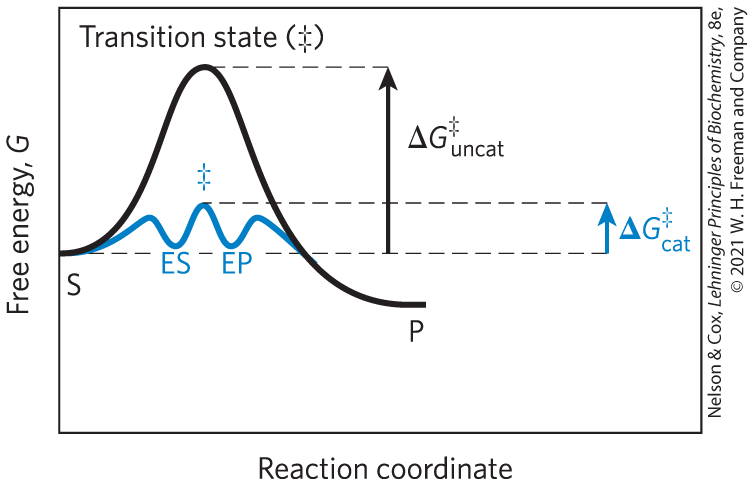
A) The activation energy would decrease.
B) The reaction rate would increase.
C) The ΔG would increase.
D) The ΔG would decrease.
E) The activation energy would increase.
E) The activation energy would increase.
How is the Michaelis constant, Km, defined?
A) the point where V0 changes slowly despite increases in substrate concentration
B) the substrate concentration at which V0 is half-maximal
C) the substrate concentration at 1/Vmax
D) the reciprocal of the substrate concentration
B) the substrate concentration at which V0 is half-maximal
Does enolase require a cofactor or a coenzyme?
A) cofactor; Mg2+
B) coenzyme; Mg2+
C) cofactor; ATP
D) coenzyme; ATP
E) It does not require either a cofactor or coenzyme.
A) cofactor; Mg2+
Consider the reaction:
Galactose 1-phosphate + UDP-glucose → UDP-galactose + glucose 1-phosphate
Which pairing correctly matches the enzyme class and Enzyme Commission number for the enzyme that catalyzes this reaction?
A) translocase; 7
B) transferase; 7
C) translocase; 2
D) isomerase; 5
E) transferase; 2
E) transferase; 2
The reaction shown is a single-step reaction.
A + B → C
What happens to the rate if the concentrations of both A and B are doubled?
A) the rate doubles
B) the rate quadruples
C) the rate stays constant
D) the rate is halved
B) the rate quadruples
What type of compound is difluoromethylornithine (DFMO), which uses two fluorine atoms to provide an alternative electron sink?
A) general acid-base catalyst
B) serine protease
C) β-lactamase
D) metalloprotease
E) suicide inactivator
E) suicide inactivator
Which statement is false regarding coenzymes?
A) Coenzymes are transient carriers of special functional groups.
B) Most coenzymes require organic nutrient precursors ingested in small amounts from the diet.
C) Riboflavin is a coenzyme.
D) Vitamin B1 is the precursor of thiamine pyrophosphate.
E) Pyridoxal phosphate transfers amino groups.
C) Riboflavin is a coenzyme.
Consider the reaction:
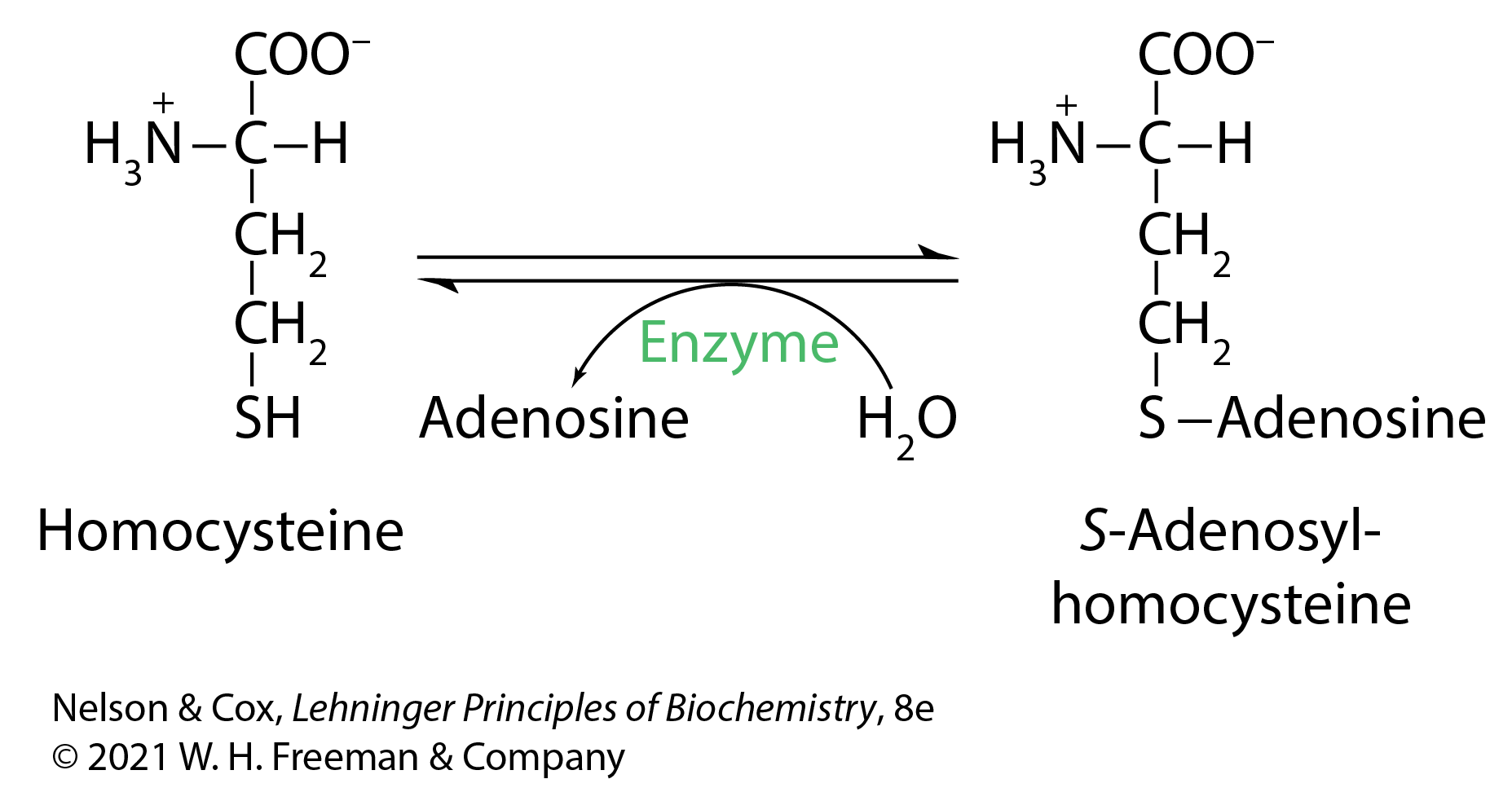
Which pairing correctly matches the enzyme class and Enzyme Commission number for the enzyme that catalyzes this reaction?
A) hydrolase; 3
B) hydrolase; 5
C) isomerase; 2
D) transferase; 2
E) transferase; 5
A) hydrolase; 3
Consider the reaction:
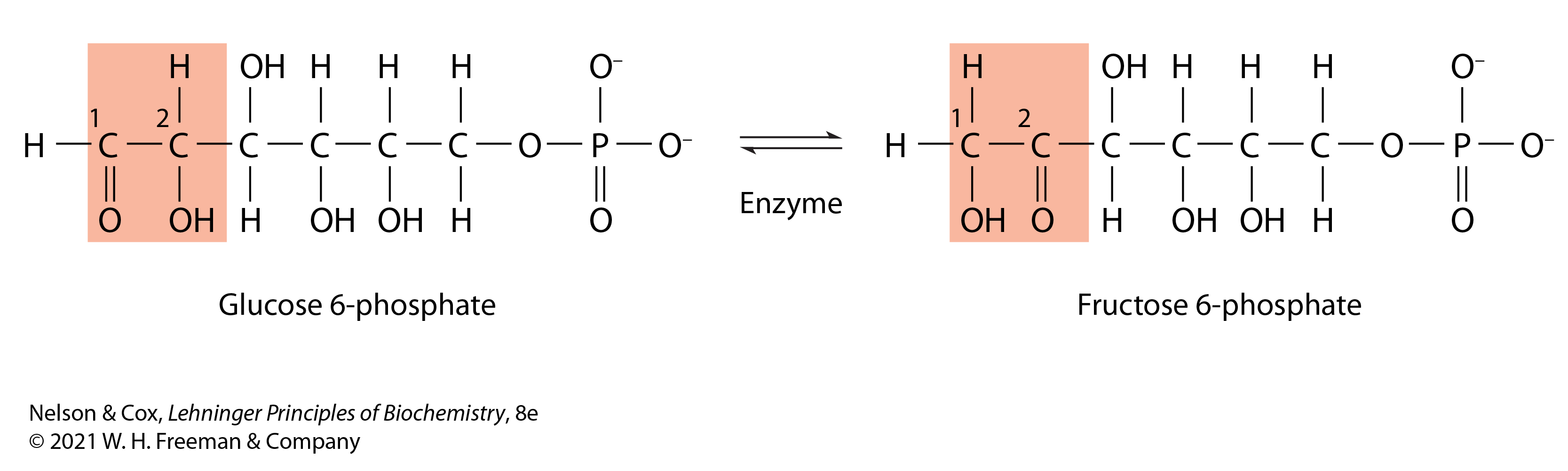
Which pairing correctly matches the enzyme class and Enzyme Commission number for the enzyme that catalyzes this reaction?
A) isomerase; 2
B) transferase; 2
C) hydrolase; 3
D) transferase; 5
E) isomerase; 5
E) isomerase; 5
In the enzymatic reaction of S → P, if ΔG′° = −6.0 kJ/mol and both [S] and [P] are present at 1 mM, what is ΔG? Note: R = 8.315 × 10⁻³ kJ/mol · K and T = 310 K.
A) +8.6 kJ/mol
B) +6.0 kJ/mol
C) −8.6 kJ/mol
D) −6.0 kJ/mol
E) −3.4 kJ/mol
D) −6.0 kJ/mol