Biology U3 AOS 2

0.0(0)
Studied by 0 people
call kaiCall Kai
Locked
learnLearn
examPractice Test
spaced repetitionSpaced Repetition
heart puzzleMatch
flashcardsFlashcards
GameKnowt Play
Card Sorting

1/62

encourage image

There's no tags or description

Looks like no tags are added yet.

Last updated 12:15 PM on 9/25/26
Name
Mastery
Learn
Test
Matching
Spaced
Call with Kai
Chat

No analytics yet

Send a link to your students to track their progress

63 Terms

1
New cards

Photoautotrophs + examples

Photoautotrophs: organisms that do not consume the food they need to survive and instead create their own energy via photosynthesis 

  • Examples of photoautotrophs include: plants, algae,  photosynthetic cyanobacteria 


2
New cards

Photosynthesis (do not write equation)

Photosynthesis: the process of capturing light energy to convert into chemical energy stored in glucose (energy source) and oxygen from carbon dioxide and water 

  • It uses two inputs – carbon dioxide and water – to produce the outputs – glucose, oxygen, and water + for this process to occur, sunlight is also required to energise the reaction 

  • Consists of two stages 


3
New cards

Photosynthesis equation + simplified version


(Simplified equation for photosynthesis) 

<p class="Paragraph SCXO218617022 BCX0" style="text-align: left;"></p><p class="Paragraph SCXO218617022 BCX0" style="text-align: left;"><span style="line-height: 20.7px; color: windowtext;">&nbsp;</span></p><p class="Paragraph SCXO218617022 BCX0" style="text-align: left;"><span style="background-color: inherit; line-height: 20.7px; color: windowtext;">(Simplified equation for photosynthesis)</span><span style="line-height: 20.7px; color: windowtext;">&nbsp;</span></p>
4
New cards

A) Where does photosynthesis occur (plant organ, cell, organelle)

B) What is chlorophyll where is located?

C) What are stomata + function

A) Leaves —> mesophyll cells (main cells) —> chloroplasts

B) Pigment stored within the thylakoids of chloroplasts that absorbs light

C) Tiny pores on the surface of leaves known as stomata open to allow carbon dioxide in the atmosphere to diffuse into the leaf + they also close to prevent water loss from the leaf in dry conditions

5
New cards
term image


<p><span style="line-height: 20.7px; color: windowtext;">&nbsp;</span></p><p></p>
6
New cards
  • The first stage of photosynthesis + its purpose (Don’t describe its steps)

  • Where does it occur

  • It’s inputs & outputs


The light-dependent stage/reactions 

(This stage requires light to occur) 

  • Light-dependent reactions occur on the chlorophyll-filled thylakoid membranes 

  • The purpose of this first stage is to generate the high energy coenzymes NADPH and ATP to power the second stage of photosynthesis 


The inputs of the light-dependent stage are:  

  • 12 water (H2O) molecules  

  • 12 NADP+  (coenzyme) 

  • 18 ADP + Pi  


The outputs of the light-dependent stage are:  

  • 6 oxygen (O2) molecules 

  • 12 NADPH 

  • 18 ATP


7
New cards

Steps in the light-dependent stage: 

  1. Inside the thylakoid, light energy excites electrons in chlorophyll --> the excited electrons (e-) move along proteins in the thylakoid membrane and as they move, their energy powers the pumping of H+ into the thylakoid lumen 


  1. Electrons are donated to chlorophyll to replace the electrons that left, by splitting water into oxygen (O2), electrons and two H+ --> this process is known as photolysis 


  1. The oxygen is released from the chloroplast --> where it will either diffuse out of stomata and into the environment or be used as an input for aerobic cellular respiration 


  1. The H+ ions from water molecules are used to generate the high energy coenzyme NADPH (NADP+ + H+ --> NADPH) +  the enzyme ATP synthase catalyses the reaction ADP + Pi --> ATP using energy from the flow of H+ down its concentration gradient (from area of higher concentration to an area of lower concentration) when leaving the lumen 


  1. ATP and NADPH coenzymes then move on to the light-independent stage 


<ol><li><p class="Paragraph SCXO259674334 BCX0" style="text-align: left;"><span style="background-color: inherit; line-height: 20.7px; color: windowtext;">Inside the thylakoid, light energy excites electrons in chlorophyll --&gt; the excited electrons (e-) move along proteins in the thylakoid membrane and as they move, their energy powers the pumping of H+ into the thylakoid lumen</span><span style="line-height: 20.7px; color: windowtext;">&nbsp;</span></p></li></ol><p class="Paragraph SCXO259674334 BCX0" style="text-align: left;"><span style="line-height: 20.7px; color: windowtext;">&nbsp;</span></p><ol start="2"><li><p class="Paragraph SCXO259674334 BCX0" style="text-align: left;"><span style="background-color: inherit; line-height: 20.7px; color: windowtext;">Electrons are donated to chlorophyll to replace the electrons that left, by splitting water into oxygen (O<sub>2</sub>), electrons and two H<sup>+</sup> --&gt; this process is known as photolysis</span><span style="line-height: 20.7px; color: windowtext;">&nbsp;</span></p></li></ol><p class="Paragraph SCXO259674334 BCX0" style="text-align: left;"><span style="line-height: 20.7px; color: windowtext;">&nbsp;</span></p><ol start="3"><li><p class="Paragraph SCXO259674334 BCX0" style="text-align: left;"><span style="background-color: inherit; line-height: 20.7px; color: windowtext;">The oxygen is released from the chloroplast --&gt; where it will either diffuse out of stomata and into the environment or be used as an input for aerobic cellular respiration</span><span style="line-height: 20.7px; color: windowtext;">&nbsp;</span></p></li></ol><p class="Paragraph SCXO259674334 BCX0" style="text-align: left;"><span style="line-height: 20.7px; color: windowtext;">&nbsp;</span></p><ol start="4"><li><p class="Paragraph SCXO259674334 BCX0" style="text-align: left;"><span style="background-color: inherit; line-height: 20.7px; color: windowtext;">The H+ ions from water molecules are used to generate the high energy coenzyme NADPH (NADP<sup>+</sup> + H<sup>+ </sup>--&gt; NADPH) +&nbsp; the enzyme ATP synthase catalyses the reaction ADP + Pi --&gt; ATP using energy from the flow of H+ down its concentration gradient (from area of higher concentration to an area of lower concentration) when leaving the lumen</span><span style="line-height: 20.7px; color: windowtext;">&nbsp;</span></p></li></ol><p class="Paragraph SCXO259674334 BCX0" style="text-align: left;"><span style="line-height: 20.7px; color: windowtext;">&nbsp;</span></p><ol start="5"><li><p class="Paragraph SCXO259674334 BCX0" style="text-align: left;"><span style="background-color: inherit; line-height: 20.7px; color: windowtext;">ATP and NADPH coenzymes then move on to the light-independent stage</span><span style="line-height: 20.7px; color: windowtext;">&nbsp;</span></p></li></ol><p></p>
8
New cards

What do NADH and ATP transfer?


VCAA NOTE: loaded carriers contain the greatest amount of stored energy 

<p><br></p><p><span style="background-color: inherit; line-height: 23px;">VCAA NOTE:</span><span style="background-color: inherit; line-height: 23px; color: windowtext;"> loaded carriers contain the greatest amount of stored energy</span><span style="line-height: 23px; color: windowtext;">&nbsp;</span></p>
9
New cards
  • The second stage of photosynthesis (Don’t describe its steps)

  • Where does it occur

  • It’s inputs & outputs


The light-independent stage/Calvin cycle/Dark stage 

(This stage doesn’t require light to occur and is instead energised by the ATP and NADPH coenzymes) 

  • The light-independent stage occurs in the stroma (the fluid substance that makes up the interior of chloroplasts), where it is facilitated by enzymes and cycles through multiple reactions  


The inputs of the light-independent stage are: 

  • 6 carbon dioxide (CO2) molecules 

  • 12 NADPH  

  • 18 ATP 


The outputs of the light-independent stage are:  

  • glucose (C6H12O6)  

  • 6 water (H2O) molecules  

  • 12 NADP+ 

  • 18 ADP + Pi 


10
New cards

The steps in the light-independent stage are: 

  1. Carbon dioxide molecules enter the Calvin cycle and undergo initial reactions --> during these changes, the carbon from CO2 combines with a 5-carbon molecule which then splits into two 3-carbon molecules 

  2. NADPH molecules donate their hydrogen ions and electrons and ATP molecules break into ADP and Pi to release energy to facilitate further changes to the carbon molecules. 

  3. Carbon molecules continue to change and rearrange as they move around the cycle and eventually one specific 3-carbon molecule is created and leaves the cycle which is used to make glucose later --> (since glucose has 6 carbons, 6 CO2 molecules must enter the cycle to make one glucose) 

  4. Some of the oxygen molecules leftover from the breaking of CO2 at the beginning of the cycle combine with hydrogen ions from NADPH to create the output water (leaves through stoma) 


<ol><li><p class="Paragraph SCXO91202544 BCX0" style="text-align: left;"><span style="background-color: inherit; line-height: 20.7px; color: windowtext;">Carbon dioxide molecules enter the Calvin cycle and undergo initial reactions --&gt; during these changes, the carbon from CO2 combines with a 5-carbon molecule which then splits into two 3-carbon molecules</span><span style="line-height: 20.7px; color: windowtext;">&nbsp;</span></p></li><li><p class="Paragraph SCXO91202544 BCX0" style="text-align: left;"><span style="background-color: inherit; line-height: 20.7px; color: windowtext;">NADPH molecules donate their hydrogen ions and electrons and ATP molecules break into ADP and Pi to release energy to facilitate further changes to the carbon molecules.</span><span style="line-height: 20.7px; color: windowtext;">&nbsp;</span></p></li><li><p class="Paragraph SCXO91202544 BCX0" style="text-align: left;"><span style="background-color: inherit; line-height: 20.7px; color: windowtext;">Carbon molecules continue to change and rearrange as they move around the cycle and eventually one specific 3-carbon molecule is created and leaves the cycle which is used to make glucose later --&gt; (since glucose has 6 carbons, 6 CO2 molecules must enter the cycle to make one glucose)</span><span style="line-height: 20.7px; color: windowtext;">&nbsp;</span></p></li><li><p class="Paragraph SCXO91202544 BCX0" style="text-align: left;"><span style="background-color: inherit; line-height: 20.7px; color: windowtext;">Some of the oxygen molecules leftover from the breaking of CO2 at the beginning of the cycle combine with hydrogen ions from NADPH to create the output water (leaves through stoma)</span><span style="line-height: 20.7px; color: windowtext;">&nbsp;</span></p></li></ol><p></p>
11
New cards

Rubisco

Rubisco is an enzyme that is responsible for binding CO2 and fixing the carbon into the organic 3-PGA, thus initiating the Calvin cycle 

12
New cards

Steps in the light-independent cycle/ calvin cycle

  1. Rubisco uses 3 × CO2 molecules and 3 × five-carbon molecules (called RuBP) to produce 6 × three-carbon molecules (called 3-PGA) 

  2. The 6 × 3-PGA are then converted by ATP and NADPH to make different 6 x three-carbon molecules (called G3P) (basically 6 × 3-PGA molecules are changed into 6 × G3P molecules, both of which have three carbon atoms) 

  3. One G3P molecule then leaves the cycle to undergo further reactions to contribute to making glucose  

    --> Note that 3 × CO2 molecules must cycle in order for one G3P to leave, and two G3P (three-carbon) leaving are required to build one glucose (six-carbon), therefore 6 × CO2 must enter to produce one glucose molecule 


  4. The remaining 5 × G3P are recycled with the help of ATP to regenerate the 3 × RuBP at the start of the cycle, and the cycle begins all over again --> Overall, the cycle must turn twice to produce one glucose molecule (3 × CO2 goes in twice to contribute to six-carbon glucose) 


13
New cards

What is the calvin cycle in three overarching stages:

  1. Carbon fixation – the conversation of CO2 and RuBP into 3-PGA --> where the carbon from the inorganic CO2 is ‘fixed’ into an organic compound (3-PGA) 

  2. Reduction – NADPH donates electrons to/reduces a three-carbon molecule in the cycle to produce G3P 

  3. Regeneration – the RuBP molecules needed to start the cycle again are reproduced 


14
New cards

Why can’t plants cannot convert CO2 directly into glucose?

Plants cannot convert CO2 directly into glucose as it would waste too much energy 

15
New cards

What is the problem with rubisco? What is this process called and why is it bad?

  • Sometimes, rather than using CO2 as a substrate, it uses O2 instead (acts as a competitive inhibitor) --> this reaction is called photorespiration 

--> This reaction is wasteful + unwanted as photosynthesis is disrupted as CO2 loses an opportunity to bind with Rubisco and hence less glucose is produced and energy is wasted and thus negatively impacts a plant’s ability to grow, survive, and reproduce 

16
New cards

What are some factors that affect whether Rubisco binds to CO2 or O2 (describe them as well)

  • Substrate concentration = the more substrate is present, the greater chance it can bind to an enzyme and undergo a reaction 


 --> therefore plants want to expose Rubisco to a high CO2 concentration and a low O2 concentration to maximise photosynthesis 


They do this by: 

  • The stomata of the plant leaves open to allow CO2 to enter the plant, while O2 and water vapour simultaneously diffuse out of the plant 


However when a plant needs to conserve water, they will close its stomata --> causing the O2 produced during the light-dependent stage of photosynthesis to build up inside its cells, leading to increased photorespiration 


  • Temperature 

    • At regular or low temperatures, Rubisco’s affinity  for CO2 is far greater than that for O2 

    • At higher temperatures, the affinity for O2 is higher, leading to Rubisco binding oxygen more often 


 (affinity: the tendency of a molecule/atom to bind or react with another molecule/atom) 

17
New cards

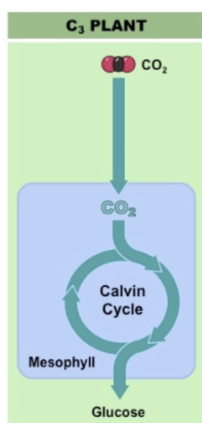
C3 Plants 

Plants with no evolved adaptation to minimise photorespiration 

  • Make up approximately 85% of plants on Earth  

  • Undertake the ‘normal’ photosynthesis 

  • Gets its name from the three-carbon 3-PGA that the initial carbon fixation produces 


e.g. 

All trees, cereals such as wheat and rice, and the majority of nuts, fruits, and vegetables 
 

<p><span style="background-color: inherit; line-height: 20.7px; color: windowtext;">Plants with no evolved adaptation to minimise photorespiration</span><span style="line-height: 20.7px; color: windowtext;">&nbsp;</span></p><ul><li><p class="Paragraph SCXO206930361 BCX0" style="text-align: left;"><span style="background-color: inherit; line-height: 20.7px; color: windowtext;">Make up approximately 85% of plants on Earth&nbsp;</span><span style="line-height: 20.7px; color: windowtext;">&nbsp;</span></p></li><li><p class="Paragraph SCXO206930361 BCX0" style="text-align: left;"><span style="background-color: inherit; line-height: 20.7px; color: windowtext;">Undertake the ‘normal’ photosynthesis</span><span style="line-height: 20.7px; color: windowtext;">&nbsp;</span></p></li><li><p class="Paragraph SCXO206930361 BCX0" style="text-align: left;"><span style="background-color: inherit; line-height: 20.7px; color: windowtext;">Gets its name from the three-carbon 3-PGA that the initial carbon fixation produces</span><span style="line-height: 20.7px; color: windowtext;">&nbsp;</span></p></li></ul><p class="Paragraph SCXO206930361 BCX0" style="text-align: left;"><span style="line-height: 20.7px; color: windowtext;">&nbsp;</span></p><p class="Paragraph SCXO206930361 BCX0" style="text-align: left;"><span style="background-color: inherit; line-height: 20.7px; color: windowtext;">e.g.</span><span style="line-height: 20.7px; color: windowtext;">&nbsp;</span></p><p class="Paragraph SCXO206930361 BCX0" style="text-align: left;"><span style="background-color: inherit; line-height: 20.7px; color: windowtext;">All trees, cereals such as wheat and rice, and the majority of nuts, fruits, and vegetables</span><span style="line-height: 20.7px; color: windowtext;">&nbsp;</span></p><p class="Paragraph SCXO206930361 BCX0" style="text-align: left;"><span style="line-height: 20.7px; color: windowtext;">&nbsp;</span></p>
18
New cards

C4 Plants  (don’t explain the steps of photosynthesis, but describe how its different from C3 plants, examples, etc)

  • The light-dependent stage of photosynthesis in C4 plants is still exactly the same as C3 plants 

  • In C4 plants, the initial carbon fixation and the remainder of the Calvin cycle are separated into two different cells rather than a single cell like in C3 plants --> where in C4 plants, initial carbon fixation occurs in a mesophyll cell while the remaining Calvin cycle occurs in specialised cells called bundle-sheath cells 

  • C4 photosynthesis gets its name from the first four-carbon molecule produced in the initial carbon fixation 

  • Examples of C4 plants include corn, sugarcane, switchgrass, and several weed species 


<ul><li><p class="Paragraph SCXO210451458 BCX0" style="text-align: left;"><span style="background-color: inherit; line-height: 20.7px; color: windowtext;">The light-dependent stage of photosynthesis in C4 plants is still exactly the same as C3 plants</span><span style="line-height: 20.7px; color: windowtext;">&nbsp;</span></p></li><li><p class="Paragraph SCXO210451458 BCX0" style="text-align: left;"><span style="background-color: inherit; line-height: 20.7px; color: windowtext;">In C4 plants, the initial carbon fixation and the remainder of the Calvin cycle are separated into two different cells rather than a single cell like in C3 plants --&gt; where in C4 plants, initial carbon fixation occurs in a mesophyll cell while the remaining Calvin cycle occurs in specialised cells called bundle-sheath cells</span><span style="line-height: 20.7px; color: windowtext;">&nbsp;</span></p></li><li><p class="Paragraph SCXO210451458 BCX0" style="text-align: left;"><span style="background-color: inherit; line-height: 20.7px; color: windowtext;">C4 photosynthesis gets its name from the first four-carbon molecule produced in the initial carbon fixation</span><span style="line-height: 20.7px; color: windowtext;">&nbsp;</span></p></li><li><p class="Paragraph SCXO210451458 BCX0" style="text-align: left;"><span style="background-color: inherit; line-height: 20.7px; color: windowtext;">Examples of C4 plants include corn, sugarcane, switchgrass, and several weed species</span><span style="line-height: 20.7px; color: windowtext;">&nbsp;</span></p></li></ul><p class="Paragraph SCXO210451458 BCX0" style="text-align: left;"><span style="line-height: 20.7px; color: windowtext;">&nbsp;</span></p><p></p>
19
New cards

Light-dependent reactions in C4 plants: 

  1. CO2 enters mesophyll cells and is fixed by the enzyme PEP carboxylase which adds the carbon from CO2 to a three-carbon molecule (PEP) to create a four-carbon molecule (oxaloacetate) --> PEP carboxylase has no affinity to bind to O2 (unlike Rubisco) 


  1. Oxaloacetate is converted to a different four-carbon molecule (malate) capable of being transported to bundle-sheath cells 


  1. Inside the bundle-sheath cell, malate breaks down and releases CO2, which then enters the Calvin cycle in exactly the same way as C3 photosynthesis, leading to glucose production 


  1. Pyruvate formed from the breakdown of malate is transported back to the mesophyll cell and converted to PEP with the help of ATP 


  1. PEP is then ready to contribute to the fixation of CO2 and production of oxaloacetate and the cycle continues all over again 


<ol><li><p class="Paragraph SCXO38468040 BCX0" style="text-align: left;"><span style="background-color: inherit; line-height: 20.7px; color: windowtext;">CO2 enters mesophyll cells and is fixed by the enzyme PEP carboxylase which adds the carbon from CO2 to a three-carbon molecule (PEP) to create a four-carbon molecule (oxaloacetate) --&gt; PEP carboxylase has no affinity to bind to O2 (unlike Rubisco)</span><span style="line-height: 20.7px; color: windowtext;">&nbsp;</span></p></li></ol><p class="Paragraph SCXO38468040 BCX0" style="text-align: left;"><span style="line-height: 20.7px; color: windowtext;">&nbsp;</span></p><ol start="2"><li><p class="Paragraph SCXO38468040 BCX0" style="text-align: left;"><span style="background-color: inherit; line-height: 20.7px; color: windowtext;">Oxaloacetate is converted to a different four-carbon molecule (malate) capable of being transported to bundle-sheath cells</span><span style="line-height: 20.7px; color: windowtext;">&nbsp;</span></p></li></ol><p class="Paragraph SCXO38468040 BCX0" style="text-align: left;"><span style="line-height: 20.7px; color: windowtext;">&nbsp;</span></p><ol start="3"><li><p class="Paragraph SCXO38468040 BCX0" style="text-align: left;"><span style="background-color: inherit; line-height: 20.7px; color: windowtext;">Inside the bundle-sheath cell, malate breaks down and releases CO2, which then enters the Calvin cycle in exactly the same way as C3 photosynthesis, leading to glucose production</span><span style="line-height: 20.7px; color: windowtext;">&nbsp;</span></p></li></ol><p class="Paragraph SCXO38468040 BCX0" style="text-align: left;"><span style="line-height: 20.7px; color: windowtext;">&nbsp;</span></p><ol start="4"><li><p class="Paragraph SCXO38468040 BCX0" style="text-align: left;"><span style="background-color: inherit; line-height: 20.7px; color: windowtext;">Pyruvate formed from the breakdown of malate is transported back to the mesophyll cell and converted to PEP with the help of ATP</span><span style="line-height: 20.7px; color: windowtext;">&nbsp;</span></p></li></ol><p class="Paragraph SCXO38468040 BCX0" style="text-align: left;"><span style="line-height: 20.7px; color: windowtext;">&nbsp;</span></p><ol start="5"><li><p class="Paragraph SCXO38468040 BCX0" style="text-align: left;"><span style="background-color: inherit; line-height: 20.7px; color: windowtext;">PEP is then ready to contribute to the fixation of CO2 and production of oxaloacetate and the cycle continues all over again</span><span style="line-height: 20.7px; color: windowtext;">&nbsp;</span></p></li></ol><p class="Paragraph SCXO38468040 BCX0" style="text-align: left;"></p>
20
New cards

Explain how the process of C4 plants helps reduce photorespiration + maximise photosynthesis: 

Outline a flaw C4 plants have that C3 plants do not:

  • With the mesophyll cells constantly pumping a source of CO2 (in the form of malate) into the bundle-sheath cells, there is always a higher concentration of CO2 present for Rubisco rather than O2 -->  thus photorespiration is minimised and photosynthesis is maximised 


However since ATP is required to convert pyruvate to PEP for the initial carbon fixation -->  C4 plants use more energy to undertake photosynthesis than C3 plants

21
New cards

CAM Plants  + outline the process + examples

  • The light-dependent stage of photosynthesis in CAM plants is still identical to that of C3 and C4 plants, but the light-independent stage differs --> where they separate the initial carbon fixation and the remainder of the Calvin cycle over time 

  • Water is also conserved in CAM plants as their stomata only open at night when it is typically cooler and more humid --> Because of this, CAM plants are very prominent in very hot dry areas like deserts (e.g. CAM plants include almost all cacti, pineapples, vanilla, and orchids) 


  1. At night, CAM plants open up their stomata to bring in CO2 which is fixed into a four-carbon molecule (oxaloacetate) by the enzyme PEP carboxylase, similarly to C4 plants 


  1.  Oxaloacetate is then converted to a different four-carbon molecule (can be malate or another organic molecule) which is stored inside vacuoles within the mesophyll cell until the daytime 


  1. During the daytime, CAM plants do not open their stomata to prevent water loss --> but can still photosynthesise during the day as the malate (or other) molecule is transported out of the vacuole and broken down to release CO2  


  1. The CO2 is then free to enter the Calvin cycle in the same fashion as in C3 and C4 plants, leading to glucose production 


<ul><li><p class="Paragraph SCXO45639010 BCX0" style="text-align: left;"><span style="background-color: inherit; line-height: 20.7px; color: windowtext;">The light-dependent stage of photosynthesis in CAM plants is still identical to that of C3 and C4 plants, but the light-independent stage differs --&gt; where they separate the initial carbon fixation and the remainder of the Calvin cycle over time</span><span style="line-height: 20.7px; color: windowtext;">&nbsp;</span></p></li><li><p class="Paragraph SCXO45639010 BCX0" style="text-align: left;"><span style="background-color: inherit; line-height: 20.7px; color: windowtext;">Water is also conserved in CAM plants as their stomata only open at night when it is typically cooler and more humid --&gt; Because of this, CAM plants are very prominent in very hot dry areas like deserts (e.g. CAM plants include almost all cacti, pineapples, vanilla, and orchids)</span><span style="line-height: 20.7px; color: windowtext;">&nbsp;</span></p></li></ul><p class="Paragraph SCXO45639010 BCX0" style="text-align: left;"><span style="line-height: 20.7px; color: windowtext;">&nbsp;</span></p><ol><li><p class="Paragraph SCXO45639010 BCX0" style="text-align: left;"><span style="background-color: inherit; line-height: 20.7px; color: windowtext;">At night, CAM plants open up their stomata to bring in CO2 which is fixed into a four-carbon molecule (oxaloacetate) by the enzyme PEP carboxylase, similarly to C4 plants</span><span style="line-height: 20.7px; color: windowtext;">&nbsp;</span></p></li></ol><p class="Paragraph SCXO45639010 BCX0" style="text-align: left;"><span style="line-height: 20.7px; color: windowtext;">&nbsp;</span></p><ol start="2"><li><p class="Paragraph SCXO45639010 BCX0" style="text-align: left;"><span style="background-color: inherit; line-height: 20.7px; color: windowtext;">&nbsp;Oxaloacetate is then converted to a different four-carbon molecule (can be malate or another organic molecule) which is stored inside vacuoles within the mesophyll cell until the daytime</span><span style="line-height: 20.7px; color: windowtext;">&nbsp;</span></p></li></ol><p class="Paragraph SCXO45639010 BCX0" style="text-align: left;"><span style="line-height: 20.7px; color: windowtext;">&nbsp;</span></p><ol start="3"><li><p class="Paragraph SCXO45639010 BCX0" style="text-align: left;"><span style="background-color: inherit; line-height: 20.7px; color: windowtext;">During the daytime, CAM plants do not open their stomata to prevent water loss --&gt; but can still photosynthesise during the day as the malate (or other) molecule is transported out of the vacuole and broken down to release CO2&nbsp;</span><span style="line-height: 20.7px; color: windowtext;">&nbsp;</span></p></li></ol><p class="Paragraph SCXO45639010 BCX0" style="text-align: left;"><span style="line-height: 20.7px; color: windowtext;">&nbsp;</span></p><ol start="4"><li><p class="Paragraph SCXO45639010 BCX0" style="text-align: left;"><span style="background-color: inherit; line-height: 20.7px; color: windowtext;">The CO2 is then free to enter the Calvin cycle in the same fashion as in C3 and C4 plants, leading to glucose production</span><span style="line-height: 20.7px; color: windowtext;">&nbsp;</span></p></li></ol><p></p>
22
New cards

Explain how the process of CAM plants helps reduce photorespiration + maximise photosynthesis: 

Outline a flaw CAM plants have that C3 plants do not:

  • The controlled release of molecules out of vacuoles ensures a high concentration of CO2 is maintained near Rubisco, maximising photosynthesis and minimising photorespiration 


  • Also note that when stomata are closed - this increases the concentration of O2 relative to CO2 - which results in an increased likelihood of photorespiration —→ in C3 plants

  • However in CAM plants when the stomata is closed in the daytime - the storage of malate (source of CO2) which are broken down to CO2 - increases its concentration to reduce photorespiration and increase photosynthesis


  • Like C4 photosynthesis, the CAM pathway requires more ATP than C3 photosynthesis to cycle PEP


23
New cards

Compare all the plants (CAM, C4, C3)

Include:

  • Does it limit photorespiration

  • Separation of initial CO2 fixation and remainder of calvin cycle

  • When stomata is open

  • +

  • -

  • Best adapted to what environment conditions

  • Examples


<p><span><br></span></p><img src="https://onenote.officeapps.live.com/o/GetImage.ashx?&amp;WOPIsrc=https%3A%2F%2Fivanhoegirlsviceduau%2Dmy%2Esharepoint%2Ecom%2Fpersonal%2Frazam%5Fivanhoegirls%5Fvic%5Fedu%5Fau%2F%5Fvti%5Fbin%2Fwopi%2Eashx%2Ffiles%2Fd8f1f04d7dfc4a849522c29d83ddced4&amp;access_token=eyJhbGciOiJSUzI1NiIsImtpZCI6Ijk1RjYyMTA0MjhBMUUxNUJENjJBQjBEQ0ZBQThFNjlBNkFDOUQxNjgiLCJ0eXAiOiJKV1QiLCJ4NXQiOiJsZlloQkNpaDRWdldLckRjLXFqbW1tckowV2cifQ%2EeyJuYW1laWQiOiIwIy5mfG1lbWJlcnNoaXB8cmF6YW1AaXZhbmhvZWdpcmxzLnZpYy5lZHUuYXUiLCJuaWkiOiJtaWNyb3NvZnQuc2hhcmVwb2ludCIsImlzdXNlciI6InRydWUiLCJjYWNoZWtleSI6IjBoLmZ8bWVtYmVyc2hpcHwxMDAzMjAwMGRmMzdkNzExQGxpdmUuY29tIiwic2hhcmluZ2lkIjoiMDAxZjc2Y2EtNjg5NC0xNDE1LWIwNmMtZjcxODEzMjVhNzc2Iiwic2lnbmluX3N0YXRlIjoiW1wia21zaVwiXSIsInV0aSI6Ilo3M1RLWWtfVlVTMUhPdVJsdUlFQUEiLCJ4bXNfY2MiOiJbXCJDUDFcIl0iLCJ4bXNfc3NtIjoiMSIsIm9pZCI6ImZiZDViMDEzLTAyNTUtNGMyOS1hOWJkLTkzYTAzM2QzODE2YiIsImlzbG9vcGJhY2siOiJUcnVlIiwiYXBwY3R4IjoiZDhmMWYwNGQ3ZGZjNGE4NDk1MjJjMjlkODNkZGNlZDQ7dlhqbUZlRWpsc2p4TTFaeTMxT2ZFVmlKQUUwPTtEZWZhdWx0Ozs3RkZGRkZGRkZGRkJGRkZGO1RydWU7OzsxMzI3Njg0OzQyYWMxNmEyLWEwNjItNTAwMC01NWE5LWJhZmZmYzdkMWEyOCIsImZpZCI6IjE5NzEyMyIsImlzcyI6IjAwMDAwMDAzLTAwMDAtMGZmMS1jZTAwLTAwMDAwMDAwMDAwMEA5MDE0MDEyMi04NTE2LTExZTEtOGVmZi00OTMwNDkyNDAxOWIiLCJhdWQiOiJ3b3BpL2l2YW5ob2VnaXJsc3ZpY2VkdWF1LW15LnNoYXJlcG9pbnQuY29tQDUxY2RjYmY2LTMxODAtNDBiYy05ZjAyLTgyMzRiN2Y1ZGU3NSIsIm5iZiI6IjE3Nzk2MDI3NzEiLCJleHAiOiIxNzc5NjM4NzcxIn0%2EiYksUSur3xNRGL0HbnasiFZBEE7FjZ4WNQJeDcIlRoT48SZqQB4CixQ%5F96MvUj6B3xcru7JczBBda4oWBGoEcKvo6fF7z4MwEef5VY4JD625oVjVLPAzLK%2DyJAB9KWEPMRznaxXPrq%5FS636TV8GpFFQ6v8NwyPhtE3OJL5nR5ihcTb44OwmJirJ7U1hg2junQayDoFY%5Fkw5GvsTf%5FeTdbNHCe8G37Vt9xeJbKy%2Dr4NBpQKGp2lRj4hRr9iwh3wwjOOjjTkyPXzy6pv0cvESR77Qp6nwQ8WuUCSqHpDClYTTj7b9qusTHrNZ1Gs%2DgpzES0JtOJt8wQuX4%2DnL97MgBlw&amp;access_token_ttl=1779638771601&amp;ObjectDataBlobId=%7Bab2dd92c-a0da-4657-bfd2-07a9fb1217eb%7D%7B1%7D&amp;usid=76b62cd8-f635-1a7a-8c57-36049495cf27&amp;build=16.0.20117.41002&amp;waccluster=PAU1&amp;wdwacuseragent=MSWACONSync" data-width="100%" data-align="center" alt=""><p></p>
24
New cards

Explain how light affects the rate of photosynthesis + show this on a graph (explain why graph is the way it is)


As seen in the above graph, the rate of photosynthesis increases as light intensity increases, but only up until point X where it plateaus  

  • The increase in the rate of photosynthesis towards point X is because the plant is exposed to greater light energy, which can energise the chlorophyll within many more plant cells, thus increasing overall photosynthesis 


There are two things that can cause the plateau on the graph: 

  1. That the maximum rate of photosynthesis has been reached assuming that other factors of photosynthesis are unlimited --> however this maximum possible rate cannot increase as the enzymes within chloroplasts are operating at their full capacity/ reached saturation

--> Where point X is known as the saturation point (point at which a substance (e.g. an enzyme) cannot receive more of another substance (e.g. a substrate)) 


  1. When there is limiting factor/reagent which is one of the reactants (e.g. temperature or carbon dioxide) needed for photosynthesis which there isn’t enough of compared to other factors, therefore it is preventing the photosynthesis rate from increasing 


<p><br></p><p><span style="background-color: inherit; line-height: 20.7px; color: windowtext;">As seen in the above graph, the rate of photosynthesis increases as light intensity increases, but only up until point X where it plateaus&nbsp;</span><span style="line-height: 20.7px; color: windowtext;">&nbsp;</span></p><ul><li><p class="Paragraph SCXO153880720 BCX0" style="text-align: left;"><span style="background-color: inherit; line-height: 20.7px; color: windowtext;">The increase in the rate of photosynthesis towards point X is because the plant is exposed to greater light energy, which can energise the chlorophyll within many more plant cells, thus increasing overall photosynthesis</span><span style="line-height: 20.7px; color: windowtext;">&nbsp;</span></p></li></ul><p class="Paragraph SCXO153880720 BCX0" style="text-align: left;"><span style="line-height: 20.7px; color: windowtext;">&nbsp;</span></p><p class="Paragraph SCXO153880720 BCX0" style="text-align: left;"><span style="background-color: inherit; line-height: 20.7px; color: windowtext;">There are two things that can cause the plateau on the graph:</span><span style="line-height: 20.7px; color: windowtext;">&nbsp;</span></p><ol><li><p class="Paragraph SCXO153880720 BCX0" style="text-align: left;"><span style="background-color: inherit; line-height: 20.7px; color: windowtext;">That the maximum rate of photosynthesis has been reached assuming that other factors of photosynthesis are unlimited --&gt; however this maximum possible rate cannot increase as <u>the enzymes within chloroplasts are operating at their full capacity</u></span><span style="line-height: 20.7px; color: windowtext;">/ reached saturation</span></p></li></ol><p class="Paragraph SCXO153880720 BCX0" style="text-align: left;"><span style="background-color: inherit; line-height: 20.7px; color: windowtext;">--&gt; Where point X is known as the saturation point (point at which a substance (e.g. an enzyme) cannot receive more of another substance (e.g. a substrate))</span><span style="line-height: 20.7px; color: windowtext;">&nbsp;</span></p><p class="Paragraph SCXO153880720 BCX0" style="text-align: left;"><span style="line-height: 20.7px; color: windowtext;">&nbsp;</span></p><ol start="2"><li><p class="Paragraph SCXO153880720 BCX0" style="text-align: left;"><span style="background-color: inherit; line-height: 20.7px; color: windowtext;">When there is limiting factor/reagent which is one of the reactants (e.g. temperature or carbon dioxide) needed for photosynthesis which there isn’t enough of compared to other factors, therefore it is preventing the photosynthesis rate from increasing</span><span style="line-height: 20.7px; color: windowtext;">&nbsp;</span></p></li></ol><p></p>
25
New cards

Comparing the effect of light on C3, C4 and CAM plants: 

Since these plant types have the same light-dependent reactions, light influences them in the same manner 

26
New cards

The wavelength (and therefore colour) of light also impacts the process of photosynthesis - outline what colours increase the rate the greatest/least

  • The greatest rate of photosynthesis occurs when a plant is exposed to violet or red light 

  • The rate of photosynthesis is relatively low under green light (most green light is reflected, which is why we see leaves as green) 


<ul><li><p class="Paragraph SCXO143522909 BCX0" style="text-align: left;"><span style="background-color: inherit; line-height: 20.7px; color: windowtext;">The greatest rate of photosynthesis occurs when a plant is exposed to violet or red light</span><span style="line-height: 20.7px; color: windowtext;">&nbsp;</span></p></li><li><p class="Paragraph SCXO143522909 BCX0" style="text-align: left;"><span style="background-color: inherit; line-height: 20.7px; color: windowtext;">The rate of photosynthesis is relatively low under green light (most green light is reflected, which is why we see leaves as green)</span><span style="line-height: 20.7px; color: windowtext;">&nbsp;</span></p></li></ul><p></p>
27
New cards

Explain how temperature affects the rate of photosynthesis + show this on a graph

  • Enzymes catalyse various reactions in both stages of photosynthesis --> hence given enzymes are affected by temperature, so too is the rate of photosynthesis 

  • The rate of photosynthesis is greatest when the temperature matches the enzyme’s optimal temperature (while every enzyme is unique, the optimal temperatures of enzymes within a plant is likely to be similar as they have evolved to be suited to the plant’s environment) 


  • The rate of photosynthesis increases toward the enzyme’s optimal temperature due to more frequent enzyme-substrate collisions.  

  • However, above the optimal temperature, the enzymes begin to denature and are unable to function, causing a decrease in photosynthesis rate 


<ul><li><p class="Paragraph SCXO230647308 BCX0" style="text-align: left;"><span style="background-color: inherit; line-height: 20.7px; color: windowtext;">Enzymes catalyse various reactions in both stages of photosynthesis --&gt; hence given enzymes are affected by temperature, so too is the rate of photosynthesis</span><span style="line-height: 20.7px; color: windowtext;">&nbsp;</span></p></li><li><p class="Paragraph SCXO230647308 BCX0" style="text-align: left;"><span style="background-color: inherit; line-height: 20.7px; color: windowtext;">The rate of photosynthesis is greatest when the temperature matches the enzyme’s optimal temperature (while every enzyme is unique, the optimal temperatures of enzymes within a plant is likely to be similar as they have evolved to be suited to the plant’s environment)</span><span style="line-height: 20.7px; color: windowtext;">&nbsp;</span></p></li></ul><p class="Paragraph SCXO230647308 BCX0" style="text-align: left;"><span style="line-height: 20.7px; color: windowtext;">&nbsp;&nbsp;</span></p><ul><li><p class="Paragraph SCXO230647308 BCX0" style="text-align: left;"><span style="background-color: inherit; line-height: 20.7px; color: windowtext;">The rate of photosynthesis increases toward the enzyme’s optimal temperature due to more frequent enzyme-substrate collisions.&nbsp;</span><span style="line-height: 20.7px; color: windowtext;">&nbsp;</span></p></li><li><p class="Paragraph SCXO230647308 BCX0" style="text-align: left;"><span style="background-color: inherit; line-height: 20.7px; color: windowtext;">However, above the optimal temperature, the enzymes begin to denature and are unable to function, causing a decrease in photosynthesis rate</span><span style="line-height: 20.7px; color: windowtext;">&nbsp;</span></p></li></ul><p></p>
28
New cards

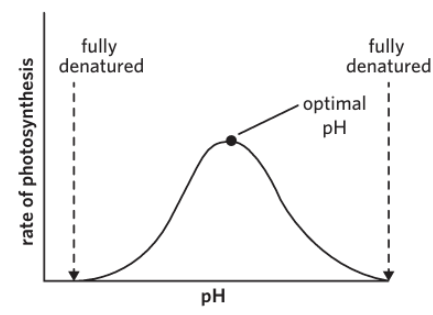
Explain how pH affects the rate of photosynthesis + show this on a graph

  • Enzymes function best at their optimal pH and thus photosynthesis occurs fastest under these conditions 

  • However above and below the optimal pH, enzymes denature, lowering photosynthesis rate 


<ul><li><p class="Paragraph SCXO32968651 BCX0" style="text-align: left;"><span style="background-color: inherit; line-height: 20.7px; color: windowtext;">Enzymes function best at their optimal pH and thus photosynthesis occurs fastest under these conditions</span><span style="line-height: 20.7px; color: windowtext;">&nbsp;</span></p></li><li><p class="Paragraph SCXO32968651 BCX0" style="text-align: left;"><span style="background-color: inherit; line-height: 20.7px; color: windowtext;">However above and below the optimal pH, enzymes denature, lowering photosynthesis rate</span><span style="line-height: 20.7px; color: windowtext;">&nbsp;</span></p></li></ul><p></p>
29
New cards

Explain how CO2 affects the rate of photosynthesis + show this on a graph (explain why graph is the way it is)

As carbon dioxide is an input in the light-independent stage of photosynthesis, its concentration impacts the rate of photosynthesis 

As seen on the graph, as carbon dioxide concentration increases, the rate of photosynthesis increases until point X where it starts to plateau 


There are two things that can cause the plateau on the graph: 


  1. That the maximum rate of photosynthesis has been reached assuming that other factors of photosynthesis are unlimited --> however this maximum possible rate cannot increase as the enzymes within chloroplasts are operating at their full capacity/saturated 


  1. When there is limiting factor/reagent which is one of the reactants (e.g. light, water, temp) needed for photosynthesis which there isn’t enough of compared to other factors, therefore it is preventing the photosynthesis rate from increasing


<p><span style="background-color: inherit; line-height: 20.7px; color: windowtext;">As carbon dioxide is an input in the light-independent stage of photosynthesis, its concentration impacts the rate of photosynthesis</span><span style="line-height: 20.7px; color: windowtext;">&nbsp;</span></p><p class="Paragraph SCXO169584280 BCX0" style="text-align: left;"><span style="background-color: inherit; line-height: 20.7px; color: windowtext;">As seen on the graph, as carbon dioxide concentration increases, the rate of photosynthesis increases until point X where it starts to plateau</span><span style="line-height: 20.7px; color: windowtext;">&nbsp;</span></p><p class="Paragraph SCXO169584280 BCX0" style="text-align: left;"><span style="line-height: 20.7px; color: windowtext;">&nbsp;</span></p><p class="Paragraph SCXO169584280 BCX0" style="text-align: left;"><span style="background-color: inherit; line-height: 20.7px; color: windowtext;">There are two things that can cause the plateau on the graph:</span><span style="line-height: 20.7px; color: windowtext;">&nbsp;</span></p><p class="Paragraph SCXO169584280 BCX0" style="text-align: left;"><span style="line-height: 20.7px; color: windowtext;">&nbsp;</span></p><ol><li><p class="Paragraph SCXO169584280 BCX0" style="text-align: left;"><span style="background-color: inherit; line-height: 20.7px; color: windowtext;">That the maximum rate of photosynthesis has been reached assuming that other factors of photosynthesis are unlimited --&gt; however this maximum possible rate cannot increase as <u>the enzymes within chloroplasts are operating at their full capacity/saturated</u></span><span style="line-height: 20.7px; color: windowtext;">&nbsp;</span></p></li></ol><p class="Paragraph SCXO169584280 BCX0" style="text-align: left;"><span style="line-height: 20.7px; color: windowtext;">&nbsp;</span></p><ol start="2"><li><p class="Paragraph SCXO169584280 BCX0" style="text-align: left;"><span style="background-color: inherit; line-height: 20.7px; color: windowtext;">When there is limiting factor/reagent which is one of the reactants (e.g. light, water, temp) needed for photosynthesis which there isn’t enough of compared to other factors, therefore it is preventing the photosynthesis rate from increasing</span></p></li></ol><p></p>
30
New cards

Explain why a lack of water decreases the rate of photosynthesis (talk about stomata)

  • However when plants experience a lack of water (due to droughts or periods of hot weather or any changes to the plant’s external environment) --> To prevent mass water loss, plants close their stomata on their leaves so that water does not evaporate out of the plant 


However this is bad as: 

  • It limits the gaseous exchange of CO2 and O2 with the environment --> where CO2 can no longer enter the leaves and O2 produced in the light-dependent stage can no longer be released 

  • This causes O2 to be more likely abundant than CO2, meaning that Rubisco is more likely to bind O2 and initiate the wasteful photorespiration pathway, rather than photosynthesis --> resulting in the plant wasting energy +   loses an opportunity to photosynthesise, which decreases the overall rate of photosynthesis 


31
New cards

Explain how enzyme inhibition (competitive and non-competitive inhibtors) affect the rate of photosynthesis + show on a graph

Enzyme inhibitors influence the function of enzymes and, as a result, the rate of photosynthesis. 

  • Where competitive inhibitors bind to the active sites of enzymes to prevent the catalysis of substrates 

  • While non-competitive inhibitors bind to an allosteric site of an enzyme causing a conformational change to the active site meaning the substrate can no longer bind 


In general, the presence of inhibitors lowers the rate of photosynthesis 

  • However, the effect of competitive reversible inhibitors can be gradually overcome if the substrate concentration is continually increased  - as it increases the likelihood of that substrate binding to the enzyme instead of the competitive inhibitor + irreversible inhibitors are permanent

  • Whereas increasing substrate concentration does not reduce the effect of irreversible inhibitors or reversible non-competitive inhibitors 


<p><span style="background-color: inherit; line-height: 20.7px; color: windowtext;">Enzyme inhibitors influence the function of enzymes and, as a result, the rate of photosynthesis.</span><span style="line-height: 20.7px; color: windowtext;">&nbsp;</span></p><ul><li><p class="Paragraph SCXO60217390 BCX0" style="text-align: left;"><span style="background-color: inherit; line-height: 20.7px; color: windowtext;">Where competitive inhibitors bind to the active sites of enzymes to prevent the catalysis of substrates</span><span style="line-height: 20.7px; color: windowtext;">&nbsp;</span></p></li><li><p class="Paragraph SCXO60217390 BCX0" style="text-align: left;"><span style="background-color: inherit; line-height: 20.7px; color: windowtext;">While non-competitive inhibitors bind to an allosteric site of an enzyme causing a conformational change to the active site meaning the substrate can no longer bind</span><span style="line-height: 20.7px; color: windowtext;">&nbsp;</span></p></li></ul><p class="Paragraph SCXO60217390 BCX0" style="text-align: left;"><span style="line-height: 20.7px; color: windowtext;">&nbsp;</span></p><p class="Paragraph SCXO60217390 BCX0" style="text-align: left;"><span style="background-color: inherit; line-height: 20.7px; color: windowtext;">In general, the presence of inhibitors lowers the rate of photosynthesis</span><span style="line-height: 20.7px; color: windowtext;">&nbsp;</span></p><ul><li><p class="Paragraph SCXO60217390 BCX0" style="text-align: left;"><span style="background-color: inherit; line-height: 20.7px; color: windowtext;">However, the effect of competitive reversible inhibitors can be gradually overcome if the substrate concentration is continually increased&nbsp;</span><span style="line-height: 20.7px; color: windowtext;">&nbsp;- as it increases the likelihood of that substrate binding to the enzyme instead of the competitive inhibitor + irreversible inhibitors are permanent</span></p></li><li><p class="Paragraph SCXO60217390 BCX0" style="text-align: left;"><span style="background-color: inherit; line-height: 20.7px; color: windowtext;">Whereas increasing substrate concentration does not reduce the effect of irreversible inhibitors or reversible non-competitive inhibitors</span><span style="line-height: 20.7px; color: windowtext;">&nbsp;</span></p></li></ul><p></p>
32
New cards

CRISPR + Cas9 + their relationship

  • CRISPR: short, clustered repeats of DNA found in prokaryotes which protects them against viral invasion 

  • Cas9: an endonuclease that creates a blunt end cut at a site specified by  (gRNA) 


--> Cas9 can be instructed by CRISPR to target specific DNA recognition sites to cut and join, altering the DNA 

33
New cards
<p>Note:</p><ul><li><p class="Paragraph SCXO92379736 BCX0" style="text-align: left;"><span style="background-color: inherit; line-height: 20.7px; color: windowtext;">An important application of CRISPR-Cas9 is removing unwanted or disadvantageous alleles within an organism’s genome, resulting in an improved or desired phenotype --&gt; where the new and improved genetically modified organism (GMO) can then adapt to and survive its environment more effectively</span><span style="line-height: 20.7px; color: windowtext;">&nbsp;</span></p></li></ul><p class="Paragraph SCXO92379736 BCX0" style="text-align: left;"><span style="line-height: 20.7px; color: windowtext;">&nbsp;</span></p><p class="Paragraph SCXO92379736 BCX0" style="text-align: left;"><span style="background-color: inherit; line-height: 20.7px; color: windowtext;">CRISPR-Cas9 can maximise crop productivity without clearing any additional land</span><span style="line-height: 20.7px; color: windowtext;">&nbsp;</span></p><ul><li><p class="Paragraph SCXO92379736 BCX0" style="text-align: left;"><span style="background-color: inherit; line-height: 20.7px; color: windowtext;">CRISPR-Cas9 is to engineer crops that bypass photorespiration, somewhat mimicking the function of C4 and CAM plants</span><span style="line-height: 20.7px; color: windowtext;">&nbsp;</span></p></li><li><p class="Paragraph SCXO92379736 BCX0" style="text-align: left;"><span style="background-color: inherit; line-height: 20.7px; color: windowtext;">Other possible changes to maximise photosynthesis efficiency could be to target Rubisco’s function directly, or edit the function of chloroplasts to make them more efficient, or target stomata to reduce the impacts of water stress</span><span style="line-height: 20.7px; color: windowtext;">&nbsp;</span></p></li><li><p class="Paragraph SCXO92379736 BCX0" style="text-align: left;"><span style="background-color: inherit; line-height: 20.7px; color: windowtext;">Other potential applications include increasing crop tolerance for harsh physical conditions such as drought, frost, disease, or the chemicals used in farming</span><span style="line-height: 20.7px; color: windowtext;">&nbsp;</span></p></li></ul><p></p>

Note:

  • An important application of CRISPR-Cas9 is removing unwanted or disadvantageous alleles within an organism’s genome, resulting in an improved or desired phenotype --> where the new and improved genetically modified organism (GMO) can then adapt to and survive its environment more effectively 


CRISPR-Cas9 can maximise crop productivity without clearing any additional land 

  • CRISPR-Cas9 is to engineer crops that bypass photorespiration, somewhat mimicking the function of C4 and CAM plants 

  • Other possible changes to maximise photosynthesis efficiency could be to target Rubisco’s function directly, or edit the function of chloroplasts to make them more efficient, or target stomata to reduce the impacts of water stress 

  • Other potential applications include increasing crop tolerance for harsh physical conditions such as drought, frost, disease, or the chemicals used in farming 


34
New cards

Cellular respiration + don’t include equation

Cellular respiration: the process by which cells create usable form of energy in the form of ATP from a series of biochemical reactions, involving the breakdown of glucose (C6H12O6) 

  • Glucose is a sugar molecule commonly found within carbohydrates 


35
New cards

Glucose can be broken down into two different ways, what are they and what is the main difference between them

Glucose can be broken down to produce ATP via two different pathways: aerobic cellular respiration or anaerobic fermentation 

  • Where aerobic cellular respiration requires oxygen, whereas anaerobic fermentation does not 


36
New cards

Outline the aerobic cellular respiration equation


<p><br></p><p></p>
37
New cards

Why is aerobic CR preferred over anaerobic fermentation?

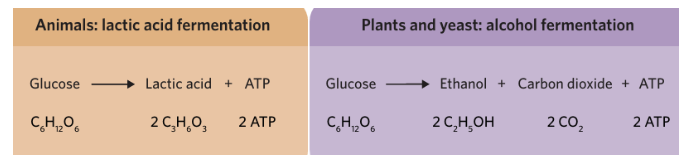
Write down the chemical equations for anaerobic fermentation for animals and yeast?

Anaerobic fermentation produces only 2 ATP and also produces a harmful by product (lactic acid or ethanol) that cells must promptly dispose of before it accumulates 
 

<p class="Paragraph SCXO8554173 BCX0" style="text-align: left;"><span style="background-color: inherit; line-height: 20.7px; color: windowtext;">Anaerobic fermentation produces only 2 ATP and also produces a harmful by product (lactic acid or ethanol) that cells must promptly dispose of before it accumulates</span><span style="line-height: 20.7px; color: windowtext;">&nbsp;</span></p><p class="Paragraph SCXO8554173 BCX0" style="text-align: left;"><span style="line-height: 20.7px; color: windowtext;">&nbsp;</span></p>
38
New cards
term image

The mitochondria includes an: 

  • Inner and outer membrane each composed of a phospholipid bilayer 

  • The space inside the inner membrane is the mitochondrial matrix and is filled with a dense fluid containing many enzymes and solutes 

  • The inner membrane folds are called cristae 


<p><span style="background-color: inherit; line-height: 20.7px; color: windowtext;">The mitochondria includes an:</span><span style="line-height: 20.7px; color: windowtext;">&nbsp;</span></p><ul><li><p class="Paragraph SCXO154831795 BCX0" style="text-align: left;"><span style="background-color: inherit; line-height: 20.7px; color: windowtext;">Inner and outer membrane each composed of a phospholipid bilayer</span><span style="line-height: 20.7px; color: windowtext;">&nbsp;</span></p></li><li><p class="Paragraph SCXO154831795 BCX0" style="text-align: left;"><span style="background-color: inherit; line-height: 20.7px; color: windowtext;">The space inside the inner membrane is the mitochondrial matrix and is filled with a dense fluid containing many enzymes and solutes</span><span style="line-height: 20.7px; color: windowtext;">&nbsp;</span></p></li><li><p class="Paragraph SCXO154831795 BCX0" style="text-align: left;"><span style="background-color: inherit; line-height: 20.7px; color: windowtext;">The inner membrane folds are called cristae</span><span style="line-height: 20.7px; color: windowtext;">&nbsp;</span></p></li></ul><p></p>
39
New cards

What are the stages of aerobic CR

Aerobic cellular respiration occurs in three distinct stages:  

  1. Glycolysis  

  2. The Krebs cycle/citric acid cycle/TCA cycle 

  3. The electron transport chain 


40
New cards

Glycolysis (where does it occur, what occurs, inputs & outputs)

  • Occurs in cytosol 

  • Where glucose (a six-carbon molecule) is broken down via a sequence of ten enzyme-regulated (different enzymes) reactions to form two pyruvate molecules (two three-carbon molecules) 


As glucose is broken down into pyruvate, energy is released which powers two key reactions: 

  • 2 ADP + 2 Pi --> 2 ATP 

  • 2 NAD+ + 2 H+ + 4 e−  --> 2 NADH 


(The H+ and electrons come from the breakdown of glucose) 

  • The two NADH molecules will be transported to the mitochondria, where each molecule will deliver protons and electrons to the electron transport chain, to help make more ATP (That's why the NADH is called an  ‘electron and proton carrier’) 


  • And the two pyruvate molecules will be transported to the mitochondria 


<ul><li><p class="Paragraph SCXO47495061 BCX0" style="text-align: left;"><span style="background-color: inherit; line-height: 20.7px;">Occurs in cytosol</span><span style="line-height: 20.7px;">&nbsp;</span></p></li><li><p class="Paragraph SCXO47495061 BCX0" style="text-align: left;"><span style="background-color: inherit; line-height: 20.7px;">Where g</span><span style="background-color: inherit; line-height: 20.7px; color: windowtext;">lucose (a six-carbon molecule) is broken down via a sequence of ten enzyme-regulated (different enzymes) reactions to form two pyruvate molecules (two three-carbon molecules)</span><span style="line-height: 20.7px; color: windowtext;">&nbsp;</span></p></li></ul><p class="Paragraph SCXO47495061 BCX0" style="text-align: left;"><span style="line-height: 20.7px; color: windowtext;">&nbsp;</span></p><p class="Paragraph SCXO47495061 BCX0" style="text-align: left;"><span style="background-color: inherit; line-height: 20.7px; color: windowtext;">As glucose is broken down into pyruvate, energy is released which powers two key reactions:</span><span style="line-height: 20.7px; color: windowtext;">&nbsp;</span></p><ul><li><p class="Paragraph SCXO47495061 BCX0" style="text-align: left;"><span style="background-color: inherit; line-height: 20.7px; color: windowtext;">2 ADP + 2 Pi --&gt; 2 ATP</span><span style="line-height: 20.7px; color: windowtext;">&nbsp;</span></p></li><li><p class="Paragraph SCXO47495061 BCX0" style="text-align: left;"><span style="background-color: inherit; line-height: 20.7px; color: windowtext;">2 NAD+ + 2 H+ + 4 e−&nbsp; --&gt; 2 NADH</span><span style="line-height: 20.7px; color: windowtext;">&nbsp;</span></p></li></ul><p class="Paragraph SCXO47495061 BCX0" style="text-align: left;"><span style="line-height: 20.7px; color: windowtext;">&nbsp;</span></p><p class="Paragraph SCXO47495061 BCX0" style="text-align: left;"><span style="background-color: inherit; line-height: 20.7px; color: windowtext;">(The H+ and electrons come from the breakdown of glucose)</span><span style="line-height: 20.7px; color: windowtext;">&nbsp;</span></p><ul><li><p class="Paragraph SCXO47495061 BCX0" style="text-align: left;"><span style="background-color: inherit; line-height: 20.7px; color: windowtext;">The two NADH molecules will be transported to the mitochondria, where each molecule will deliver protons and electrons to the electron transport chain, to help make more ATP (That's why the NADH is called an&nbsp; ‘electron and proton carrier’)</span><span style="line-height: 20.7px; color: windowtext;">&nbsp;</span></p></li></ul><p class="Paragraph SCXO47495061 BCX0" style="text-align: left;"><span style="line-height: 20.7px; color: windowtext;">&nbsp;</span></p><ul><li><p class="Paragraph SCXO47495061 BCX0" style="text-align: left;"><span style="background-color: inherit; line-height: 20.7px; color: windowtext;">And the two pyruvate molecules will be transported to the mitochondria</span><span style="line-height: 20.7px; color: windowtext;">&nbsp;</span></p></li></ul><p class="Paragraph SCXO47495061 BCX0" style="text-align: left;"></p>
41
New cards

The link reaction

The link reaction is when pyruvate is transported to the matrix of the mitochondria and combines with coenzyme A (CoA) to form acetyl-CoA, which also releases CO2 (waste product) and NADH 

<p><span style="background-color: inherit; line-height: 20.7px;"><u>The link reaction</u> is when </span><span style="background-color: inherit; line-height: 20.7px; color: windowtext;">pyruvate is transported to the matrix of the mitochondria and combines with coenzyme A (CoA) to form acetyl-CoA, which also releases CO2 (waste product) and NADH</span><span style="line-height: 20.7px; color: windowtext;">&nbsp;</span></p>
42
New cards

The Krebs Cycle (where does it occur, what occurs, inputs & outputs)

  • Occurs in mitochondria, specifically the mitochondrial matrix 

  • The Krebs cycle is a series of eight reactions that extract the energy from the ‘acetyl-’ (two-carbon) component of acetyl-CoA, breaking it down and allowing the coenzyme A molecule to be recycled back for use in the link reaction 


  • By breaking down acetyl-CoA, protons and high-energy electrons are released --> which are loaded onto NAD+ and FAD molecules to generate high-energy coenzymes NADH and FADH2 

  • The Krebs cycle produces two CO2 molecules for every one acetyl-CoA molecule 

  • The Krebs cycle produces a small amount of energy in the form of two ATP (one per acetyl-CoA molecule) 


<ul><li><p class="Paragraph SCXO219174998 BCX0" style="text-align: left;"><span style="background-color: inherit; line-height: 20.7px;">Occurs in mitochondria, specifically the mitochondrial matrix</span><span style="line-height: 20.7px;">&nbsp;</span></p></li><li><p class="Paragraph SCXO219174998 BCX0" style="text-align: left;"><span style="background-color: inherit; line-height: 20.7px; color: windowtext;">The Krebs cycle is a series of eight reactions that extract the energy from the ‘acetyl-’ (two-carbon) component of acetyl-CoA, breaking it down and allowing the coenzyme A molecule to be recycled back for use in the link reaction</span><span style="line-height: 20.7px; color: windowtext;">&nbsp;</span></p></li></ul><p class="Paragraph SCXO219174998 BCX0" style="text-align: left;"></p><ul><li><p class="Paragraph SCXO219174998 BCX0" style="text-align: left;"><span style="background-color: inherit; line-height: 20.7px; color: windowtext;">By breaking down acetyl-CoA, protons and high-energy electrons are released --&gt; which are loaded onto NAD+ and FAD molecules to generate high-energy coenzymes NADH and FADH2</span><span style="line-height: 20.7px; color: windowtext;">&nbsp;</span></p></li><li><p class="Paragraph SCXO219174998 BCX0" style="text-align: left;"><span style="background-color: inherit; line-height: 20.7px; color: windowtext;">The Krebs cycle produces two CO2 molecules for every one acetyl-CoA molecule</span><span style="line-height: 20.7px; color: windowtext;">&nbsp;</span></p></li><li><p class="Paragraph SCXO219174998 BCX0" style="text-align: left;"><span style="background-color: inherit; line-height: 20.7px; color: windowtext;">The Krebs cycle produces a small amount of energy in the form of two ATP (one per acetyl-CoA molecule)</span><span style="line-height: 20.7px; color: windowtext;">&nbsp;</span></p></li></ul><p class="Paragraph SCXO219174998 BCX0" style="text-align: left;"><span style="line-height: 20.7px; color: windowtext;">&nbsp;</span></p>
43
New cards

The electron transport chain  (where does it occur, what occurs, inputs & outputs)

  • Occurs in mitochondria, specifically on the inner folds of the inner membrane (cristae) 


  1. NADH and FADH2 unload electrons and protons at the first and second protein complexes of the electron transport chain  

These following reactions take place: 

(1) NADH --> NAD+  +  H+  + 2 e  

(2) FADH2 -->  FAD + 2 H+  + 2 e– 


  1. The excited electrons (from NADH and FADH2) are transferred through a number of different protein complexes embedded in the electron transport chain, powering the active transport of protons (H+) from the mitochondrial matrix into the narrow intermembrane space, leading to a buildup of protons in the intermembrane space 


  1. To move down their concentration gradient, these protons must travel through the specialised protein channel ATP synthase, which causes the enzyme to spin like a turbine --> the kinetic energy of this movement powers the reaction ADP + Pi --> ATP which occurs in the matrix, producing 26 or 28 ATP for each original glucose molecule 

  1. This process produces large amounts of ATP, but also leads to many free protons and electrons building up in the matrix which can cause problems for cells in large concentrations – they can damage DNA, interfere with reactions and create dysfunctional proteins  

--> To prevent this from happening, oxygen acts as the terminal acceptor, binding with these dangerous protons and electrons to form water (by-product)  

<ul><li><p class="Paragraph SCXO169171441 BCX0" style="text-align: left;"><span style="background-color: inherit; line-height: 20.7px;">Occurs in mitochondria, specifically on the inner folds of the inner membrane (cristae)</span><span style="line-height: 20.7px;">&nbsp;</span></p></li></ul><p class="Paragraph SCXO169171441 BCX0" style="text-align: left;"><span style="line-height: 20.7px;">&nbsp;&nbsp;</span></p><ol><li><p class="Paragraph SCXO169171441 BCX0" style="text-align: left;"><span style="background-color: inherit; line-height: 20.7px; color: windowtext;">NADH and FADH2 unload electrons and protons at the first and second protein complexes of the electron transport chain&nbsp;</span><span style="line-height: 20.7px; color: windowtext;">&nbsp;</span></p></li></ol><p class="Paragraph SCXO169171441 BCX0" style="text-align: left;"><span style="background-color: inherit; line-height: 20.7px; color: windowtext;">These following reactions take place:</span><span style="line-height: 20.7px; color: windowtext;">&nbsp;</span></p><p class="Paragraph SCXO169171441 BCX0" style="text-align: left;"><span style="background-color: inherit; line-height: 20.7px; color: windowtext;">(1) NADH --&gt; NAD+&nbsp; +&nbsp; H+&nbsp; + 2 e&nbsp;</span><span style="line-height: 20.7px; color: windowtext;">&nbsp;</span></p><p class="Paragraph SCXO169171441 BCX0" style="text-align: left;"><span style="background-color: inherit; line-height: 20.7px; color: windowtext;">(2) FADH2 --&gt;&nbsp; FAD + 2 H+&nbsp; + 2 e–</span><span style="line-height: 20.7px; color: windowtext;">&nbsp;</span></p><p class="Paragraph SCXO169171441 BCX0" style="text-align: left;"><span style="line-height: 20.7px; color: windowtext;">&nbsp;</span></p><ol start="2"><li><p class="Paragraph SCXO169171441 BCX0" style="text-align: left;"><span style="background-color: inherit; line-height: 20.7px; color: windowtext;">The excited electrons (from NADH and FADH2) are transferred through a number of different protein complexes embedded in the electron transport chain, powering the active transport of protons (H+) from the mitochondrial matrix into the narrow intermembrane space, leading to a buildup of protons in the intermembrane space</span><span style="line-height: 20.7px; color: windowtext;">&nbsp;</span></p></li></ol><p class="Paragraph SCXO169171441 BCX0" style="text-align: left;"><span style="line-height: 20.7px; color: windowtext;">&nbsp;</span></p><ol start="3"><li><p class="Paragraph SCXO169171441 BCX0" style="text-align: left;"><span style="background-color: inherit; line-height: 20.7px; color: windowtext;">To move down their concentration gradient, these protons must travel through the specialised protein channel ATP synthase, which causes the enzyme to spin like a turbine --&gt; the kinetic energy of this movement powers the reaction ADP + Pi --&gt; ATP which occurs in the matrix, producing 26 or 28 ATP for each original glucose molecule</span><span style="line-height: 20.7px; color: windowtext;">&nbsp;</span></p></li></ol><ol start="4"><li><p class="Paragraph SCXO96593496 BCX0" style="text-align: left;"><span style="background-color: inherit; line-height: 20.7px; color: windowtext;">This process produces large amounts of ATP, but also leads to many free protons and electrons building up in the matrix which can cause problems for cells in large concentrations – they can damage DNA, interfere with reactions and create dysfunctional proteins&nbsp;</span><span style="line-height: 20.7px; color: windowtext;">&nbsp;</span></p></li></ol><p class="Paragraph SCXO96593496 BCX0" style="text-align: left;"><span style="background-color: inherit; line-height: 20.7px; color: windowtext;">--&gt; To prevent this from happening, oxygen acts as the terminal acceptor, binding with these dangerous protons and electrons to form water (by-product)</span><span style="line-height: 20.7px; color: windowtext;">&nbsp;&nbsp;</span></p>
44
New cards

What are ATP, NAD+, and FAD and how do they help cellular respiration?

Some cellular respiration enzymes require some extra help to catalyse their reactions, these include using coenzymes (such as ATP, NAD+, and FAD) 

  • Coenzymes will cycle between unloaded (ADP, NAD+, FAD, CoA) and loaded (ATP, NADH, FADH2, acetyl-CoA) states as they help catalyse the reactions of cellular respiration 

--> In general, coenzymes are unloaded in reactions that need extra energy and become loaded in reactions that produce energy 


<p><span style="background-color: inherit; line-height: 20.7px; color: windowtext;">Some cellular respiration enzymes require some extra help to catalyse their reactions, these include using coenzymes (such as ATP, NAD+, and FAD)</span><span style="line-height: 20.7px; color: windowtext;">&nbsp;</span></p><ul><li><p class="Paragraph SCXO45330960 BCX0" style="text-align: left;"><span style="background-color: inherit; line-height: 20.7px; color: windowtext;">Coenzymes will cycle between unloaded (ADP, NAD+, FAD, CoA) and loaded (ATP, NADH, FADH2, acetyl-CoA) states as they help catalyse the reactions of cellular respiration</span><span style="line-height: 20.7px; color: windowtext;">&nbsp;</span></p></li></ul><p class="Paragraph SCXO45330960 BCX0" style="text-align: left;"><span style="background-color: inherit; line-height: 20.7px; color: windowtext;">--&gt; In general, coenzymes are unloaded in reactions that need extra energy and become loaded in reactions that produce energy</span><span style="line-height: 20.7px; color: windowtext;">&nbsp;</span></p><p class="Paragraph SCXO45330960 BCX0" style="text-align: left;"><span style="line-height: 20.7px; color: windowtext;">&nbsp;</span></p>
45
New cards

What happens if the electron transport chain (ETC) becomes non-functional?

If the electron transport chain (ETC) becomes non-functional:

  • both the Krebs cycle and glycolysis will eventually stop functioning because the ETC is responsible for converting NADH and FADH₂ back into NAD⁺ and FAD —> These unloaded electron carriers are required for reactions in both the Krebs cycle and glycolysis

  • Without enough NAD⁺ and FAD available, these stages of cellular respiration cannot continue.


46
New cards
  • Anaerobic fermentation + where does it occur

  • Why is it less desirable then aerobic respiration?


Anaerobic fermentation involves the breakdown of glucose and ATP production in the absence of oxygen 

  • Occurs in cytosol 

  • Less desirable than aerobic respiration as it is less energy efficient and the products can damage cells 


47
New cards

Why are oxygen-dependent pathways of the Krebs cycle and the electron transport chain disrupted under anaerobic conditions? 

  1. At the end of the ETC, oxygen acts as the final electron acceptor where it combines with the electrons and hydrogen ions to form water 

  2. Because oxygen removes the electrons from the chain, NADH is converted back into NAD⁺ and FADH₂ is converted back into FAD --> these unloaded coenzymes are then recycled back to the Krebs cycle 

  3. However when oxygen is absent, there is no final electron acceptor, and thus NADH and FADH₂ cannot unload their electrons.  

  4. Because NADH and FADH₂ cannot unload electrons, they cannot be converted back into NAD⁺ and FAD 

  5. The Krebs cycle requires NAD⁺ and FAD to accept electrons during its reactions & without enough NAD⁺ and FAD available, the Krebs cycle can no longer continue 

  6. Since both the electron transport chain and Krebs cycle stop, aerobic ATP production decreases 


48
New cards

In anaerobic fermentation, the process of glycolysis is ___ for animals and yeasts

Where does the NAD+ regeneration stage that occur?

  • Same

  • Cytosol for both animals and yeasts


49
New cards

Anaerobic fermentation in animals + can this process occur indefinitely. Why/Why not?

  • Animals undertake lactic acid fermentation after glycolysis --> which breaks down pyruvate into lactic acid/lactate and cycles NADH back to NAD+ 


--> However lactic acid cannot accumulate indefinitely, as it lowers the pH of our cells and blood, and can be toxic in high amounts --> to deal with this, once oxygen is present again, lactic acid is metabolised back into pyruvate and used for aerobic cellular respiration 


<ul><li><p class="Paragraph SCXO26877436 BCX0" style="text-align: left;"><span style="background-color: inherit; line-height: 20.7px; color: windowtext;">Animals undertake lactic acid fermentation after glycolysis --&gt; which breaks down pyruvate into lactic acid/lactate and cycles NADH back to NAD+</span><span style="line-height: 20.7px; color: windowtext;">&nbsp;</span></p></li></ul><p class="Paragraph SCXO26877436 BCX0" style="text-align: left;"><span style="line-height: 20.7px; color: windowtext;">&nbsp;</span></p><p class="Paragraph SCXO26877436 BCX0" style="text-align: left;"><span style="background-color: inherit; line-height: 20.7px; color: windowtext;">--&gt; However lactic acid cannot accumulate indefinitely, as it lowers the pH of our cells and blood, and can be toxic in high amounts --&gt; to deal with this, once oxygen is present again, lactic acid is metabolised back into pyruvate and used for aerobic cellular respiration</span><span style="line-height: 20.7px; color: windowtext;">&nbsp;</span></p><p class="Paragraph SCXO26877436 BCX0" style="text-align: left;"></p>
50
New cards

Anaerobic fermentation in yeasts 

  • In yeasts, ethanol fermentation occurs after glycolysis --> where pyruvate is converted to ethanol and carbon dioxide 


<ul><li><p class="Paragraph SCXO44016048 BCX0" style="text-align: left;"><span style="background-color: inherit; line-height: 20.7px; color: windowtext;">In yeasts, ethanol fermentation occurs after glycolysis --&gt; where pyruvate is converted to ethanol and carbon dioxide</span><span style="line-height: 20.7px; color: windowtext;">&nbsp;</span></p></li></ul><p class="Paragraph SCXO44016048 BCX0" style="text-align: left;"></p>
51
New cards

Outline differences between aerobic CR and anaerobic fermentation
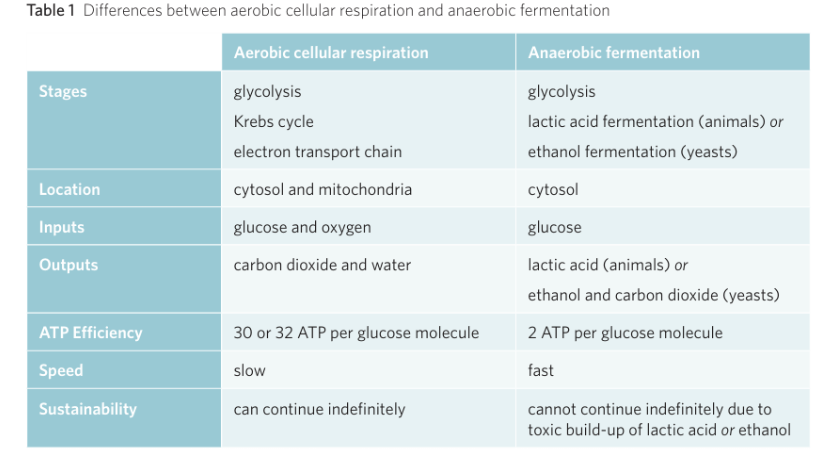


<p><br></p>
52
New cards

Explain how CR is affected by temperature + draw a graph

Cellular respiration rate and ATP production are highest when the temperature aligns with the enzyme’s optimal temperature 


--> Below the optimal temperature, enzymes and substrates have less kinetic energy so there are fewer reaction-inducing collisions, resulting in a lower rate of cellular respiration 


--> Above the optimal temperature enzymes begin to denature (bonds start to break) and respiration rate drops rapidly due to the loss of enzyme function 


53
New cards

Explain how CR is affected by pH + draw a graph

  • Different enzymes function optimally at different pHs 

  • Above or below the optimal pH, enzymes begin to denature and the rate of respiration slows 


54
New cards

Explain how CR is affected by the concentrations of glucose and oxygen + draw a graph

  • Glucose is the input for glycolysis, the first stage of both aerobic respiration and anaerobic fermentation  

--> an increase in glucose availability increases the rate of cellular respiration 

-->  a decrease in glucose availability reduces the rate of cellular respiration 


--> As oxygen levels rise, the rate of aerobic respiration increases 


  • However increasing glucose/oxygen concentration will increase respiration rate until a maximum level is reached --> where at this maximum level, the respiration rate plateaus because the enzymes involved in respiration have reached their saturation point and are operating at their maximum capacity 


55
New cards

A) Draw a graph on how different enzyme inhibitor affect CR (uninhibited, competitive/non-competitive, reversible/irreversible)

B) End-product inhibition


End-product inhibition: a form of inhibition where the final product in a series of reactions inhibits an enzyme in an earlier reaction in the sequence 

<p><br></p><img src="https://onenote.officeapps.live.com/o/GetImage.ashx?&amp;WOPIsrc=https%3A%2F%2Fivanhoegirlsviceduau%2Dmy%2Esharepoint%2Ecom%2Fpersonal%2Frazam%5Fivanhoegirls%5Fvic%5Fedu%5Fau%2F%5Fvti%5Fbin%2Fwopi%2Eashx%2Ffiles%2Fd8f1f04d7dfc4a849522c29d83ddced4&amp;access_token=eyJhbGciOiJSUzI1NiIsImtpZCI6Ijk1RjYyMTA0MjhBMUUxNUJENjJBQjBEQ0ZBQThFNjlBNkFDOUQxNjgiLCJ0eXAiOiJKV1QiLCJ4NXQiOiJsZlloQkNpaDRWdldLckRjLXFqbW1tckowV2cifQ%2EeyJuYW1laWQiOiIwIy5mfG1lbWJlcnNoaXB8cmF6YW1AaXZhbmhvZWdpcmxzLnZpYy5lZHUuYXUiLCJuaWkiOiJtaWNyb3NvZnQuc2hhcmVwb2ludCIsImlzdXNlciI6InRydWUiLCJjYWNoZWtleSI6IjBoLmZ8bWVtYmVyc2hpcHwxMDAzMjAwMGRmMzdkNzExQGxpdmUuY29tIiwic2hhcmluZ2lkIjoiMDAxZjc2Y2EtNjg5NC0xNDE1LWIwNmMtZjcxODEzMjVhNzc2Iiwic2lnbmluX3N0YXRlIjoiW1wia21zaVwiXSIsInV0aSI6Ilo3M1RLWWtfVlVTMUhPdVJsdUlFQUEiLCJ4bXNfY2MiOiJbXCJDUDFcIl0iLCJ4bXNfc3NtIjoiMSIsIm9pZCI6ImZiZDViMDEzLTAyNTUtNGMyOS1hOWJkLTkzYTAzM2QzODE2YiIsImlzbG9vcGJhY2siOiJUcnVlIiwiYXBwY3R4IjoiZDhmMWYwNGQ3ZGZjNGE4NDk1MjJjMjlkODNkZGNlZDQ7dlhqbUZlRWpsc2p4TTFaeTMxT2ZFVmlKQUUwPTtEZWZhdWx0Ozs3RkZGRkZGRkZGRkJGRkZGO1RydWU7OzsxMzI3Njg0OzQyYWMxNmEyLWEwNjItNTAwMC01NWE5LWJhZmZmYzdkMWEyOCIsImZpZCI6IjE5NzEyMyIsImlzcyI6IjAwMDAwMDAzLTAwMDAtMGZmMS1jZTAwLTAwMDAwMDAwMDAwMEA5MDE0MDEyMi04NTE2LTExZTEtOGVmZi00OTMwNDkyNDAxOWIiLCJhdWQiOiJ3b3BpL2l2YW5ob2VnaXJsc3ZpY2VkdWF1LW15LnNoYXJlcG9pbnQuY29tQDUxY2RjYmY2LTMxODAtNDBiYy05ZjAyLTgyMzRiN2Y1ZGU3NSIsIm5iZiI6IjE3Nzk2MDI3NzEiLCJleHAiOiIxNzc5NjM4NzcxIn0%2EiYksUSur3xNRGL0HbnasiFZBEE7FjZ4WNQJeDcIlRoT48SZqQB4CixQ%5F96MvUj6B3xcru7JczBBda4oWBGoEcKvo6fF7z4MwEef5VY4JD625oVjVLPAzLK%2DyJAB9KWEPMRznaxXPrq%5FS636TV8GpFFQ6v8NwyPhtE3OJL5nR5ihcTb44OwmJirJ7U1hg2junQayDoFY%5Fkw5GvsTf%5FeTdbNHCe8G37Vt9xeJbKy%2Dr4NBpQKGp2lRj4hRr9iwh3wwjOOjjTkyPXzy6pv0cvESR77Qp6nwQ8WuUCSqHpDClYTTj7b9qusTHrNZ1Gs%2DgpzES0JtOJt8wQuX4%2DnL97MgBlw&amp;access_token_ttl=1779638771601&amp;ObjectDataBlobId=%7Bfcd32739-a517-43ec-9e4c-8a277a0802ac%7D%7B1%7D&amp;usid=76b62cd8-f635-1a7a-8c57-36049495cf27&amp;build=16.0.20117.41002&amp;waccluster=PAU1&amp;wdwacuseragent=MSWACONSync" data-width="50%" data-align="center" alt="" style="display: block; width: 50%; margin-left: auto; margin-right: auto;"><p><span style="background-color: inherit; line-height: 20.7px; color: windowtext;"><strong>End-product inhibition: </strong>a form of inhibition where the final product in a series of reactions inhibits an enzyme in an earlier reaction in the sequence</span><span style="line-height: 20.7px; color: windowtext;">&nbsp;</span></p>
56
New cards

How does the concentration of wastes (CO2, ethanol, lactic acid) affect CR rate

As concentration of wastes increases, rate of cellular respiration decreases as accumulation of waste products are toxic to cells, causing cells to die. 

57
New cards

What are fossil fuels and what are they used for? Are they renewable?

Humans use energy that is typically sourced from fossil fuels (e.g. coal, oil) – which is a type of fuel that is formed over tens of millions of years from the remains of dead organic material  

--> However they are non-renewable as they are replenished at a slower rate than it is being used 

58
New cards

What is a substitute for fossil fuels? What are they made of and what are some examples? Are they carbon neutral and renewable?

A substitute for fossil fuels are biofuels – which is a fuel that can be made from organic material such as plant matter and animal waste called biomass 

  • Biomass can be sourced in large amounts from industries such as agriculture, food manufacturing, and forestry, making it readily available and easily replenished  

  • Examples of biomass include: edible grains such as corn and sugarcane, and non-edible crops such as waste wood and waste paper 


--> Biofuels are renewable as biomass is renewable, given that we can continue sourcing plant material and animal by-products indefinitely  


  • Biofuels are typically carbon neutral (meaning that there is no net increase in the amount of CO2 released into the atmosphere) as the carbon dioxide that is released during combustion was originally captured by the plant during photosynthesis


59
New cards

How are biofuels usually made (talk about fermentation, don’t explain in detail)

Biofuels are generally made via the process of fermentation, which involves the anaerobic chemical breakdown of starches and sugars in plants and converts that glucose into ethanol and carbon dioxide, which is then harnessed and refined to produce much of the biofuel 

60
New cards

Outline the process of creating bioethanol

  1. Breakdown of biomass – where its SA is increased enough to make fermentation more efficient 

--> The cell wall and cellulose is broken down via different methods (e.g. biological approaches such as enzyme breakdown, chemical approaches such as exposure to acids, physical approaches such as mashing and grinding, and/or physiochemical approaches such as heating) 


  1. Digestion by enzymes – the biomass is then exposed to enzymes (such as amylase) which break down the starch and cellulose and convert them into glucose and other sugars --> this breaking down is aided by the presence of water in a process known as hydrolysis 


  1. Ethanol fermentation 

--> Yeast is used to facilitate the anaerobic fermentation of the sugars, where a large amount of ethanol is produced 

--> The ethanol diffuses out of the yeast cells and is harnessed for biofuel 


  1. Purification and dehydration  

-->  Ethanol is distilled via the removal of water, converting it into a usable form called biofuel which is then purified and is ready to be used as liquid fuel 

61
New cards

How are bioethanol and biodiesel different?

  • Bioethanol is derived from the fermentation of plant sugars 

  • While biodiesel is typically produced via the formation of fatty acids (from natural oils like animal fats and vegetable oil) combined with short-chain alcohols (typically methanol or ethanol) 


62
New cards


Outline some of the strengths and weaknesses of FF and BF
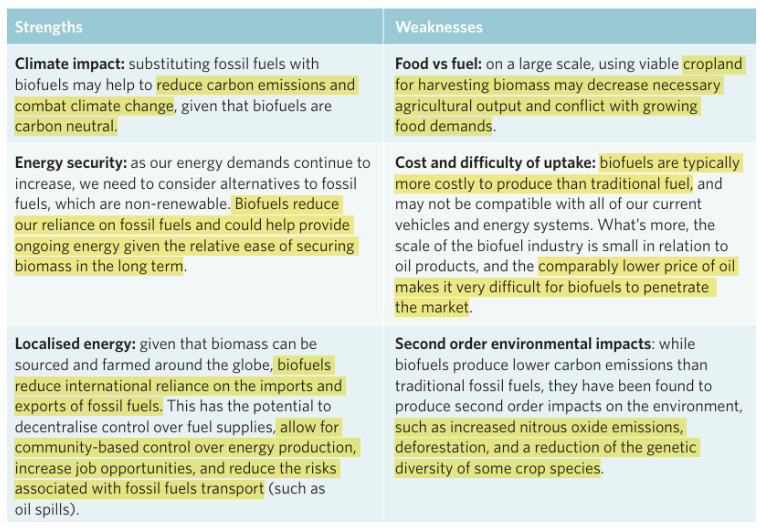


<p><br></p><p></p>
63
New cards

First gen vs Second gen Biofuels


<p><br></p><p></p>