1ST SEM: LONG EXAM 1 INTERNAL MEDICINE II AUGUST 29, 2025
 Call Kai
 Learn
Learn Practice Test
 Spaced Repetition
 Match
Match Flashcards
 Knowt Play
1/51

There's no tags or description
Looks like no tags are added yet.
Name | Mastery | Learn | Test | Matching | Spaced | Call with Kai | Chat |
|---|
No analytics yet
Send a link to your students to track their progress
52 Terms
A 58 year old with a history of Mi. An s3 gallop is noted. ECG shows dilated left ventricular with an ejection fraction of 30%. Which of the following is most characteristic of heart failure with reduced ejection fraction?
A. Concentric hypertrophy with preserved EF
B. Dilated left ventricular with impaired contractility
C. Normal ventricular size with impaired relaxation
D. Right ventricular hypertrophy due to pulmonary hypertension
A. Concentric hypertrophy with preserved EF
In patients with chronic heart failure, why does fluid retention occur despite the release of natriuretic peptides (ANP, BNP)?
A. The kidneys become less responsive to their natriuretic effect - answer
B. They directly increase aldosterone secretion
C. They are not produced in significant amounts
D. They cause water retention without sodium excretion
E. They only work during acute myocardial infarction
A. The kidneys become less responsive to their natriuretic effect - answer
Potent antifibrotic effect of HFREF patients
A. Arni
B. Mrai
C. sglt inh
D. aspirin
C. sglt inh
It is the most common electrical dyssynchrony resulting in abnormal ventricular contraction?
A. Aortic fibrillation
B. Left BBB
C. Sinus Tachycardia
D. Ventricular Tachycardia
B. Left BBB
If a patient has Right Ventricular Hypertrophy, what will be the physical finding?
A. Double apical impulse
B. Left Parasternal Heave
C. Displaced apical Impulse
B. Left Parasternal Heave
Which of the following medications is considered the strongest antifibrotic agent used in HFrEF?
A. Aspirin
B. Enalapril
C. Spironolactone
D. Sacubitril/valsartan
C. Spironolactone
Which of the following is a sign of left sided heart failure?
A. Loss of appetite
B. Bipedal edema
C. Enlarged liver and spleen
D. shortness of breath 1-2 hours after falling
D. shortness of breath 1-2 hours after falling
the ff are part of the 4 pillars of management of heart failure with reduced ejection fraction, except?
A. Aspirin
B. Eplerenone
C. sucub + valsartan
D. sglt inhibitors
A. Aspirin
Which of the following arrhythmia can cause cardiac decompensation
A. Atrial fibrillation in rapid ventricular refilling
B. Supraventricular tachycardia
C. Ventricular Tachycardia
D. All of the above
D. All of the above
Prevents cardiac remodeling
A. Enapril
B. Amlodepine
C. MRAs
D. Captopril
What is a gram positive bacterial cell wall product that is present in patients with heart failure in setting of increased intestinal permeability during congestion
A. G protein
B. Lipopolysaccharide
C. Ppar
D. Tnf a
B. Amlodepine
B. Lipopolysaccharide
Which drug has been shown to reverse pathological cardiac remodeling in chronic heart failure?
A. Amiodarone
B. Captopril
C. Amlodipine
D. Furosemide
B. Captopril
Action of digoxin?
A. Water and Na retention
B. Inotropic drug
C. Vasoconstriction
D. All of the above
B. Inotropic drug
What is the moa of sacubitril-valsartan?
A. causes natriuresis
B. causes vasoconstriction
C. causes sodium retention
D. all of the above
A. causes natriuresis
Which of the following would benefit from
cardioverter defibrillator?
A. UNRECALLED
B. UNRECALLED
C. UNRECALLED
D. All of the above
The following criteria may be used in identifying the ECG abnormality associated with the above condition, EXCEPT:
A. Bazetts
B. Cornell voltage
C. Romhilt-Estes
D. Sokolow-Lyon
A. UNRECALLED
A. Bazetts
Cause of systolic heart failure?
A. Coronary artery disease
B. Myocarditis
C. Ventricular heart disease
D. All of the above
D. All of the above
Which of the following drugs cause prolongation of diastolic filling time?
A. Amlodipine
B. Captopril
C. Trimetazidine
D. Ivabradine
Which of the following is the characteristic of a sinus node?
A.Automaticity
B. Reentry
C.Spontaneous impulse generation
D.None of the above
D. Ivabradine
A.Automaticity
404
404
Cut off p wave amplitude of p-pulmonale
A. >0.2 mV
B. >0.25 mV
C. >0.3 mV
D. >0.5 mV
B. >0.25 mV
A 35-year-old medical student came in at the emergency room due to easy fatigability and shortness of breath. The Internal Medicine resident assessed the patient and noticed displaced apex beat 6th ICS anterior axillary line with associated grade 3/6 systolic murmur radiating to the back suggestive of anterior mitral valve prolapse with severe mitral regurgitation. He requested 12L ECG immediately. Which of the following is the expected ECG finding/s to this patient?
a. Tall R wave in V5 and V6
b. Deep S wave V2/V3
c. Biphasic/Prolonged Terminal Negative deflection in P-wave V1
D. All of the above
D. All of the above
Which of the following criteria assess the ECG abnormality based on the above case.
A.UNRECALLED
B. Cornell product
C. Romhilt-Estes
D. Sokolow Lyon
D. Sokolow Lyon
Torsades de Pointes is consistent with
A 23 year old female suddenly collapsed while jogging and was brought to the emergency room. ECG revealed polymorphic ventricular tachycardia consistent with Torsades de Pointes. Further history revealed her mother died at the age of 30. Which of the following is true regarding this patient’s condition?
A. Anti-seizure medications can be given as an add on to limit symptoms
B. Beta-blockers mainstay of treatment
C. Digoxin is treatment of choice
D. ICD only for low risk patients
ANS: prolong QT interval
B. Beta-blockers mainstay of treatment
404
404
Part of conduction system that slows the conduction time
A. AV
B. Bundle of His
C. Purkinje Fiber
D. SA
A. AV
A 48-year-old female is brought to the emergency department with shortness of breath and skipped heart sounds. What is the most likely diagnosis?
A. Complete Heart Block (Third-Degree AV Block)
B. First-Degree AV Block
C. Mobitz Type II
D. Wenckebach Phenomenon
A. Complete Heart Block (Third-Degree AV Block)
A 41 female was brought to the emergency room unconscious and resuscitated by ACLS, brother died in his sleep. What is true about his condition?
A. ChannelopathieS
B. UNRECALLED
C. Beta blocker is mainstay of treatment
D. pacemaker
A. ChannelopathieS

Pertaining to This Image What is this?
A.normal
B.Mobitz 1
C.Mobitz 2
D.third Degree Block
B.Mobitz 1
What is the normal PR interval on an electrocardiogram (ECG)?
A. 0.04 – 0.10 seconds
B. 0.08 – 0.12 seconds
C. 0.12 – 0.20 seconds
D. 0.20 – 0.30 seconds
C. 0.12 – 0.20 seconds
Most common cause of acquired coronary disease by 50% AV block
A. Automaticity
B. Fibrosis/sclerosis
C. Ischemia/ acute coronary syndrome
D. Unrecalled
B. Fibrosis/sclerosis
19 year old with supraventricular tachycardia, which is true
A. At risk for cardiac death due to rapid conduction of atrial fibrillation
B. B. Treated with adenosine and verapamil
C. C. Cause by tendon of todaro
D. D. Drop beat
B. B. Treated with adenosine and verapamil
Most common cause of acquired, 50% av block
A. Autoimmune
B. Fibrosis/sclerosis
C. Ischemia/ACS
D. Metabolic/electrolytes
B. Fibrosis/sclerosis
An 18 year female presented with exertional dyspnea with findings of fixed split S2, resulting in atrial septal defect. What ECG abnormality is associated?
A. ECG findings of LVH
B. ECF findings of RVH
C. Multi p wave
Atrial septal defect (ASD) → causes left-to-right shunt → increased blood flow to the right atrium, right ventricle, and pulmonary artery.
Chronic volume overload leads to:
Right atrial enlargement
Right ventricular hypertrophy (RVH)
Fixed split S2 (classic finding)
ECG findings depend on ASD type:
Ostium secundum ASD (most common): Right axis deviation + RVH.
Ostium primum ASD: Left axis deviation.
Fixed splitting of S₂ is a hallmark of ASD, reflecting the chronic volume overload of the right atrium (RA) and right ventricle (RV). Longstanding left-to-right shunting places volume stress on the right heart, potentially leading to right heart failure over time.
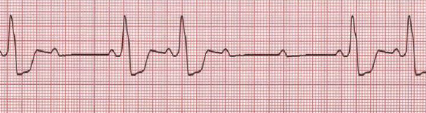
Mr. Roque after his interview experienced chest heaviness, retrosternal 10/10 radiating to the left shoulder. He was brought to the ER by his bodyguard. ECG shows
A. LVH by voltage
B. Complete AV block
C. NSTEMI
D. STEMI
What is the most likely ECG diagnosis in this patient?
A. Complete heart block
B. Mobitz type I
C. Mobitz type II
D. ST elevation
C. NSTEMI
C. Mobitz type II
Which of the following is true about sinus node
A. Atrial relaxation
B. Normal rate 40-60bpm
C. Spontaneous automaticity
D. R wave in ecg
C. Spontaneous automaticity
75yo with dm with history of stroke , ECG atrial fibrillation. What is the CHA2DS2VACs score.
A. 3
B. 4
C. 5
D. 6
D. 6
18 small boxes in ECG. What is the cardiac rate?
A. 63bpm
B. 71bpm
C. 80bpm
D. 85bpm
D. 85bpm
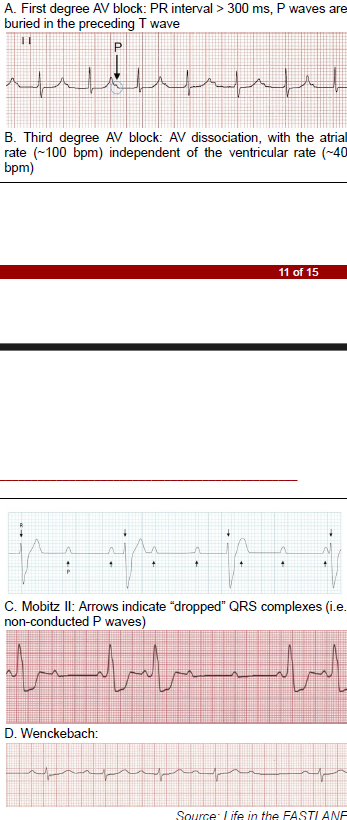
unrecalled ecg image
What is your diagnosis? (From the ecg above/ bonus number)
A. First degree AV block
B. Third degree AV block
C. Mobitz II
D. Wenckebach
What is the pathologic hallmark of rheumatic severe mitral stenosis
A. Annular calcification
B. Commissural fusion
C. Leaflet vegetation
D. Medial commissural degeneration
B. Commissural fusion
True regarding av block in acute mi
A. Oftentimes transient
B. Pacemaker generally indicated
C. Most associated with anterior wall defect
D. Fascicular block something
A. Oftentimes transient
Pathologic hallmark of rheumatic severe mitral stenosis
A. Annular calcification
B. Commissural fusion
C. Leaflet vegetation
D. Medial commissural degeneration
B. Commissural fusion
This is a soft, low-pitched, rumbling mid-to-late murmur at the apex in aortic regurgitation.
A. Austin flint sign
B. Carvallo sign
C. Graham steel sign
D. NOTA
A. Austin flint sign
The valve area that defines severe aortic stenosis is?
A. <1.0 cm²
B. 1.0–1.5 cm²
C. 1.5–2.0 cm²
D. >2.0 cm²
A. <1.0 cm²
In patients with severe mitral stenosis, the most common site of thrombus formation is:
A. Interatrial septum
B. Left atrial free wall
C. Left atrial appendage
D. Roof of the left atrium
C. Left atrial appendage
Gene mutation in bicuspid aortic valve?
A. CHD7
B. NSD
C. KANSL
D. NOTCH1
D. NOTCH1
The most common site of thrombus in severe mitral stenosis
A. interatrial septum of left ventricle
B. lateral wall of left ventricle
C. left atrium appendages
D. roof of left atrium
D. roof of left atrium
Valve area of severe aortic stenosis
A. <1 cm 2
B. 1.5 cm2
C. 2 cm2
D. 2.5 cm2
A. <1 cm 2
Mutation of this gene is associated with Bicuspid AVD and identified in most families with said disease
A. GATA6
B. KLM47
C. NRX4.5
D. NOTCH1
D. NOTCH1
What is the hemodynamic hallmark of mitral stenosis?
404
The hemodynamic hallmark of mitral stenosis is:
✅ Elevated left atrial pressure due to obstruction of blood flow from the left atrium to the left ventricle during diastole.
Explanation
Mitral stenosis narrows the mitral valve, making it difficult for blood to flow from the left atrium (LA) to the left ventricle (LV) during diastole. This results in:
↑ Left atrial pressure (hallmark)
Diastolic pressure gradient between the LA and LV (the classic hemodynamic finding)
Left atrial enlargement
Pulmonary venous hypertension
Pulmonary hypertension (in advanced disease)
Right ventricular hypertrophy and eventually right-sided heart failure
High-yield exam point
Hemodynamic hallmark: Increased left atrial pressure with a persistent diastolic pressure gradient across the mitral valve.
✅ Answer: Elevated left atrial pressure (diastolic pressure gradient between the left atrium and left ventricle).
....systolic murmur on 2nd ICS right parasternal
ANS: Severe aortic stenosis
Rationale:
MIAS TIPS (systolic murmur)
2nd ICS right parasternal - aortic valve
Upon arrival at the ER, the above patient developed acute heart failure, what is their prognosis?
A. 1.5-2 years
B. 2 years
C. 3 years
D. Less than a year
A. 1.5-2 years
What is the most characteristic of severe mitral stenosis?
A. Increased LA pressure
B. Increased PA pressure
C. Decrease LA pressure and pulmonary arterial hypertension
D. Increased cardiac output
E. Decreased Left Ventricular End-diastolic volume
A. Increased LA pressure
Beck’s triad is classically associated with:
A. Cardiac tamponade
B. Charcot’s triad
C. Chvostek’s sign
D. Constrictive pericarditis
A. Cardiac tamponade
ESSAY:
1. Austin flit murmur
a. Chronic, severe AR also may produce a lower-pitched mid to late, grade 1 or 2 diastolic murmur at the apex (Austin Flint murmur), which is thought to reflect turbulence at the mitral inflow area from the admixture of regurgitant (aortic) and forward (mitral) blood flow. -Harrisons
2. Correlation and Intensity of murmur of MS
a. MS= intensity of murmur is inversely proportional to severity -Doc Hanz
3. Intensity of Murmur in AS in the squatting position.
a. Increased murmur: leg raising, squatting and after premature ventricular beat (increased in preload) - PPT