aqua pollut/ toxic
 Call Kai
 Learn
Learn Practice Test
 Spaced Repetition
 Match
Match Flashcards
 Knowt Play
1/43

There's no tags or description
Looks like no tags are added yet.
Name | Mastery | Learn | Test | Matching | Spaced | Call with Kai | Chat |
|---|
No analytics yet
Send a link to your students to track their progress
44 Terms
define pollutant
introduction of substances or energy into the environment that causes adverse effects
define contaminent
presence of a substance where it should not be or at concentrations above background
define toxicology
Field of science that helps us understand the harmful effects that chemicals, substances, or situations, can have on people, animals, and the environment. (From the National Institute of Environmental Health
Describe how water is distributed on Earth
Describe the water cycle
define ecosystems
include communities of living organisms (biotic) and the abiotic
components of the environment
define autotrophs
define heterotrophs
Diagram the structure of a grazing food chain and label the trophic levels

Give examples of organisms that function as primary producers in aquatic systems
dinoflagellate, algae, grass, kelp, cyanobacteria
Compare and contrast the source of energy and carbon for photoautotrophs, chemoautotrophs, and heterotroph
photo: sun
chemo: oxidation of chemical compounds
(chemosynthesis
hetero: acquire energy and carbon by consuming organic compounds
• Animals • Fungi * Most bacteria • Many protists
Explain why ecological efficiency is so low
Energy Transfer Between Trophic Levels is Not 100% Efficient
There is a decrease in the flux
of food to higher trophic levels
Ecological efficiencies are
generally low (10-20%)
Explain why ecological efficiency can be higher in aquatic systems than in terrestrial systems
plants harder to breakdown while there is cyanobacteria with simpler structure so organisms feeding can obtain more energy
Discuss what is shown by ecological pyramids and describe scenarios where the pyramids may become inverted temporarily
calories/energy/biomass/ # of organisms transferred from one level to the next
more biomass herbivores than producers (a lot of production) temporary lots of herb but then die back down)
Define detritus and detritivore
Diagram the detritus food chain and give examples of what is found at each trophic level

Describe the microbial loop and explain its importance in linking the detritus and grazing food chains
Describe the interaction (and benefits of the interaction) between the detritus and grazing food chains
Explain how differences in the overall amount of photosynthesis vs. respiration can lead to eutrophication
Explain how cultural eutrophication differs from natural eutrophication processes
Describe food chain magnification.
Biodegradable pollutants can be catabolized and rendered harmless
• Non-biodegradable pollutants, especially those that are stored within an organism’s body, can be passed through the grazing food chain
• Very high concentrations of a pollutant can occur at the higher levels of a food chain through food chain magnificatio
Why are carbon, nitrogen, and phosphorus essential for organisms?
Trace the movement of carbon through the short term and long-term carbon cycles
Short Term Carbon Cycle: Timescale of decades; driven primarily by biological activity
• Long Term Carbon Cycle: Timescale of centuries or longer; driven primarily by physical processes
List different forms of nitrogen in the nitrogen cycle. Which forms are most available for primary producers?
nitrogen gas (N2) (dinitrogen)
ammonia (NH3)
ammonium (NH4+)
nitrite
nitrate
nitrous oxide
nitric oxide
organic nitrogen
most available: nitrate
Describe and distinguish between the processes within the nitrogen cycle and identify the types of organisms responsible for each. Also note whether the processes require oxygen or not

Trace the movement of nitrogen through the nitrogen cycle.

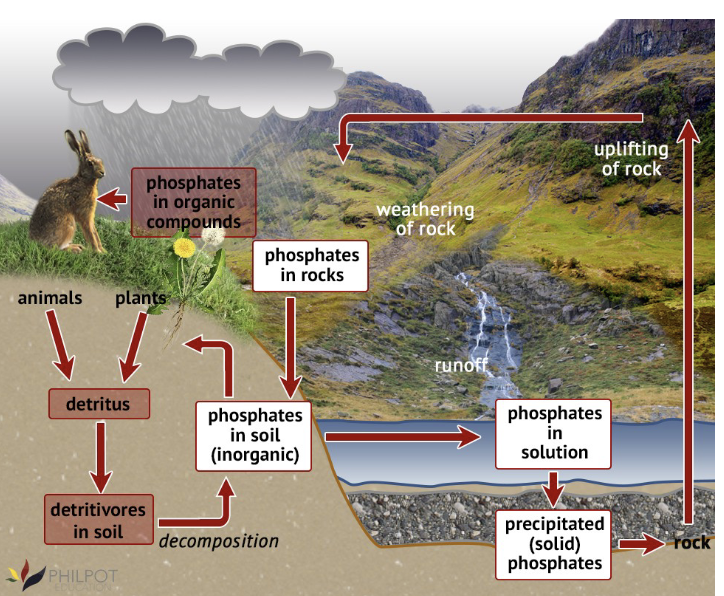
Trace the movement of phosphorus through the phosphorus cycle