Week 1 - Oil and Gas
 Call Kai
 Learn
Learn Practice Test
 Spaced Repetition
 Match
Match Flashcards
 Knowt Play
1/138

There's no tags or description
Looks like no tags are added yet.
Name | Mastery | Learn | Test | Matching | Spaced | Call with Kai | Chat |
|---|
No analytics yet
Send a link to your students to track their progress
139 Terms
Crude oil is the product that comes out of the ground, but crude oil often comes out of the well with
a variety of substances
Generally speaking, there are two types of wells:
Oil wells
Natural gas wells
However, calling something an “oil well” does not mean that only oil comes out of it. An oil well may have
natural gas associated with it. Likewise, a natural gas well may produce liquids along with the gas.
Those liquids might be:
Crude oil
NGLs (natural gas liquids)
NGLs are not crude oil. Many NGLs have a very high octane level and, by their nature, are somewhat
like a refined product
The “production stream” refers to
everything that comes through the well during production.
A single production stream may contain several different substances rather than just one product.
Where Do Natural Gas Liquids Come From?
The professor used a Dr Pepper can as an analogy.
When a can of soda is unopened, the inside of the can is under pressure. Carbon dioxide (CO₂) is dissolved in the liquid while it remains under pressure.
When you open the can, the pressure decreases. Once the pressure drops, the CO₂ begins to come out of solution. That is what causes the soda to bubble.
Something similar happens when oil and gas are produced from an underground reservoir.
Before production, the hydrocarbons in the reservoir are under pressure. When a wellbore penetrates the reservoir, it is like “opening the can.” The pressure drops, and the reservoir pressure pushes the product toward the surface.
Important: The product is pushed to the surface by reservoir pressure; it is not sucked out of the ground.
As the pressure suddenly decreases, substances that were previously dissolved in the formation fluids begin to come out of solution.
As a result, by the time the production stream reaches the surface, it may contain several separate products, including:
Crude oil
Associated natural gas
Natural gas liquids (NGLs)
Sulfur
The distinction is important because:
there may be different royalty streams for different things.
Royalty on crude oil
Royalty on natural gas
Royalty on NGLs
Royalty on sulfur
Thus, one well may generate several different royalty obligations.
Sulfur might be worth very little, for example, approximately 50 cents per ton.
It would therefore be easy for an oil company to think that the sulfur is basically worthless and not worth worrying about.
But legally, that can be dangerous. Why?
A lessor who wants to get rid of the lessee may look for a very small or “nitpicky” lease violation.
Therefore, even a relatively insignificant product like sulfur can matter if the lease requires the lessee to account for it or pay royalty on it.
Pipelines Can Carry Different
Hydrocarbon Products.
Different pipelines may transport:
CO₂
Crude oil
Natural gas
Natural gas liquids (NGLs)
Another important set of oil and gas terms is:
Upstream
Midstream
Downstream
This class focuses primarily on the upstream side of the oil and gas business. (x)
x
Upstream
Upstream refers to
production in the field.
This includes the process of actually producing oil and gas from wells.
For purposes of this class, upstream is the main focus because traditional Oil & Gas courses, as well as the Texas Bar Exam when it still tested Oil & Gas, focused heavily on upstream issues.
Midstream
Midstream generally refers to transporting the product
away from the production area and toward somewhere closer to its ultimate destination.
The main example is pipelines.
A midstream company may purchase or transport the oil or gas produced by the upstream company.
Downstream
Downstream generally includes:
Refining
Distribution
Preparing oil or gas for sale
Preparing oil or gas for shipment overseas
The United States now exports significant amounts of oil and gas.
The professor mentioned LNG, or liquefied natural gas, and noted that Lithuania has a major LNG import terminal.
(x)
When we get into oil and gas leases, there will generally be several important parties.
Farmer Brown is the lessor.
The oil company is the lessee.
The document between Farmer Brown and the oil company is the
oil and gas lease
The lessee may then have a separate agreement with the company that purchases or transports the production.
That company is often a midstream company.
The agreement between the lessee and the midstream company is a
contract
So there are two separate legal relationships:
Lessor and lessee: oil and gas lease
Lessee and midstream company: contract
The professor said that the oil and gas lease and the midstream contract can be “in a minuet with each other,” meaning that the two agreements can interact closely.
For example, the oil and gas lease may require the lessee to pay a royalty.
But in determining how much royalty is owed, it may be necessary to look at the lessee’s contract with the midstream company or purchaser.
Thus, royalty calculations may depend partly on what happens under the midstream contract.
x
Midstream companies often own or operate large pipelines made from high-tensile steel. The important point is that a pipeline company will not necessarily accept whatever product comes directly out of the well. Before the product can enter the pipeline, it generally must be brought
Up to spec
“Up to spec” means that the product
satisfies the technical requirements contained in the contract with the pipeline company.
The pipeline company establishes criteria for the product it will accept.
For example, the product may need to be:
Dehydrated so that excess water is removed
Treated to remove H₂S, or hydrogen sulfide
Brought to a certain temperature
Brought to a certain pressure
Water can harm pipelines, which is one reason dehydration is important.
Hydrogen sulfide can also be highly corrosive and therefore may need to be removed before the product enters the larger pipeline system. (x)
x
The contract between the upstream producer and the midstream company
specifies these technical requirements
Why Technical Specifications Matter
The professor gave an example from his wife’s experience working as a petroleum engineer for a major oil company in Houston.
She worked in the marketing department of an upstream company.
The marketing department was responsible for monetizing the product, meaning turning the company’s produced oil or gas into revenue.
Why would a marketing department need a petroleum engineer?
Because disputes can arise over whether the oil or gas meets the pipeline company’s specifications.
According to the professor, midstream companies may sometimes come up with “creative” reasons for refusing to take the producer’s product.
For example, the midstream company might say:
“Your gas was out of spec.”
The producer might respond:
“No, it wasn’t.”
The midstream company might continue insisting that the gas failed to satisfy the required specifications.
At that point, someone with technical expertise is useful.
The professor compared his wife’s approach to the television detective Columbo. Columbo would appear unassuming and casually ask a series of questions until the person he was questioning realized that he knew much more than they originally thought.
Similarly, the professor’s wife would start asking detailed technical questions about the product and the contractual specifications.
Eventually, the midstream company might realize that she understood the technical requirements and had evidence showing that the product actually complied.
For example:
Midstream company: “Your gas was out of spec.”
Producer: “No, it wasn’t.”
Midstream company: “Yes, it was.”
Producer: “No, it wasn’t. You sent us a certificate saying that it complied.”
At that point, the midstream company may have difficulty continuing to refuse the product.
The professor’s wife would sometimes add that, if the issue could not be resolved, she would have to send it to the company’s legal department.
The point of the story is that oil and gas disputes can involve both legal and highly technical issues. Lawyers working in this area need to understand enough of the engineering and industry terminology to understand the contractual dispute. (x)
(x)
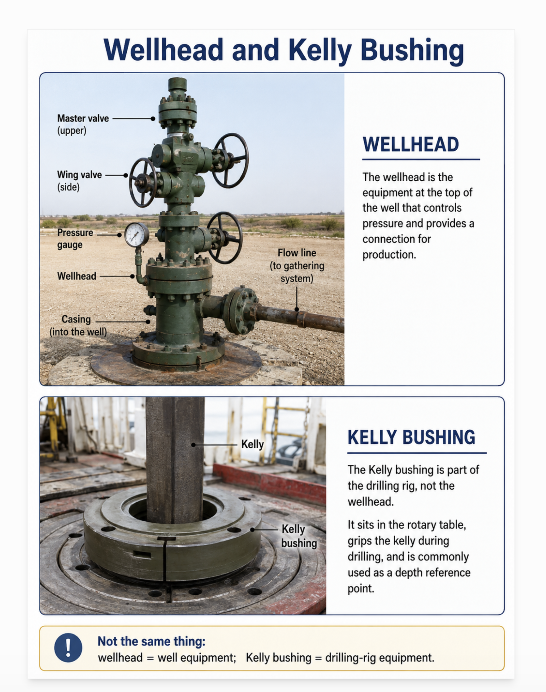
Another term used in the industry is the Kelly Bushing. Once the product passes through the wellhead area, it moves into a flow line. (x)
(x)
Each individual well generally has a small pipeline connected to it.
If you fly over West Texas, you may see individual wells with small dirt roads leading to each one.
Each well may also have its own small line carrying the product away from the well.
This is called a
gathering line

(x)
(X)
A gathering line is basically
a miniature pipeline serving an individual well.
The gathering line carries the production from the well toward a
Central Distribution Point or Gathering Point
The individual gathering lines from multiple wells may eventually meet at a central location.
The professor referred to this as a:
CDP, or central distribution point
Gathering point
As more gathering lines connect together, the pipeline carrying the combined production becomes larger. (X)
(X)
Interstate and Intrastate Pipelines
Some major pipelines cross state boundaries.
Others remain completely within one state.
This distinction can affect which government has jurisdiction.
Intrastate pipeline = 1)
Interstate pipeline = 2)
1) generally state jurisdiction 2) generally federal jurisdiction
When the production stream comes out of the ground, it will probably pass through a
separator
Remember that the production stream may contain several different substances at the same time.
These may include:
Oil
Natural gas
Natural gas liquids
Water
Other substances such as H₂S
Initially, the entire production stream may travel through gathering lines.
These gathering lines must be relatively robust because they may have to carry whatever comes directly out of the ground, including corrosive substances such as hydrogen sulfide.
The production stream then reaches a separator.
The separator separates the combined production stream into its different components.
In other words, the stream that came out of the well mixed together is split apart into
separate substances
Produced Water
Water commonly comes out of oil and gas wells along with the hydrocarbons.
The water produced with the well may contain:
Salt
Particulates
Other contaminants
This water cannot simply be dumped into a river.
Doing so would violate environmental law.
Therefore, produced water must be stored and ultimately disposed of in a manner that complies with state and federal environmental laws.
Water-storage tanks may temporarily hold the produced water. (X)
(X)
Saltwater Disposal Wells
In Texas, one common method of disposing of produced water is through a saltwater disposal well, often abbreviated SWD.
The water that came out of the producing well is first separated from the hydrocarbons.
It is then
injected deep underground through the saltwater disposal well.

(X)
(X)
A vertical separator is equipment used to separate
the different substances that come out of the production stream.
The production enters through an inlet connected to the
gathering line
Inside the separator:
Natural gas rises and exits from the top.
Oil separates from the water because of the difference in density.
Water settles below the oil.
Solid particulates may also need to be removed.
The professor emphasized the density order:
Natural gas = least dense
Oil
Water = more dense
This difference in density is what helps the separator divide the production stream into its different components.
In the field, a vertical separator often looks like a tall capsule standing upright rather than a propane tank lying on its side.
Sometimes this equipment is called a
heater-treater
A heater-treater may heat the fluids near the bottom in order to
help the different phases separate more effectively.
Texas allows the ownership of land to be divided into separate estates:
1) surface estate and the 2) mineral estate
The surface estate and mineral estate can be owned by different people.
Suppose oil and gas are produced from a tract where one person owns the minerals and another owns the surface.
Generally, the mineral owner is the person who receives the economic benefit from production.
At common law, the surface owner does not automatically receive money simply because oil and gas are being produced from the tract.
This creates an obvious source of conflict.
The mineral owner may be happy because production means money.
The surface owner may be unhappy because the surface owner has to deal with the physical effects of oil and gas development on the land.
The professor emphasized that one person is making the money while the other person is not. (X)
(X)
The mineral owner may be excited about production.
The surface owner may have the exact opposite reaction because the surface owner receives the
disruption without necessarily receiving the production money.
Measurement Disputes and Litigation
Another source of conflict involves determining how much oil or gas was actually sold.
For example:
Pipeline company: “You sold us this much.”
Oil company: “No, we sold you more than that.”
If the parties disagree about how much product passed through the system, litigation can result.
Therefore, meters and other field equipment can become extremely important evidence in an oil and gas dispute. (x)
(x)
Producing and Transporting Oil
After oil has been produced and placed into storage tanks, it can be transported to:
A truck
A crude-oil purchaser’s pipeline
Oil is comparatively easy to handle because it is a
liquid. I- t can be stored or transported in things such as:
Tanks
Trucks
Railroad cars
Pits
Hollowed-out salt domes
Professor’s phrase:
“Oil is a fairly obedient beast.”
Oil is a dog.
Natural gas is a cat.
The idea is that oil is relatively easy to control, while natural gas “does what it wants.”
The professor also noted that many oil and gas disputes, especially royalty disputes, involve natural gas more often than oil.
Gas Wells and Christmas Trees
The professor showed a gas well located outside Hobbs, New Mexico.
At that site, the drilling rig was already gone.
What remained was the equipment associated with the producing gas well.
The professor said that this type of equipment is commonly referred to as a:
christmas tree

Gas production comes up the wellbore and then moves through the
Christmas-tree equipment before continuing into the production system.
Natural gas generally requires much more continuous processing than oil.
The professor emphasized two major things that commonly must happen to gas. It must be:
dehydrated and compressed
Dehydration removes 1)
Compression helps 2)
1) water from the gas.
2) push the gas through pipelines.
Natural gas is generally worth more after
the necessary processing and transportation work has been performed.
The professor compared this to buying a new car.
Suppose you could take delivery of your new car in:
Round Rock; or
Greenland.
You would presumably rather take delivery in Round Rock because the car is already where it is useful to you.
Oil and gas products are similar.
A product that has already been processed and moved closer to its final market is generally more valuable than the same product sitting untreated in the field. (X)
(X)
Natural gas can contain different hydrocarbon molecules.
The professor mentioned examples such as:
Methane
Butane
Propane
A natural-gas purchase contract may specify how much gas the purchaser is buying.
There are two important ways gas can be measured:
1) Volume
2) Heating Value
Gas can be measured according to the amount of
physical space it occupies
Natural gas may therefore be measured in:
Millions of cubic feet
Billions of cubic feet
Trillions of cubic feet
Natural gas can also be measured according to the amount of
energy it contains
The professor emphasized that two identical volumes of natural gas may have
different heating values
Therefore, two equal volumes of gas may not necessarily be
worth the same amount.
Liquids are generally simpler.
Crude oil and NGLs are basically measured according to
volume. Ex: Gallons, Barrels
Natural Gas After the Christmas Tree
Once natural gas comes up through the Christmas tree and enters the flow line, additional processing generally has to occur.
For example, it may pass through a dehydrator.
The dehydrator removes water so that the gas will satisfy the pipeline’s requirements.
Other substances may also need to be separated from the gas before the p
pipeline accepts it
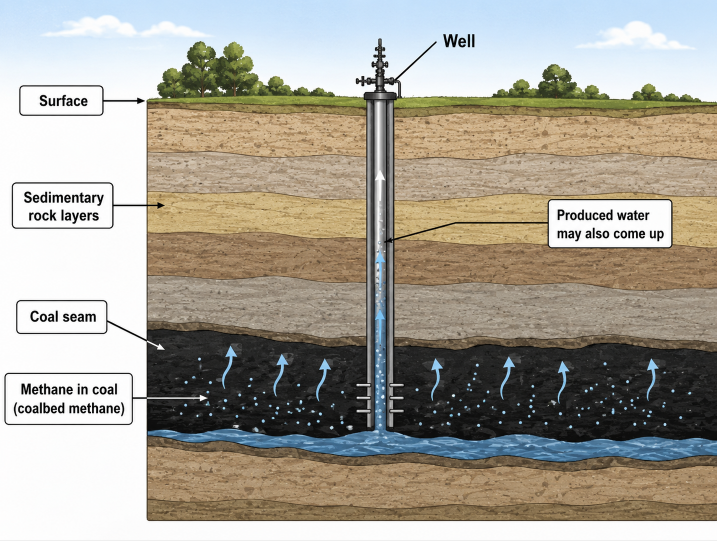
A significant amount of water may come out of the well along with the natural gas.
This is called:
produced water
Coal is a sedimentary rock, meaning it was deposited in layers.
Methane can exist within a layer of coal.
This creates what the professor called
coalbed methane.
(x)
(x)
Subdividing the Mineral Estate
A legal problem can arise when different people own different minerals beneath the same tract of land.
For example:
One person owns the coal.
Another person owns the natural gas.
The coal owner may want to mine the coal, while the natural-gas owner may want to drill for and produce the gas.
The problem is that
developing one resource may sometimes interfere with or destroy the other.
If producing the coal causes the natural gas to escape, for example, the natural-gas owner may lose the resource.
This illustrates an important concept:
The mineral estate itself can be subdivided according to
the type of mineral
For example:
Person A owns the coal.
Person B owns the oil and gas.
Person C owns all other minerals.
The surface owner owns the non-mineral portions of the land. (X)
(X)
What Counts as a “Mineral”?
Problems can arise when a valuable substance is discovered that is not specifically mentioned in the deed.
The professor jokingly used “kryptonite” as an example.
Suppose the deed separately addresses:
Coal
Oil and gas
Other minerals
Then someone discovers a valuable substance that nobody anticipated.
The surface owner may argue:
“It is not a mineral, so it belongs to the surface estate.”
The mineral owner may argue:
“It may not be coal or oil and gas, but it is still a mineral, so I own it.”
This creates an instrument-interpretation dispute over what the deed
actually conveyed or reserved.
Surface Use by the Mineral Owner
Oil and gas development requires more than simply drilling a hole.
There may also be:
Dehydrators
Produced-water tanks
Roads
Parking or work areas
Other production equipment
These activities can substantially affect the surface estate.
The professor emphasized that the surface owner generally has to allow the mineral owner to
reasonably use the surface in order to develop the minerals.
The important phrase is:
reasonable use of the surface
The mineral owner cannot necessarily use the surface in absolutely any way imaginable, but the mineral owner has
significant rights to use the surface as reasonably necessary for mineral development.
Disputes Over Roads and Access
Suppose the mineral owner wants to build a road across a particular part of the property to reach the drilling location.
The surface owner might respond:
“I don’t want the road there. Put it somewhere else where it is less visible.”
That creates a dispute over where access should be located.
The professor connected this issue to the property-law concept of an
an easement by neccesity
An easement by necessity generally provides access when a tract
otherwise lacks necessary access.
Professor’s Easement-by-Necessity Example
The professor told a story about former University of Oklahoma football coach Barry Switzer.
Switzer purchased a large tract of land that apparently did not have direct access to a county road. His lawyer told him not to worry because he would have an easement by necessity. That part was correct.
But the lawyer also told him that he would get to choose where the easement went. That turned out to be wrong.
The dispute went to court, and the court determined the location based on the applicable legal rule, which the professor described as using the shortest route to a county road.
The location selected by the court was apparently the opposite direction from where Switzer wanted the easement.
Professor’s point: having a right to an easement does not
necessarily mean you have complete freedom to choose its location.
Transportation of Oil and Condensate
Oil and condensate can generally be moved by:
Truck
Pipeline
Pipeline is safer than _____.
Train is safer than _____.
train / truck
Natural gas generally must be moved by
pipeline
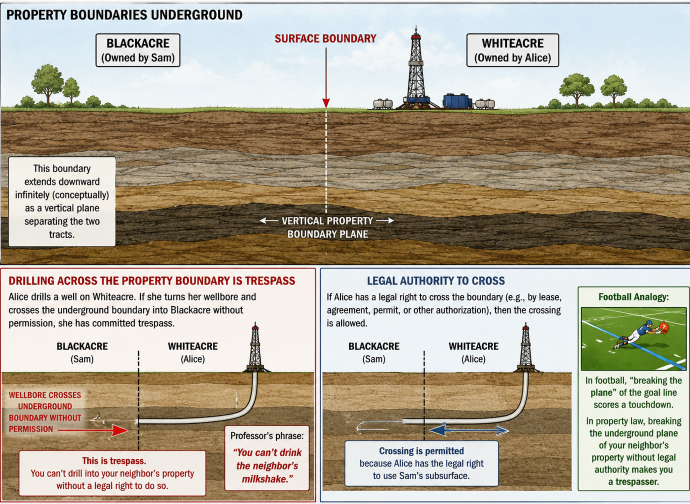
The professor then returned to the Blackacre and Whiteacre hypothetical.
Assume:
Sam owns Blackacre.
Alice owns Whiteacre.
When looking at a diagram of the properties, imagine that you are viewing a vertical cross-section of the Earth.
There is a vertical property boundary separating the underground rock beneath Blackacre from the underground rock beneath Whiteacre.
That boundary is not merely a line on the surface. Conceptually, it extends downward as a vertical plane separating the two tracts. (X)
(X)
Suppose Alice owns Whiteacre.
Alice can drill a well on her own property.
But if she drills downward and then directs the wellbore horizontally across the underground boundary into Blackacre without permission, she has crossed Sam’s property line.
That can constitute
Trespass
You generally need some legal right to cross that boundary, such as an appropriate lease, agreement, permit, or other legal authorization.
You cannot simply drill across the boundary on your own.
Professor’s phrase:
“You can’t drink the neighbor’s milkshake.” (x)
(X)

A reservoir is typically located within________ ______. Sedimentary rock is originally deposited in _______.
sedimentary rock / layers
However, those layers may later be bent by tectonic forces over millions of years.
One important geological structure is an:
anticline
An anticline is essentially an
upward arch or fold in layers of rock.
Oil and Gas in an Anticline
Oil and natural gas are less dense than formation water.
Because they are less dense, they tend to migrate upward through permeable reservoir rock.
When they reach the upper part of an anticline, they may accumulate there.
They do not continue moving upward indefinitely because an impermeable layer may sit above the reservoir.
Often, that sealing layer is shale.
Shale has very low permeability and therefore can prevent the oil and gas from continuing upward.
The result is a trapped accumulation of hydrocarbons beneath the sealing rock. (X)
(X)
One Reservoir Under Multiple Properties
Now assume the same reservoir extends underneath both Blackacre and Whiteacre.
Sam owns Blackacre.
Alice owns Whiteacre.
Sam may drill a well on Blackacre.
Alice may drill a well on Whiteacre.
Both wells may be producing from the same underground reservoir.
This is important because the oil beneath each property is not physically isolated from the oil beneath the neighboring property.
The reservoir is in communication across the property boundary.
If Sam produces oil from his well, some oil located beneath Alice’s property may migrate across the underground boundary toward Sam’s well.
The professor noted that this leads directly into the ______.
rule of capture
Early Well Stimulation: “Shooting the Well”
Early oil wells could eventually stop producing as reservoir pressure declined.
Producers discovered that they could sometimes increase production by placing explosives into the well.
This practice was called:
shooting the well
What is shooting the well?
The professor described early operators pouring nitroglycerin into the well and detonating it.
The explosion could fracture the surrounding rock and cause additional oil and gas to flow toward the well.
The professor connected this practice to early legal cases involving ultrahazardous activities.
Today, intentionally detonating explosives in a well located in the middle of a populated town would obviously raise serious concerns.
But in the nineteenth century, courts were actually confronting questions about whether and under what circumstances this type of activity could be performed.
Reservoir Damage
Now suppose Sam shoots his well.
The explosion increases Sam’s immediate production.
Sam therefore receives a short-term benefit.
But suppose the explosion damages the reservoir and reduces the total amount of oil that can ultimately be recovered.
Sam may get slightly more oil now, but Alice and the other owners sharing the reservoir may ultimately recover less oil because of Sam’s actions.
The professor described this as reducing the reservoir’s
ultimate recovery
This hypothetical introduces the doctrine of
correlative rights
Sam and Alice both have rights associated with the common reservoir beneath their properties.
Neither owner’s rights exist entirely independently of the other because both are producing from the same connected
underground reservoir.
The professor described them as having:
correlative rights to the common reservoir
So while the rule of capture may permit one owner to produce hydrocarbons that migrate toward that owner’s well, correlative-rights principles address conduct that improperly damages or interferes with the common reservoir and the rights of neighboring owners.
Simple way to remember it:
Rule of capture = you may generally capture migrating oil or gas through a lawful well on your own property.
Correlative rights =
you cannot necessarily damage the common reservoir or unfairly interfere with the rights of the other owners who share it.
Ownership: Common Patterns
The professor said this section is the “cast of characters” that we need to understand going forward.
In Property, the broadest ownership interest is fee simple absolute.
That means:
100% of the tract
all rights
forever
In oil and gas, however, the word “fee” is sometimes used as
industry slang
What Does “Fee Interest” Mean in Oil & Gas?
If someone says:
“They own the property in fee.”
or:
“They have a fee interest.”
that can mean different things depending on context.
Sometimes, “fee interest” is used to mean that the same person owns both:
the surface estate
the mineral estate. In other words, the estate has not been split.
The professor emphasized that this usage is not technically precise, but judges and lawyers sometimes use the term this way.
“Fee” can also mean that the property is privately owned rather than owned by:
the federal government
a state government
an Indian tribe
So “fee tract” can simply mean privately owned land.
Split Estates
A fee estate can be split into separate ownership interests.
For example:
One person owns the surface estate.
Another person owns the mineral estate.
The mineral owner has the right to develop the minerals.
The mineral owner also has the right to use as much of the surface as is
reasonably necessary to develop those minerals.
Why Mineral Owners Usually Lease Their Rights
A mineral owner may legally have the right to develop the minerals but may not have:
enough money
technical expertise
drilling equipment
personnel
time
to actually develop the minerals personally.
So instead, the mineral owner will usually lease the mineral interest to an oil and gas company through an:
oil and gas lease
Once the mineral owner leases the minerals, the oil and gas company obtains a
leasehold interest
For purposes of developing the minerals, the oil company essentially steps into the shoes of the
mineral owner
The oil company receives the contractual right to:
explore for the minerals
drill for the minerals
produce the minerals
reasonably use the surface as necessary for development
So now one tract of land can have three separate chains of title:
Surface estate
Mineral estate
Leasehold estate
Oil and gas companies can then buy, sell, and trade those leasehold interests among
themselves