Fields
 Call Kai
 Learn
Learn Practice Test
 Spaced Repetition
 Match
Match Flashcards
 Knowt Play
1/26

There's no tags or description
Looks like no tags are added yet.
Name | Mastery | Learn | Test | Matching | Spaced | Call with Kai | Chat |
|---|
No analytics yet
Send a link to your students to track their progress
27 Terms
force field
region in which a body experiences a non-contact force
can be represented as a vector
field line
the path which a test mass in a gravitational field field would follow
radial field
field lines always directed towards centre for gravitational field
straight
converge to or diverge from a single point
uniform field
field is same strength and direction at every point
parallel field lines
gravity
universal attractive force acting between all matter
gravitational field strength, g
g=mF
the force per unit mass on a small test mass placed in the field at a particular position in the field where it is only acted on by gravitational force
negative of gravitational potential gradient
Nkg^-1
gravitational potential (V)
the work done per unit mass to move a small test mass from infinity to a particular point in a gravitational field
zero value at infinity
negative everywhere within the field
energy required per unit mass to remove that mass from the gravitational field (work must be done by the mass against gravity to leave the field)
V=W/m
gravitational potential difference
the work done in moving a mass m between two points in a gravitational field
∆W=m∆V
gravitational potential energy
work done to move a small test mass from infinity to a particular point in a gravitational field
also negative as 0 gpe at infinity and work must be done by gravitational force moving object from that point in field to infinity
work is done by the field so work supplied is negative
Equipotential
a line or surface in a field along which the electric or gravitational potential
is constant
no work is done when moving along an equipotential surface
the direction of the field is perpendicular to a point on the line
Why equipotentials get more spaced apart
at an increased distance from the mass, the graviatational field gets weaker so the gain of gpe per unit distance (height) decreases
for an equal increase in potential, the equipotentials must become more spaced apart since that same work is done by mass (height)against a smaller force so a greater distance must be moved
the closer they are, the greater the potential gradient and the stronger the field is
the potential gradient
change of potential per unit change in distance along the field at a point in a gravitational field
Jkg^-1m^-1 or Nkg^-1
ΔrΔV
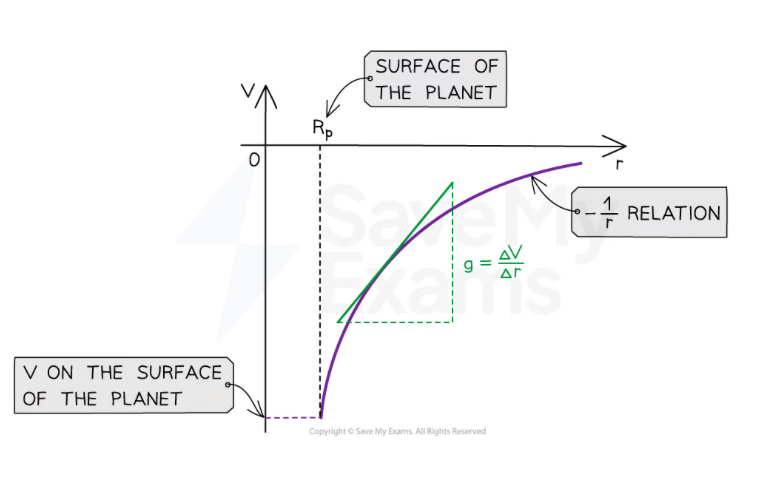
graph of gravitational potential V against distance from centre of planet
values for V all negative as gravitational potential is always negative
V=−rGM
V is inversely proportional to -r
g ( gravitational field strength) is the gradient at any point
newton’s law of gravitation
assumes that the force between two objects with mass is
always attractive
proportional to the product of the masses of the two objects
inversely proportional to the square of their separations
F=r2Gm1m2
Gravitational constant G
6.67×10^-11 Nm²kg^-2
Same for all masses
gravitational force on a test mass mt in a gravitational field between two bodies
test mass experiences attractive forces from both objects
point in the field between the masses at which the test mass experiences a resultant force of 0 as the forces on it will be equal and opposite
Force from m1 = −d2Gm1m3
Force from m2 =(D−d)2Gm2m3
where D is the distance between the centres of both bodies and d is the distance from centre of m1 to centre of test mass
gravitational force against distance

gravitational field strength from law of gravitation
can determine the gravitational field strength at any point in the field of a mass
a spherical body of mass can be treated as if it was a point mass acting from a point in the centre (same field lines)
M is the mass of the body producing the field
g=r2GM
variation of g for spherical planet as you move a test mass beyond radius
g drops off rapidly as it is inversely proportional to square of distance from centre

variation of g with distance from centre less than radius R ( within body of mass)
g is 0 at centre and increases linearly with distance until it reaches radius (surface)
g is directly proportional to r
gravitational potential from law of gravitation
V=−rGM
escape velocity
minimum velocity an object must be given to escape from a planet when projected vertically from the surface
needs sufficient kinetic energy to overcome gravitational force of attraction towards earth
v=R2GM
radial speed of orbit
v=rGM
derived from equating centripetal force equation to gravitational force
kepler’s third law
T2r3=4π2GMS
assumptions for calculating radial speed
point masses
circular orbit
geostationary satellite
satellite stays above same point on earth’s equator
24 hr time period
orbits in same direction as earth’s direction of rotation
communications
avoids dish having to track / needs to remain at same point above the earth
energy of an orbiting satellite
sub radial speed equation into kinetic energy equation 2rGMm
gravitational potential equation x mass −rGMm
Etotal=2rGMm−rGMm
total energy always negtive
for any object in fixed circular orbit, kinetic and potential energy constant
elliptical orbit - total energy constant but potential and kinetic energy vary such that as one increases, other decreases