Plants
 Call Kai
 Learn
Learn Practice Test
 Spaced Repetition
 Match
Match Flashcards
 Knowt Play
1/32

There's no tags or description
Looks like no tags are added yet.
Name | Mastery | Learn | Test | Matching | Spaced | Call with Kai | Chat |
|---|
No analytics yet
Send a link to your students to track their progress
33 Terms
Phytomer:
Basic module of a plant that consists of an internode, node, leaf, and an axillary meristem

Cell walls are composed of:
Cellulose, hemicellulose, pectin
Cell wall functions:
Connect adjacent cells
Act as an exoskeleton
Determine plant shape
Act as diffusion barriers
Provide anchor point for sensory proteins
Act as barrier to pathogens, parasites, and herbivores
Provide strength for xylem
Difference between primary and secondary cell walls and lamella:
Primary: must be elastic for young growth
Secondary: thicker and stronger
Middle lamella: cements the walls of neighboring cells together
Glucan:
A polymer of glucose units linked end to end
Cell wall components:
Glucose units → molecules (chains) → microfibrils → macrofibrils → fibers → lamellae (layers)
Cellulose microfibril deposition determines the directions of cell expansion (T or F):
True
Recalcitrance:
The intrinsic resistance of cell walls to deconstruction of their component polymers to sugars and aromatics (lignin and cellulose strongl interact, making it difficult to seperate)
Meristems:
Localized regions of ongoing cell division that enables growth during post-embryonic development (SAM at top, RAM at bottom)
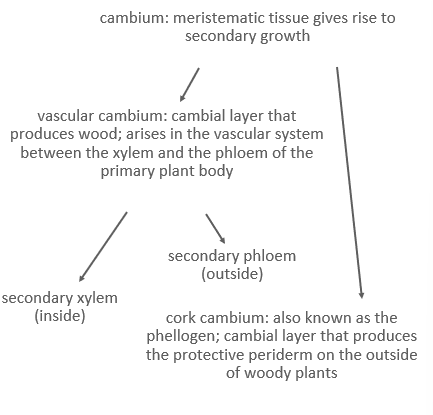
Primary and secondary growth:
Primary: phase of plant development that gives rise to new organs and to the basic plant form; gives rise to primary plant body: part of the plant derived from the shoot and root apicial meristems and primary meristems
Secondary: increase in width or diameter of shoots and roots that happens to a plant as it grows
Layers of trees:
Apical dominance:
Growth habit by a weakly-branched plant, with a strong branching response to decapitation
Plant tissues:

Root system architecture:
The geometric arrangement of individual roots within the plant’s root system
Phyllome:
The collective term for any type of leaf or modified leaf on a plant
Phyllotaxy:
How leaves are arranged on the shoot; three main patterns (alternate, decussate, spiral)
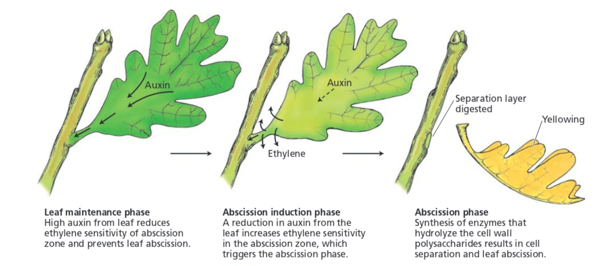
Leaf phases:
Nuclear envelope:
Dotted with nuclear pores: selective channels made up of nucleoporin proteins
Chromosomes:
DNA and associated proteins
Chromosome formation:
DNA double helix → nucleosomes (“beads on a string”) → chromatin fiber → condensed chromatin → chromosome
Plant reproduction

Pollination:
Process of transferring pollen grains from the anther of the stamen to the stigma of the pistil
Operation Outcross: Two Strategies
Floral Morphology: Stamen and pistils mature at different times; pistil or stamen longer or shorter than other
Self-Incompatibility: biochemical barrier that prevents self pollination (kills pollen grains/tubes when same S locus is expressed
Double fertilization:
One sperm cell fuses with the egg to create the zygote, the other sperm fuses with the binucleate central cell to produce a triploid primary endosperm cell

Embryogenesis:
The process by which plant embryos form and develop; during embryogenesis the basic body plan of the plant is laid down, primary tissue types form, and fats and starches are accumulated that will ultimetly be broken down after
Types or relationships:
Commensalism: symbiotic relationship where one organism benefits and the other gains/loses nothing
Mutualism: symbiotic relationship where both organisms benifit
Coevolution: linked adaptations of two or more organisms
Lichens:
Composite of a fungus and an organism capable of photosynthesis; green algae and/or cyanobacteria
Fungi can photosynthesize (T or F):
False; they cannot and therefore form lichens sometimes
The commonality between lichens is shared genetics (T or F):
False; commonality is mode of nutrition
Photobiont:
Photosythentic symbiont of lichens
Nitrogen-fixing bacteria:
Convert atmospheric nitrogen into usable nitrogen for plant; plant allows bacteria to infect due to chemical “password’’
Mycorrizal fungi:
Arbuscular: enhances nutrient absorption efficiency; agriculturally important (grows in cells)
Ectomycorrhizal: allow for trees/forest to connect/talk with eachother (grow between/around cells)
Rhizobacteria:
Umbrella term for bacteria that provide several benificial services to plants