Lecture 01: Pharmacokinetics & Pharmacodynamics (1)
 Call Kai
 Learn
Learn Practice Test
 Spaced Repetition
 Match
Match Flashcards
 Knowt Play
1/29

Earn XP
Description and Tags
Sept 2, 2026
Name | Mastery | Learn | Test | Matching | Spaced | Call with Kai | Chat |
|---|
No analytics yet
Send a link to your students to track their progress
30 Terms
What is pharmacodynamics?
Therapeutic and/or toxic actions of the drug on the body, receptor interactions (agonist, antagonist), concentration-effect component
Simplified, it is how a drug acts on your body, how it binds to cells, and how the dose changes the strength of the effect. (G)
Very simply, it is what the drug does to the body (e.g., a blood pressure pill lowering your blood pressure). (G)
(s3)
What is pharmacokinetics?
Effects of the body on the drug, dose-concentration component
For example, how well the drug gets absorbed, how well it gets metabolized, etc.
Very simply, it is what the body does to the drug (e.g., how your stomach absorbs the pill, how your liver breaks it down, and how your kidneys flush it out). (G)
(s3)
What is pharmacogenetics?
Effects of genetics on how the drug is metabolized by the body and affects the body
Basically it is the study of how your genes affect your body's response to medications. (G)
(s3)
What are the two reasons why pharmacokinetics is useful?
We can make predictions about drug effectiveness or toxicity
We can calculate blood concentrations in an individual under specific conditions
Essentially, pharmacokinetics helps us understand how a drug will act in the body so we can optimize efficacy and safety.
(s4)
What is LADME and what does it stand for?
LADME describes the five core phases a drug undergoes in pharmacokinetics. (G)
LADME determines how rapid, in what concentration and how long the drug takes to reach the target organ.
L = Liberation (occasionally omitted)
A = Absorption
D = Distribution
M = Metabolism
E = Excretion
Both metabolism and excretion are part of clearance
(s5)
What is the general process of LADME?
When the drug dose is administered, it first needs to be liberated from its capsule and then absorbed. The drug concentration will be in circulation.
When in circulation, the drug can either reach a clearance site or a target site.
If it reaches the clearance site = it undergoes metabolism or excretion
If it reaches the target site = it will have its pharmacological effect (efficacy or toxicity)
(s6)

What is availability?
Availability is a function of liberation and absorption.
This means that
come back to
(s8)
What is liberation?
Liberation is the physical process where the active drug molecule is released from the pill, capsule, or tablet, etc. and enters the fluid at the site of administration, like your stomach or gut. (G)
Many drugs must be released from their solid form and made soluble in solution.
(s9)
What are the 4 things that the rate of liberation depends on?
Formulation
Polymer layers
Eg. The inside layer could take longer to dissolve, creating sustained release tablets.
Distribution in formulation
Eg. Higher concentration of drug on the inside vs. outside to control the rate of release
Liquid solutions
Liquid solutions get absorbed quicker, leading to sharp availability
Amount
Large bolus takes longer to dissolve (like a large concentrated mass of drug powder instead of scattering into tiny floating specks) (G)
Drug Solubility
Environmental pH
Numbers 3 and 4 help dissolve the drug so it can be absorbed effectively.
(s9)

List the 4 factors influencing absorption.
Gastrointestinal Factors
Physicochemical Drug Properties
Solubility, charge, size, structure
Transporters
Route of Administration
(s10)

List the factors that affect absorption of drugs in the GI.
Food
pH
Perfusion, motility, surface area
Enzymes, microflora, permeability
(s10)
Describe how the factors affect absorption of drugs in the GI (food, pH, perfusion, motility, surface area, enzymes, microflora, permeability).
Food
Food coats the stomach and intestinal lining. This causes the drug to have less contact with the surface area, therefore slowing down absorption.
pH
Affects charge. Some drugs are weakly acidic or alkaline, and their charge affects how they are absorbed.
Perfusion, motility, and surface area (SA)
If the surface area (SA) is physically reduced (eg. due to Celiac disease) → severely compromised drug absorption
If motility is too high (e.g., diarrhea), the drug rushes through the GI tract too quickly to be absorbed (G)
Enzymes, microflora, permeability
Enzymes can get blocked which can compromise or facilitate absorption
Healthy microflora can help absorb drugs
High permeability means a drug is highly lipid-soluble and can pass straight through the cells (G)
(s10)
What is absorption?
The dissolved drug moves from the site of administration across cell membranes into circulation.
Large, charged molecules need help getting across lipid bilayers.
Small neutral molecules freely diffuse.
(s11)

What are the two most common functional groups to know? How do they change with pH?
Tertiary amine (-R3N)
Natively has no extra proton attached to it, making it neutral.
Tertiary amine is a weak base. This means that it wants to steal protons.
When it is sitting in an environment with no extra protons around (alkaline) (like the alkaline intestines) (G), it has no protons to steal, so it stays neutral.
When it is sitting in an environment with lots of extra protons (ie. highly acidic environment) (like the stomach) (G), it will steal a proton and have a positive charge.
Carboxylic acid (-COOH)
Natively has a proton attached to it, making it neutral.
Carboxylic acid is a weak acid. This means that it wants to give away protons.
When it is sitting in an environment with no extra protons around (alkaline) (intestines), the environment strips its proton away, so it becomes negative.
When it is sitting in an acidic environment (stomach), it holds onto its proton and stays neutral.
(s13)

What is the pKa of a weak acid and the pKa of a weak base? What is pKa?
pKa of a weak acid (eg. aspirin) = 3.5
pKa of a weak base (eg. morphine) = 7.9
pKa is the exact environmental pH value where the drug is perfectly split 50% neutral and 50% charged. (G)
(s13)
For a weak acid and base, when would it be ionized and when would it not be ionized?
Weak acid (eg. aspirin) (think carboxylic acid)
pH < pKa = not ionized (neutral)
Lower pH means the environment is highly acidic and packed with loose protons. Weak acids want to give away protons but there is no need to give away protons, so it holds onto its proton, staying neutral.
pH > pKa = ionized (charged)
Higher pH means the environment is more alkaline. There are no loose protons and the weak acid wants to give protons away. It will be negatively charged (ionized).
Weak base (eg. morphine) (think tertiary amine)
pH < pKa = ionized
Weak bases want to steal protons. When the pH is lower, there are lots of protons to steal, and it becomes positively charged (ionized).
pH > pKa = not ionized (neutral)
When the pH is higher, there are no protons to steal, so it stays neutral.
(s13)
What is the Henderson Hassel-Balch (HH) Equation? What is it used to determine?
It is used to determine the charge status of a drug at a specific pH
This is important because in general, charged molecules are less readily absorbed than uncharged molecules, which can freely pass through lipid bilayers.
(s14)

Aspirin is a weak acid, with a carboxylic functional group (pKa of 3.5). In a stomach pH of 2.0, what is the ratio of charged to uncharged aspirin?

Also, remember that for a weak acid:
pH < pKa = not ionized
pH > pKa = ionized
In this case, pH is less than pKa, so majority of aspirin would be not ionized (uncharged/neutral)
(s14)
The intestines have a pH of 7.4. What is the ratio of charged to uncharged aspirin (pKa of 3.5) in the intestines?
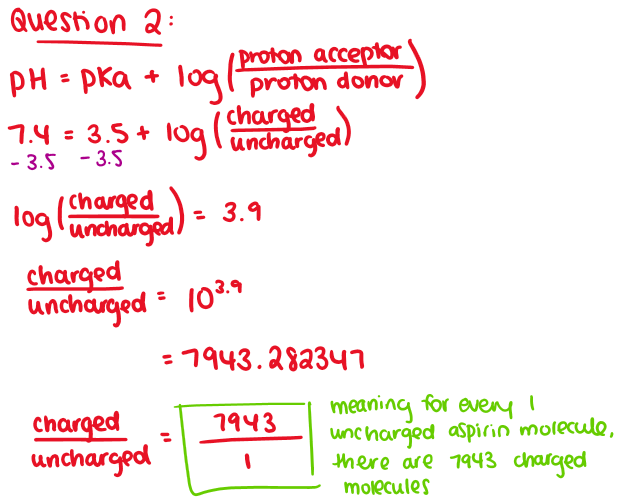
Also, remember that for a weak acid:
pH < pKa = not ionized
pH > pKa = ionized
In this case, pH is more than pKa, so majority of aspirin would be ionized (charged)
(s14)
Is aspirin mostly absorbed in the stomach or the intestines?
Stomach
Aspirin is neutral in the stomach, so most of the absorption would be in the stomach
(s14)
What is AUC (area under the curve) best for?
AUC is the best indicator of the total cumulative amount of the drug or toxin that enters and circulates through your bloodstream over time. (G) (s16)

What is bioavailability? How do you calculate it?
The amount of drug dose that enters circulation.
Intravenous AUC represents 100% bioavailability.
(s17)

If the AUC of an oral dose was 0.25 and the AUC of an intravenous dose is 2.0, what is the bioavailability?
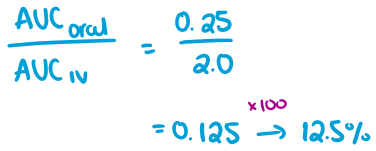
(s17)
What is first pass metabolism?
Intestinal and liver metabolism reduce bioavailability of an orally administered drug prior to the drug reaching the systemic circulation
First pass metabolism is important because the liver is a major detox organ
(s18)

What do you need to consider when calculating bioavailability?
Bioavailability (F) Factor: Fraction of active dose that makes it to circulation
Chemical Form (S) Factor: Fraction of formulation that is the active form of the drug. (s19) It considers the form of the drug (salt or ester) and active ingredient. (s22)
(s19)
What does a bioavailability factor (F) of 1 mean? How about <1?
Intravenous (complete absorption) F = 1
Extravascular (incomplete absorption) F < 1
(s20)
What is the difference between bioavailability and availability?
Bioavailability only estimates extent not rate of absorption
It measures only the total fraction of the dose that makes it into your bloodstream, completely ignoring how long it took to get there.
Eg. If 100 mg of a drug enters your blood, whether it takes 10 minutes or 10 hours, the bioavailability is the same. (G)
Availability includes rate of absorption.
It measures the total fraction reaching the blood plus how quickly it gets there.
Eg. An immediate-release pill and an extended-release pill might both deliver 100 mg to your bloodstream (same bioavailability), but the immediate-release pill has higher availability because it works much faster. (G)
(s21)
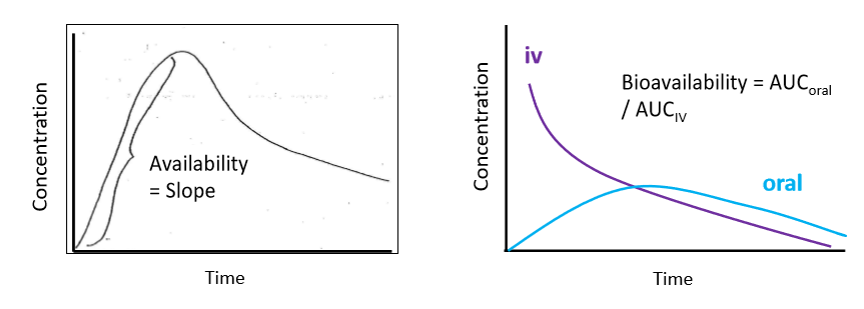
How do you calculate effective dose?
(s22)
