DNA, Chromosomes, and Sex Determination
 Call Kai
 Learn
Learn Practice Test
 Spaced Repetition
 Match
Match Flashcards
 Knowt Play
1/27

There's no tags or description
Looks like no tags are added yet.
Name | Mastery | Learn | Test | Matching | Spaced | Call with Kai | Chat |
|---|
No analytics yet
Send a link to your students to track their progress
28 Terms
Human cells are eukaryotic or prokaryotic cells?
Eukaryotic - they have a nucleus
In the nucleus, what do our cells contain that is like “a book that contains instructions”?
Chromosomes - we have 23 pairs
What are chromosomes made of?
Genes: One chapter of the book
DNA: Individual words or letters
The chromosomes contain genes, but are physically made up of the DNA molecule wrapped around proteins (histones)
What is the primary structure of DNA and RNA?
A chain of many nucleotide units linked together (polymer)
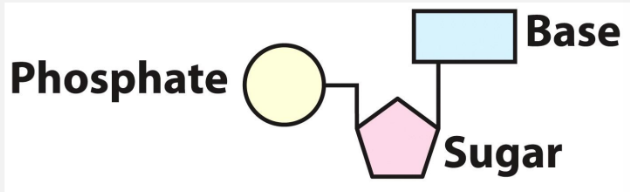
What is a nucleotide?
Repeating units of DNA and RNA made up of:
Pentose sugar
Phosphate Group
Nitrogenous Base
What is the major difference between ribose and deoxyribose?
Deoxyribose does not contain a second OH group, rather it is just an H
Is DNA or RNA less stable?
RNA is less stable than DNA because of the OH group
Phosphate group traits
They carry a negative charge essential for functions of DNA
It is always bonded to the 5’ carbon atom of the sugar
What are the four nucleotides?
dAMP, dGMP, dTMP, dCMP
Purines
Pure As Gold
Adenine
Guanine
Pyrimidines
CUT
Cytosine
Thymine (DNA)
Uracil (RNA)
One purine pairs with one pyrimidine to maintain the same width of dsDNA. What are the pairs?
A+T
G+C
Why can’t we bond A and C?
There is a third bond on C that A cannot bind to
Polynucleotide strands of DNA run _____________
antiparallel
Phosphodiester bonds
Bonds between 5’ PO4 and 3’ OH groups of adjoining nucleotides
Hydrogen bonds are between:
complementary bases of opposite strands - intermolecular
What base pairs have two H-bonds and what base pairs have 3 H-bonds?
A-T = 2
G-C = 3
Complementary base pairing is crucial for every part of DNA. Many procedures like ________ are based on complementary base pairing.
Hybridization
Denaturation and renaturation
dsDNA → ssDNA → dsDNA
Melting temperature
Temperature at which DNA becomes denatured
Why is it more energy required to denature GC base pairs than AT base pairs?
Since there are more H-bonds in GC base pairs, a higher temperature is required to denature the protein.
Abbreviations
ssDNA: single stranded
dsDNA: double stranded
bp: base pair
Kb: kilo base pair
Mb: mega base pair
Secondary structures in ssDNA and RNA?
Hairpins (loops) and stems
Intramolecular H-bonds: bonds in the same molecule
The secondary structure of DNA is
the DNA double helix - 2 strands are antiparallel and held together by H-bonds between complementary bases
Prokaryotic cell traits
No nucleus
Small
One circular DNA molecule
Not complexed with histones
Small amount of DNA
No membrane bounded organelles
Eukaryotic cell traits
Nucleus
Relatively large cell
Multiple linear DNA molecules
Complexed with histones
Relatively large amount of DNA
Membrane bounded organelles
Tertiary structure of bacterial DNA
Supercoiling - condensing the DNA
Topoisomerases: add or remove rotations in DNA by breaking and then rejoining DNA strands
Tertiary structure of eukaryotic DNA
Linear chromosomes - dsDNA and a diverse array of proteins
Organized as a chromatin: DNA and associated proteins of a chromosome