Exam 3 - Science, Society, and the Environment I
 Call Kai
 Learn
Learn Practice Test
 Spaced Repetition
 Match
Match Flashcards
 Knowt Play
1/114

There's no tags or description
Looks like no tags are added yet.
Name | Mastery | Learn | Test | Matching | Spaced | Call with Kai |
|---|
No analytics yet
Send a link to your students to track their progress
115 Terms
evolution
change in a kind of organism over time; process by which modern organisms have descended from ancient organisms through generations; originates in genes and often leads to modifications in appearance or behavior
speciation
process by which new species are generated
endemic species
exist nowhere else on the planet; if an event affects region → affects all members of species
(ex: island-dwelling species are at elevated risk of extinction, bc isolated from typical evolutionary pressures like predators)
number of identified species vs. actual number
1.8 million identified; 3—100 million actual
niche
organism’s role in its community; includes resource use + interaction w/ other organisms
population size
number of organisms in an area at a given time; will grow when there’s abundant resources + very few natural enemies
evolutionary change:
takes a long time and helps to protect a population against unique challenges
fossil
imprint of a dead organism in stone; paleontologists can learn when organisms lived by dating the rock layers that contain fossils
carrying capacity
maximum population size of a species that an environment can sustain
naturalists who came up with natural selection
Charles Darwin and Alfred Russel Wallace (1850s)
closely related species that live in different environments tend to
diverge in their traits
(diff. selective pressures → diff. adaptations)
adaptation
a structure, behavior, or physiological process that helps an organism survive and reproduce in a particular environment
genes that lead to better reproductive success will eventually evolve through the entire population
mutations
accidental changes in DNA → give rise to genetic variation
biological evolution
the change over time in populations of related organisms
convergent evolution
unrelated species in similar environments + separate locations acquiring similar traits (similar selective pressures)
how species arise
1. biological evolution
2. establishes the common ancestry of all species
3. pre-existing species changing through time
species
a classification of organism whose members can interbreed and produce fertile offspring
population
a group of individuals within a species that live in the same geographic area
3 observations natural selection is based on
1. organisms face a constant struggle to survive and reproduce
2. organisms tend to produce more offspring than can survive to maturity
3. individuals of a species vary in their attributes
causes of genetic variation
1. mutations (accidental changes in DNA)
2. sexual reproduction (mixing of genetic material)
medical advances resulting from learning about evolution:
1. how infectious diseases spread + gain/lose potency
2. tracking evolving strains of influenza, HIV, etc.
3. detection of evolution of bacteria’s antibiotic resistance
biodiversity
the variety of life across all levels (species, genes, populations, communities)
evolutionary fitness
success in passing genes to the next generation
what generates biodiversity?
evolution
how speciation occurs
reduced gene flow; some parts of the population no longer reproduce with other parts, which prevents the exchange of genes
allopatric speciation
result of speciation in populations that are geographically isolated from one another; eventually populations grow so different, they can no longer mate
sympatric isolation
two subpopulations become reproductively isolated within the same geographic area
phylogenetic trees
how scientists represent history of divergence; constructed by analyzing + external traits of organisms
taxonomists
group species into categories meant to reflect evolutionary relationships
species that are more vulnerable to extinction
small populations, species that are specialized to narrow resources, endemic species that are only found in one area of the world
background extinction rate
average rate at which species become extinct over the long term; usually 1-5 species per year (1-2 species per 1 million species go extinct per year)
number of mass extinctions earth has seen
at least 5; Permian extinction being the worst
(causes: volcanism, asteroid impact, methane releases, CO2 concentration, global warming, etc.)
ecology
scientific study of interactions among organisms and between organisms and their environment
population
a group of individuals of the same species that live in the same area
community ecology
study of how interactions between species affect community structure and organization
ecosystem ecology
study of energy flow and chemical cycling among the various biotic and abiotic components
biosphere
sum total of all living things and habitats on earth
landscape ecology
examines how ecosystems, communities, and population are distributed across earth
specialists
species with narrow niches
generalists
species that can utilize a wider variety of resources
population ecology
the study of factors that cause populations to increase or decrease
demographers
scientists who study human populations
they track:
natality
mortality
immigration
emigration
exponential growth
when unregulated populations increase by a fixed percentage each year; J-shaped curve
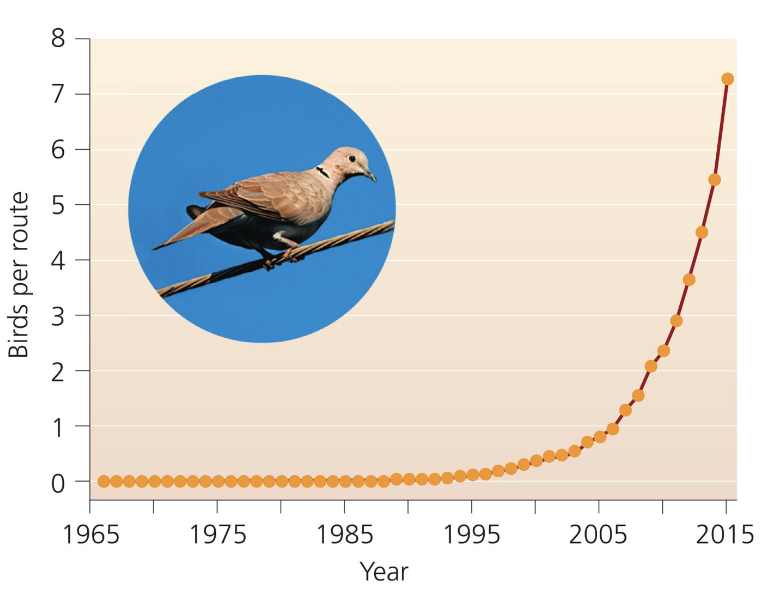
when exponential growth occurs in nature
when a population is small, competition is minimal, and environmental conditions are ideal
limiting factors
determine the carrying capacity (max. pop. size of a species env. can sustain)
logistic growth
when population growth slows down as it reaches the carrying capacity; produces S-shaped curve
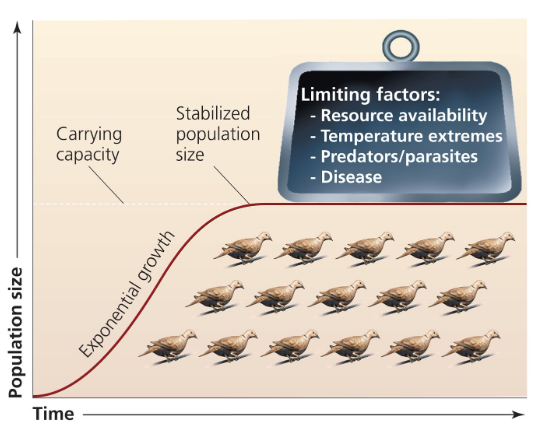
density dependent factors
limiting factors that rise/fall with population density
(ex: predation, disease)
density independent factors
limiting factors that are unaffected by population density
(ex: extreme temperatures, catastrophic natural disasters)
what are life history patterns determined by?
life form, habitat; tradeoffs in different life history traits
"slow" life history
long time to sexual maturity, long life spans, low numbers of offspring, high parental investment
"fast" life history
short time to sexual maturity, short life spans, high numbers of offspring, little parental investment
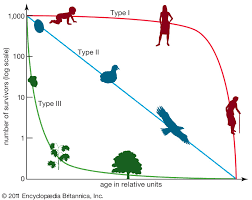
Type III survivorship
high mortality early on in life, with relatively low rates of death for those surviving; usually r-selected
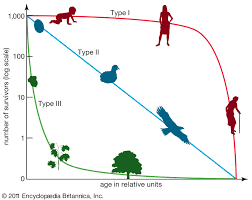
Type II survivorship
constant mortality rate regardless of age; prey animals (like birds) can follow this pattern of survival
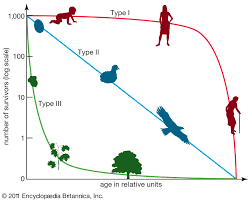
Type I survivorship
usually experience high survival in early and middle life, followed by a rapid decline in later life; usually K-selected
ecotourism
the practice and business of recreational travel based on concern for the environment
Central Case Study
asian carp scandal; catfish farms imported carp to clean up algae and snail infestations; carp escaped and began spreading across the Mississippi valley
species interactions
predation, competition, parasitism
competition
the struggle between organisms to survive in a habitat with limited resources
coexisting species
species alter behaviors to minimize competition, altering their niche
intraspecific competition
competition between members of the same species
interspecific competition
competition between members of different species
competition become more intense when:
populations are more dense
fundamental niche
The full potential range of the physical, chemical, and biological factors a species can use if there is no competition from other species in a niche
Predation
An interaction in which one organism kills another for food.
cryptic coloration
Camouflage; makes an organism difficult to spot.
warning coloration
conspicuous coloration or markings of an animal serving to warn off predators
mimicry coloration
patterns in physical appearance making an organic look like another organism
Parasitism
A relationship between two organisms of different species where one benefits and the other is harmed
Herbivory
interaction in which one animal (the herbivore) feeds on producers (such as plants)
mutualism
relationship between two species where both species benefit
what do food chains consist of?
trophic levels
how much energy is lost as heat at each trophic level?
90%; only have 10% of the energy content, organisms, and biomass compared to the one below them
Biomass
total amount of living tissue within a given trophic level
keystone species
species that influences the survival of many other species in an ecosystem
ecosystem engineers
a keystone species that creates or maintains habitat for other species
what does succession begin with?
pioneer species
primary succession
An ecological succession that begins in an area where no biotic community previously existed
secondary succession
Succession following a disturbance that destroys a community without destroying the soil
introduced species
species moved by humans to new geographic areas, either intentionally or accidentally
how can we respond to invasive species?
control, eradication, or prevention
what two aims may ecological restoration have?
1. restore the functionality of an ecosystem
2. return a community to its "presettlement" condition
biome
group of ecosystems that share similar climates and typical organisms
what exerts the greatest influence over all other climatic factors?
temperature and precipitation
what creates global patterns of biomes?
temperature and precipitation, which are highly correlated with latitude
rain shadow effect
precipitation falls on the windward side of a mountain range; causes lush vegetation & a warm, moist climate on one side, but a desert area on the leeward/downwind side
temperate deciduous forest
at midlatitudes; relatively even precipitation
temperate grasslands
temperature differences between winter and summer and more extreme and rainfall diminishes; not enough water to support trees; biomes are known as prairie or steppe
temperate rainforest
rich in rainfall, but still found in midlatitudes; mostly contain coniferous trees; soils are fertile, but susceptible to erosion if the forests are cleared
tropical rainforests
year round growing; dark, lush vegetation, and highly diverse communities; high number of tree species intermixed at low densities; acidic soils are low in organic matter
tropical dry forest
wet and dry seasons that each occupy half of the year; temperature is consistently warm; leaves are shed during the dry season
savannas
tropical grasslands interspersed with acacias or other trees; herbivores and fire create disturbances; found ind ry tropical areas, including parts of Africa, Australia, and India; distinct wet and dry seasons
deserts
the driest biome, receiving less than 25 cm of rain per year; soils have high mineral and low organic matter content; animals and plants must adapt to minimize water loss; animals often active at night
tundras
very dry but are constantly cold all year; underground soil is permanently frozen, called permafrost; tundras are unoccupied by humans but are the most directly impacted by air pollution and climate change
boreal forests
cold, but receive more precipitation than tundras; they are dominated by few species of evergreen trees; soils are acidic and nutrient-poor
chaparral
found in only a few small patches throughout the world; covered by a dense thicket of evergreen shrubs; fires are frequently climate is influenced by nearby oceans
aquatic biomes
defined by water characteristics; depth, salinity, distance to land
adaptive radiation
an evolutionary pattern in which many species evolve from a single ancestral species
genetic drift
A change in the allele frequency of a population as a result of chance events rather than natural selection.
Microevolution
evolutionary change within a species or small group of organisms, especially over a short period.
Macroevolution
large-scale evolutionary changes that take place over long periods of time

