Lecture 9: synaptic plasticity and memory
 Studied by 0 people
 Call Kai
 Learn
Learn Practice Test
 Spaced Repetition
 Match
Match Flashcards
 Knowt Play
1/29

There's no tags or description
Looks like no tags are added yet.
Name | Mastery | Learn | Test | Matching | Spaced |
|---|
No study sessions yet.
30 Terms
Key attributes in the sea slug, aplysia
water enters gills → extract O2 → exits siphon
rhinophores: chemical sensors
Aplysia gill withdrawal reflex circuitry (only touched on siphon skin)
a stimulus to the siphon causes the animal to withdraw its gill
gill is used for oxygen, hence needs to protect it
Circuitry:
siphon skin is touched
sensory neurons activated
carries signal from the siphon to the CNS
sensory neuron forms a synapse with a motor neuron
monosynaptic excitatory connection
when activated, the motor neuron sends an AP to the gill muscle
activation of the motor neuron causes the gill to contract and withdraw
habituation
a progressive decrease in response to a repeated stimulus
→ adaptation is CONSTANT stimulus
sensitization
a heightened response to an innocuous (harmless) stimulus, caused by a previous noxious (harmful) stimulus
→ in case of aplysia, it is to the tail
it is not reversing habituation, but new method
Aplysia gill withdrawal reflex circuitry
tail → sensory neuron →modulatory (faciliatory) interneuron (IN) → motor neuron (axo-axonic synapse) → gill
modulatory interneuron releases serotonin (serotonergic)
acts on the sensory neuron presynaptic terminal
increases ca2+ influx and neurotransmitter release from the sensory neuron
excites motor neuron more strongly
result:
the same siphon touch produces a larger gill withdrawal
modulatory interneuron: changes how strong the connection is (plasticity)
sensitization of the aplysia gill withdrawal reflex
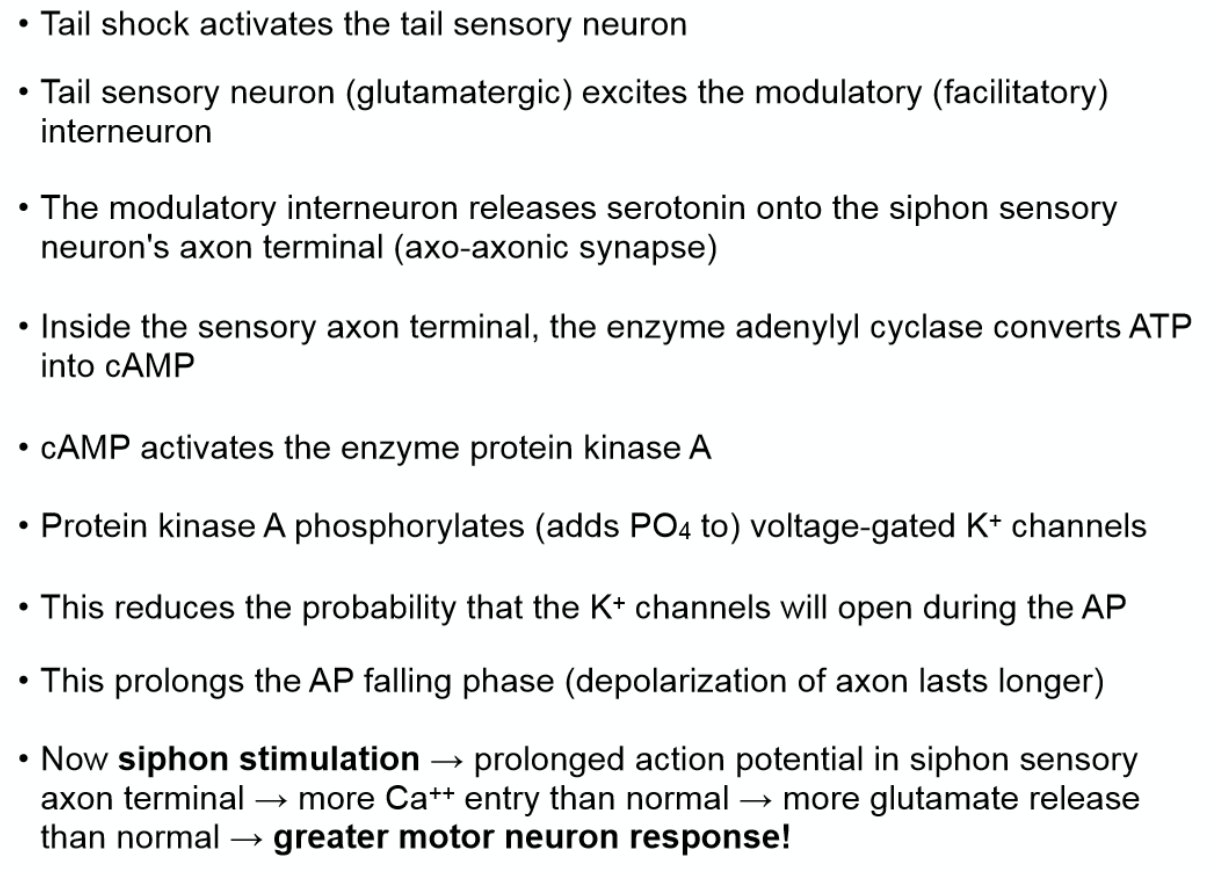
tail shock causes a broadening of the AP in the siphon sensory neuron’s axon terminal
this causes more Ca2+ entry in the siphon sensory neuron’s axon terminal and consequently more glutamate release and a greater motor neuron EPSP
basically, widens the AP length → axon stays depolarized for longer
sensitization of the aplysia gill withdrawal reflex
Explain how an LTP is created in rat hippocampus
high freq stimulation (tetanus) of axon 1 is created
causes an increase in the EPSP amplitude evoked by a subsequent single stimulus on axon 1
no change to EPSP evoked by axon 2
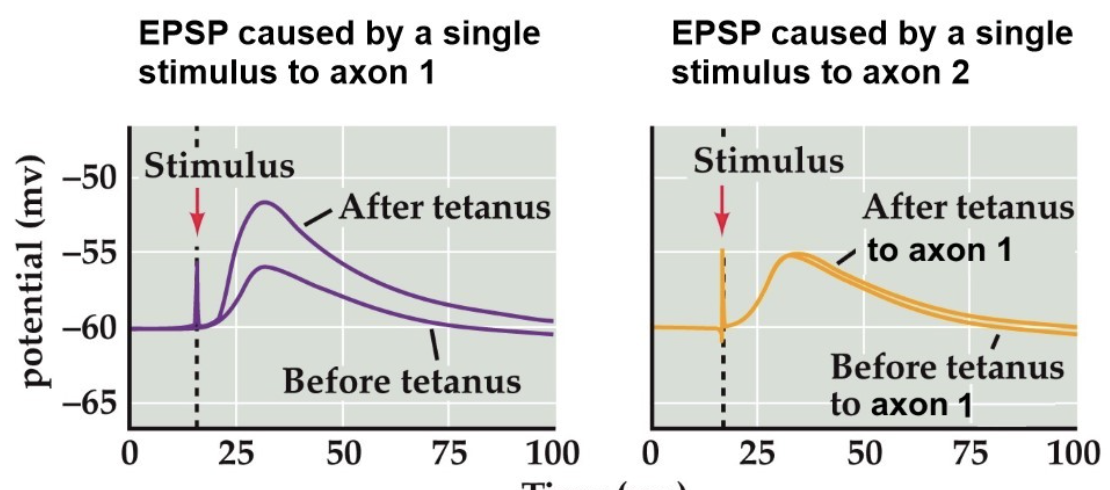
note: axon 2 was NOT given tetanus but just was recorded how it was affected after it was given to axon 1
the effect: long-term potentiation (LTP)
type of specificity
since only one axons epsps went up, while one did not change much from baseline → example of specificity
Properties of LTPs: compare specificity, associativity, and cooperativity
Property | Definition | What is Required | Classic Example | Why It Matters for Learning |
|---|
Specificity | Only the active synapses are strengthened during LTP | Activity at a particular synapse; glutamate release + postsynaptic depolarization | One stimulated synaptic pathway is potentiated, while a nearby inactive pathway is unchanged | Ensures memories are precise, not global or diffuse |
Associativity | A weak stimulus can undergo LTP when paired with a strong stimulus at the same time | Coincident activation of weak and strong inputs; NMDA receptor activation | Weak pathway gains LTP when paired with a strong pathway | Explains associative learning (linking events together) |
Cooperativity | Multiple weak inputs together can induce LTP | Simultaneous activation of many weak synapses to depolarize the postsynaptic neuron | Several weak synapses fire together to trigger LTP | Allows neurons to act as coincidence detectors |
what is a LTP
Long-term potentiation
long-lasting increase in synaptic strength between two neurons that occurs after repeated or strong stimulation
neurons that fire together, wire together
it is a cellular mechanism for learning and memory
shows how experiences can produce lasting changes in the brain
one of the many different types of plasticity at cellular level
What is the NMDA receptor channel?
channel that is permeable to Na+, K+, and Ca2+
ligand-gated: opens when glutamate binds
voltage-gated: also requires postsynaptic depolarization
When can the NMDA channel open/how does it open?
At resting potential, the NMDA channel is blocked by Mg²⁺.
Presynaptic neuron releases glutamate, which binds NMDA receptors.
If the postsynaptic neuron is strongly depolarized (often via AMPA receptors), the Mg²⁺ block is removed.
the positive force inside the cell repels the positive Mg
The NMDA channel opens, allowing Ca²⁺ influx.
Ca²⁺ triggers intracellular signaling that strengthens the synapse (e.g., AMPA receptor insertion).
LTP is initiated
Conditions necessary for LTP induction
ca2+ entry initiates LTP at the synapse:
when Ca2+ enters the postsynaptic dendrite, LTP occurs at that location
for ca2+ to enter the dendrite, two conditions must be met:
the postsynaptic cell must be depolarized
glutamate must be present
→ conditions ensure that Mg2+ will pop out of the NMDA receptor channel and thus ca2+ will be able to enter
Why does LTP specificity occur
ca2+ enters the dendrite at synapse 1 only because:
the post synaptic cell is depolarized (everywhere) but
glutamate is present only at synapse 1
why does associativity LTP occur?
Ca2+ enters the dendrite at both synapses because:
the postsynaptic cell is depolarized (everywhere) and
glutamate is present at both synapses
why does cooperativity LTP occur?
Ca2+ enters the dendrite at both synapses because:
the postsynaptic cell is eventually depolarized (by the joint action of both synapses) and
glutamate is present at both synapses
Possible mechanisms responsible for LTP expression
enhancement of existing AMPA receptor conductance
insertion of new AMPA receptors
Enhancement of existing AMPA receptor conductance
the AMPA receptors already present at the postsynaptic membrane conduct more current in response to glutamate.
As a result, the same presynaptic input produces a larger EPSP.
How it happens (mechanism):
Strong synaptic activity activates NMDA receptors.
Ca²⁺ enters the postsynaptic neuron.
Ca²⁺ activates protein kinases (e.g., CaMKII, PKC).
These kinases phosphorylate AMPA receptors.
Phosphorylation increases AMPA channel open probability or conductance.
Importance:
it is fast
insertion of new AMPA receptors
Additional AMPA receptors are added to the postsynaptic membrane at an active synapse.
This increases the neuron’s response to the same amount of glutamate.
How it happens (mechanism):
Strong or repeated stimulation activates NMDA receptors.
Ca²⁺ enters the postsynaptic neuron.
Ca²⁺ activates signaling pathways (especially CaMKII).
AMPA receptors stored in intracellular vesicles are trafficked to the synapse.
These receptors are inserted into the postsynaptic density.
Importance:
produces larger and more stable EPSPs
longer lasting, but slower
Memory can be divided into two:
declarative → available to consciousness
daily episodes
words and their meanings
history
EXPLICIT
nondeclarative → generally not available to consciousness
motor skills
associations
priming cues
puzzle solving skills
IMPLICIT
Retrograde amnesia
loss of previously stored memory
anterograde amnesia
inability to form new memories
cannot remember what happened to them after the brain damage but can remember before
the involvement of hippocampus in memory
involved in:
consolidation of new explicit, long-term memory
making these new memories BUT NOT STORING them
NOT involved in:
long-term storage of explicit memories
consolidation or storage of implicit memories
Henry Molaison (H.M)
suffered from intractable epilepsy
had a bilateral hippocampectomy
resulted in anterograde amnesia
also experienced temporally graded retrograde amnesia
could acquire new implicit memories and had normal WM
could learn new sport or skill but would not remember he learned them but could perform it (implicit memory)
temporally graded retrograde amnesia
lost memory of some events in the decade preceding surgery
older memories from earlier life were intact
Connection between hippocampus and possible declarative memory storage sites
wide spread projections from association neocortex converge on the hippocampal region (areas that deal with declarative memory storage)
the output of the hippocampus is ultimately directed back to these same neocortical areas
explain how the memory consolidation and storage model works
→ explicit memory formation, consolidation, and long term storage
two parts involved:
hippocampus = temporary index/bridge that links different sensory features of a memory
cortex = long term storage site
memory formation uses cooperativity and associativity LTPs
simultaneous sigh and smell of a rose → coverage on hippocampal neuron →if only one sense is present, it allows for a weak cortical input with strong hippocampal signal → memory replay over time strengthens in the cortex-cortex connections → cortex gradually learns association on own without stimuli → long term memory consolidation in cortex, not hippocampus
TOW: Multi electrode extracellular recording
electrodes are outside the cells (not penetrating the membrane)
array of electrodes
they detect voltage changes in the extracellular space
measures activity, not stimulating it
aps, LFPs
signals come from ionic currents flowing during neuronal firing
what is being recorded:
when neuron fires, a⁺ influx and K⁺ efflux create small voltage changes outside the cell
Each electrode picks up:
Spikes from nearby neurons
Smaller contributions from more distant neurons
Signal size depends on:
Distance to neuron
Neuron size
Electrode impedance
Technique | Location | Records | # neurons |
|---|---|---|---|
Patch clamp | Inside cell | Vm, currents | 1 |
Single extracellular | Outside cell | Spikes | Few |
Multielectrode extracellular | Outside cells | Spikes + LFPs | Many |
TOW: hand population vector and dr. andrew schwartz
population vector is a way to decode intended hand movement direction by combining the activity of many motor cortex neurons
the neuron fires most when movement is in the direction of the motor cortex neurons preferred direction for hand movement
TOW: how does multi-electode extracellular recording and population vectors connect
Motor cortex neurons (M1)
⬇ (multielectrode extracellular recording)
Spike trains from many neurons
⬇ (population vector decoding)
Estimated hand movement direction
⬇
Cursor / robotic arm / prosthetic hand
🔥 Critical result from Schwartz’s lab:
The hand does not need to move
Intention alone is enough to generate population vectors