L9 - Beta Blockers (Part B)
 Call Kai
 Learn
Learn Practice Test
 Spaced Repetition
 Match
Match Flashcards
 Knowt Play
1/65

There's no tags or description
Looks like no tags are added yet.
Name | Mastery | Learn | Test | Matching | Spaced | Call with Kai | Chat |
|---|
No analytics yet
Send a link to your students to track their progress
66 Terms
What chemical forces are responsible for drug-target binding?
Covalent bonds, ionic bonds, hydrogen bonds, dipole-dipole interactions, van der Waals interactions, hydrophobic interactions, and halogen bonds.
What is the strongest drug-target binding force?
Covalent bonds (300–500 kJ/mol).
How strong are ionic bonds in drug-target binding?
~20 kJ/mol; attraction between oppositely charged groups.
How strong are hydrogen bonds in drug-target binding?
~12–30 kJ/mol; occur between hydrogen-bond donors and acceptors.
How strong are dipole-dipole interactions?
~1–33 kJ/mol; attraction between permanent partial charges of polar groups.
How strong are van der Waals interactions?
~0.4–4.0 kJ/mol; individually weak attractions between atoms in close contact.
What are hydrophobic interactions?
Interactions between nonpolar/lipophilic portions of a drug and hydrophobic regions of its target; <40 kJ/mol.
How strong are halogen bonds?
~5–40 kJ/mol.
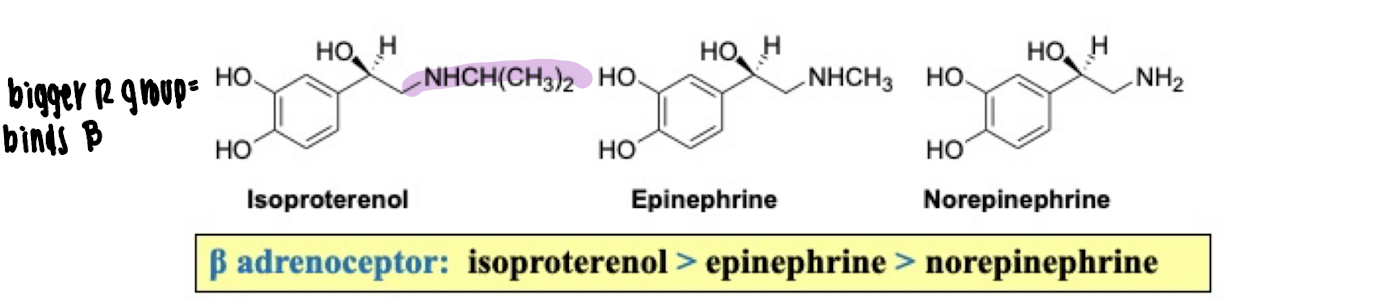
What is the β-adrenoceptor agonist potency order?
Isoproterenol > epinephrine > norepinephrine.
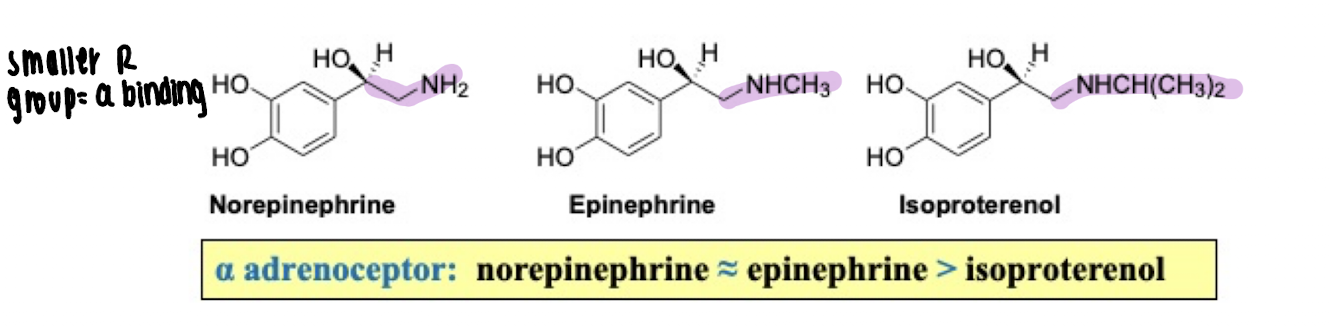
What is the α-adrenoceptor agonist potency order?
Norepinephrine ≈ epinephrine > isoproterenol.
What structural feature increases preference for β-adrenoceptors?
A larger N-alkyl substituent; the N-isopropyl group of isoproterenol increases β-receptor preference.
Where are β1 vs β2 receptors predominantly found?
β1: heart; β2: bronchial smooth muscle and blood vessels.
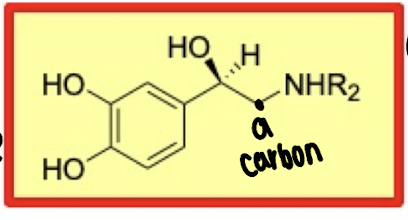
What is the critical structural group of catecholamine β-agonists?
The ethanolamine group.
How does the ethanolamine -OH contribute to β-receptor binding?
It forms hydrogen bonds with the receptor.
How does the amine of catecholamine agonists contribute to β-receptor binding?
The -NHR2 group is protonated/positively charged and forms ionic interactions with the receptor.
How do the catechol -OH groups contribute to agonist activity?
They form hydrogen bonds with the receptor and are important for receptor activation.
How does the aromatic ring of catecholamines contribute to receptor binding?
It participates in van der Waals interactions.
Which catecholamine stereoisomer has greater β-adrenoceptor activity?
The (R)-enantiomer has greater activity than the (S)-enantiomer.
What does adding a -CH3 group to the α-carbon of a catecholamine do?
Increases selectivity for the α2-receptor.
What was the starting lead for development of β-blockers?
Isoprenaline (isoproterenol), a β-receptor-preferring agonist with an N-isopropyl group.
What was the main design strategy used to develop β-blockers from isoprenaline?
Exploit its β-receptor selectivity: retain important β-binding features while modifying structural features responsible for agonist activation.
Which parts of isoprenaline were initially retained during β-blocker development?
The ethanolamine side chain and N-isopropyl group because they are important for β-receptor interactions.
Which part of isoprenaline was initially modified to create β-blockers?
The catechol -OH groups.
What was dichloroisoprenaline (DCI)?
A compound synthesized in 1958 in which the catechol -OH groups were replaced with chlorines; it was the first β-blocker but still had some intrinsic sympathomimetic activity (ISA).
What is intrinsic sympathomimetic activity (ISA)?
Partial agonist activity at β-receptors despite the drug functioning as a β-blocker.
Why was DCI not an ideal β-blocker?
It still possessed some partial agonist activity/ISA.
What structural change converted DCI into pronethalol?
The dichlorobenzene ring was replaced with a hydrophobic naphthalene aromatic ring.
What was important about pronethalol?
It was the first β-blocker used clinically and was used for angina, arrhythmia, and hypertension, but still had ISA.
Why was pronethalol withdrawn?
It was withdrawn in 1963 because of concerns about tumor development; this was considered a drug effect rather than a β-blocker class effect.
What structural change led from pronethalol toward propranolol?
A linker was introduced between the naphthalene ring system and the ethanolamine side chain.
Why was the 1-naphthol derivative that became propranolol originally synthesized?
The intended 2-naphthol starting material was unavailable, so the 1-naphthol derivative was made to perfect the synthesis while waiting for the materials.
What is the β-blocker development sequence?
Epinephrine → isoprenaline → dichloroisoprenaline (DCI) → pronethalol → propranolol.
How are β-blockers structurally similar to endogenous catecholamine agonists?
Both contain structural features such as a secondary amine and secondary alcohol that interact similarly with the β-receptor.
Why can propranolol bind the β-receptor but not activate it like a catecholamine agonist?
Its secondary amine and secondary alcohol allow receptor binding, but it lacks the phenolic catechol -OH groups needed for full receptor activation.
What structural feature helps distinguish β-blocker antagonist activity from catecholamine agonist activity?
β-blockers lack the catechol phenolic -OH groups required for the agonist's full receptor activation.
Why do some β-blockers still show partial agonist activity?
Although they lack the phenolic -OH groups, some receptor-activating interactions can still occur, producing ISA.
What is a racemic mixture?
A 1:1 mixture of two enantiomers.
How is propranolol marketed stereochemically?
As a racemic mixture of (R)-(+)-propranolol and (S)-(-)-propranolol.
Which propranolol enantiomer binds β-adrenoceptors more strongly?
The (S)-enantiomer.
How much greater is the β-adrenoceptor affinity of (S)-propranolol?
Approximately 100 times greater than the other enantiomer.
What older stereochemical terminology may be used for propranolol?
The L isomer may be called the active isomer and the D isomer the inactive isomer.
Why can (R)-catecholamine agonists and (S)-propranolol both preferentially bind the β-receptor?
R/S designation depends on CIP priority rules, not simply the physical direction groups point in space; structural differences between the molecules change priority assignments even though their key binding groups can occupy similar receptor positions.
What principle explains why one enantiomer can bind a receptor more strongly than another?
Drug targets are chiral, so the 3D orientation of functional groups determines how well the drug can make multiple complementary interactions with the binding site (Easson-Stedman hypothesis).
Is propranolol ionized at physiological pH?
Yes. Its basic amine is largely protonated, giving propranolol a positive charge.
What functional group is responsible for propranolol protonation?
The secondary amine.
What acid-base forms can propranolol exist as?
Protonated propranolol and the uncharged free-base form.
What is propranolol's LogP?
ACD/LogP ≈ 2.9.
Is propranolol lipophilic?
Yes, propranolol is highly lipophilic.
Why can propranolol cause sleep disturbances, vivid dreams, and nightmares?
Its high lipophilicity allows substantial penetration into the CNS/brain.
How extensively is propranolol protein bound?
~90%.
What is propranolol's half-life?
~4–5 hours.
How is propranolol metabolized?
Extensively, including extensive first-pass metabolism.
What percentage of propranolol reaches systemic circulation after first-pass metabolism?
About 25%.
In what salt form is propranolol supplied?
HCl salt.
What type of β-blocker is propranolol?
A nonselective β-blocker with affinity for both β1 and β2 receptors.
Does propranolol block α-receptors?
No.
Does propranolol have intrinsic sympathomimetic activity (ISA)?
No; ISA = negative.
Does propranolol have membrane-stabilizing activity (MSA)?
Yes; MSA = positive.
What are the major clinical uses of propranolol listed in the lecture?
Angina, hypertension, and arrhythmias.
What are the major functional groups/ring systems in propranolol?
Naphthalene aromatic ring system, aryl ether, secondary alcohol, and secondary amine.
What ring system does propranolol contain?
A naphthalene ring system (two fused aromatic benzene rings).
What type of alcohol does propranolol contain?
A secondary alcohol.
What type of amine does propranolol contain?
A secondary amine.
What type of ether does propranolol contain?
An aryl ether linking the naphthalene ring system to the side chain.
What are the key β-receptor-binding groups of propranolol?
The protonated secondary amine and secondary alcohol interact with the receptor similarly to those of catecholamine agonists.
What are the highest-yield structural differences between a catecholamine agonist and propranolol?
Catecholamine agonists have catechol phenolic -OH groups needed for activation; propranolol lacks these OH groups and instead contains a hydrophobic naphthalene ring connected through an ether linker, allowing binding without full receptor activation.