Exam 1 Terms (MSE 2001)
 Call Kai
 Learn
Learn Practice Test
 Spaced Repetition
 Match
Match Flashcards
 Knowt Play
1/20

There's no tags or description
Looks like no tags are added yet.
Name | Mastery | Learn | Test | Matching | Spaced | Call with Kai | Chat |
|---|
No analytics yet
Send a link to your students to track their progress
21 Terms
Determines price of materials
Material-driven costs
Terrestrial abundance
Extraction cost
People-driven costs
People-driven costs
Supply/demand
Technology
Geopolitics
Speculation
Material-driven costs
Terrestrial abundance
Extraction cost
People-driven costs
Supply/demand
Technology
Geopolitics
Speculation
Stiffness
Force (stress) it takes to flex material
Strength
Force (stress) it takes to permanently deform material
Toughness
Energy it takes to break material
Performance parameters
Load (kg, lb, N)
Total elongation (mm, cm, in)
Stress (σ)
N/m², Pa

Strain (ε)
No units

Produces a stress-strain curve
Tensile test
Elastic deformation
Deformation is temporary
Stress/strain linear relationship
Material returns to original shape
Plastic deformation
Deformation is permanent
Stress not proportional to strain
Poisson’s ratio
lateral strain / longitudinal strain (0.3 for most materials)
Yield stress (σᵧ)
“Strength,” stress to permanently deform material
Elastic modulus (E)
stress / strain

Increasing E makes a material…
More stiff
Ultimate tensile strength (UTS)
“Ultimate strength,” stress beyond which material fails/fractures
Ductility
Maximum strain (% elongation) at failure
Modulus of resilience (Ur)
Describes elastic energy per volume returned to material after stress

Coefficient of restitution
Performance parameter for modulus of resilience
Toughness
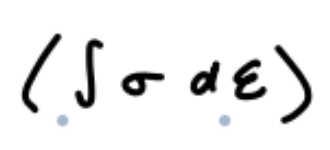
Energy per volume to break material